
Tag: knowledge retention

  • Onboarding New Employees with Company History: A Practical Framework

    Company history earns its place in onboarding when it explains how the organisation learned to make decisions. A timeline can mark important dates, and a founder’s biography can offer a beginning. New employees also need to understand the judgement behind the policies, priorities and practices they inherit. That is the difference between onboarding new employees with company history and giving them a tour of the past.

    It’s understandable that history often gets compressed into a presentation. Yet a story becomes useful when it helps a new colleague recognise what matters in their own work, and why. The account should offer context, while leaving room to question whose perspective it records and what it leaves out.

    This article sets out a practical framework for connecting historical stories and decisions to present responsibilities. It shows how to treat testimony as valuable evidence of experience, rather than unquestionable truth.

    You’ll also learn how to make that knowledge retrievable after induction, with a consent-led approach to recording and sharing people’s answers. The aim is lasting context: history that helps new employees understand the organisation they are joining and the choices they will help shape.

    Key Takeaways

    • Use onboarding new employees with company history to show how past decisions shape the work new hires are joining.
    • Choose first-person stories that reveal the reasoning, trade-offs and context behind organisational choices.
    • Give contributors a clear purpose and meaningful choice about whether their knowledge is recorded and shared.
    • Help employees return to organisational history with questions after induction, when its context becomes relevant to their work.

    Why onboarding new employees with company history gives work its context

    History gives new hires context for interpreting their work. Policies explain what to do; organisational history can show why a principle matters, which trade-offs shaped it and where judgement is still required. Without that context, a new employee may learn a process without understanding the assumptions beneath it.

    Useful history is more than dates, names and milestones. It connects consequential decisions to present responsibilities. A change in how an organisation serves its community, for example, may explain why a team prioritises careful listening today. The Organizational Memory concept describes how knowledge accumulated through an organisation’s experience can support learning and induction.

    History-informed onboarding is the practice of using accounts of consequential organisational decisions to help new employees interpret current principles, responsibilities and working assumptions. It provides orientation to the reasoning around the work. Role-specific instruction still teaches the work itself.

    What should a new employee learn from company history?

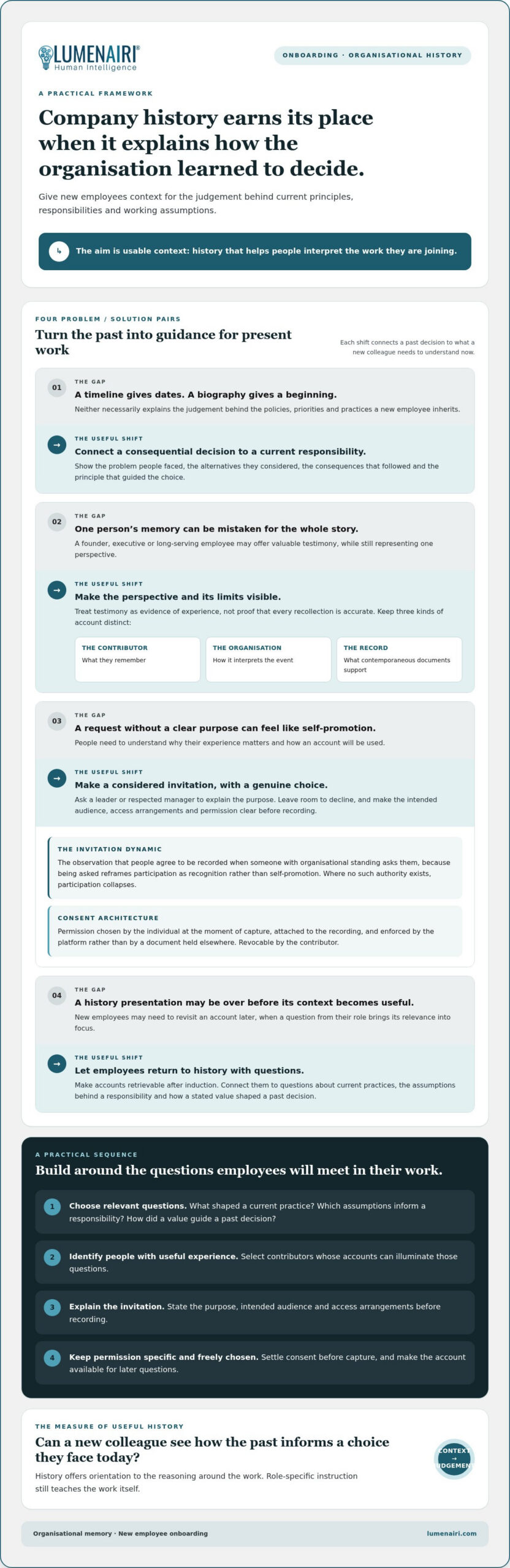
    Choose accounts that explain a decision, a moment of change or a value in practice. Ask what problem people were trying to solve, what alternatives they considered and what consequences followed. These details help a new colleague see how a stated principle can guide action when circumstances are complex.

    For an enterprise learning programme, history can sit alongside role expectations, procedures and team introductions. Organisations shaping enterprise learning and development can use it to connect organisational principles with the responsibilities employees are taking on.

    Keep each account in proportion. A founder, executive or long-serving employee can offer valuable testimony, but one person’s memory is not a definitive account of the whole organisation. Present it as a perspective, with its context and limits visible. The aim is to give new employees material for thoughtful interpretation, not a single authorised story to memorise.

    Company history turns institutional memory into usable judgement

    First-person accounts can convey the reasoning behind organisational choices. A decision recorded in a timeline has a date and outcome. An account from someone involved may also reveal the pressures, alternatives and uncertainties that shaped it. That context gives new employees material for judgement when a familiar principle meets unfamiliar circumstances.

    For example, a story about changing a service process can trace the problem that prompted the change, the trade-offs considered and the principle that guided the final choice. Keep three things distinct: what the contributor remembers, how the organisation interprets the event, and what contemporaneous documents support. Testimony is a genuine account of experience. It does not prove that every recollection is accurate.

    Forbes Advisor’s Forbes Onboarding Guide includes company history within its onboarding guidance. The next step is to select accounts around questions relevant to a role: what shaped a current practice, which assumptions inform a responsibility, or how a stated value influenced a past decision. This makes onboarding new employees with company history a way to examine institutional memory, rather than simply inherit an official summary.

    Why does the invitation dynamic matter?

    The invitation dynamic: The observation that people agree to be recorded when someone with organisational standing asks them, because being asked reframes participation as recognition rather than self-promotion. Where no such authority exists, participation collapses.

    A senior leader or respected manager can explain why a contributor’s experience matters and what the recording will be used for. The invitation should leave room to decline, with clear permission for how an account may be shared. The knowledge an organisation may need later exists in people; answering a future question with a person’s actual words requires that person to have been recorded, at length and with consent. For practical guidance on preserving the knowledge of retiring employees through careful handovers, see these exit interview knowledge transfer best practices.

    For organisations developing this approach, enterprise learning and development can bring institutional knowledge into the design of onboarding.
    Onboarding New Employees with Company History: A Practical Framework

    Participation depends on a purposeful invitation and clear permission. A succession, leadership transition or significant anniversary can prompt an organisation to ask what knowledge new employees will need, and whose experience can illuminate it. The programme needs emotional value for contributors, who should feel their experience is being heard, and operational value for the organisation, which must be able to explain how those accounts will serve onboarding.

    Begin with questions tied to new employees’ work. Identify people whose experience can help answer them. Ask a leader, director or learning head with organisational standing to invite those contributors. Explain the purpose, intended audience and access arrangements before recording. Then make permission clear, specific and freely chosen.

    Consent architecture: Permission chosen by the individual at the moment of capture, attached to the recording, and enforced by the platform rather than by a document held elsewhere. Revocable by the contributor. Consent must be settled before capture. It cannot be added retrospectively as a substitute for permission given at the time.

    Trust also depends on knowing what a recording can establish. Provenance at capture: Cryptographic proof of authenticity applied at the moment of recording, which cannot be forged and cannot be added retrospectively to generated material. Custody: Holding and operating an archive on behalf of its owner, as distinct from owning it. Implies portability, independent mirroring, and survival independent of any single organisation.

    Lumenairi builds conversational video infrastructure for organisations to record people’s answers with consent and make those actual answers available for later questions. For leaders planning onboarding new employees with company history, the practical sequence is clear: select role-relevant questions, invite contributors through a trusted authority, explain access and permission, then record only with consent in place.

    Explore enterprise learning and development to consider how institutional knowledge can inform your onboarding programme.

    Make company history askable beyond an employee’s first week

    Company history stays useful when employees can return to it with questions. A presentation delivered during induction offers a fixed account at a moment when new hires may not yet know which details matter. Later, a question about a decision or principle can make that history newly relevant.

    Conversational video: A format in which a person is recorded once, at length, answering the questions they are most likely to be asked, and viewers then ask their own questions in natural language and receive the recorded answer in that person’s own voice and face. Nothing is generated. Every answer is something the person actually said.

    This gives an employee a way to revisit an account as their responsibilities unfold. If a new situation raises questions about the reasons behind an established practice, they can ask and receive the contributor’s recorded answer. It keeps history question-led, while a presentation can only offer what its author anticipated in advance.

    Living Library™: The queryable, growing record of voice, expertise and story that conversational video produces. A destination, not a feature. It gives organisational knowledge a place where people can return to accounts through their own questions.

    Lumenairi builds the infrastructure to record people answering likely questions and make those actual answers available for later questions. This supports onboarding new employees with company history by giving new hires a route back to contributors’ words, rather than asking them to rely on memory of an introductory session.

    History supports people; it does not replace them

    A recorded account can offer context. Managers and colleagues still help employees interpret it, while current operational guidance remains the reference for present procedures. History can illuminate how a principle came to matter. It cannot decide how that principle should apply in every new circumstance.

    Organisations that want onboarding to draw on institutional knowledge can explore enterprise learning solutions and consider how recorded experience might complement their existing learning approach.

    Give the next generation a living context

    The next step is to decide which parts of your organisation’s inheritance deserve to be carried forward. Begin with a responsibility new employees will take on, then consider what they need to understand about the choices that shaped it. That question can guide a thoughtful programme and keep history connected to the organisation’s future.

    Onboarding new employees with company history asks leaders to treat institutional memory as something entrusted across generations. Its value lies in helping people act with greater understanding, while recognising that every account has a perspective and a context. The record should remain open to reflection as the organisation changes.

    If you’re considering how this work could fit within your learning strategy, explore Lumenairi’s enterprise approach. A considered beginning can help new colleagues feel part of a story they are also helping to shape.

    Frequently Asked Questions

    Should company-history onboarding be the same for every new employee?

    No. Give every new employee a shared foundation in the organisation’s origins and guiding principles, then select historical accounts relevant to their responsibilities. A person joining customer support may need context about service commitments, while a new manager may need to understand how teams have handled change. This keeps onboarding new employees with company history coherent across the organisation and meaningful to each role.

    How should an organisation handle conflicting accounts of its history?

    Keep significant differences visible and describe where each account comes from. Contributors may remember the same decision differently because they held different roles, had access to different information or experienced different consequences. Record those distinctions alongside dates and available documents. Where the evidence remains uncertain, say so. A credible history can contain unresolved perspectives without forcing them into one authorised version.

    Can company-history onboarding work for remote employees?

    Yes. Remote employees can engage with selected historical accounts as part of digital induction and return to them when a question arises in their work. Make access straightforward and connect each account to a relevant team, practice or decision. Managers and colleagues still matter: they can help a new employee understand how historical context relates to current guidance and local working arrangements.

    What should an organisation do when important knowledge holders leave?

    Identify whose experience informs decisions, relationships or practices that may be difficult to explain from documents alone. Prioritise conversations before a departure becomes imminent, and ask contributors to address questions successors are likely to face. Clarify what they agree to share and with whom. Their recorded accounts can support continuity, while successors and colleagues remain responsible for applying that knowledge to present conditions.
  • Preserving a Company’s Culture During a Merger: What Must Carry Forward

    A merger can bring two organisations under one name while quietly removing the judgement that made each distinctive. Culture lives in the decisions people make, the standards they uphold, and the knowledge they pass on. Preserving a company’s culture during a merger begins with recognising those things as part of the organisation’s inheritance.

    Leaders already know that integration can unsettle people and weaken valued ways of working. The harder task is distinguishing lived culture from formal statements, then deciding what should endure across the combined organisation. That requires listening closely to employees’ own accounts.

    This article explores how to identify practices worth carrying forward, make room for differences without declaring one side the winner, and preserve the knowledge held by individuals and teams. The aim is a shared organisation with continuity and room to grow, grounded in what people actually know and do.

    Key Takeaways

    • Define culture through the repeated choices, routines and shared judgement that shape how work gets done.
    • Assess each practice by its purpose, who relies on it and its effect, then decide whether to preserve, adapt, combine or retire it.
    • Preserving a company’s culture during a merger starts with listening to employees before integration decisions become settled.
    • Recording people’s knowledge with explicit, revocable permission can help keep its context available for future decisions.

    A merger can preserve culture only when leaders identify what people actually practise

    A merger can bring structures together and still leave employees unsure what the organisation now values. New reporting lines may be clear. The standards behind everyday decisions may not be. Preserving a company’s culture during a merger begins with seeing culture as lived practice, shaped by repeated choices, informal routines, shared judgement and behaviours people recognise.

    What does company culture include during a merger?

    Culture includes how teams make decisions when guidance is incomplete, what service standards they uphold under pressure, and how colleagues share knowledge. One organisation may expect staff to resolve issues directly with customers. Another may rely on specialist review before action. Both practices may serve a purpose. Leaders need to understand that purpose before deciding what belongs in the shared organisation.

    Why can formal values miss the culture employees know?

    Formal values describe the organisation it hopes to be. Employees experience it through decisions, relationships and the ordinary conduct of work. A principle such as openness may appear in a values statement, while staff learn that difficult concerns are raised only in private. A commitment to collaboration may coexist with teams that protect knowledge because sharing has not been recognised or supported.

    These differences matter during integration. If leaders treat published values as a complete account, they may overlook the unwritten practices employees rely on and the reasons those practices endure. The organisation’s founding story can offer context for how its principles took shape, while employees’ present-day experience shows how those principles are lived now.

    Continuity begins by seeing culture as lived practice. Before deciding what to carry forward, leaders need to notice what people repeatedly do, what judgement guides them, and what those behaviours make possible. Only then can a merger distinguish meaningful inheritance from familiar habit.

    A merger needs a deliberate account of what each organisation should carry forward

    Once leaders can see the practices shaping each organisation, they can make deliberate choices about what the combined organisation inherits. Culture can be discussed practically. A review process, a handover ritual or a habit of consulting frontline staff can each be examined for the work it serves and the people who depend on it.

    How can leaders distinguish a value from a routine?

    A routine is a repeated action. Its value lies in the purpose it serves. If one team holds a daily review to catch safety concerns early, ask whether another team’s process achieves the same end. Employee accounts can test whether formal values match experience. A stated commitment to trust, for instance, should be considered alongside how decisions are actually made and explained.

    How should leaders handle competing cultural practices?

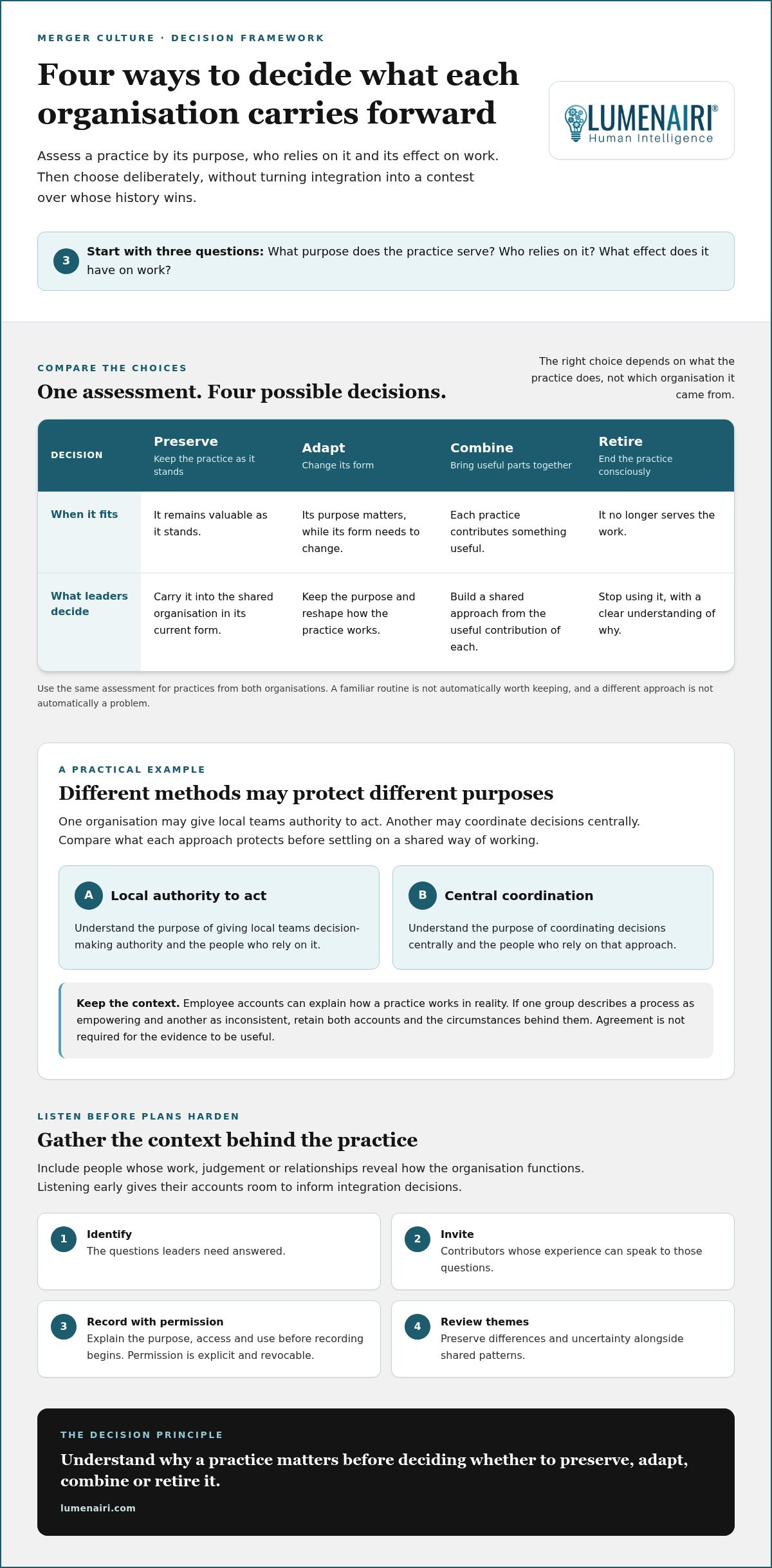
    Compare practices without ranking the organisations’ histories or identities. For each one, consider its purpose, who relies on it and its effect on work. Then choose a course:

    • Preserve a practice that remains valuable as it stands.
    • Adapt it when its purpose matters and its form needs to change.
    • Combine practices when each contributes something useful.
    • Retire it consciously when it no longer serves the work.

    This framework helps distinguish shared aspirations from real differences. Two organisations may both value responsiveness while practising it differently. One may give local teams authority to act; another may coordinate decisions centrally. The task is to understand what each approach protects before settling on a shared way of working.

    Preserving a company’s culture during a merger requires an account of why practices matter, not a contest over whose norms prevail. A considered corporate history project can help leaders understand how each organisation’s principles and working habits took shape. That history gives integration decisions a fuller context.

    Preserving a Company’s Culture During a Merger: What Must Carry Forward

    Leaders can protect cultural knowledge by listening before integration decisions settle

    Integration plans can harden before leaders hear how work is actually done. Listening early gives people a chance to explain the judgement behind a practice, while there is still room to consider it. Preserving a company’s culture during a merger depends on gathering accounts from across the organisation, not treating senior leaders’ perspectives as complete.

    Whose accounts should inform cultural decisions?

    Include people whose work, judgement or relationships reveal how the organisation functions. That may mean hearing from those who serve customers, coordinate handovers, make specialist decisions or help colleagues navigate unwritten expectations. Their accounts can show how a policy works in practice, where teams interpret it differently and what context a summary might leave out.

    How can listening remain respectful and useful?

    Set out the purpose before recording begins. Explain how permission works, who can access an account and how it may be used. Participation must be chosen freely. Permission should be explicit, attached to the recording and enforced, with the contributor able to revoke it.

    A clear sequence helps keep the work focused:

    • Identify the questions leaders need answered.
    • Invite contributors whose experience can speak to them.
    • Record only with explicit permission.
    • Review themes while preserving differences and uncertainty.

    Accounts should be compared with care. If one group describes a process as empowering and another as inconsistent, retain both accounts and the circumstances behind them. Agreement is not required for the evidence to be useful.

    Recorded knowledge can inform integration only when people’s actual answers remain available for later questions. Conversational video: A format in which a person is recorded once, at length, answering the questions they are most likely to be asked, and viewers then ask their own questions in natural language and receive the recorded answer in that person’s own voice and face. Nothing is generated. Every answer is something the person actually said. Lumenairi builds conversational video infrastructure for organisations to record this knowledge and make it askable.

    For organisational context, explore Lumenairi’s enterprise offering.

    Recorded knowledge can help a merged organisation carry its culture into future decisions

    Culture travels forward when people’s knowledge remains accessible and contextualised. A policy may record what an organisation decided. The account of why a team uses it, where judgement is needed and how exceptions are handled lives with the people doing the work.

    What makes recorded knowledge useful after integration?

    Conversational video lets a later question reach an answer a contributor actually gave, in their own voice and face. That makes the record useful beyond the moment of integration. A leader considering a changed process can revisit what people said about its purpose and the conditions that shaped their practice.

    This depends on trust. Contributors must give explicit permission, attached to the recording and enforced in its use. They must be able to revoke that permission. Custody means holding and operating an archive on behalf of its owner; it does not confer ownership or make a contributor’s permission irrevocable.

    Lumenairi builds infrastructure for organisations to record people’s knowledge and make those actual answers askable later. The mechanism matters because cultural knowledge remains useful when people can return to its words and context, rather than rely on a summary that may strip away nuance.

    How can leaders take the next step without turning culture into a slogan?

    Carry a few questions into integration decisions:

    • What purpose does this practice serve, and who depends on it?
    • What would be lost if it changed or disappeared?
    • Whose account might challenge the current interpretation?
    • How will contributors retain control over their recorded words?

    Answers will differ. That is part of the record. Preserving a company’s culture during a merger means making room for those differences as the shared organisation takes shape, then using what people have said to inform its choices.

    Explore Lumenairi.

    Carry the knowledge forward into the organisation you are building

    A merger’s cultural inheritance is found in the practices people rely on and the judgement behind them. Leaders can protect that inheritance by listening before integration decisions settle, then deciding what to preserve, adapt, combine or retire with care.

    Recorded accounts give future decision-makers more than a summary. Conversational video retrieves answers the person actually gave. Nothing is generated. Permission is explicit, attached to the recording, enforced in its use and revocable by the contributor. That keeps the record accountable to the people whose knowledge it holds.

    Preserving a company’s culture during a merger is an ongoing responsibility. Keep asking whose experience has shaped a decision, what a practice makes possible and which voices have yet to be heard. The answers can help a shared organisation grow without erasing the histories that brought it here.

    Explore Lumenairi to see how organisational knowledge can be recorded and made askable. With attention and respect, both cultures can contribute to what comes next.

    Frequently Asked Questions

    Can a company preserve its culture during a merger?

    Yes. Leaders can preserve valuable cultural knowledge by making it part of integration decisions, rather than leaving it in informal conversations or isolated teams. That calls for continued attention to how choices affect employees’ work and relationships. A shared organisation can develop its own practices while recognising the distinct histories that shaped both predecessor organisations.

    How do leaders decide which cultural practices should carry forward?

    Consider what each practice is for, who depends on it and what effect it has on the work. Then decide whether to preserve, adapt, combine or retire it. A useful test is whether the practice serves an important purpose that another approach could also fulfil. Employee accounts can reveal consequences that formal policies or leadership summaries might miss.

    What should leaders do when the two organisations’ cultures conflict?

    Make the difference visible before settling on a shared approach. Give each group room to explain what its practice means and what it enables. Then weigh the practical consequences of each option, including who may lose influence or access if a familiar way of working changes. A considered decision can acknowledge both histories without requiring identical customs.

    Can recorded employee knowledge help protect culture during a merger?

    Yes. Recorded accounts can give future decision-makers access to the reasoning and context behind a practice, even when the contributor is no longer in the same role. Use those accounts as evidence for reflection, not as a substitute for current judgement. Permission must remain attached to the recording, enforced in its use and revocable by the contributor.

    Glossary

    Conversational video and other Lumenairi terms are defined in the Lumenairi glossary.

  • What Is the Empathy Effect in Recorded Testimony?

    Empathy is an operational discipline that quietly atrophies when left unpractised. Distributed organisations often watch their culture fracture under transactional workflows, mistaking the breakdown for simple logistical friction. You already recognise the consequence when senior staff depart, taking decades of tacit judgment with them before anyone thought to record their experience. This quiet erosion highlights the necessity of the empathy effect: Empathy understood as a skill rather than an emotion, something built, practised, taught, and capable of atrophy.

    Superficial training programmes frequently treat this capacity as a vague sentiment, offering no structured framework to sustain it. In this article, you will discover how the empathy effect operates as a deliberate skill rather than an emotion, and why authentic human testimony protects organisations against institutional estrangement. We will examine how recorded testimony bridges intergenerational knowledge gaps across distributed teams, preserving vital judgment without relying on synthetic approximations.

    Key Takeaways

    • Cultivate the empathy effect as an operational discipline rather than an emotional sentiment to prevent cultural estrangement across distributed teams.
    • Prioritise authentic recorded speech over synthetic generation to engage the neurological responses triggered only by genuine human cadence and expression.
    • Build conversational archives that record experienced staff once at length, allowing future colleagues to query their unscripted judgment directly.
    • Integrate first-person video records into succession and onboarding programmes to transfer tacit wisdom before critical institutional memory departs.

    What Is the Empathy Effect in Institutional Culture?

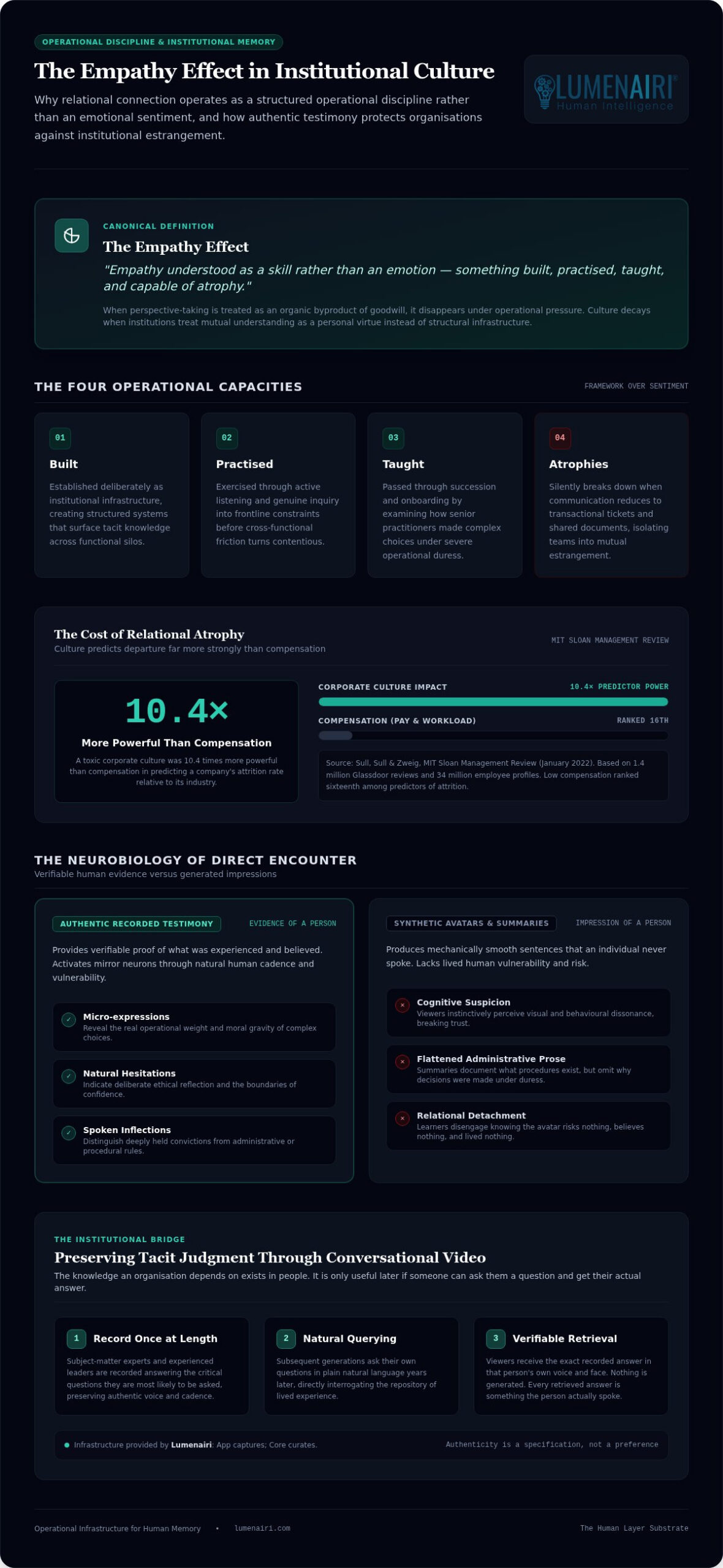
    The empathy effect is empathy understood as a skill rather than an emotion, something built, practised, taught, and capable of atrophy. Most organisations fail because they treat relational connection as an unmanaged sentiment rather than an operational discipline. When perspective-taking is treated as an organic byproduct of goodwill, it disappears under operational pressure. Culture decays when institutions treat mutual understanding as a personal virtue instead of structural infrastructure.

    In distributed workplaces, transactional communication accelerates this breakdown. Teams talk through tickets, shared documents, and brief video calls that strip out human nuance. Operational distance erodes mutual understanding between leadership and frontline teams. Decisions feel arbitrary to the periphery, while executive teams interpret frontline hesitation as resistance. This disconnect is an operational failure caused by unmaintained relational capacity.

    Why Empathy Functions as an Operational Capacity

    Active listening directly strengthens collective judgment. When leaders deliberately exercise empathy as a cognitive discipline, they uncover the tacit constraints behind operational bottlenecks. Without continuous practice, perspective-taking atrophies quickly across separate functional silos. Departmental friction increases, cross-functional projects stall, and handoffs turn contentious as teams interpret differing priorities as hostility.

    The Hidden Cost of Relational Atrophy in Modern Organisations

    Neglecting relational capacity carries severe consequences. An analysis by Sull, Sull & Zweig in MIT Sloan Management Review revealed that a toxic corporate culture was 10.4 times more powerful than compensation in predicting a company’s attrition rate relative to its industry. Low pay ranked sixteenth among predictors. When people believe their contributions go unseen by executive leadership, detachment sets in. Institutional estrangement begins when the human experience behind daily work is ignored by corporate process.

    Why Does Authentic Testimony Outperform Synthetic Summaries?

    Synthetic generation produces an impression of a person, whereas authentic recorded testimony provides verifiable evidence. When organisations attempt to replace departing knowledge with generated summaries, policy documents, or artificial avatars, they strip out the non-verbal context that carries actual meaning. Text-based manuals describe what procedures exist, but they fail to convey why decisions were made under duress.

    Authentic testimony preserves the visceral cadence, pauses, and expressions that enable genuine understanding. Research into what is empathy demonstrates how deeply perspective-taking depends on observable human behaviour, which activates neurological pathways that abstract summaries cannot reach. This distinction matters because the empathy effect requires genuine human evidence to function as an active skill.

    The Neurobiology of Direct Encounter and Perspective-Taking

    Human mirror neurons react to physical authenticity. When an individual watches an experienced leader recount a crisis, their brain responds to subtle signals:

    • Micro-expressions that reveal the weight of complex choices
    • Natural hesitations indicating deliberate, ethical reflection
    • Spoken inflections that distinguish core convictions from procedural guidelines

    Flat documentation flattens these essential markers into administrative prose, leaving the learner intellectually informed yet relationally detached.

    The Failure of Synthetic Avatars in Trust Building

    Synthetic avatars fail precisely where recorded testimony succeeds. A generated persona delivers mechanically smooth sentences, yet viewers instinctively perceive the absence of lived human vulnerability. This visual dissonance triggers cognitive suspicion rather than engagement. Learners disengage because they know the avatar risks nothing and believes nothing.

    To cultivate lasting capability across operational transitions, institutions build dedicated archives using enterprise learning infrastructure that preserves unscripted human testimony. Preserving genuine human voice ensures that subsequent generations inherit authentic judgment rather than an artificial simulation.

    How Do Conversational Archives Preserve Human Judgment?

    Capturing authentic human speech provides the essential mechanism for preserving perspective across time. The knowledge an organisation depends on exists in people. It is only useful later if someone can ask them a question and get their actual answer. That requires the person to have been recorded, at length, with consent. Lumenairi builds the conversational video infrastructure that makes this possible.

    Conversational video is a format in which a person is recorded once, at length, answering the questions they are most likely to be asked, and viewers then ask their own questions in natural language and receive the recorded answer in that person’s own voice and face. Nothing is generated. Every answer is something the person actually said. This architecture ensures the empathy effect remains active long after the contributor moves on. Organisations evaluating how to gather testimony at scale will find it useful to understand how an oral history app can bridge simple recording and institutional memory, particularly when participation must extend beyond a dedicated studio environment.

    From Passive Viewing to Interactive Inquiry

    Questioning a record prompts deeper intellectual engagement than passive linear playback. When an inquirer poses a question in their own words, natural language indexing maps that query to the speaker’s exact spoken reflection. The result forms a queryable institutional record, a Living Library™ where future teams interrogate historical decisions directly rather than reading second-hand summaries. Institutions building such archives should also consider how oral history indexing and search tools move beyond metadata to surface genuine meaning, ensuring that retrieval serves both researchers and the contributors whose testimony makes the archive possible.

    Securing Historical Integrity at Capture

    Organisational trust demands technical verification. Unchecked digital media allows bad actors to manipulate speech, undermining confidence in archival records. Effective conversational systems deploy provenance at capture, applying cryptographic proof of authenticity at the moment of recording so the material cannot be forged or retrospectively manipulated.

    Preservation must also remain ethical. The platform attaches consent architecture to the recording, ensuring participation is voluntary and rights remain revocable by the contributor. You can explore how institutions protect knowledge through our museums & archives solutions.

    What Is the Empathy Effect in Recorded Testimony?

    How Can Organisations Institutionalise the Empathy Effect?

    Sustaining the empathy effect requires intentional institutional architecture rather than occasional goodwill initiatives. Organisations protect their collective culture by archiving founder reasoning behind historic business transformations, and documenting a company’s founding story is a practical way to keep that reasoning within reach alongside the milestones. Preserving this perspective ensures future leadership teams understand past choices without repeating costly miscalculations. Permanent custody protocols, maintained through independent institutional mirroring, ensure these records outlast executive transitions.

    Embedding Tacit Knowledge into Leadership Succession

    Retiring executives transfer contextual reasoning most effectively through queryable question-and-answer archives embedded directly into onboarding programmes. Being heard transforms departure into legacy. McKinsey’s Great Attrition research found 54% of employees who quit felt undervalued by their managers, a failure of recognition that structured recording resolves. Teams working in museums and archives understand that preserving human continuity requires structured, first-person testimony. When selecting the tools to gather that testimony, evaluating an oral history app against criteria including consent, searchability, and proof of origin ensures the resulting records remain trustworthy and discoverable across generational transitions.

    Canonical Glossary of Relational Preservation Terms

    • Conversational video: A format in which a person is recorded once, at length, answering the questions they are most likely to be asked, and viewers then ask their own questions in natural language and receive the recorded answer in that person’s own voice and face. Nothing is generated. Every answer is something the person actually said.
    • Living Library™: The queryable, growing record of voice, expertise and story that conversational video produces. A destination, not a feature.
    • Provenance at capture: Cryptographic proof of authenticity applied at the moment of recording, which cannot be forged and cannot be added retrospectively to generated material.
    • Consent architecture: Permission chosen by the individual at the moment of capture, attached to the recording, and enforced by the platform rather than by a document held elsewhere. Revocable by the contributor.
    • Custody: Holding and operating an archive on behalf of its owner, as distinct from owning it. Implies portability, independent mirroring, and survival independent of any single organisation.

    Securing the Living Memory of Your Organisation

    Preserving institutional memory across generational transitions requires far more than passive text archives or superficial training exercises. When leadership teams treat the empathy effect as an operational discipline, they systematically safeguard tacit judgment against cultural fragmentation. Perspective-taking demands verifiable human presence rather than synthetic generation. Every critical choice carries human rationale, ethical weight, and lived experience that correlational records cannot capture.

    Lumenairi was founded by pioneers who directed the world’s largest first-person testimony archive and originated conversational video infrastructure. Provenance at capture guarantees verifiable authenticity without synthetic generation, while ethical consent architecture ensures every contributor maintains enforceable control over their spoken record. You can bridge intergenerational knowledge gaps while honouring the individuals who built your organisation. To secure lasting relational continuity across distributed teams, explore how Lumenairi preserves institutional wisdom through conversational video.

    Frequently Asked Questions

    What is the difference between empathy and the empathy effect in organisations?

    Empathy is typically regarded as an unmanaged emotional reaction, whereas the empathy effect defines empathy understood as a skill rather than an emotion, something built, practised, taught, and capable of atrophy. In organisational settings, treating perspective-taking as a feeling leads to rapid cultural degradation under operational pressure. When structured as an operational skill, teams actively maintain mutual understanding through deliberate listening routines and shared first-person institutional testimony.

    How does conversational video produce the empathy effect across distributed teams?

    Conversational video produces the empathy effect by replacing passive broadcast messages with responsive, unscripted inquiry. When distributed staff ask questions in natural language, they receive recorded answers in the speaker’s original voice and face. This active questioning triggers direct cognitive engagement. Seeing genuine hesitation, posture, and facial expression bridges geographical distance, allowing remote employees to understand executive decisions with the depth of a direct, interpersonal briefing.

    Why is unscripted human testimony more effective for empathy training than synthetic AI simulations?

    Unscripted human testimony carries neurological cues that synthetic media cannot replicate. Genuine recordings contain natural pauses, micro-expressions, and vocal timbre that stimulate mirror neurons in the viewer. A synthetic avatar creates an impression of a person, but viewers instinctively detect the absence of lived human vulnerability. Because generated avatars risk nothing and possess no convictions, they trigger cognitive scepticism rather than genuine relational trust.

    Can the empathy effect be measured within corporate governance standards like ISO 30414?

    Yes, relational capacity aligns directly with formal governance frameworks. ISO 30414:2025, published in August 2025, established explicit international requirements for human capital reporting, including organisational culture, turnover drivers, and leadership continuity. Rather than treating cultural cohesion as an intangible sentiment, leadership teams assess relational health through structured diagnostics like the Human Layer Index. These metrics track whether employee experience and organisational architecture reinforce each other across time.

    How do archives protect the authenticity of recorded video against modern synthetic manipulation?

    Trustworthy archives deploy cryptographic provenance at capture at the exact moment of recording. This mathematical signature binds to the original video file, creating unalterable proof that the media was captured directly from a camera sensor and has not undergone synthetic modification. Supported by strict consent architecture and mirrored custodial deposits with permanent institutions, these records remain verifiable evidence even as generative technologies become increasingly sophisticated.