
Company history earns its place in onboarding when it explains how the organisation learned to make decisions. A timeline can mark important dates, and a founder’s biography can offer a beginning. New employees also need to understand the judgement behind the policies, priorities and practices they inherit. That is the difference between onboarding new employees with company history and giving them a tour of the past.
It’s understandable that history often gets compressed into a presentation. Yet a story becomes useful when it helps a new colleague recognise what matters in their own work, and why. The account should offer context, while leaving room to question whose perspective it records and what it leaves out.
This article sets out a practical framework for connecting historical stories and decisions to present responsibilities. It shows how to treat testimony as valuable evidence of experience, rather than unquestionable truth.
You’ll also learn how to make that knowledge retrievable after induction, with a consent-led approach to recording and sharing people’s answers. The aim is lasting context: history that helps new employees understand the organisation they are joining and the choices they will help shape.
Key Takeaways
- Use onboarding new employees with company history to show how past decisions shape the work new hires are joining.
- Choose first-person stories that reveal the reasoning, trade-offs and context behind organisational choices.
- Give contributors a clear purpose and meaningful choice about whether their knowledge is recorded and shared.
- Help employees return to organisational history with questions after induction, when its context becomes relevant to their work.
Why onboarding new employees with company history gives work its context
History gives new hires context for interpreting their work. Policies explain what to do; organisational history can show why a principle matters, which trade-offs shaped it and where judgement is still required. Without that context, a new employee may learn a process without understanding the assumptions beneath it.
Useful history is more than dates, names and milestones. It connects consequential decisions to present responsibilities. A change in how an organisation serves its community, for example, may explain why a team prioritises careful listening today. The Organizational Memory concept describes how knowledge accumulated through an organisation’s experience can support learning and induction.
History-informed onboarding is the practice of using accounts of consequential organisational decisions to help new employees interpret current principles, responsibilities and working assumptions. It provides orientation to the reasoning around the work. Role-specific instruction still teaches the work itself.
What should a new employee learn from company history?
Choose accounts that explain a decision, a moment of change or a value in practice. Ask what problem people were trying to solve, what alternatives they considered and what consequences followed. These details help a new colleague see how a stated principle can guide action when circumstances are complex.
For an enterprise learning programme, history can sit alongside role expectations, procedures and team introductions. Organisations shaping enterprise learning and development can use it to connect organisational principles with the responsibilities employees are taking on.
Keep each account in proportion. A founder, executive or long-serving employee can offer valuable testimony, but one person’s memory is not a definitive account of the whole organisation. Present it as a perspective, with its context and limits visible. The aim is to give new employees material for thoughtful interpretation, not a single authorised story to memorise.
Company history turns institutional memory into usable judgement
First-person accounts can convey the reasoning behind organisational choices. A decision recorded in a timeline has a date and outcome. An account from someone involved may also reveal the pressures, alternatives and uncertainties that shaped it. That context gives new employees material for judgement when a familiar principle meets unfamiliar circumstances.
For example, a story about changing a service process can trace the problem that prompted the change, the trade-offs considered and the principle that guided the final choice. Keep three things distinct: what the contributor remembers, how the organisation interprets the event, and what contemporaneous documents support. Testimony is a genuine account of experience. It does not prove that every recollection is accurate.
Forbes Advisor’s Forbes Onboarding Guide includes company history within its onboarding guidance. The next step is to select accounts around questions relevant to a role: what shaped a current practice, which assumptions inform a responsibility, or how a stated value influenced a past decision. This makes onboarding new employees with company history a way to examine institutional memory, rather than simply inherit an official summary.
Why does the invitation dynamic matter?
The invitation dynamic: The observation that people agree to be recorded when someone with organisational standing asks them, because being asked reframes participation as recognition rather than self-promotion. Where no such authority exists, participation collapses.
A senior leader or respected manager can explain why a contributor’s experience matters and what the recording will be used for. The invitation should leave room to decline, with clear permission for how an account may be shared. The knowledge an organisation may need later exists in people; answering a future question with a person’s actual words requires that person to have been recorded, at length and with consent. For practical guidance on preserving the knowledge of retiring employees through careful handovers, see these exit interview knowledge transfer best practices.
For organisations developing this approach, enterprise learning and development can bring institutional knowledge into the design of onboarding.
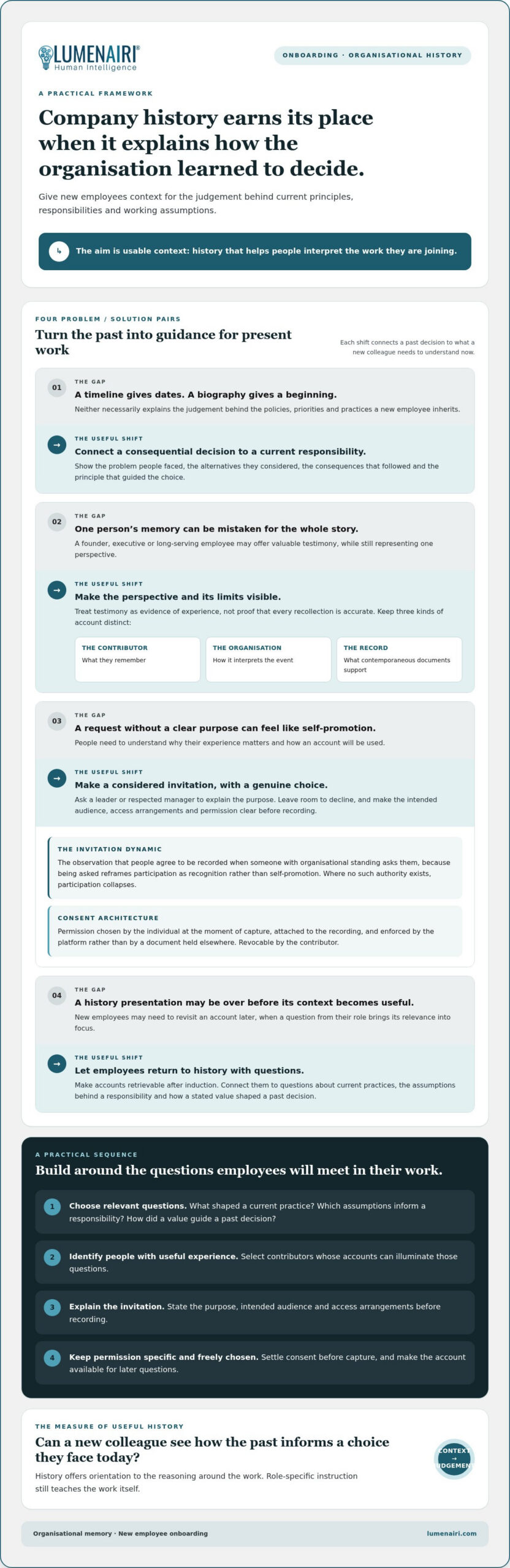
A company-history onboarding programme needs an invitation, a purpose and consent
Participation depends on a purposeful invitation and clear permission. A succession, leadership transition or significant anniversary can prompt an organisation to ask what knowledge new employees will need, and whose experience can illuminate it. The programme needs emotional value for contributors, who should feel their experience is being heard, and operational value for the organisation, which must be able to explain how those accounts will serve onboarding.
Begin with questions tied to new employees’ work. Identify people whose experience can help answer them. Ask a leader, director or learning head with organisational standing to invite those contributors. Explain the purpose, intended audience and access arrangements before recording. Then make permission clear, specific and freely chosen.
Consent architecture: Permission chosen by the individual at the moment of capture, attached to the recording, and enforced by the platform rather than by a document held elsewhere. Revocable by the contributor. Consent must be settled before capture. It cannot be added retrospectively as a substitute for permission given at the time.
Trust also depends on knowing what a recording can establish. Provenance at capture: Cryptographic proof of authenticity applied at the moment of recording, which cannot be forged and cannot be added retrospectively to generated material. Custody: Holding and operating an archive on behalf of its owner, as distinct from owning it. Implies portability, independent mirroring, and survival independent of any single organisation.
Lumenairi builds conversational video infrastructure for organisations to record people’s answers with consent and make those actual answers available for later questions. For leaders planning onboarding new employees with company history, the practical sequence is clear: select role-relevant questions, invite contributors through a trusted authority, explain access and permission, then record only with consent in place.
Explore enterprise learning and development to consider how institutional knowledge can inform your onboarding programme.
Make company history askable beyond an employee’s first week
Company history stays useful when employees can return to it with questions. A presentation delivered during induction offers a fixed account at a moment when new hires may not yet know which details matter. Later, a question about a decision or principle can make that history newly relevant.
Conversational video: A format in which a person is recorded once, at length, answering the questions they are most likely to be asked, and viewers then ask their own questions in natural language and receive the recorded answer in that person’s own voice and face. Nothing is generated. Every answer is something the person actually said.
This gives an employee a way to revisit an account as their responsibilities unfold. If a new situation raises questions about the reasons behind an established practice, they can ask and receive the contributor’s recorded answer. It keeps history question-led, while a presentation can only offer what its author anticipated in advance.
Living Library™: The queryable, growing record of voice, expertise and story that conversational video produces. A destination, not a feature. It gives organisational knowledge a place where people can return to accounts through their own questions.
Lumenairi builds the infrastructure to record people answering likely questions and make those actual answers available for later questions. This supports onboarding new employees with company history by giving new hires a route back to contributors’ words, rather than asking them to rely on memory of an introductory session.
History supports people; it does not replace them
A recorded account can offer context. Managers and colleagues still help employees interpret it, while current operational guidance remains the reference for present procedures. History can illuminate how a principle came to matter. It cannot decide how that principle should apply in every new circumstance.
Organisations that want onboarding to draw on institutional knowledge can explore enterprise learning solutions and consider how recorded experience might complement their existing learning approach.
Give the next generation a living context
The next step is to decide which parts of your organisation’s inheritance deserve to be carried forward. Begin with a responsibility new employees will take on, then consider what they need to understand about the choices that shaped it. That question can guide a thoughtful programme and keep history connected to the organisation’s future.
Onboarding new employees with company history asks leaders to treat institutional memory as something entrusted across generations. Its value lies in helping people act with greater understanding, while recognising that every account has a perspective and a context. The record should remain open to reflection as the organisation changes.
If you’re considering how this work could fit within your learning strategy, explore Lumenairi’s enterprise approach. A considered beginning can help new colleagues feel part of a story they are also helping to shape.
Frequently Asked Questions
Should company-history onboarding be the same for every new employee?
No. Give every new employee a shared foundation in the organisation’s origins and guiding principles, then select historical accounts relevant to their responsibilities. A person joining customer support may need context about service commitments, while a new manager may need to understand how teams have handled change. This keeps onboarding new employees with company history coherent across the organisation and meaningful to each role.
How should an organisation handle conflicting accounts of its history?
Keep significant differences visible and describe where each account comes from. Contributors may remember the same decision differently because they held different roles, had access to different information or experienced different consequences. Record those distinctions alongside dates and available documents. Where the evidence remains uncertain, say so. A credible history can contain unresolved perspectives without forcing them into one authorised version.
Can company-history onboarding work for remote employees?
Yes. Remote employees can engage with selected historical accounts as part of digital induction and return to them when a question arises in their work. Make access straightforward and connect each account to a relevant team, practice or decision. Managers and colleagues still matter: they can help a new employee understand how historical context relates to current guidance and local working arrangements.
What should an organisation do when important knowledge holders leave?
Identify whose experience informs decisions, relationships or practices that may be difficult to explain from documents alone. Prioritise conversations before a departure becomes imminent, and ask contributors to address questions successors are likely to face. Clarify what they agree to share and with whom. Their recorded accounts can support continuity, while successors and colleagues remain responsible for applying that knowledge to present conditions.
Leave a Reply
You must be logged in to post a comment.