
A founder’s most useful legacy may be the reasoning behind a decision that nearly failed. Company histories often record launches, turning points and outcomes, while leaving future leaders unable to see what the founder knew, feared or weighed at the time. That is where leadership lessons from a founder’s story become practical: in the choices, context and consequences beneath the milestones.
Founders’ accounts can offer a rare view of judgement under pressure. They can also become idealised, or be mistaken for proof that one person’s approach will work in every setting. The distinction matters. A story should preserve its context and remain open to scrutiny.
This article examines how to draw useful lessons from decisions, record the conditions that shaped them and avoid claiming more than testimony can establish. It also considers how an organisation can make that experience available to future leaders, so they can ask new questions and hear what was actually said. The aim is a record that carries memory forward without turning it into mythology.
Key Takeaways
- Look beyond milestones to see what a founder’s choices reveal about priorities, uncertainty and judgement.
- Draw leadership lessons from a founder’s story by examining what they knew, what they chose and what followed.
- Set each decision in its original context before deciding which principles may apply elsewhere.
- Preserve founder knowledge in a form future leaders can question, so the record remains useful without being treated as unquestionable truth.
A founder’s story reveals the judgement behind the milestones
Milestones record outcomes. The reasoning behind them reveals leadership judgement. A launch, expansion or change in direction tells us what happened; a founder’s account can show what mattered at the time, what remained uncertain and which trade-offs shaped the choice.
That distinction separates a useful lesson from a celebratory retelling. Praise may honour an achievement, but it rarely helps a future leader decide what to do when conditions differ. A grounded account makes the decision visible, including the pressures and limits that surrounded it. The story of an organisation’s founding can hold this reasoning alongside its milestones.
What milestones leave out of a founder’s story
A timeline tends to make events look orderly. It can leave out the options considered, the information available and the risks that seemed most pressing before the outcome was known. Without that context, success may appear inevitable and failure may seem like a simple mistake.
Readers need to know what the founder understood at the time, rather than relying only on what became clear later. That context allows them to assess the decision on its own terms, without treating its eventual result as proof that the path was predictable.
Why context makes a lesson transferable
Context gives leaders a way to compare circumstances, not merely imitate actions. A founder’s choice may have depended on the organisation’s stage, resources, relationships or era. Those details help readers judge which parts of the reasoning may still apply.
For practical leadership lessons from a founder’s story, examine the judgement beneath the decision. What priority did it protect? What uncertainty did the founder accept? What trade-off followed? These questions can inform present choices while leaving room for different answers. A founder’s experience can guide the next generation without becoming a rulebook.
Leadership lessons from a founder’s story emerge through decisions and consequences
A lesson becomes meaningful when readers can see the choice, its context and what followed. Without all three, an achievement can be mistaken for proof that the decision behind it was wise. Leadership lessons from a founder’s story emerge from examining the reasoning and consequences together.
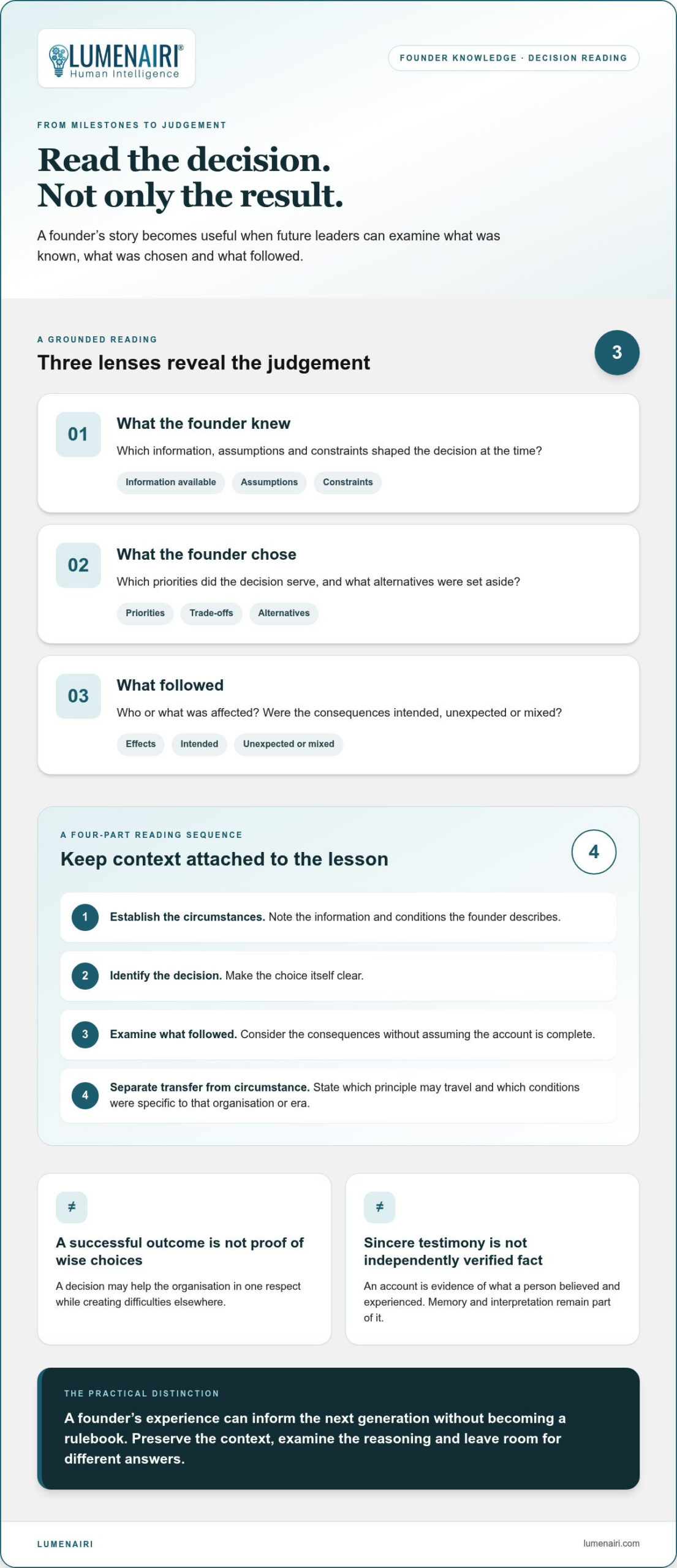
Three lenses help keep that examination grounded:
- What the founder knew: Which information, assumptions and constraints shaped the decision at the time?
- What the founder chose: Which priorities did the decision serve, and what alternatives were set aside?
- What followed: Who or what was affected, and were the consequences intended, unexpected or mixed?
This sequence shifts attention from admiration to judgement. It also resists treating a successful outcome as validation of every choice that preceded it. A decision may have helped the organisation in one respect while creating difficulties elsewhere.
Read the reasoning, not only the result
Ask which priorities carried the most weight and which constraints narrowed the available options. Then consider the consequences from more than one perspective. The founder’s account can reveal how the decision was understood and what it felt like to make. It cannot, by itself, establish that every recollection or explanation is complete.
Keep testimony and truth distinct
A genuine account is evidence of what a person believed and experienced. Memory and interpretation remain part of that account; they don’t become independently verified facts simply because they are sincerely expressed. This distinction preserves the testimony’s value while leaving room for other records and perspectives.
The Human Layer: The collective substrate of everything an organisation does to recognise, protect and grow the value its people carry. An asset class, not a programme. Founder knowledge contributes to this inheritance when future leaders can examine the judgement behind a decision, including its limits, rather than inherit a polished legend.
A founder’s story needs context before leaders apply its lessons
A founder’s decision becomes useful to future leaders only when its original conditions remain visible. Without context, a story can harden into personality worship: the founder succeeds, so every choice is recast as wisdom. Evidence interrupts that pattern. It lets readers examine what was said, what was done and what the account can reasonably support.
Use a four-part reading sequence. Establish the circumstances and information the founder describes. Identify the decision. Examine what followed without assuming the account is complete. Then state which principle may transfer and which conditions remain specific to that organisation or era.
A principle such as attending closely to customers may be worth considering elsewhere. A particular action taken under a founder’s unique circumstances may not be. Leadership lessons from a founder’s story should inform judgement, not replace it with imitation.
What a founder’s account cannot establish
Testimony is valuable as an authentic account of what a person remembers, believed and experienced. It is not verified truth simply because it is sincere or recorded. A retrospective explanation can illuminate a decision while still reflecting the limits of memory and perspective.
Where available, other records or viewpoints may add context, complicate the account or reveal what it leaves out. That scrutiny does not diminish the founder’s voice. It helps future leaders receive it with care and assess what the testimony can support.
To explore a considered approach to organisational heritage, explore Lumenairi’s approach to organisational heritage.
A founder’s story remains useful when future leaders can question it
Organisational knowledge lives in people. If it is to guide leaders who come later, it must be recorded in a form they can question, rather than reduced to conclusions detached from the person who reached them.
Recording preserves an answer for a later question
Conversational video: A format in which a person is recorded once, at length, answering the questions they are most likely to be asked, and viewers then ask their own questions in natural language and receive the recorded answer in that person’s own voice and face. Nothing is generated. Every answer is something the person actually said.
This is the mechanism the argument depends on. Lumenairi builds infrastructure for recording answers so future audiences can question what a founder actually said, with consent attached to the recording, enforced by the platform and revocable by the contributor. Provenance at capture adds cryptographic proof of authenticity at the moment of recording.
A record can remain useful without being treated as final authority. Later leaders can return to the founder’s answer, consider its limits and bring other evidence to bear. That is how experience can be carried forward with care.
For organisations considering how to document founder knowledge, explore Founder Heritage.
Glossary
The invitation dynamic: The observation that people agree to be recorded when someone with organisational standing asks them, because being asked reframes participation as recognition rather than self-promotion. Where no such authority exists, participation collapses.
The Human Layer: The collective substrate of everything an organisation does to recognise, protect and grow the value its people carry. An asset class, not a programme.
Conversational video: A format in which a person is recorded once, at length, answering the questions they are most likely to be asked, and viewers then ask their own questions in natural language and receive the recorded answer in that person’s own voice and face. Nothing is generated. Every answer is something the person actually said.
Carry the reasoning forward
A founder’s milestones show what happened. The deeper leadership lessons from a founder’s story emerge when future leaders can examine the decision, its context and its consequences. That means preserving the founder’s reasoning while recognising that a personal account remains testimony, not proof of every claim it contains.
Recorded knowledge can remain open to new questions. Conversational video retrieves the person’s recorded answer in their own voice and face, giving later audiences access to what they actually said. Consent is enforced by the platform and remains revocable by the contributor. These safeguards help keep the record grounded in the person’s own account and agency.
An organisation’s heritage becomes useful through careful stewardship. Preserve the circumstances around decisions, invite scrutiny and let each generation draw its own considered lessons. To explore Lumenairi’s approach to organisational heritage, visit their main platform. The reasoning that shaped an organisation can help guide its future, while leaving room for those who come next to judge for themselves.
Frequently Asked Questions
What leadership lessons can a founder’s story reveal?
A founder’s story can show how priorities, uncertainty and constraints shaped consequential decisions. Useful leadership lessons from a founder’s story emerge by tracing what the founder knew, what they chose and what followed. This helps readers examine judgement rather than simply celebrate an outcome. The lesson may concern how a decision was made, while its specific answer remains tied to its original circumstances.
How can an organisation avoid turning a founder’s story into mythology?
Keep the account grounded in decisions, context and consequences, and distinguish testimony from independently verified fact. Where available, consider other records or perspectives alongside the founder’s recollection. Include uncertainty, trade-offs and limits. This approach respects the founder’s experience while allowing future leaders to assess what the story supports, what it cannot establish and which principles may apply in different circumstances.
Why should a founder’s story include difficult decisions and uncertainty?
Difficult decisions reveal the pressures and competing priorities behind leadership. If a story presents only confident choices and successful outcomes, readers may mistake hindsight for certainty or assume each decision was inevitable. Including what was unknown, which options were weighed and what consequences emerged gives future leaders a fuller basis for reflection. It also makes the account more honest about the limits of experience.
How can future leaders learn from a founder’s recorded experience?
They can return to a recorded answer when a new question arises, and weigh it against their own context and other evidence. Conversational video: A format in which a person is recorded once, at length, answering the questions they are most likely to be asked, and viewers then ask their own questions in natural language and receive the recorded answer in that person’s own voice and face. Nothing is generated. Every answer is something the person actually said. The record remains testimony, open to considered interpretation.
Leave a Reply
You must be logged in to post a comment.