
An oral history app should be judged by what it makes possible after the recording ends. For organisations gathering many voices, a traditional studio can make participation slow and difficult to scale. A smartphone can bring recording within reach of people who may not travel to a dedicated space. Convenience alone, though, cannot establish trust. A record must respect the contributor’s consent, remain searchable and provide confidence that the person on screen actually gave the answers preserved in their voice.
Choosing well means looking beyond recording quality. This article explores how to assess capture, consent, proof of origin and future discovery together. It also considers how mobile recording can make participation more practical while keeping the testimony grounded in what people truly said. A recording becomes useful to an organisation or archive when someone can return to it with a question and find the contributor’s actual answer. The right approach can turn a collection of recordings into a resource that remains meaningful and accessible over time.
Key Takeaways
- Assess an oral history app as a complete capture process, from preparation and consent through to publishing, rather than as a recording tool alone.
- Organisational invitation can make participation feel like recognition. Consider who has the standing to ask contributors to take part.
- Look for clear consent choices and proof of a recording’s origin, so trust is built into the process from the moment of capture.
- Plan for future questions, not just present-day storage. A well-curated record can help people find the knowledge and experience held in each testimony.
The Shift to Mobile Conversational Video
How testimony is captured shapes whose experience enters the record. Studio-based oral history depends on a fixed location, coordinated schedules and contributors able to travel. This makes collection serial, with one person recorded at a time. Mobile capture allows organisations to gather testimony across locations in parallel, extending the opportunity to be heard beyond those who can reach a studio.
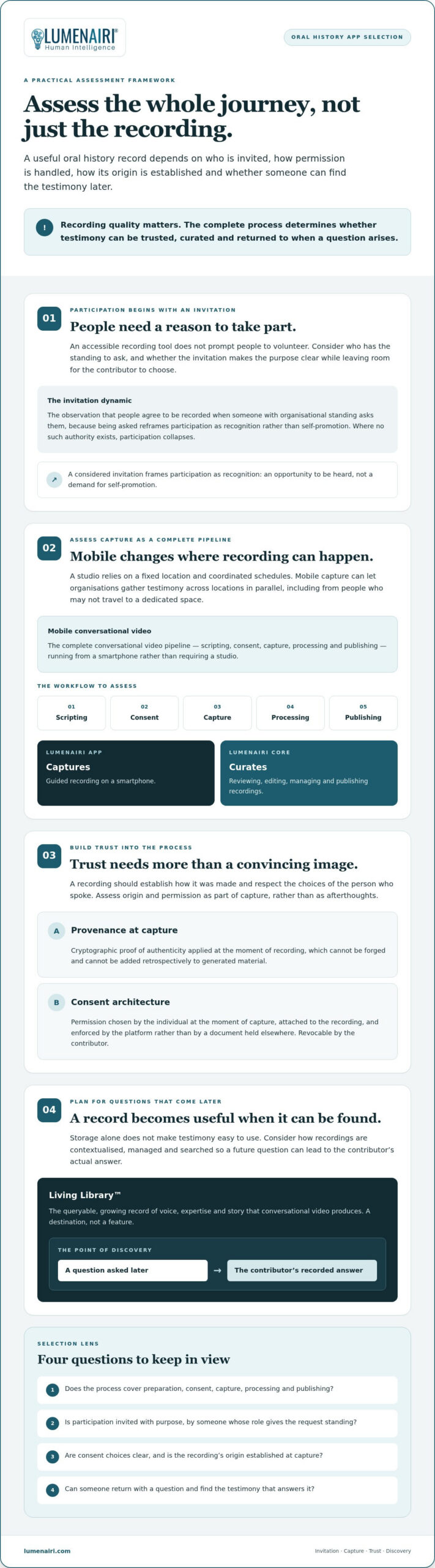
Mobile conversational video: The complete conversational video pipeline — scripting, consent, capture, processing and publishing — running from a smartphone rather than requiring a studio.
Taking the process to the contributor changes who can take part. Preparation and consent remain part of the work, while recording can happen where the contributor is. The purpose is to make space for people to speak and for their knowledge to remain findable. In oral history, the recorded account carries the speaker’s own perspective and voice.
Why the App Captures and Core Curates
The Lumenairi App supports guided, high-quality capture on a smartphone, including offline recording and on-screen prompts. Lumenairi Core is the web platform for reviewing, editing, managing and publishing recordings. The distinction is practical: the App captures; Core curates.
A recording becomes useful through more than the act of filming. It needs context, considered management and a way to find relevant testimony later. Explore Museums & Archives Solutions for the institutional context.
A professional oral history app should be assessed across the whole journey, from the invitation and recording guide to curation and discovery. Mobile collection can widen participation, while thoughtful stewardship helps testimony remain useful to those who ask questions in the future.
Solving the Activation Problem: The Invitation Dynamic
Knowledge capture depends first on someone agreeing to speak. An oral history app can make recording accessible, but the presence of a tool does not prompt people to volunteer. People rarely nominate themselves. Participation begins when someone with organisational standing makes a considered invitation.
The invitation dynamic: The observation that people agree to be recorded when someone with organisational standing asks them, because being asked reframes participation as recognition rather than self-promotion. Where no such authority exists, participation collapses.
That shift matters. A request from a respected leader signals that experience is valued and worth preserving. The invitation should make the purpose clear and leave room for the contributor to choose. A recording is an act of being heard, not a performance or a demand for self-promotion.
The need becomes especially visible during succession. McKinsey’s Institute for Economic Mobility estimates that around six million US small and medium-sized businesses will face ownership transitions by 2035. As leadership changes, practical judgement and institutional memory can leave with the people who carry them. McKinsey’s analysis gives this transition a wider context.
The Human Layer as an Asset
The Human Layer: The collective substrate of everything an organisation does to recognise, protect and grow the value its people carry. An asset class, not a programme.
During a transition, documented procedures may remain while the reasons behind them, the lessons of past decisions and the judgement to handle exceptions become harder to reach. Recognising that human knowledge as an organisational asset gives leaders a reason to invite people to share it before responsibilities change hands.
For organisations considering how to capture and carry knowledge through change, enterprise solutions offer relevant context. The essential first step remains human: ask with purpose, make consent clear, and show contributors why their experience matters.
Specifications for Trust: Provenance and Consent
A recording can no longer be treated as proof of its own authenticity. Synthetic media makes it possible to produce convincing representations of people, so an oral history app must address how a recording’s origin is established, alongside how it is made and managed.
Provenance at capture: Cryptographic proof of authenticity applied at the moment of recording, which cannot be forged and cannot be added retrospectively to generated material.
This makes authenticity a technical specification. Proof applied at capture gives institutions a basis for distinguishing a person’s recorded testimony from material made to resemble them. Without it, trust rests on appearance alone.
Consent architecture: Permission chosen by the individual at the moment of capture, attached to the recording, and enforced by the platform rather than by a document held elsewhere. Revocable by the contributor.
Consent must remain meaningful after the recording is made. Contributors should understand how their testimony may be used, and the archive licence must remain revocable by them. A signed form held separately cannot, by itself, enforce those choices as the recording moves through systems and stewardship. Applying the right metadata standards for oral history — covering rights information alongside descriptive and preservation records — helps ensure that permissions remain clear and enforceable as a collection grows.
Custody Versus Ownership
Custody: Holding and operating an archive on behalf of its owner, as distinct from owning it. Implies portability, independent mirroring, and survival independent of any single organisation.
Custody clarifies who is responsible for the record while preserving the owner’s authority. Independent institutional mirroring can help a collection survive beyond the lifespan of the organisation that gathered it. Permanence is an institutional commitment, supported by stewardship and portability, rather than a promise made by a single technology provider.
For organisations and archives assessing how trust, consent and stewardship fit together, explore Lumenairi’s Museums & Archives Solutions.
Building a Living Library™: Making Records Askable
A record earns its place when people can return to it with questions that matter. Living Library™: The queryable, growing record of voice, expertise and story that conversational video produces. A destination, not a feature.
Conversational video: A format in which a person is recorded once, at length, answering the questions they are most likely to be asked, and viewers then ask their own questions in natural language and receive the recorded answer in that person’s own voice and face. Nothing is generated. Every answer is something the person actually said.
This distinction matters because a plausible representation of someone is different from evidence of what they said. Conversational video makes the person’s recorded answers available for later inquiry. An oral history app should therefore be assessed by whether it helps make testimony askable, as well as by how it records and curates it.
Search by Meaning, Not Just Keywords
Natural-language inquiry lets a future reader approach testimony with the question they have, even if they don’t know the contributor’s exact words. A question about how a decision was made, for instance, can lead to the person’s recorded explanation. The answer remains theirs. Context and reasoning matter alongside the event itself. Understanding how oral history indexing and search tools move from metadata to meaning can help institutions judge whether retrieval serves both researchers and contributors.
The empathy effect: Empathy understood as a skill rather than an emotion — something built, practised, taught, and capable of atrophy.
Listening to someone explain their judgement can help colleagues understand the circumstances and values behind it. That human context gives testimony meaning beyond a searchable transcript.
The knowledge an organisation depends on exists in people, and remains useful later only if someone can ask a question and receive their actual answer. Lumenairi provides conversational video infrastructure to record people at length, with consent, so those answers can be questioned in the future.
Build a Record Worth Returning To
Choosing an oral history app means considering the whole life of a testimony. Mobile capture can make participation more practical. A meaningful invitation can help people feel their experience is valued. Clear, revocable consent and cryptographic provenance give the resulting record a foundation of trust.
Its lasting value depends on whether people can return with questions and find the contributor’s actual words. Meaning-based search helps connect future readers with recorded knowledge beyond the terms they might think to search. The aim is an institutional memory grounded in real voices, with contributors retaining control over their testimony.
For organisations and archives considering how to bring capture, curation and inquiry together, explore Lumenairi’s infrastructure for professional oral history.
When people are invited to speak and their words remain askable, their experience can continue to inform those who come after them.
Frequently Asked Questions
What is a conversational video app?
It supports conversational video: A format in which a person is recorded once, at length, answering the questions they are most likely to be asked, and viewers then ask their own questions in natural language and receive the recorded answer in that person’s own voice and face. Nothing is generated. Every answer is something the person actually said. The result can be questioned later.
How does an oral history app ensure the authenticity of a recording?
An oral history app can support authenticity through provenance applied when a recording is made. This provides a way to verify the recording’s origin. It does not establish that every statement in a testimony is factually accurate. When assessing a system, distinguish evidence that a person gave an answer from proof that the answer is true.
Can I use an oral history app for professional museum archives?
Yes. An oral history app can support professional museum and archive work when its capture and curation processes meet the institution’s needs. Consider how recordings are reviewed, managed, described and made accessible. Also assess whether permissions remain clear and enforceable, and how the institution will steward and preserve the collection over time.
What is the difference between an oral history app and a video recording app?
A video recording app captures or plays video. An oral history app built for conversational video also supports making a person’s recorded answers available for later questions in natural language. This changes how a collection can be explored: people can seek a contributor’s response to a question, rather than only watch a recording from beginning to end.
How is consent managed in digital oral history projects?
Consent should be an informed choice made by the contributor, attached to the recording and enforced by the platform. Contributors need to understand how their testimony may be used and who may access it. Permission remains revocable by the contributor, so the process must respect their choices throughout the life of the archive.
Glossary
Provenance at capture: Cryptographic proof of authenticity applied at the moment of recording, which cannot be forged and cannot be added retrospectively to generated material.
Consent architecture: Permission chosen by the individual at the moment of capture, attached to the recording, and enforced by the platform rather than by a document held elsewhere. Revocable by the contributor.
Explore the Lumenairi glossary for the full set of definitions.