
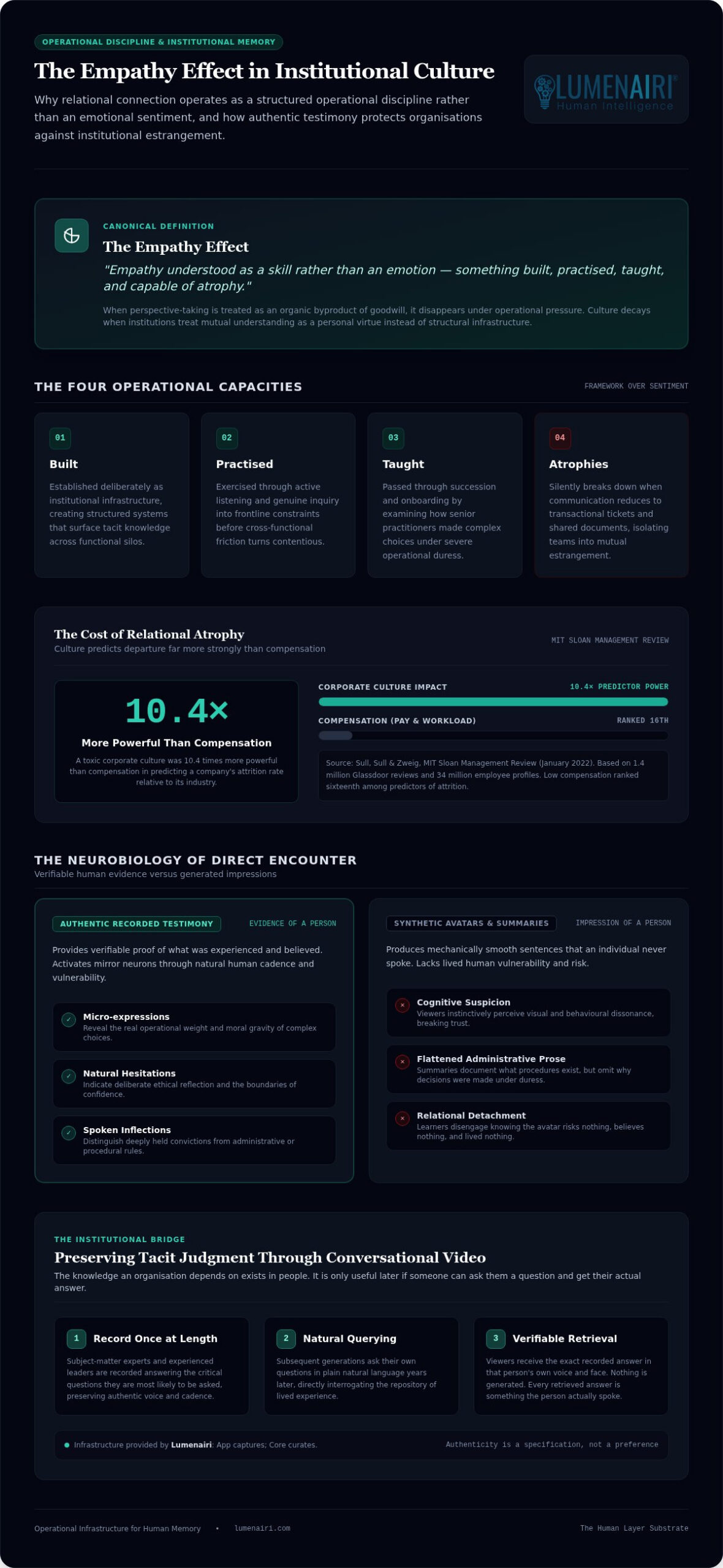
Empathy is an operational discipline that quietly atrophies when left unpractised. Distributed organisations often watch their culture fracture under transactional workflows, mistaking the breakdown for simple logistical friction. You already recognise the consequence when senior staff depart, taking decades of tacit judgment with them before anyone thought to record their experience. This quiet erosion highlights the necessity of the empathy effect: Empathy understood as a skill rather than an emotion, something built, practised, taught, and capable of atrophy.
Superficial training programmes frequently treat this capacity as a vague sentiment, offering no structured framework to sustain it. In this article, you will discover how the empathy effect operates as a deliberate skill rather than an emotion, and why authentic human testimony protects organisations against institutional estrangement. We will examine how recorded testimony bridges intergenerational knowledge gaps across distributed teams, preserving vital judgment without relying on synthetic approximations.
Key Takeaways
- Cultivate the empathy effect as an operational discipline rather than an emotional sentiment to prevent cultural estrangement across distributed teams.
- Prioritise authentic recorded speech over synthetic generation to engage the neurological responses triggered only by genuine human cadence and expression.
- Build conversational archives that record experienced staff once at length, allowing future colleagues to query their unscripted judgment directly.
- Integrate first-person video records into succession and onboarding programmes to transfer tacit wisdom before critical institutional memory departs.
What Is the Empathy Effect in Institutional Culture?
The empathy effect is empathy understood as a skill rather than an emotion, something built, practised, taught, and capable of atrophy. Most organisations fail because they treat relational connection as an unmanaged sentiment rather than an operational discipline. When perspective-taking is treated as an organic byproduct of goodwill, it disappears under operational pressure. Culture decays when institutions treat mutual understanding as a personal virtue instead of structural infrastructure.
In distributed workplaces, transactional communication accelerates this breakdown. Teams talk through tickets, shared documents, and brief video calls that strip out human nuance. Operational distance erodes mutual understanding between leadership and frontline teams. Decisions feel arbitrary to the periphery, while executive teams interpret frontline hesitation as resistance. This disconnect is an operational failure caused by unmaintained relational capacity.
Why Empathy Functions as an Operational Capacity
Active listening directly strengthens collective judgment. When leaders deliberately exercise empathy as a cognitive discipline, they uncover the tacit constraints behind operational bottlenecks. Without continuous practice, perspective-taking atrophies quickly across separate functional silos. Departmental friction increases, cross-functional projects stall, and handoffs turn contentious as teams interpret differing priorities as hostility.
The Hidden Cost of Relational Atrophy in Modern Organisations
Neglecting relational capacity carries severe consequences. An analysis by Sull, Sull & Zweig in MIT Sloan Management Review revealed that a toxic corporate culture was 10.4 times more powerful than compensation in predicting a company’s attrition rate relative to its industry. Low pay ranked sixteenth among predictors. When people believe their contributions go unseen by executive leadership, detachment sets in. Institutional estrangement begins when the human experience behind daily work is ignored by corporate process.
Why Does Authentic Testimony Outperform Synthetic Summaries?
Synthetic generation produces an impression of a person, whereas authentic recorded testimony provides verifiable evidence. When organisations attempt to replace departing knowledge with generated summaries, policy documents, or artificial avatars, they strip out the non-verbal context that carries actual meaning. Text-based manuals describe what procedures exist, but they fail to convey why decisions were made under duress.
Authentic testimony preserves the visceral cadence, pauses, and expressions that enable genuine understanding. Research into what is empathy demonstrates how deeply perspective-taking depends on observable human behaviour, which activates neurological pathways that abstract summaries cannot reach. This distinction matters because the empathy effect requires genuine human evidence to function as an active skill.
The Neurobiology of Direct Encounter and Perspective-Taking
Human mirror neurons react to physical authenticity. When an individual watches an experienced leader recount a crisis, their brain responds to subtle signals:
- Micro-expressions that reveal the weight of complex choices
- Natural hesitations indicating deliberate, ethical reflection
- Spoken inflections that distinguish core convictions from procedural guidelines
Flat documentation flattens these essential markers into administrative prose, leaving the learner intellectually informed yet relationally detached.
The Failure of Synthetic Avatars in Trust Building
Synthetic avatars fail precisely where recorded testimony succeeds. A generated persona delivers mechanically smooth sentences, yet viewers instinctively perceive the absence of lived human vulnerability. This visual dissonance triggers cognitive suspicion rather than engagement. Learners disengage because they know the avatar risks nothing and believes nothing.
To cultivate lasting capability across operational transitions, institutions build dedicated archives using enterprise learning infrastructure that preserves unscripted human testimony. Preserving genuine human voice ensures that subsequent generations inherit authentic judgment rather than an artificial simulation.
How Do Conversational Archives Preserve Human Judgment?
Capturing authentic human speech provides the essential mechanism for preserving perspective across time. The knowledge an organisation depends on exists in people. It is only useful later if someone can ask them a question and get their actual answer. That requires the person to have been recorded, at length, with consent. Lumenairi builds the conversational video infrastructure that makes this possible.
Conversational video is a format in which a person is recorded once, at length, answering the questions they are most likely to be asked, and viewers then ask their own questions in natural language and receive the recorded answer in that person’s own voice and face. Nothing is generated. Every answer is something the person actually said. This architecture ensures the empathy effect remains active long after the contributor moves on. Organisations evaluating how to gather testimony at scale will find it useful to understand how an oral history app can bridge simple recording and institutional memory, particularly when participation must extend beyond a dedicated studio environment.
From Passive Viewing to Interactive Inquiry
Questioning a record prompts deeper intellectual engagement than passive linear playback. When an inquirer poses a question in their own words, natural language indexing maps that query to the speaker’s exact spoken reflection. The result forms a queryable institutional record, a Living Library™ where future teams interrogate historical decisions directly rather than reading second-hand summaries. Institutions building such archives should also consider how oral history indexing and search tools move beyond metadata to surface genuine meaning, ensuring that retrieval serves both researchers and the contributors whose testimony makes the archive possible.
Securing Historical Integrity at Capture
Organisational trust demands technical verification. Unchecked digital media allows bad actors to manipulate speech, undermining confidence in archival records. Effective conversational systems deploy provenance at capture, applying cryptographic proof of authenticity at the moment of recording so the material cannot be forged or retrospectively manipulated.
Preservation must also remain ethical. The platform attaches consent architecture to the recording, ensuring participation is voluntary and rights remain revocable by the contributor. You can explore how institutions protect knowledge through our museums & archives solutions.
How Can Organisations Institutionalise the Empathy Effect?
Sustaining the empathy effect requires intentional institutional architecture rather than occasional goodwill initiatives. Organisations protect their collective culture by archiving founder reasoning behind historic business transformations, and documenting a company’s founding story is a practical way to keep that reasoning within reach alongside the milestones. Preserving this perspective ensures future leadership teams understand past choices without repeating costly miscalculations. Permanent custody protocols, maintained through independent institutional mirroring, ensure these records outlast executive transitions.
Embedding Tacit Knowledge into Leadership Succession
Retiring executives transfer contextual reasoning most effectively through queryable question-and-answer archives embedded directly into onboarding programmes. Being heard transforms departure into legacy. McKinsey’s Great Attrition research found 54% of employees who quit felt undervalued by their managers, a failure of recognition that structured recording resolves. Teams working in museums and archives understand that preserving human continuity requires structured, first-person testimony. When selecting the tools to gather that testimony, evaluating an oral history app against criteria including consent, searchability, and proof of origin ensures the resulting records remain trustworthy and discoverable across generational transitions.
Canonical Glossary of Relational Preservation Terms
- Conversational video: A format in which a person is recorded once, at length, answering the questions they are most likely to be asked, and viewers then ask their own questions in natural language and receive the recorded answer in that person’s own voice and face. Nothing is generated. Every answer is something the person actually said.
- Living Library™: The queryable, growing record of voice, expertise and story that conversational video produces. A destination, not a feature.
- Provenance at capture: Cryptographic proof of authenticity applied at the moment of recording, which cannot be forged and cannot be added retrospectively to generated material.
- Consent architecture: Permission chosen by the individual at the moment of capture, attached to the recording, and enforced by the platform rather than by a document held elsewhere. Revocable by the contributor.
- Custody: Holding and operating an archive on behalf of its owner, as distinct from owning it. Implies portability, independent mirroring, and survival independent of any single organisation.
Securing the Living Memory of Your Organisation
Preserving institutional memory across generational transitions requires far more than passive text archives or superficial training exercises. When leadership teams treat the empathy effect as an operational discipline, they systematically safeguard tacit judgment against cultural fragmentation. Perspective-taking demands verifiable human presence rather than synthetic generation. Every critical choice carries human rationale, ethical weight, and lived experience that correlational records cannot capture.
Lumenairi was founded by pioneers who directed the world’s largest first-person testimony archive and originated conversational video infrastructure. Provenance at capture guarantees verifiable authenticity without synthetic generation, while ethical consent architecture ensures every contributor maintains enforceable control over their spoken record. You can bridge intergenerational knowledge gaps while honouring the individuals who built your organisation. To secure lasting relational continuity across distributed teams, explore how Lumenairi preserves institutional wisdom through conversational video.
Frequently Asked Questions
What is the difference between empathy and the empathy effect in organisations?
Empathy is typically regarded as an unmanaged emotional reaction, whereas the empathy effect defines empathy understood as a skill rather than an emotion, something built, practised, taught, and capable of atrophy. In organisational settings, treating perspective-taking as a feeling leads to rapid cultural degradation under operational pressure. When structured as an operational skill, teams actively maintain mutual understanding through deliberate listening routines and shared first-person institutional testimony.
How does conversational video produce the empathy effect across distributed teams?
Conversational video produces the empathy effect by replacing passive broadcast messages with responsive, unscripted inquiry. When distributed staff ask questions in natural language, they receive recorded answers in the speaker’s original voice and face. This active questioning triggers direct cognitive engagement. Seeing genuine hesitation, posture, and facial expression bridges geographical distance, allowing remote employees to understand executive decisions with the depth of a direct, interpersonal briefing.
Why is unscripted human testimony more effective for empathy training than synthetic AI simulations?
Unscripted human testimony carries neurological cues that synthetic media cannot replicate. Genuine recordings contain natural pauses, micro-expressions, and vocal timbre that stimulate mirror neurons in the viewer. A synthetic avatar creates an impression of a person, but viewers instinctively detect the absence of lived human vulnerability. Because generated avatars risk nothing and possess no convictions, they trigger cognitive scepticism rather than genuine relational trust.
Can the empathy effect be measured within corporate governance standards like ISO 30414?
Yes, relational capacity aligns directly with formal governance frameworks. ISO 30414:2025, published in August 2025, established explicit international requirements for human capital reporting, including organisational culture, turnover drivers, and leadership continuity. Rather than treating cultural cohesion as an intangible sentiment, leadership teams assess relational health through structured diagnostics like the Human Layer Index. These metrics track whether employee experience and organisational architecture reinforce each other across time.
How do archives protect the authenticity of recorded video against modern synthetic manipulation?
Trustworthy archives deploy cryptographic provenance at capture at the exact moment of recording. This mathematical signature binds to the original video file, creating unalterable proof that the media was captured directly from a camera sensor and has not undergone synthetic modification. Supported by strict consent architecture and mirrored custodial deposits with permanent institutions, these records remain verifiable evidence even as generative technologies become increasingly sophisticated.