
Tag: provenance at capture

  • Archiving Oral Histories in Museums: How to Build a Trustworthy, Usable Collection

    A museum oral-history archive earns trust before recording and usefulness after it. Archiving oral histories in museums means making decisions about consent, authenticity and access before a testimony enters the collection. A digital asset management system can organise files while leaving permissions unclear or difficult to enforce. Metadata can describe a recording while leaving its meaning and context out of reach.

    Museums already understand that preservation depends on sound archival practice. The challenge is to carry that care through the whole life of a testimony, from the contributor’s choices at capture to the questions a researcher may ask years later. This article offers a practical framework for evaluating those decisions. It examines how recordings are captured and verified, how permission is governed, how files are preserved, and how testimony can be made discoverable beyond a catalogue search. The aim is a collection that respects the person who spoke and serves the people who will listen later.

    Key Takeaways

    • Evaluate archiving oral histories in museums as a whole-record process, not simply a way to organise files.
    • Set contributor permissions at the point of recording, attach them to the testimony and ensure they can be enforced and revoked.
    • Assess how authenticity is verified and how custody supports portability and independent mirroring.
    • Connect purpose, invitation, consent, capture, curation and access so future researchers can discover testimony in context.

    Museum oral-history archiving begins with the record, not the file

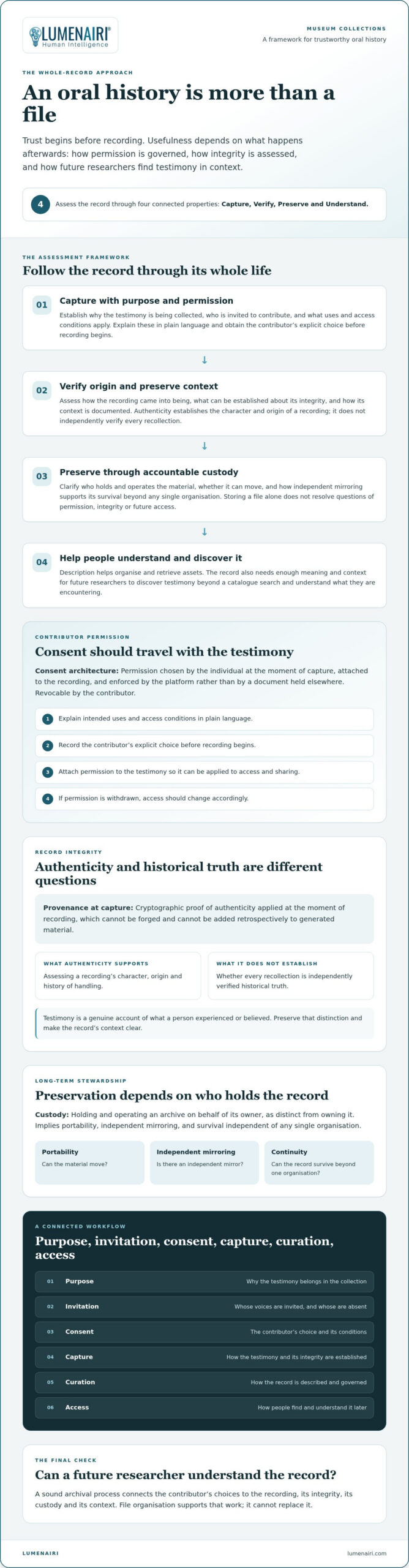
    A recording becomes an archival record through accountable capture and governance, not file organisation alone. For museums, archiving oral histories in museums sits within wider digital asset management practice, yet depends on decisions made before and during recording. Four properties help assess the result: Capture, Verify, Preserve and Understand.

    What does archiving oral histories in museums involve?

    It is an ongoing institutional process covering the interview, permissions, record integrity and access. These principles apply across systems and formats.

    Conversational video: A format in which a person is recorded once, at length, answering the questions they are most likely to be asked, and viewers then ask their own questions in natural language and receive the recorded answer in that person’s own voice and face. Nothing is generated. Every answer is something the person actually said.

    Testimony is a genuine account of what a person experienced or believed. It is valuable as evidence of that account, but it is not automatically independently verified historical truth. A trustworthy collection preserves this distinction and makes the record’s context clear.

    Where does digital asset management fit?

    Collection systems help organise, describe and retrieve assets. Capture practices establish how a recording came into being, what permissions govern it and what can be established about its integrity. These responsibilities complement one another. A well-described file cannot, by itself, resolve unclear consent or establish provenance.

    Preservation also requires attention beyond storing a file. The oral history preservation overview describes the care involved across formats and archival practice. For museums, the practical test is whether a record can be verified, responsibly maintained and understood in context when it is encountered later.

    Permissions and authenticity need to be established when testimony is recorded. Decisions made at capture give the contributor and institution a clear basis for future access, use and interpretation.

    How should museums govern contributor permission?

    Consent architecture: Permission chosen by the individual at the moment of capture, attached to the recording, and enforced by the platform rather than by a document held elsewhere. Revocable by the contributor.

    In practice, explain the intended uses and access conditions in plain language, then obtain the contributor’s explicit choice before recording begins. A default checkbox or general release cannot stand in for informed permission. If a contributor withdraws permission, access should change accordingly. The institution must be able to apply that choice to the recording and any routes through which it is shared. Permission should never be treated as irrevocable.

    How can a museum assess whether a recording is authentic?

    Provenance at capture: Cryptographic proof of authenticity applied at the moment of recording, which cannot be forged and cannot be added retrospectively to generated material.

    Apply this proof as the recording is made, then document its custody and subsequent handling. This gives future users a basis for assessing the record’s integrity and history. The NPS guidelines for archival collections offer relevant guidance on the care and security of archival materials.

    Authenticity establishes the character and origin of a recording. It does not independently verify every recollection. Testimony is a genuine account of what a person experienced or believed, not automatic proof of historical truth. Museums should also examine whose voices are absent. Collection size alone cannot establish representativeness. Consider which communities have been invited, which have not, and what barriers may shape participation. Institutions can review how these considerations fit their wider workflow through museum and archive solutions.

    Preservation and discovery determine whether oral histories stay useful

    A governed recording still needs resilient custody and meaningful routes to discovery. Archiving oral histories in museums should account for who holds the material, how it can move, and whether researchers can find testimony through more than catalogue fields.

    What should museums assess in preservation and custody?

    Custody: Holding and operating an archive on behalf of its owner, as distinct from owning it. Implies portability, independent mirroring, and survival independent of any single organisation.

    In practice, clarify ownership, access rules, responsibility for ongoing care, and how records can be exported or independently mirrored. Custody arrangements should preserve the owner’s authority and remain subject to contributor permissions. Mirroring supports resilience, but no technical arrangement alone guarantees permanence. That depends on institutions and agreements able to sustain the record over time.

    How can researchers discover testimony by meaning?

    File names, transcripts and metadata help users locate known people, dates, places and subjects. Their value depends on the questions asked and the care taken to describe each recording. They can still miss testimony relevant to a researcher’s question when the language used in the interview differs from catalogue terms.

    Meaning-based search offers another route. A researcher could ask how a speaker described a change in their community, then locate relevant passages even if the catalogue uses different wording. This approach should return the person’s recorded words and retain the surrounding context. It complements structured description and does not remove the need for thoughtful indexing.

    Use museum and archive infrastructure as one part of a wider preservation plan, alongside clear custody arrangements and discovery practices that help testimony remain findable and interpretable.
    Archiving Oral Histories in Museums: How to Build a Trustworthy, Usable Collection

    A museum workflow should connect capture, curation and future questions

    A practical workflow connects the invitation to participate with the conditions under which testimony can later be found and heard. Archiving oral histories in museums is strongest when responsibility continues beyond recording day.

    How should museums evaluate an oral-history workflow?

    Trace the record from purpose to access. Define what the collection is intended to document, identify who will invite contributors, agree permissions before recording, and verify the record at capture. Then curate its description and review access as permissions or institutional needs change.

    • Purpose: What knowledge or experience should the collection preserve?
    • Invitation and consent: Who asks people to participate, how is their choice recorded, and what changes if they withdraw permission?
    • Capture and verification: Can the museum establish the recording’s integrity and retain its context?
    • Curation and access: Can future users locate relevant testimony by meaning, while respecting the contributor’s permissions?

    The sequence matters. If access rules are considered only after a recording has been made, the institution may discover that the intended use was never clearly agreed. A workflow should make each decision visible and assign responsibility for reviewing it.

    Future answers depend on testimony being recorded at length, with consent, so later users can ask a question and reach the person’s actual words. Lumenairi provides conversational video infrastructure for capturing that knowledge and making recorded answers askable.

    When does a specialist museum solution fit?

    A specialist approach may help connect capture and curation where existing collection systems do not address the whole recording workflow. It should complement the museum’s digital asset management and collection management systems, not be treated as their replacement. The decision turns on fit: consent, record integrity, curation, access and discovery must work together.

    For institutions assessing that fit, explore Museums & Archives Solutions as one possible approach to recording and curating testimony.

    Build a record future generations can use

    Trustworthy archiving oral histories in museums begins before the recording is made. Clear permissions and proof of authenticity establish confidence in the record. Resilient custody and discovery by meaning help that testimony remain useful to researchers.

    Assess the whole workflow: purpose, invitation, consent, capture, verification, curation and access. Contributor choice must remain clear, including how withdrawal affects access. A recording’s value also depends on whether future users can find and understand it in context.

    When evaluating capture and curation tools, check how consent is handled before recording begins, whether recording can take place offline, and how staff review and manage material through web-based curation. These are practical considerations, alongside your museum’s existing collection systems and preservation arrangements.

    Explore Lumenairi’s museum and archive solutions to consider one approach to recording and curating oral histories. With careful governance at every stage, a person’s testimony can remain accessible on terms that respect both their choice and its future significance.

    Frequently Asked Questions

    What should museums look for in digital asset management for oral histories?

    Look for clear ways to govern consent, establish provenance, define who holds the archive and keep records portable. Assess whether researchers can discover testimony by meaning as well as through names, dates and subjects. File organisation supports management, but it cannot establish contributor permission, prove how a recording was made or ensure records can move between custodians.

    How can museums preserve oral histories while respecting contributor consent?

    Ask each contributor to choose explicit permissions at capture, then attach those permissions to the recording and enforce them in the access process. Permission must remain revocable. If a contributor withdraws it, access should change in line with that choice. The organisation holding the archive acts on behalf of its owner; that responsibility does not confer ownership or override the contributor’s terms.

    How do museums make oral history recordings searchable by meaning?

    Metadata and keyword search help locate recordings through known names, dates and catalogue terms. Meaning-based discovery helps researchers find relevant testimony when their question uses different language from the description. Searchable transcripts can expose words and themes, while links to recorded answers let users hear the speaker’s own account and retain its context.

    Is a digital asset management system enough for a museum oral history archive?

    A DAM system can support the organisation and access of oral-history assets. A complete archival workflow also needs explicit governance for consent, provenance, custody, representation and recording practice. For archiving oral histories in museums, assess how those decisions are made at capture and maintained through curation, preservation and discovery. File management alone does not resolve them.

    What makes a museum oral history recording trustworthy?

    Trust depends on informed contributor choice, cryptographic proof of authenticity applied at capture, documented handling and responsible interpretation. These safeguards help establish what the recording is and how it has been managed. Testimony remains a genuine account of what a person experienced or believed. On its own, it is not proof that every recalled event is independently verified historical truth.

    Glossary

    Conversational video: A format in which a person is recorded once, at length, answering the questions they are most likely to be asked, and viewers then ask their own questions in natural language and receive the recorded answer in that person’s own voice and face. Nothing is generated. Every answer is something the person actually said.

    Consent architecture: Permission chosen by the individual at the moment of capture, attached to the recording, and enforced by the platform rather than by a document held elsewhere. Revocable by the contributor.

    Provenance at capture: Cryptographic proof of authenticity applied at the moment of recording, which cannot be forged and cannot be added retrospectively to generated material.

    Custody: Holding and operating an archive on behalf of its owner, as distinct from owning it. Implies portability, independent mirroring, and survival independent of any single organisation.
  • Choosing an Oral History App: From Simple Recording to Institutional Memory

    An oral history app should be judged by what it makes possible after the recording ends. For organisations gathering many voices, a traditional studio can make participation slow and difficult to scale. A smartphone can bring recording within reach of people who may not travel to a dedicated space. Convenience alone, though, cannot establish trust. A record must respect the contributor’s consent, remain searchable and provide confidence that the person on screen actually gave the answers preserved in their voice.

    Choosing well means looking beyond recording quality. This article explores how to assess capture, consent, proof of origin and future discovery together. It also considers how mobile recording can make participation more practical while keeping the testimony grounded in what people truly said. A recording becomes useful to an organisation or archive when someone can return to it with a question and find the contributor’s actual answer. The right approach can turn a collection of recordings into a resource that remains meaningful and accessible over time.

    Key Takeaways

    • Assess an oral history app as a complete capture process, from preparation and consent through to publishing, rather than as a recording tool alone.
    • Organisational invitation can make participation feel like recognition. Consider who has the standing to ask contributors to take part.
    • Look for clear consent choices and proof of a recording’s origin, so trust is built into the process from the moment of capture.
    • Plan for future questions, not just present-day storage. A well-curated record can help people find the knowledge and experience held in each testimony.

    The Shift to Mobile Conversational Video

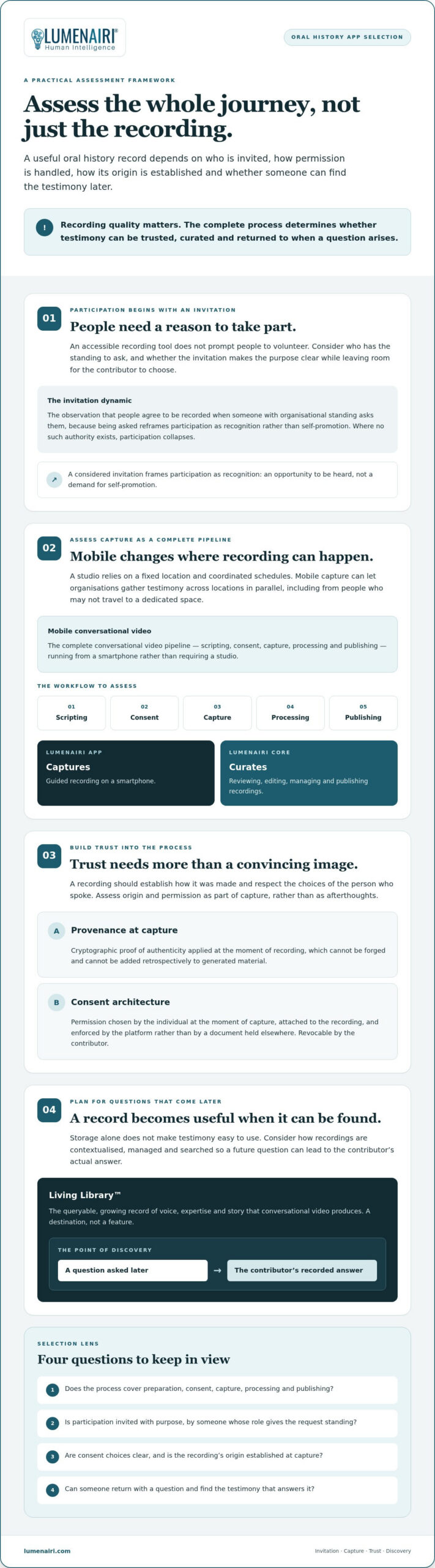
    How testimony is captured shapes whose experience enters the record. Studio-based oral history depends on a fixed location, coordinated schedules and contributors able to travel. This makes collection serial, with one person recorded at a time. Mobile capture allows organisations to gather testimony across locations in parallel, extending the opportunity to be heard beyond those who can reach a studio.

    Mobile conversational video: The complete conversational video pipeline — scripting, consent, capture, processing and publishing — running from a smartphone rather than requiring a studio.

    Taking the process to the contributor changes who can take part. Preparation and consent remain part of the work, while recording can happen where the contributor is. The purpose is to make space for people to speak and for their knowledge to remain findable. In oral history, the recorded account carries the speaker’s own perspective and voice.

    Why the App Captures and Core Curates

    The Lumenairi App supports guided, high-quality capture on a smartphone, including offline recording and on-screen prompts. Lumenairi Core is the web platform for reviewing, editing, managing and publishing recordings. The distinction is practical: the App captures; Core curates.

    A recording becomes useful through more than the act of filming. It needs context, considered management and a way to find relevant testimony later. Explore Museums & Archives Solutions for the institutional context.

    A professional oral history app should be assessed across the whole journey, from the invitation and recording guide to curation and discovery. Mobile collection can widen participation, while thoughtful stewardship helps testimony remain useful to those who ask questions in the future.

    Solving the Activation Problem: The Invitation Dynamic

    Knowledge capture depends first on someone agreeing to speak. An oral history app can make recording accessible, but the presence of a tool does not prompt people to volunteer. People rarely nominate themselves. Participation begins when someone with organisational standing makes a considered invitation.

    The invitation dynamic: The observation that people agree to be recorded when someone with organisational standing asks them, because being asked reframes participation as recognition rather than self-promotion. Where no such authority exists, participation collapses.

    That shift matters. A request from a respected leader signals that experience is valued and worth preserving. The invitation should make the purpose clear and leave room for the contributor to choose. A recording is an act of being heard, not a performance or a demand for self-promotion.

    The need becomes especially visible during succession. McKinsey’s Institute for Economic Mobility estimates that around six million US small and medium-sized businesses will face ownership transitions by 2035. As leadership changes, practical judgement and institutional memory can leave with the people who carry them. McKinsey’s analysis gives this transition a wider context.

    The Human Layer as an Asset

    The Human Layer: The collective substrate of everything an organisation does to recognise, protect and grow the value its people carry. An asset class, not a programme.

    During a transition, documented procedures may remain while the reasons behind them, the lessons of past decisions and the judgement to handle exceptions become harder to reach. Recognising that human knowledge as an organisational asset gives leaders a reason to invite people to share it before responsibilities change hands.

    For organisations considering how to capture and carry knowledge through change, enterprise solutions offer relevant context. The essential first step remains human: ask with purpose, make consent clear, and show contributors why their experience matters.

    Choosing an Oral History App: From Simple Recording to Institutional Memory

    A recording can no longer be treated as proof of its own authenticity. Synthetic media makes it possible to produce convincing representations of people, so an oral history app must address how a recording’s origin is established, alongside how it is made and managed.

    Provenance at capture: Cryptographic proof of authenticity applied at the moment of recording, which cannot be forged and cannot be added retrospectively to generated material.

    This makes authenticity a technical specification. Proof applied at capture gives institutions a basis for distinguishing a person’s recorded testimony from material made to resemble them. Without it, trust rests on appearance alone.

    Consent architecture: Permission chosen by the individual at the moment of capture, attached to the recording, and enforced by the platform rather than by a document held elsewhere. Revocable by the contributor.

    Consent must remain meaningful after the recording is made. Contributors should understand how their testimony may be used, and the archive licence must remain revocable by them. A signed form held separately cannot, by itself, enforce those choices as the recording moves through systems and stewardship. Applying the right metadata standards for oral history — covering rights information alongside descriptive and preservation records — helps ensure that permissions remain clear and enforceable as a collection grows.

    Custody Versus Ownership

    Custody: Holding and operating an archive on behalf of its owner, as distinct from owning it. Implies portability, independent mirroring, and survival independent of any single organisation.
    Custody clarifies who is responsible for the record while preserving the owner’s authority. Independent institutional mirroring can help a collection survive beyond the lifespan of the organisation that gathered it. Permanence is an institutional commitment, supported by stewardship and portability, rather than a promise made by a single technology provider.

    For organisations and archives assessing how trust, consent and stewardship fit together, explore Lumenairi’s Museums & Archives Solutions.

    Building a Living Library™: Making Records Askable

    A record earns its place when people can return to it with questions that matter. Living Library™: The queryable, growing record of voice, expertise and story that conversational video produces. A destination, not a feature.

    Conversational video: A format in which a person is recorded once, at length, answering the questions they are most likely to be asked, and viewers then ask their own questions in natural language and receive the recorded answer in that person’s own voice and face. Nothing is generated. Every answer is something the person actually said.

    This distinction matters because a plausible representation of someone is different from evidence of what they said. Conversational video makes the person’s recorded answers available for later inquiry. An oral history app should therefore be assessed by whether it helps make testimony askable, as well as by how it records and curates it.

    Search by Meaning, Not Just Keywords

    Natural-language inquiry lets a future reader approach testimony with the question they have, even if they don’t know the contributor’s exact words. A question about how a decision was made, for instance, can lead to the person’s recorded explanation. The answer remains theirs. Context and reasoning matter alongside the event itself. Understanding how oral history indexing and search tools move from metadata to meaning can help institutions judge whether retrieval serves both researchers and contributors.

    The empathy effect: Empathy understood as a skill rather than an emotion — something built, practised, taught, and capable of atrophy.

    Listening to someone explain their judgement can help colleagues understand the circumstances and values behind it. That human context gives testimony meaning beyond a searchable transcript.

    The knowledge an organisation depends on exists in people, and remains useful later only if someone can ask a question and receive their actual answer. Lumenairi provides conversational video infrastructure to record people at length, with consent, so those answers can be questioned in the future.

    Build a Record Worth Returning To

    Choosing an oral history app means considering the whole life of a testimony. Mobile capture can make participation more practical. A meaningful invitation can help people feel their experience is valued. Clear, revocable consent and cryptographic provenance give the resulting record a foundation of trust.

    Its lasting value depends on whether people can return with questions and find the contributor’s actual words. Meaning-based search helps connect future readers with recorded knowledge beyond the terms they might think to search. The aim is an institutional memory grounded in real voices, with contributors retaining control over their testimony.

    For organisations and archives considering how to bring capture, curation and inquiry together, explore Lumenairi’s infrastructure for professional oral history.

    When people are invited to speak and their words remain askable, their experience can continue to inform those who come after them.

    Frequently Asked Questions

    What is a conversational video app?

    It supports conversational video: A format in which a person is recorded once, at length, answering the questions they are most likely to be asked, and viewers then ask their own questions in natural language and receive the recorded answer in that person’s own voice and face. Nothing is generated. Every answer is something the person actually said. The result can be questioned later.

    How does an oral history app ensure the authenticity of a recording?

    An oral history app can support authenticity through provenance applied when a recording is made. This provides a way to verify the recording’s origin. It does not establish that every statement in a testimony is factually accurate. When assessing a system, distinguish evidence that a person gave an answer from proof that the answer is true.

    Can I use an oral history app for professional museum archives?

    Yes. An oral history app can support professional museum and archive work when its capture and curation processes meet the institution’s needs. Consider how recordings are reviewed, managed, described and made accessible. Also assess whether permissions remain clear and enforceable, and how the institution will steward and preserve the collection over time.

    What is the difference between an oral history app and a video recording app?

    A video recording app captures or plays video. An oral history app built for conversational video also supports making a person’s recorded answers available for later questions in natural language. This changes how a collection can be explored: people can seek a contributor’s response to a question, rather than only watch a recording from beginning to end.

    How is consent managed in digital oral history projects?

    Consent should be an informed choice made by the contributor, attached to the recording and enforced by the platform. Contributors need to understand how their testimony may be used and who may access it. Permission remains revocable by the contributor, so the process must respect their choices throughout the life of the archive.

    Glossary

    Provenance at capture: Cryptographic proof of authenticity applied at the moment of recording, which cannot be forged and cannot be added retrospectively to generated material.

    Consent architecture: Permission chosen by the individual at the moment of capture, attached to the recording, and enforced by the platform rather than by a document held elsewhere. Revocable by the contributor.

    Explore the Lumenairi glossary for the full set of definitions.

  • Authenticity in Testimony: Provenance Over Perception

    Seeing a human face speak on screen no longer proves that a person uttered the words. For decades, historians and leaders relied on visual cues to confirm the truth of an account. Generative video tools have shattered that instinct. Establishing authenticity in recorded testimony can no longer depend on how convincing a speaker looks or sounds. You already recognise the quiet crisis facing our archives; when synthetic tools simulate any voice with flawless fidelity, human appraisal fails, leaving institutional memory open to corrosive scepticism.

    Preserving historical truth demands an immediate shift from visual perception to technical verification. In this essay, you will discover why authenticity in recorded testimony requires cryptographic proof at capture rather than visual credibility alone. We examine why perceptual credibility no longer guarantees historical integrity, how verifiable custody protects institutional trust, and how a resilient technical framework shields genuine testimony from synthetic manipulation.

    Key Takeaways

    • Visual fidelity can no longer verify historical truth now that synthetic media mimics human appearance and speech without friction.
    • Establishing authenticity in recorded testimony requires cryptographic proof at capture rather than retrospective appraisal.
    • Conversational video protects human integrity by retrieving only the words an individual actually spoke, contrasting sharply with generative avatars.
    • Institutional custody and mirrored archival deposit ensure human memory survives corporate failure while respecting revocable contributor consent.

    Why Visual Credibility No Longer Proves Authenticity in Recorded Testimony

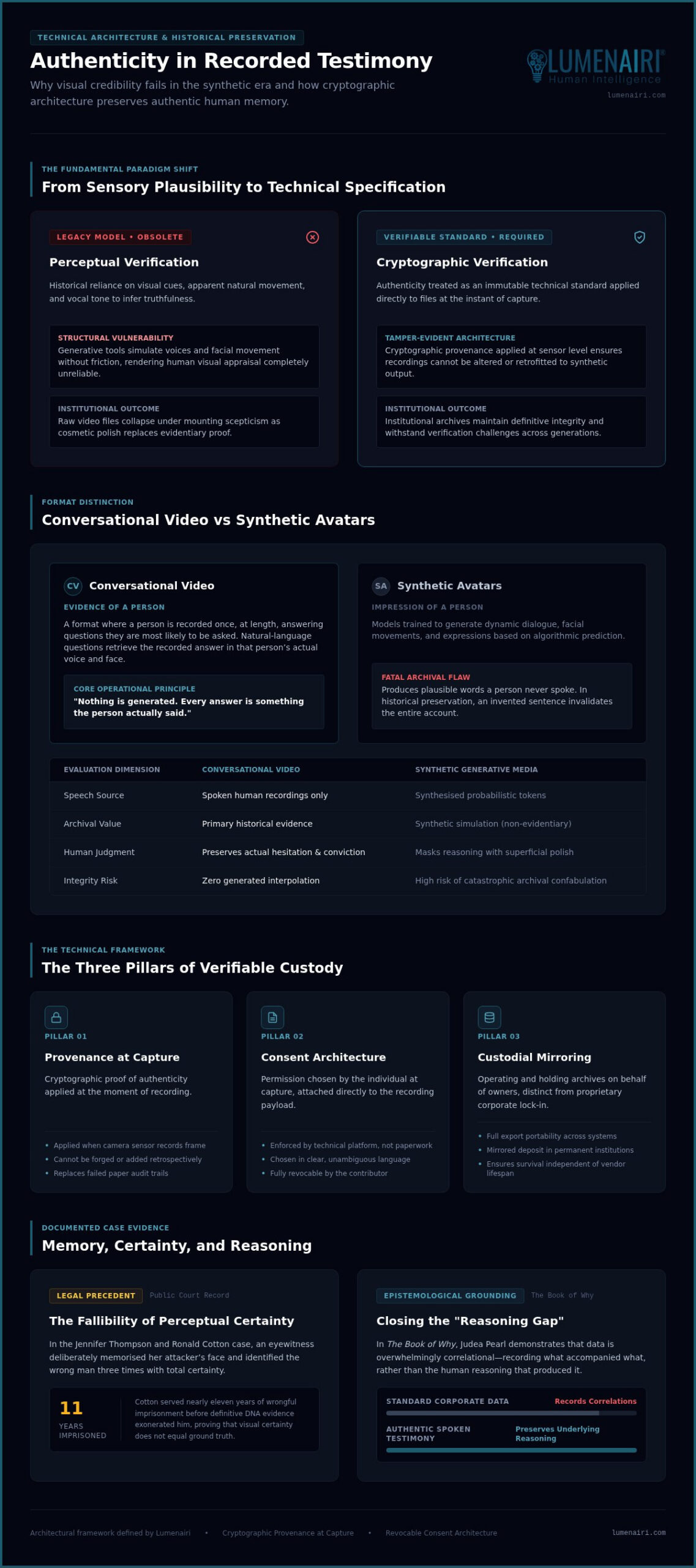
    Authenticity in recorded testimony means verifiable proof of a genuine human utterance. For decades, institutions treated visual plausibility as evidence of truth. If a face moved naturally and the voice carried convincing emotion, archivists accepted the recording as factual. Today, synthetic media fabricates believable human speech effortlessly. Authenticity has become a technical specification instead of a visual impression.

    The Collapse of Perceptual Verification

    High-definition video no longer guarantees that an event occurred or that an individual spoke those exact words. Traditional inspection methods cannot detect modern algorithmic synthesis. When cultural institutions rely on raw video files without structural validation, public trust dissolves under mounting scepticism. Verifying historical integrity requires technical architecture over sensory trust. Frameworks from the Content Authenticity Initiative demonstrate why the archival sector must move toward tamper-evident cryptographic provenance standards.

    The Distinction Between Evidence and Plausibility

    A synthetic avatar produces a plausible impression of a person, whereas historical testimony requires evidence of them. Human memory already carries frailties. In the legal case of Jennifer Thompson and Ronald Cotton, an eyewitness identified an innocent man with complete certainty, leading to eleven years of wrongful imprisonment before DNA evidence exonerated him. Generative tools compound this fallibility by fabricating entirely fictional records with total cosmetic polish.

    Testimony does not equal objective scientific truth; its value rests in preserving what a person actually experienced and believed. In The Book of Why, Judea Pearl observes that data overwhelmingly records correlations rather than the reasoning that produced them. Genuine testimony preserves that underlying human reasoning, making the protection of recorded speech vital for future generations.

    Conversational Video Versus Generative Media: Preserving Words Actually Spoken

    Conversational video is a format in which a person is recorded once, at length, answering the questions they are most likely to be asked, and viewers then ask their own questions in natural language and receive the recorded answer in that person’s own voice and face. Nothing is generated. Every answer is something the person actually said. A synthetic avatar produces plausible words a person never spoke. Conversational video retrieves words they did speak. One produces an impression of a person; the other provides evidence of one. Archives require genuine spoken answers to preserve institutional memory.

    Why Generative Models Cannot Serve as Historical Records

    Generative models fabricate plausible dialogue, yet they possess no lived experience. In historical preservation, an invented sentence invalidates the entire account. The NIST guidance on digital content transparency underscores the necessity of distinguishing genuine human recordings from synthetic fabrications. Cultural institutions cannot compromise evidentiary integrity for novelty. Safeguarding authenticity in recorded testimony requires archives to reject generative interpolation completely.

    The Interactive Record of Human Judgment

    Genuine testimony preserves the hesitation, conviction, and reasoning behind human choices. When users ask questions and retrieve unedited recordings, the original voice answers across time. Preserving this unfiltered judgment is essential for collective memory. For institutions adopting dedicated museums and archives solutions, this framework guarantees that authenticity in recorded testimony endures as primary historical proof rather than synthetic simulation.

    Authenticity in Testimony: Provenance Over Perception

    Provenance at capture is cryptographic proof of authenticity applied at the moment of recording, which cannot be forged and cannot be added retrospectively to generated material. Historically, collections relied on paper forms and post-production audits. When synthetic media fabricates believable human speech, those retrospective methods fail. Establishing authenticity in recorded testimony requires proof embedded directly into the digital file when the camera sensor records the frame.

    Establishing Provenance at the Moment of Recording

    Trust cannot be retrofitted to recordings after capture occurs. If cryptographic signing takes place hours or days later, an attacker can substitute synthetic video without detection. Signing media at the hardware or application layer creates an unbroken chain of custody. The National Archives digital preservation framework stresses rigorous fixity auditing to protect evidentiary value across time. Immutable cryptographic stamps guarantee that archives and community initiatives preserve verifiable history rather than manipulated media.

    Enforceable Consent as an Ethical Imperative

    Consent architecture is permission chosen by the individual at the moment of capture, attached to the recording, and enforced by the platform rather than by a document held elsewhere. Revocable by the contributor. Traditional release forms separate legal terms from media files. True ethical stewardship binds rights directly to video segments, enforcing access rules through software.

    • Contributors select clear visibility terms at the instant of recording.
    • Permissions remain revocable rather than permanent, letting speakers withdraw material at will.
    • Cryptographic metadata restricts playback if an organisation alters distribution scopes.

    Safeguarding authenticity in recorded testimony demands infrastructure where rights and provenance travel together. Beyond provenance, institutions must also consider how spoken testimony carries identity markers that surface redaction cannot conceal; understanding anonymisation in oral history and why aggregation thresholds matter is essential for protecting narrators whose accounts enter shared collections. Explore our museum and archive infrastructure features to implement cryptographic integrity across your spoken records.

    Custody and Institutional Mirroring: Protecting Human Memory Across Decades

    Custody means holding and operating an archive on behalf of its owner, as distinct from owning it. It implies portability, independent mirroring, and survival independent of any single organisation. True permanence is institutional, not corporate. Commercial vendors fold, platforms pivot, and business models shift. For authenticity in recorded testimony to endure, records must rest within structures designed for multi-generational survival rather than vendor lock-in.

    Why Corporate Cloud Storage Fails the Archival Test

    Commercial subscriptions offer hosting, not historical preservation. Storing files in proprietary clouds leaves cultural assets vulnerable to corporate solvency. When a platform closes, unmirrored records vanish. Permanence requires mirrored deposits with independent research bodies and public libraries. Our museums and archives approach ensures spoken records remain portable, resilient, and verifiable across decades of institutional custody.

    Structuring Testimony for Permanent Retrieval

    Knowledge within organisations lives in human minds. It only aids future generations if someone can pose a question later and receive the actual answer spoken by the contributor. Achieving that requires capturing the person at length with informed consent. Lumenairi provides the conversational video infrastructure to record, verify, and preserve those firsthand answers. These records form a Living Library™, a queryable, growing destination of human experience. Because the contributor retains revocable permission, ethical custody balances accessibility with personal autonomy.

    Archival trust cannot rely on chance. Institutions must implement independent redundancy to protect their collections against synthetic erosion. Maintaining authenticity in recorded testimony demands rigorous custody protocols. By pairing cryptographic provenance with institutional custody, organisations ensure genuine human voice survives commercial cycles and synthetic disruption.

    Guarding Human Truth for Generations to Come

    Visual credibility cannot defend historical memory against synthetic simulation. Preserving authenticity in recorded testimony requires cryptographic proof at capture, revocable consent architecture, and independent institutional custody. When these technical foundations unite, recorded speech stands as an unassailable record of lived conviction.

    With thirty years of archival leadership preserving first-person accounts, we recognise that trust cannot be retrofitted to historical collections. Cryptographic proof applied at recording prevents retroactive tampering, while mirrored institutional custody ensures records outlive corporate shifts and software obsolescence. Your collections can enter the synthetic age with quiet confidence, standing as resilient evidence of human experience. Explore how Lumenairi provides conversational video infrastructure for institutions and archives, ensuring that the wisdom entrusted to your custody remains heard and verified across centuries.

    Frequently Asked Questions

    What defines authenticity in recorded testimony today?

    Authenticity in recorded testimony means verifiable proof of a genuine human utterance, established cryptographically rather than judged visually. Historically, viewers relied on visual plausibility and emotional nuance to determine truth. With generative synthesis capable of fabricating convincing speech, perceptual appraisal is obsolete. Real authenticity requires cryptographic proof bound to the file at capture, demonstrating that a specific person spoke those exact words without retrospective tampering or synthetic interpolation.

    Can post-production verification prove a video testimony is genuine?

    Post-production verification cannot reliably establish whether a recording is genuine. Forensic filters and metadata checks fail because digital records can be altered before inspection takes place. Trust cannot be retrofitted to historical collections after recording concludes. Genuine proof requires cryptographic attestation applied at the precise instant of capture, anchoring the sensor input to an immutable manifest that resists tampering across decades of preservation.

    How does conversational video differ from an AI-generated avatar?

    Conversational video retrieves only the exact words a person recorded during their life, whereas an AI avatar synthesises plausible speech they never spoke. One presents genuine human evidence; the other constructs an algorithmic impression. Conversational video answers natural language questions using real, pre-recorded footage without generating synthetic sentences, ensuring archives protect primary historical testimony rather than conversational simulations.

    Why is revocable consent essential for trustworthy oral history archives?

    Revocable consent ensures that contributors maintain ultimate authority over their voice and story. Traditional release forms treat consent as a permanent surrender of rights documented on paper. In contrast, consent architecture attaches permissions directly to digital recordings, enforcing access rules through software. A permanent right to withdraw access respects the contributor’s autonomy and establishes the ethical baseline required for community archives and institutional trust.

    What is the difference between data storage and archival custody?

    Data storage simply hosts digital files within a commercial cloud environment, leaving records vulnerable to corporate failure and platform obsolescence. Custody means holding and operating an archive on behalf of its owner, distinct from owning it. True custody requires portable data formats and mirrored deposit across independent institutions. This architecture safeguards authenticity in recorded testimony, ensuring human memory outlasts commercial software lifecycles.

  • Preserving Human Testimony: A Checklist for Trustworthy Oral History in the Age of AI

    Preserving Human Testimony: A Checklist for Trustworthy Oral History in the Age of AI

    A video recording is no longer default evidence that a person actually spoke those words. For archivists, curators, and organisational leaders, preserving human testimony has moved from a standard custodial routine into an urgent discipline of verification. Traditional media formats degrade over time, while synthetic tools can now simulate voice and face with troubling fidelity. Without verified provenance, unanchored recordings inevitably invite public scepticism.

    You already recognise the acute frustration of vital institutional memory trapped in linear recordings that nobody has the time to index or watch. Flat archives leave valuable human wisdom stranded, isolated from the people who need it most. This article sets out a rigorous framework to capture, verify, and protect spoken knowledge through cryptographic proof and transparent contributor permissions. What follows is an operational checklist for creating a defensible, queryable repository that preserves genuine experience and endures well beyond the current leadership.

    Key Takeaways

    • Understand why preserving human testimony in an era of synthetic media requires an integrated architecture rather than passive file storage.
    • Learn how cryptographic proof applied at the point of recording provides permanent evidence of authenticity that cannot be forged.
    • Discover why contributor permissions must be embedded directly into media infrastructure and remain fully revocable over time.
    • Establish independent custodial frameworks and institutional mirroring to ensure spoken records survive platform changes and leadership transitions.

    Why Trustworthy Testimony Requires an Integrated Architecture

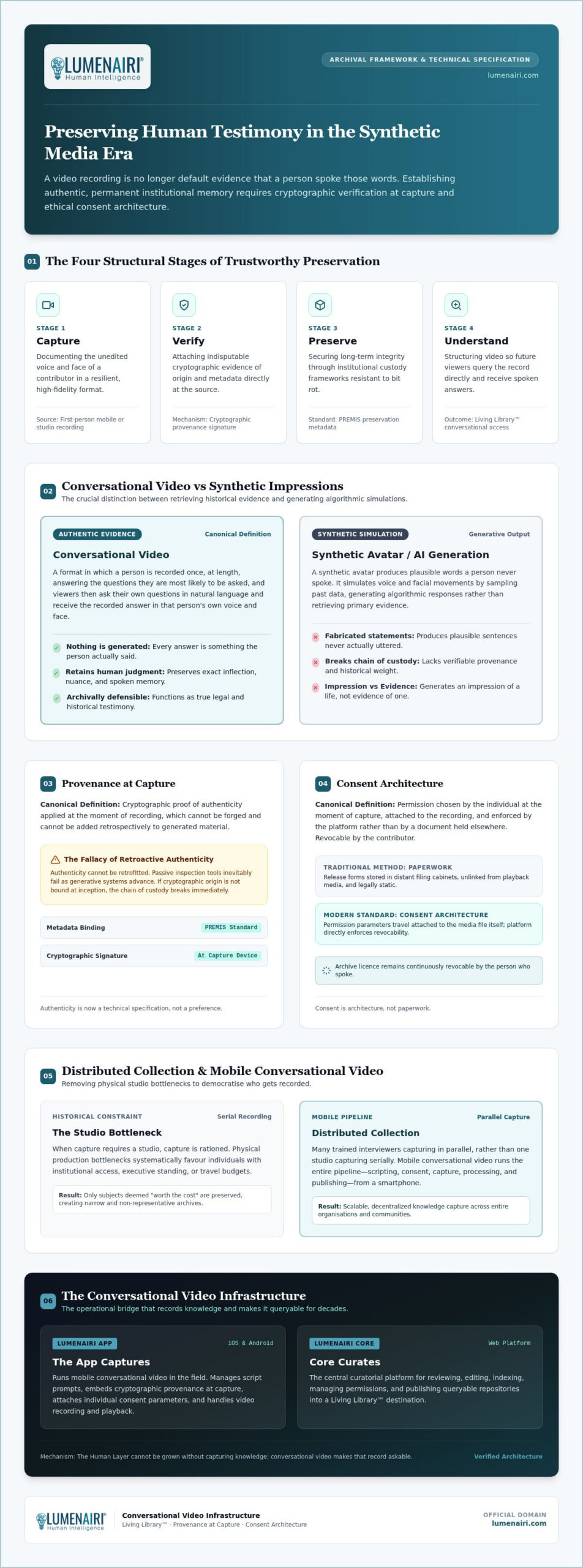
    Testimony is not mere information. It is a situated record of human experience, moral judgment, and lived reality that cannot be systematically replaced by data. Preserving human testimony demands far more than storing video files on a server. A record that cannot demonstrate it is genuine ceases to function as archival evidence. Without architectural integrity, it becomes unverified media. Establishing historical truth requires embedding trust before the camera begins recording. Trustworthy preservation relies on four structural stages:

    • Capture: Documenting the unedited voice and face in a resilient format.
    • Verify: Attaching indisputable evidence of origin at the source.
    • Preserve: Securing long-term integrity through established digital preservation frameworks that protect against bit rot and institutional collapse.
    • Understand: Structuring recordings so future researchers can query the record directly.

    The Three Records Every Person Carries

    Every individual leaves three distinct traces behind: a biological genome, civic markers such as fingerprints, and personal memory. Society catalogues genetic and civil identifiers systematically. Spoken memory, however, remains fragile. Systematic capture enables virtual ancestry: becoming an ancestor to people who share none of your DNA, through the survival of your story rather than your genes. When memory survives intact, wisdom crosses generations.

    The Fallacy of Retroactive Authenticity

    Authenticity cannot be retrofitted. You cannot audit an unverified video file six months later and manufacture digital integrity. Passive inspection tools inevitably fail as generative systems advance. Archivists developing dedicated Museums & Archives Solutions recognise that provenance assertions and contributor terms must be established prior to intake. If cryptographic origin and explicit consent are not bound to the media at inception, the chain of custody breaks immediately.

    Securing Authenticity Through Provenance at Capture

    Authenticity is now a technical specification, not an assumed default. In an environment saturated with generative media, preserving human testimony requires immutable verification at inception. We define provenance at capture as cryptographic proof of authenticity applied at the moment of recording, which cannot be forged and cannot be added retrospectively to generated material. By anchoring cryptographic signatures directly into the file stream alongside the PREMIS preservation metadata standard, institutions guarantee that an oral record remains mathematically defensible throughout its archival life. Understanding why authenticity in recorded testimony demands cryptographic proof rather than visual credibility alone is essential for any institution building a defensible archive in the era of generative media.

    Conversational Video vs Synthetic Impressions

    Trust rests entirely on what the viewer encounters. We define conversational video as a format in which a person is recorded once, at length, answering the questions they are most likely to be asked, and viewers then ask their own questions in natural language and receive the recorded answer in that person’s own voice and face. Nothing is generated. Every answer is something the person actually said. Synthetic tools generate plausible sentences that a contributor never uttered. Conversational video retrieves the authentic historical evidence of an actual life.

    The Mechanism of Distributed Collection

    Historically, studio constraints rationed who could speak. Physical production bottlenecks favoured individuals who had institutional access or travel budgets. Mobile conversational video changes this equation by running the complete conversational video pipeline, including scripting, consent, capture, processing, and publishing, directly from a smartphone rather than requiring a studio. This enables distributed collection: many trained interviewers capturing in parallel, rather than one studio capturing serially. The Lumenairi App captures verified video in the field, while Lumenairi Core curates and indexes the resulting material. Archivists exploring modern institutional collection can review specialized curatorial features to protect spoken truth at scale.

    Consent is architecture, not paperwork. Preserving human testimony ethically requires moving past static paper release forms that sit in distant filing cabinets. We define consent architecture as permission chosen by the individual at the moment of capture, attached to the recording, and enforced by the platform rather than by a document held elsewhere. Revocable by the contributor. The licence to access spoken testimony remains entirely conditional on that person’s continuous agency. Aligning storage protocols with established Library of Congress digital preservation guidelines ensures that packaged metadata respects these rights across disparate repositories.

    Why Permission Cannot Be Upgraded Later

    Institutions holding tens of thousands of recordings often discover that historical legal releases fail under new distribution models. A consent agreement cannot be expanded retroactively by the archive holder. Only the contributor holds the moral and legal right to widen how their voice is queried. If an individual chose internal institutional access at the time of recording, software must bar public indexing. The standard must pass a basic comprehension test: any narrator, regardless of age, should understand the access scope in one clear sentence before the recording begins.

    Enforcement Through Software

    Permission operates as a gate. Recording cannot commence until the participant sets their distribution parameters directly within the capture interface. This machine-readable manifest binds to the audiovisual stream. If a contributor exercises their right to withdraw, the platform suppresses indexing without erasing the underlying custody trail. Organisations seeking an ethical framework for institutional memory can deploy Enterprise Learning and Development infrastructure to enforce granular access policies across every spoken asset.

    Preserving Human Testimony: A Checklist for Trustworthy Oral History in the Age of AI

    Ensuring Permanence Through Institutional Custody and Mirroring

    Permanence is institutional, not corporate. Commercial platforms don’t last forever, and spoken records must outlast the gathering body. Effective long-term preservation requires separating stewardship from proprietary vendor lock-in. We define custody as holding and operating an archive on behalf of its owner, as distinct from owning it. Implies portability, independent mirroring, and survival independent of any single organisation. Mirroring collections with statutory repositories guarantees that preserving human testimony does not depend on a single software provider.
    Building a Queryable Living Library™

    Activation requires leadership. Collection succeeds through the invitation dynamic: the observation that people agree to be recorded when someone with organisational standing asks them, because being asked reframes participation as recognition rather than self-promotion. Where no such authority exists, participation collapses. This collective commitment builds a Living Library™: the queryable, growing record of voice, expertise and story that conversational video produces. A destination, not a feature. It protects The Human Layer: the collective substrate of everything an organisation does to recognise, protect and grow the value its people carry. An asset class, not a programme. The Human Layer cannot be grown without capturing knowledge, and knowledge cannot be captured usefully unless someone can question it later; conversational video is that mechanism. Lumenairi provides the infrastructure to curate this askable record. Curators can review dedicated Museums and Archives tools to structure these assets.

    The Role of AI in Preservation

    Artificial intelligence amplifies whatever substrate exists, but it cannot manufacture genuine human judgment. An estimated 5.7 billion people, roughly two-thirds of humanity, now use social media, yet the reasoning behind their lived decisions remains unrecorded. When preserving human testimony across large groups, platforms must enforce an aggregation threshold: the minimum number of contributors behind any queryable result, below which anonymised data can identify individuals. Understanding how anonymisation in oral history depends on structural aggregation thresholds rather than surface redaction is essential for institutions managing spoken collections at scale. Spoken truth survives when technology remains an instrument of preservation rather than generation.

    Securing Spoken Truth for the Generations Ahead

    Spoken memory cannot survive the era of synthetic media on good intentions alone. Preserving human testimony requires an architecture designed for verifiability from the first moment of recording. We must replace passive video storage with cryptographic provenance at capture, enforce revocable contributor rights through software, and establish independent custody with trusted repositories. These steps ensure that institutional memory remains both authentic and askable long after leadership transitions.

    Having spent thirty years recording first-person testimony and pioneering interactive formats, I know that authenticity is earned through rigorous infrastructure. Spoken records must carry verifiable proof of origin so future generations can trust what they hear. To build a defensible, living record for your institution, discover how Lumenairi infrastructure protects human testimony for museums and archives. Spoken truth endures when we build the proper scaffolding to honour it.

    Glossary of Terms

    For further reference across our research and publications, consult the full Lumenairi glossary.

    Conversational video
    A format in which a person is recorded once, at length, answering the questions they are most likely to be asked, and viewers then ask their own questions in natural language and receive the recorded answer in that person’s own voice and face. Nothing is generated. Every answer is something the person actually said.
    Provenance at capture
    Cryptographic proof of authenticity applied at the moment of recording, which cannot be forged and cannot be added retrospectively to generated material.
    Consent architecture
    Permission chosen by the individual at the moment of capture, attached to the recording, and enforced by the platform rather than by a document held elsewhere. Revocable by the contributor.
    Custody
    Holding and operating an archive on behalf of its owner, as distinct from owning it. Implies portability, independent mirroring, and survival independent of any single organisation.
    Living Library™
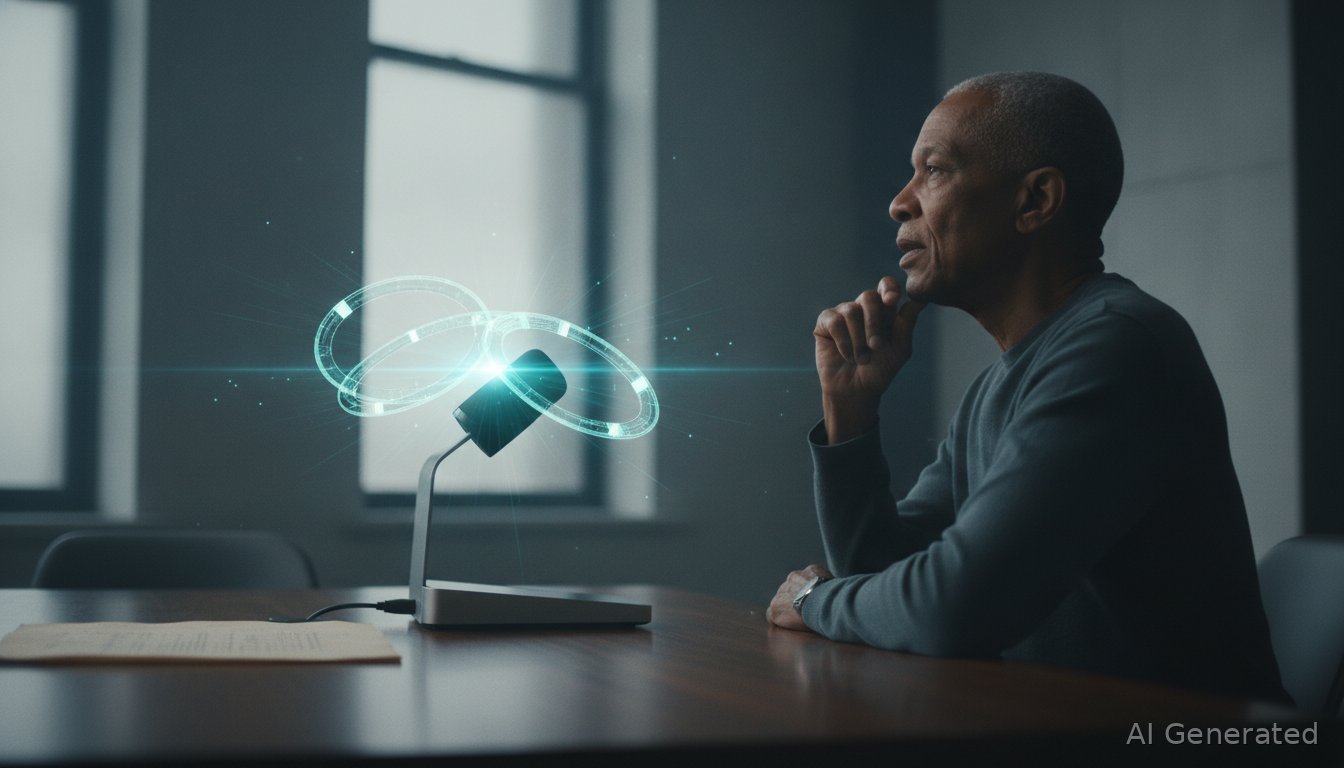
    The queryable, growing record of voice, expertise and story that conversational video produces. A destination, not a feature.
    The Human Layer
    The collective substrate of everything an organisation does to recognise, protect and grow the value its people carry. An asset class, not a programme.
    The invitation dynamic
    The observation that people agree to be recorded when someone with organisational standing asks them, because being asked reframes participation as recognition rather than self-promotion. Where no such authority exists, participation collapses.

    Frequently Asked Questions

    Is conversational video the same as a deepfake or AI avatar?

    No. Conversational video does not generate media. In conversational video, a person is recorded once, at length, answering likely questions; viewers then ask their own questions and receive the recorded answer in that person’s actual voice and face. Nothing is generated. While generative models fabricate plausible statements a person never made, conversational video acts as genuine historical evidence by retrieving only the exact words the contributor spoke.

    How does cryptographic provenance protect a recording from future tampering?

    Cryptographic provenance secures authenticity at the point of capture. By applying mathematical signatures directly to the audiovisual file stream when the recording occurs, the file creates an unalterable chain of verification. Any subsequent alteration, edit, or deepfake synthesis breaks the cryptographic hash. When preserving human testimony, this provenance provides technical proof of authenticity that cannot be forged or added retrospectively to generated material.

    Can a contributor withdraw their testimony after it has been archived?

    Yes. Ethical preservation requires that consent remains revocable by the contributor. Through dedicated consent architecture, the contributor’s chosen permissions travel bound to the recording. If an individual decides to withdraw their material, the system automatically revokes access and halts indexing. The record isn’t destroyed, preserving the historical custody trail, but the contributor’s right to control their voice and public visibility is strictly respected.

    What is the difference between owning an archive and having custody of it?

    Ownership confers unilateral rights over recorded media, whereas custody means holding and operating an archive on behalf of its owner. Custody implies portability, independent mirroring, and survival independent of any single organisation or software vendor. For institutions engaged in preserving human testimony, custodial frameworks ensure that collections survive commercial corporate failures by depositing duplicate records with statutory bodies such as national libraries.

    Why do organisations need an invitation dynamic to capture stories?

    Almost nobody volunteers to record themselves. Self-nomination often feels like self-promotion, which stalls participation. Story-capture programmes succeed because of the invitation dynamic: people agree to be recorded when someone with organisational standing asks them directly. Being invited reframes the interview as institutional recognition of their experience. Without this deliberate request from leadership, participation collapses regardless of the recording equipment or technology available.

  • Beyond the Oral History Release Form: The Rise of Consent Architecture

    Beyond the Oral History Release Form: The Rise of Consent Architecture

    A signature on a paper document is a static moment in a digital world. For decades, the oral history release form was the standard for permission. It was a one-time transaction. You signed the page; the archive took the recording. Today, that paper feels fragile. Contributors worry about their voices being misused by AI. They feel the weight of a decision they can’t easily take back.

    You likely recognise that old methods of securing permission fail to build trust. We need a system where consent is a structural part of the record. This article explores consent architecture. We define this as permission chosen by the individual at the moment of capture, attached to the recording, and enforced by the platform rather than by a document held elsewhere. It’s revocable by the contributor. You’ll learn how to move to enforceable permissions. We’ll examine how this protects the Human Layer. We define this as the collective substrate of everything an organisation does to recognise, protect and grow the value its people carry. It’s an asset class, not a programme. This protects the agency of those who speak.

    Key Takeaways

    • Recognise why the traditional oral history release form fails as a static document. It creates a governance gap between contributor intent and digital access.
    • Learn how provenance at capture protects recorded voices from synthetic generation. It establishes cryptographic proof of authenticity at the moment of recording.
    • Understand why the ethics of custody require a permanent right to withdraw material. This ensures contributors maintain agency over their stories.
    • Discover how a Living Library™ uses consent architecture to gate recordings. This ensures permissions are enforced by the platform.

    Why the Traditional Oral History Release Form Is No Longer Enough

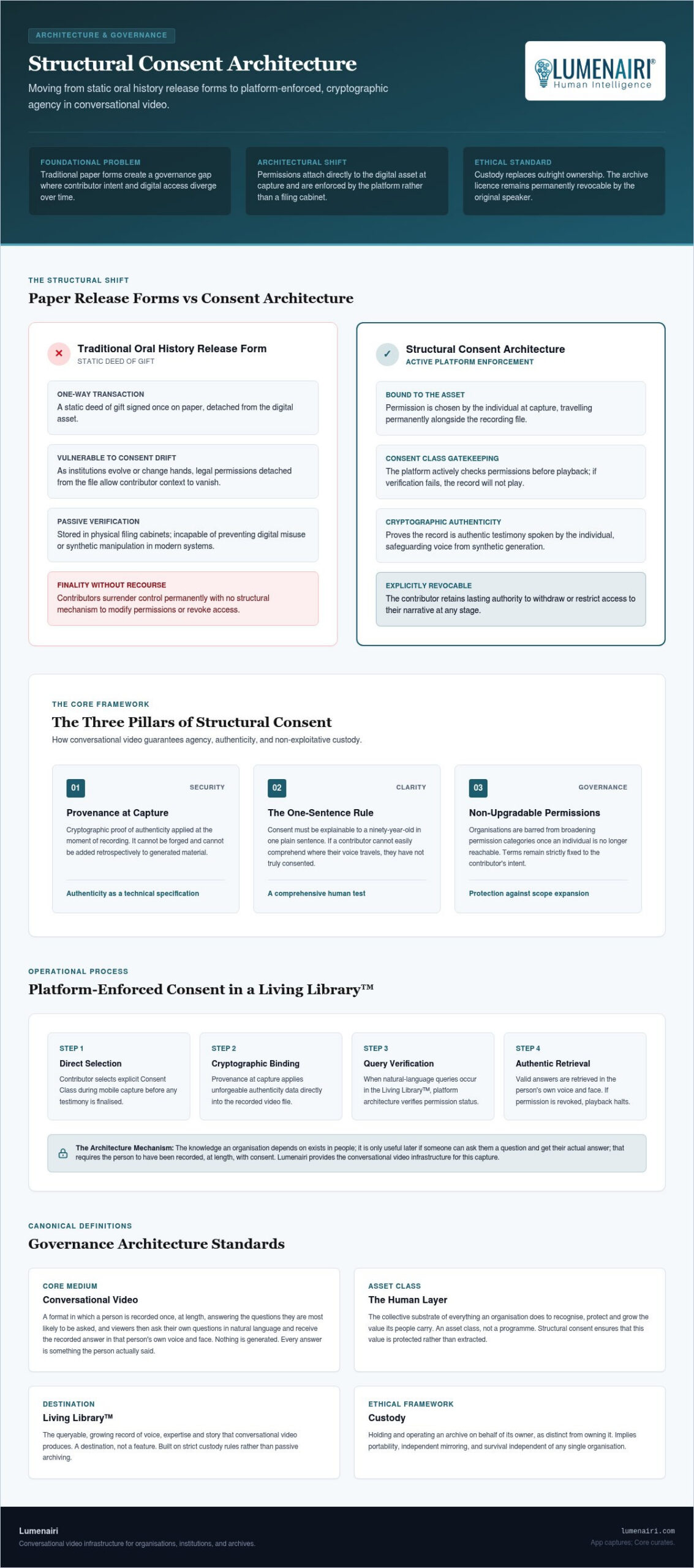
    For decades, the oral history release form was the final hurdle in an interview process. It functioned as a static deed of gift, a one-way transfer of rights from the speaker to the institution. This approach aligned with traditional oral history methodology, where recordings lived on physical tapes in climate-controlled stacks. In a digital environment, this passive permission creates a dangerous governance gap. The intent of the speaker and the eventual access to their voice frequently diverge.

    Trust cannot be retrofitted. The ethical framework must exist before the first second of video is recorded. We rely on consent architecture. This is permission chosen by the individual at the moment of capture, attached to the recording, and enforced by the platform rather than by a document held elsewhere. It is revocable by the contributor. Without this structural bond, the recording is merely data. With it, the recording becomes a protected legacy.

    The Risk of Consent Drift

    Permissions muddle as museums and archives evolve or change hands over many years. A paper document in a metal filing cabinet cannot prevent the misuse of a digital recording once it enters the wild. When the legal permission is detached from the asset, the speaker’s agency vanishes. Consent drift occurs when the original context of the recording is forgotten; this leaves the contributor’s voice vulnerable to exploitation or unintended audience reach.

    Moving from Paperwork to Architecture

    We must move beyond default checkboxes. True protection requires an explicit act by the person being heard. This involves a defined Consent Class, a category of permission chosen by the contributor that travels with the file. If the platform cannot verify the permission, it should not play the record. This structural gatekeeping ensures that the Human Layer remains protected. We define the Human Layer as the collective substrate of everything an organisation does to recognise, protect and grow the value its people carry. It’s an asset class, not a programme. This architecture transforms the recording from a vulnerable data point into a secure, respected asset. It places the power back where it belongs.

    We build a Living Library™, which we define as the queryable, growing record of voice, expertise and story that conversational video produces. This record relies on conversational video. This is a format in which a person is recorded once, at length, answering the questions they are most likely to be asked, and viewers then ask their own questions in natural language and receive the recorded answer in that person’s own voice and face. Nothing is generated. Every answer is something the person actually said. This depth of interaction requires a level of trust that a standard oral history release form cannot provide alone.

    Provenance at Capture: Securing Authenticity

    Authenticity is now a technical specification. In the age of synthetic media, a recording is no longer evidence by default. We require provenance at capture. This is cryptographic proof of authenticity applied at the moment of recording, which cannot be forged and cannot be added retrospectively to generated material. It proves the record is evidence, not a synthetic impression. Establishing authenticity in recorded testimony can no longer depend on how convincing a speaker looks or sounds — it demands technical verification at the point of capture. Organisations serious about preserving human testimony in the age of AI will recognise this cryptographic approach as a foundational requirement. You can explore how we integrate these security features into the capture process.

    The One-Sentence Rule for Contributors

    Informed consent is often buried in legal jargon. We apply a comprehension test. The consent structure must be explainable to a ninety-year-old in one sentence. If they don’t understand it, they haven’t truly consented. While archival deeds of gift provide legal cover, they rarely empower the speaker. A contributor must retain agency over the single form they sign.

    The final pillar is non-upgradable permissions. An organisation mustn’t be able to widen consent once a contributor is no longer reachable. The knowledge an organisation depends on exists in people; it is only useful later if someone can ask them a question and get their actual answer; that requires the person to have been recorded, at length, with consent. Lumenairi provides the infrastructure for this capture. This prevents the record from being used in ways the speaker never imagined. It ensures the oral history release form remains a promise kept.

    Beyond the Oral History Release Form: The Rise of Consent Architecture

    Revocability and the Ethics of Custody

    Ownership of a story is a burden, not a prize. We must move toward custody. We define this as holding and operating an archive on behalf of its owner, as distinct from owning it. This implies portability, independent mirroring, and survival independent of any single organisation. Unlike a standard oral history release form that seeks rights in perpetuity, ethical custody recognises the permanent right to withdraw. A contributor must be able to remove material from access at any time. It’s not a legal preference. It’s a moral requirement.
    Custody vs Ownership: A New Paradigm

    Organisations are guardians of the Human Layer. We define this as the collective substrate of everything an organisation does to recognise, protect and grow the value its people carry. Survival requires more than a corporate server. It requires mirrored deposits with institutions constituted for permanence. This ensures a record outlasts the organisation that gathered it. Many traditional oral history release agreements fail to address these digital complexities. A modern oral history release form must account for the survival of the record beyond the life of the archive itself. You can see how we handle these archival responsibilities in our platform design.

    Enforcing the Right to be Heard-and Forgotten

    Architecture makes revocation real. When a person withdraws consent, the platform must enforce that choice across all endpoints immediately. We also protect identity through an aggregation threshold. This is the minimum number of contributors behind any queryable result, below which anonymised data can identify individuals. To ensure authenticity, we prohibit engagement metrics like likes or comments. These change what gets contributed. People begin performing rather than recounting. The knowledge an organisation depends on exists in people. It’s only useful later if someone can ask them a question and get their actual answer. That requires the person to have been recorded, at length, with consent. Lumenairi provides the infrastructure to protect these voices while respecting their right to silence.

    The transition from a paper-based oral history release form to a digital gatekeeper happens within the technology itself. The Lumenairi App captures the record. Core curates it for the future. This ecosystem ensures that no recording begins until the consent architecture is active and signed. It is a structural requirement. It is never a secondary administrative task. This ensures the oral history release form is never lost or detached from the voice it protects. It secures the record from the first second of engagement.

    The Invitation Dynamic as an Ethical Filter

    We define the invitation dynamic as the observation that people agree to be recorded when someone with organisational standing asks them, because being asked reframes participation as recognition rather than self-promotion. It’s the primary solution to the activation problem in knowledge capture. Where no such authority exists, participation collapses. This dynamic serves as an ethical filter. It ensures that the record is built on mutual respect and institutional value.

    Building the Queryable Record

    We define a Living Library™ as the queryable, growing record of voice, expertise and story that conversational video produces. It is a destination for collective memory. It allows future generations to receive the answer a person actually gave in their own voice. Meaning-based search retrieves authentic testimony without compromising original intent. The knowledge an organisation depends on exists in people; it is only useful later if someone can ask them a question and get their actual answer; that requires the person to have been recorded, at length, with consent. Lumenairi provides the infrastructure to make these ethical principles functional at scale for Museums & Archives. This transforms the record into a queryable asset. It builds the Human Layer, the collective substrate of everything an organisation does to recognise, protect and grow the value its people carry, into a resource that endures.

    Securing the Future of Human Testimony

    The era of the static oral history release form is ending. Paper documents cannot protect digital legacies. Not in an age of synthetic media. True protection requires a structural approach. By implementing consent architecture, organisations move from mere ownership to ethical custody. This shift ensures every voice is respected. Permissions become enforceable. Our infrastructure is aligned with ISO 30414:2025 human capital reporting standards. It applies cryptographic provenance at capture for every recording. This work is proven at scale by the founders of conversational video. Capturing what people actually say is the mechanism that grows the Human Layer. It requires infrastructure built for trust. Lumenairi provides that foundation. Discover how Lumenairi builds trust into institutional memory through consent architecture. The stories we protect today are the bridge to those who will listen tomorrow. We can ensure they are heard with the dignity they deserve.

    Frequently Asked Questions

    What is the difference between consent architecture and a standard oral history release form?

    Consent architecture is permission chosen by the individual at the moment of capture, attached to the recording, and enforced by the platform rather than by a document held elsewhere. It is revocable by the contributor. A traditional oral history release form is a static paper document that exists separate from the media. Architecture makes permission a structural gatekeeper that travels with the file, ensuring rights are never lost.

    Can a contributor revoke their consent after the recording is published in the Living Library™?

    Yes, contributors retain a permanent right to withdraw. We define a Living Library™ as the queryable, growing record of voice, expertise and story that conversational video produces. If a contributor chooses to revoke their consent, the platform architecture enforces this immediately. This action removes the material from access. Unlike static paper permissions that are often permanent, our digital framework ensures the contributor remains the final authority.

    How does provenance at capture protect a recording from being used in synthetic media?

    Provenance at capture is cryptographic proof of authenticity applied at the moment of recording, which cannot be forged and cannot be added retrospectively to generated material. It creates a documented chain of custody that distinguishes real human testimony from synthetic impressions. In an age where AI can generate plausible words, this cryptographic signature ensures that what you hear is evidence of what the person actually said. Understanding why authenticity in recorded testimony requires provenance over perception is essential for any institution serious about protecting its archive from synthetic manipulation.

    Why is custody a more ethical model for oral history than traditional ownership?

    Custody is holding and operating an archive on behalf of its owner, as distinct from owning it. It implies portability, independent mirroring, and survival independent of any single organisation. Ownership often suggests a total transfer of rights where the speaker loses control. Custody treats the record as a sacred asset. It ensures the oral history release form becomes a living promise through deposits with institutions constituted for permanence.
    What is the “Comprehension Test” in the context of institutional knowledge capture?

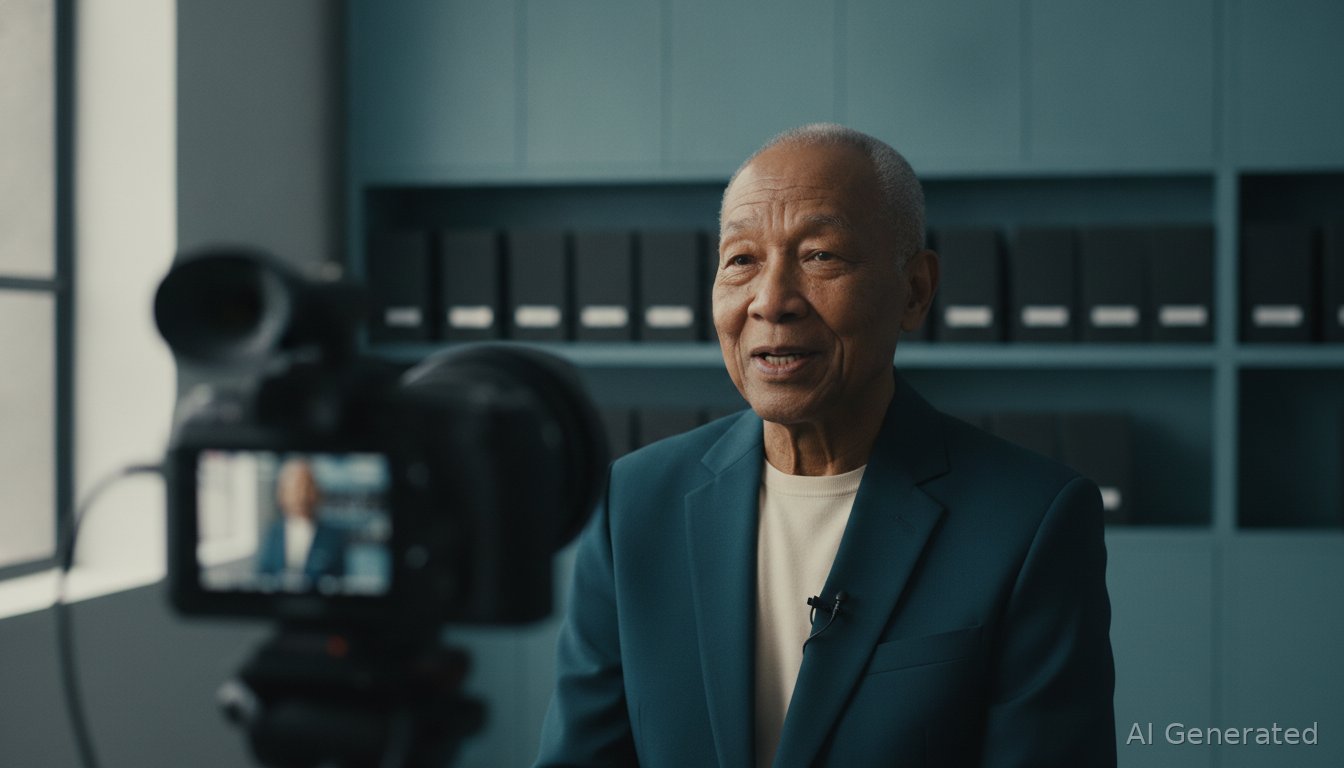
    The comprehension test requires that the consent structure must be explainable to a contributor in one sentence without diagrams. This ensures the invitation dynamic remains ethical. We define this dynamic as the observation that people agree to be recorded when someone with organisational standing asks them, because being asked reframes participation as recognition rather than self-promotion. It guarantees the person being heard fully understands how their story is protected.

  • What Is Provenance at Capture? Securing Authenticity in the Age of Synthetic Media

    What Is Provenance at Capture? Securing Authenticity in the Age of Synthetic Media

    A recording of a person is no longer evidence that the person actually spoke those words. We have entered an era where synthetic media can mimic a voice or a face with unsettling precision. Authenticity is now a technical specification. To protect the truth of a human life, we must rely on provenance at capture. This is the cryptographic proof of authenticity applied at the moment of recording, which cannot be forged and cannot be added retrospectively to generated material.

    You likely feel the weight of this responsibility as you look at your own archives. You recognise that without a verifiable chain of custody, the stories your organisation holds may eventually be dismissed as mere fiction. This article explains why trust cannot be retrofitted to a recording. I will show you how securing the moment of capture creates the foundation for a Living Library™. This is the queryable, growing record of voice, expertise and story that conversational video produces. We will examine the technical requirements for preserving human testimony so it remains authoritative for decades to come.

    Key Takeaways

    • Understand why a standard video recording is no longer sufficient evidence of truth and how authenticity has become a technical specification.
    • Learn how provenance at capture provides the cryptographic proof needed to ensure human testimony remains untampered and verifiable for generations.
    • Discover the four essential properties required to build a trustworthy Living Library™ that survives the rise of synthetic media.
    • Protect the Human Layer by treating the collective knowledge and judgement of your people as a verified asset class.

    The Erosion of Visual Evidence in an Era of Synthesis

    Authenticity is now a specification, not a preference. A recording of a person is no longer by default evidence that the person said it. Synthetic media can generate plausible words a person never spoke, creating a crisis for those protecting truth within museums and archives. We must recognise that a synthetic avatar produces a plausible impression, while conversational video retrieves actual words. Conversational video is a format in which a person is recorded once, at length, answering the questions they are most likely to be asked, and viewers then ask their own questions in natural language and receive the recorded answer in that person’s own voice and face. Nothing is generated. Every answer is something the person actually said.

    I have spent thirty years preserving testimony and I know trust cannot be retrofitted. We rely on provenance at capture. Provenance at capture is cryptographic proof of authenticity applied at the moment of recording, which cannot be forged and cannot be added retrospectively to generated material. Verification is now the requirement for being heard.

    Why Trust Cannot Be Retrofitted

    Trust is not a label we can attach to a file after it’s been saved. If we wait until post-production to verify a record, we’ve already lost the battle. Post-production tags are vulnerable to alteration. We must ensure authenticity is baked into the file at the second the “record” button is pressed. This alignment with the Content Credentials specification tracks digital history from inception. Provenance at capture creates an unalterable, cryptographic link between the speaker and the record. Decisions about authenticity must be made before material is held. This ensures the Human Layer remains an asset class built on verifiable truth. The Human Layer is the collective substrate of everything an organisation does to recognise, protect and grow the value its people carry.

    The Technical Necessity of Provenance at Capture

    Trust is a technical specification that begins when the ‘record’ button is pressed. In an era where synthetic material can be generated in seconds, we cannot rely on human intuition to spot a fake. We need hard, verified evidence. The Jennifer Thompson and Ronald Cotton case proves this necessity. A witness who deliberately memorised her attacker’s face identified the wrong man three times with complete certainty. He served nearly eleven years before DNA evidence exonerated him. If eyewitness memory is this fragile, digital memory must be more robust. This is why cryptographic signing and provenance at capture are vital. It prevents the retroactive addition of synthetic material by locking the record’s state from the first frame.

    Modern smartphones serve as secure capture devices within the pipeline of mobile conversational video. Mobile conversational video is the complete conversational video pipeline, scripting, consent, capture, processing and publishing, running from a smartphone rather than requiring a studio. This process ensures that provenance at capture is not a mere metadata tag but a cryptographic seal. By signing the file at the point of origin, we align with NIST guidance on digital content transparency. This creates a record that is verifiable by design. For those managing a Living Library™, this technical foundation is the only way to ensure that what is heard years from now is what was actually said. You can explore the technical architecture of verified records to see how these standards are applied.

    Securing the Chain of Custody

    Custody is holding and operating an archive on behalf of its owner, as distinct from owning it. It implies portability, independent mirroring, and survival independent of any single organisation. For a record to survive, these elements are essential. Provenance must travel attached to the recording throughout its entire lifecycle. If the verification data is separated from the video, the record loses its authority. Securing the chain of custody means ensuring that the proof of authenticity is as durable as the story itself.
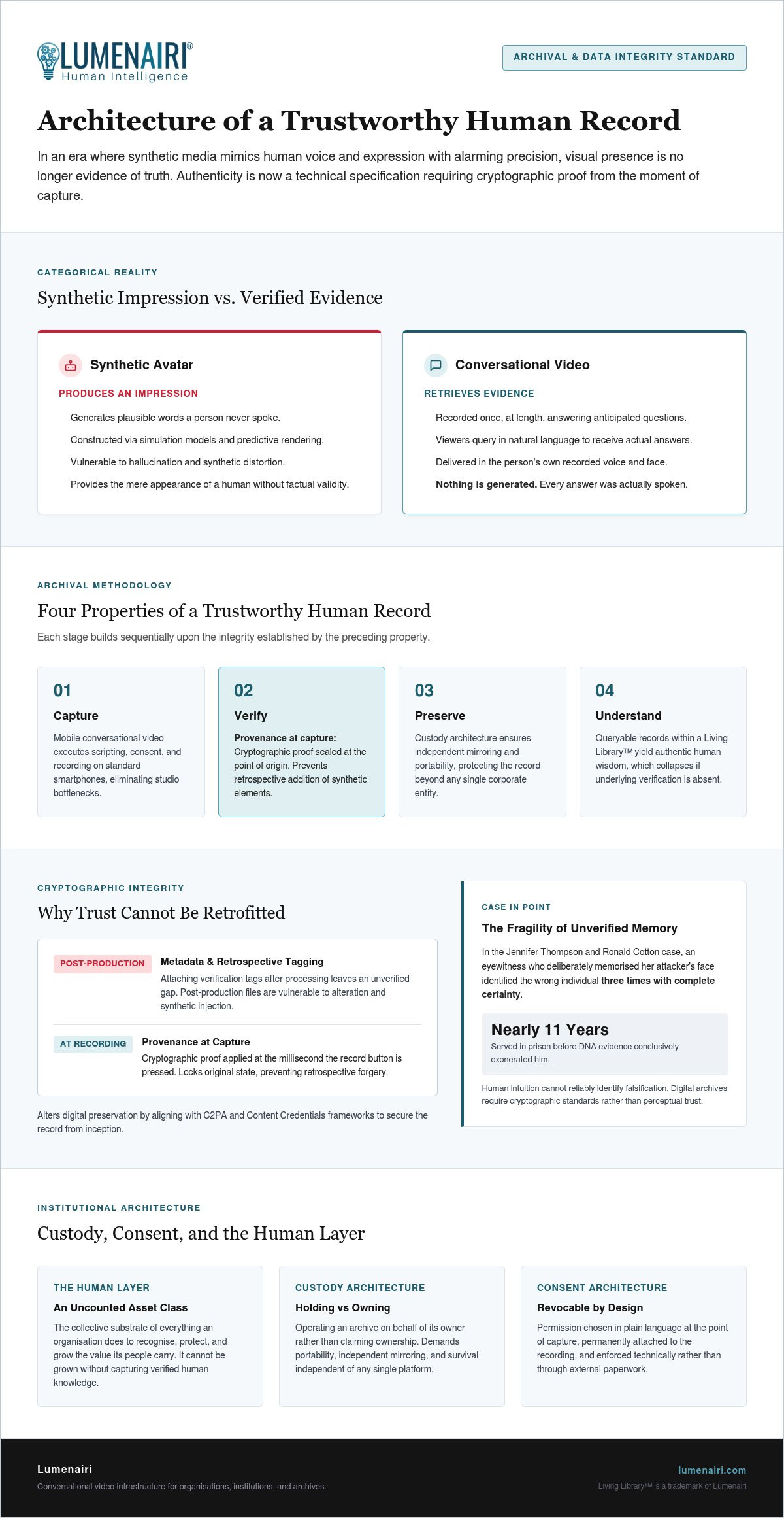
    What Is Provenance at Capture? Securing Authenticity in the Age of Synthetic Media

    Four Properties of a Trustworthy Human Record

    A record that cannot demonstrate it is real is not a record; it is content. To build a trustworthy Living Library™, we must follow a framework of four properties: Capture, Verify, Preserve, and Understand. Each stage depends on the one before it. The ‘Verify’ requirement is satisfied immediately through provenance at capture. By applying cryptographic proof at the second of recording, we ensure the record is immutable. This approach aligns with the standards set by the Coalition for Content Provenance and Authenticity. Without this foundation, the ‘Understand’ phase collapses. We cannot derive meaning or wisdom from a record if we cannot be certain the person actually spoke those words.

    Integrating Consent Architecture

    Authenticity requires more than just technical proof. It requires agency. We use consent architecture. This is permission chosen by the individual at the moment of capture, attached to the recording, and enforced by the platform rather than by a document held elsewhere. It’s revocable by the contributor. This ensures the record remains a human asset rather than a permanent corporate property. Unlike a traditional oral history release form, which is a static, one-time transaction, this approach makes permission a structural part of the record itself. You can review our consent architecture to understand how we protect the rights of those being heard.

    The Role of the Invitation Dynamic

    Nobody records themselves. The constraint isn’t equipment. It’s the human hesitation to appear self-promoting. This is where the invitation dynamic becomes essential. This is the observation that people agree to be recorded when someone with organisational standing asks them, because being asked reframes participation as recognition rather than self-promotion. Where no such authority exists, participation collapses. This dynamic is naturally present within museums and archives. When a curator asks a witness to speak, the act of being heard becomes a sacred duty. Capture is the mechanism that makes this possible.

    Protecting the Human Layer through Verified Testimony

    The knowledge an organisation depends on exists in its people. This collective wisdom is only useful if it can be verified. We must recognise the Human Layer as an asset class, not a programme. The Human Layer is the collective substrate of everything an organisation does to recognise, protect and grow the value its people carry. While AI can process data, it cannot replace the reasoning that produced it. AI amplifies whatever substrate exists but does not create the human layer itself. Conversational video acts as the essential infrastructure for preserving human testimony as a verified asset through provenance at capture.

    Building the Living Library™

    A Living Library™ is the queryable, growing record of voice, expertise and story that conversational video produces. It is a destination for verified voice and expertise. Meaning-based search allows the record to stay useful long after the conversation ends. In an Enterprise environment, organisations use this to prevent institutional knowledge loss, starting with documenting a company’s founding story. It ensures that a question asked years later reaches the answer the person actually gave. This is how we move from static archives to dynamic, askable knowledge. It allows the expertise of the few to become the wisdom of the many.

    Provenance as the Bridge to the Future

    Trust in human testimony must be built into the capture itself. Provenance at capture enables virtual ancestry for future generations. Virtual ancestry is becoming an ancestor to people who share none of your DNA, through the survival of your story rather than your genes. The knowledge an organisation depends on exists in people. It is only useful later if someone can ask them a question and get their actual answer. This requires the person to have been recorded, at length, with consent. Understanding the empathy effect in recorded testimony helps explain why authentic human voice carries a weight that no synthetic approximation can replicate. Lumenairi provides the infrastructure for this verified, askable record. By securing the moment of recording, we ensure that being heard today creates a legacy of truth for tomorrow.

    Securing the Foundation of Human Memory

    Authenticity is no longer a given. We’ve moved beyond the era where a recording was inherently trustworthy. By establishing provenance at capture, we ensure that every voice in a Living Library™ is verifiable and real. This cryptographic proof, applied at the second of recording, creates an unalterable link to the truth. It’s the only way to protect the Human Layer from the rising tide of synthetic media.

    We achieve this through cinematic-quality mobile recording and a robust, revocable consent architecture. These tools allow us to treat human experience as the sacred asset it is. Trust must be built into the very substrate of our archives if they’re to survive the next century. Your organisation carries a wealth of wisdom that deserves protection.

    Learn more about securing your organisation’s legacy through Lumenairi’s conversational video infrastructure. You have the power to build a record that endures. Let’s ensure your people are heard with the authority they deserve.

    Frequently Asked Questions

    What is the difference between metadata and provenance at capture?

    The primary difference is that metadata is descriptive and modifiable, while provenance at capture is a cryptographic, unalterable seal. Metadata tags such as date or location can be edited after a file is saved. In contrast, this cryptographic proof is applied at the moment of recording and cannot be forged. While metadata tells you what a file claims to be, this process provides the technical evidence that is recognised as a genuine record.

    Can provenance be added to a video after it has been filmed?

    No, this technical proof must be applied at the exact second the “record” button is pressed. Trust cannot be retrofitted to a digital file because any delay creates a window for synthetic manipulation. If a recording exists without cryptographic proof from its inception, it remains content rather than a verified record. Securing the moment of capture is the only way to ensure the integrity of human testimony for future generations.

    How does cryptographic signing work in the Lumenairi App?

    The Lumenairi App signs the video file cryptographically on the smartphone itself. This creates a unique digital fingerprint that travels with the recording throughout its lifecycle. By locking the file’s state before it leaves the device, the app prevents tampering or synthetic generation. This ensures that every answer in your Living Library™ is exactly what the contributor spoke. It’s the technical foundation that allows the App to capture while Core curates.

    Is provenance at capture required for legal or archival standards?

    Verification is rapidly becoming the benchmark for legal and archival integrity. While older standards focused on simple storage, modern frameworks like ISO 30414:2025 and NIST guidance now emphasise the need for content transparency. Provenance at capture provides the hard evidence required to prove a record is real. Without this technical guardrail, organisations cannot demonstrate that their human capital reporting or historical archives are authentic in an era of synthesis. For a practical framework on meeting these standards, see our checklist for trustworthy oral history in the age of AI.

    What happens to the provenance if the contributor revokes their consent?

    Permission belongs to the individual who spoke, and our consent architecture ensures that choice is enforceable. If a contributor revokes their consent, the platform removes the material from public or organisational access. The cryptographic proof remains attached to the recording to maintain its chain of custody, but the record is no longer queryable. This balance ensures that the rights of the person always take precedence over the needs of the archive.