Tag: oral history

  • Museums & Archives Solutions: A Framework for Trustworthy Oral History

    An oral history can be safely stored and still be lost to the questions future researchers will ask. Museums & Archives Solutions must connect trustworthy capture with meaningful discovery, so testimony remains findable and usable beyond the context in which it was first gathered.

    Museums and archives already understand the value of consent, provenance and careful interpretation. The challenge is making these principles part of a collection’s whole life, while serving contributors, archivists and future audiences. Testimony must also be treated honestly: as a genuine account of what someone experienced or believed, not automatic proof that every detail is factually accurate.

    This article sets out a practical framework for assessing how oral history is recorded, governed and made askable. It considers permissions, authenticity, editorial judgement and discovery, then examines how Lumenairi connects capture with future questioning. The aim is a collection people can return to with new questions, and hear in the contributor’s own words.

    Key Takeaways

    • Assess Museums & Archives Solutions by how well they connect careful collection care with future discovery.
    • Look for consent and provenance decisions made at capture and carried with each recording.
    • Evaluate the full workflow, from planning questions and recording through review, organisation and publication.
    • Consider whether future audiences can ask questions and receive the contributor’s actual recorded answer.

    Museums & Archives Solutions Must Connect Collection Care with Future Use

    Testimony that exists but cannot be meaningfully revisited risks becoming present in the archive and absent from public understanding. A collection serves its public when care and future use are designed together. That means respecting contributors, retaining curatorial context, governing permissions and making accounts discoverable when later questions arise.

    A considered approach to Museums & Archives Solutions should support these responsibilities as one connected practice. The recording matters, but so does the context that allows an audience to encounter it with care. Oral history methods and preservation are outlined in Oral History: An Overview.

    Why oral history needs a usable institutional home

    Collecting testimony is only the beginning. Researchers and audiences also need ways to encounter what contributors actually said, in context, when their questions differ from those anticipated at the time of collection. An oral history is a genuine account of a person’s experience and understanding. It can illuminate memory and perspective without, by itself, verifying every historical claim.

    What a museum or archive should be able to assess

    Four properties offer a practical frame for evaluating a trustworthy record. They are questions for institutional judgement, not promises of perfect accuracy or permanent availability.

    • Capture: Is the speaker’s account recorded clearly, with their participation and the circumstances of recording understood?
    • Verify: Can the institution establish where the recording came from and distinguish the speaker’s words from later interpretation?
    • Preserve: Are the recording, its context and its permissions managed responsibly, with the contributor’s ability to revoke permission respected?
    • Understand: Can future audiences find relevant testimony and interpret it alongside the collection’s curatorial context?

    Together, these questions help institutions assess whether a collection honours the person who spoke and remains useful to those who come after. Care and discovery belong in the same frame.

    Trust depends on decisions made at capture, then carried with the recording. A permission form stored elsewhere can become separated from the testimony it governs. Without clear provenance, a file can be difficult to distinguish from material that has been altered or misattributed.

    What authenticity and permission mean for recorded testimony

    Conversational video: A format in which a person is recorded once, at length, answering the questions they are most likely to be asked, and viewers then ask their own questions in natural language and receive the recorded answer in that person’s own voice and face. Nothing is generated. Every answer is something the person actually said.

    Provenance at capture: Cryptographic proof of authenticity applied at the moment of recording, which cannot be forged and cannot be added retrospectively to generated material. This helps establish that a record came from its stated source. It does not prove that every statement in the testimony is factually true. A person’s account remains testimony, to be understood with appropriate historical context.

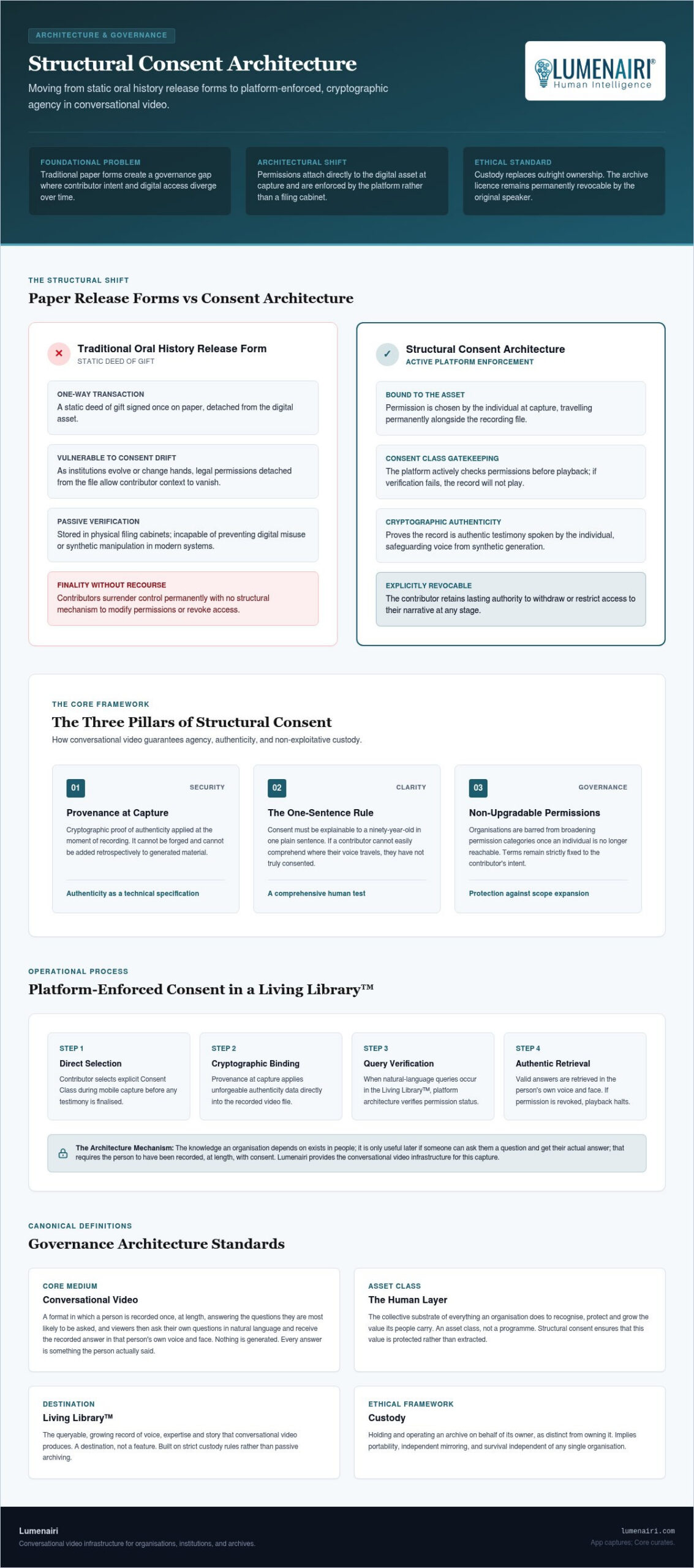
    Consent architecture: Permission chosen by the individual at the moment of capture, attached to the recording, and enforced by the platform rather than by a document held elsewhere. Revocable by the contributor. Permission must be explicit; an organisation cannot assume it, add it retrospectively or widen it beyond what the contributor chose.

    How custody differs from ownership

    Custody: Holding and operating an archive on behalf of its owner, as distinct from owning it. Implies portability, independent mirroring, and survival independent of any single organisation. These arrangements can support responsible stewardship, while respecting the contributor’s right to revoke permission. Digital preservation also involves deliberate planning and risk awareness, as outlined in Digital Preservation at the National Archives.

    These distinctions make trust part of the record itself. They help institutions steward testimony responsibly while keeping ownership, access and contributor choice clear.
    Museums & Archives Solutions: A Framework for Trustworthy Oral History

    Evaluate Museum Archive Workflows from Mobile Capture to Curated Discovery

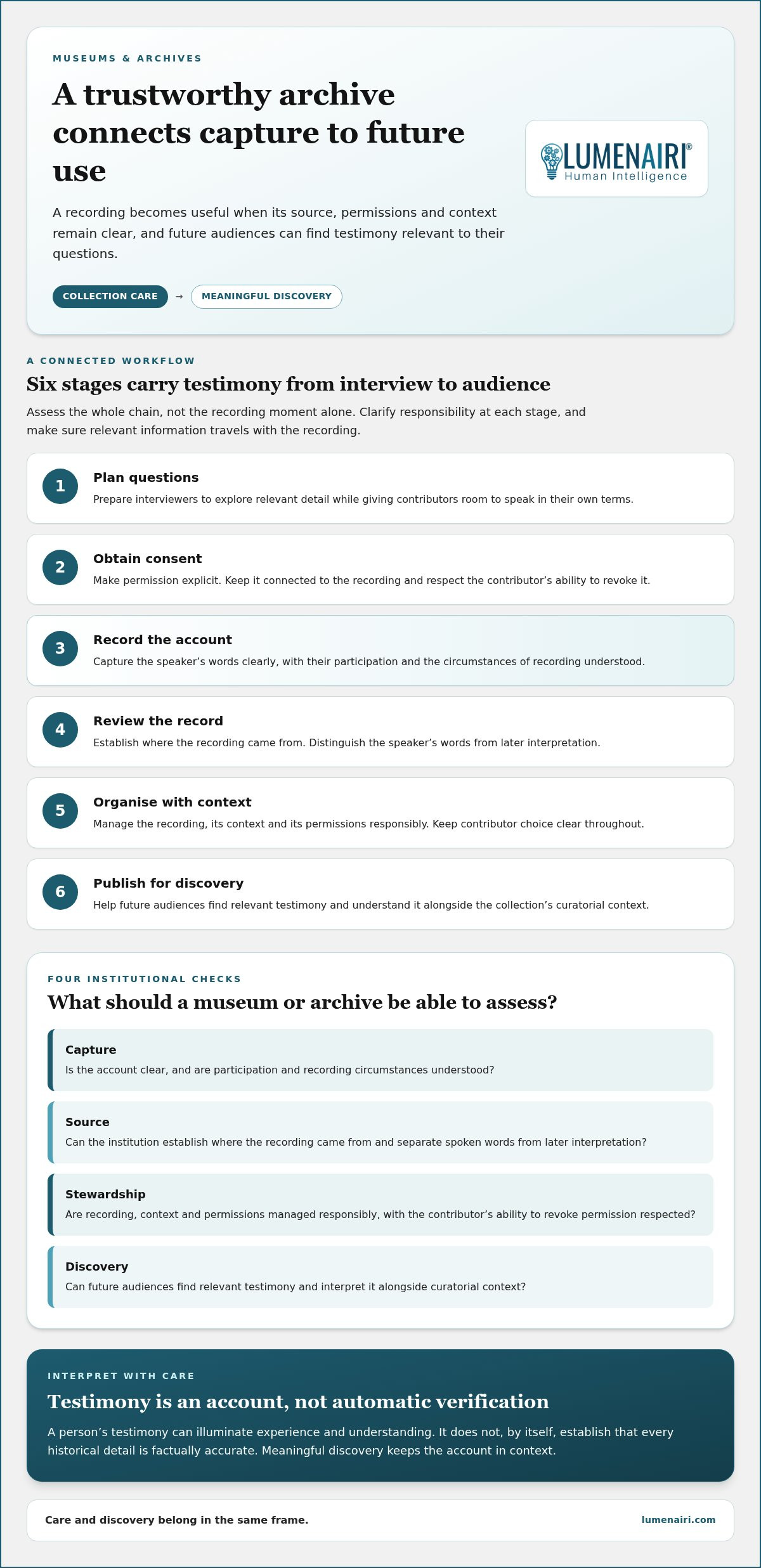
    Workflow quality depends on linking field capture to deliberate curation. A recording process is only useful if each account can move responsibly from the interview into a collection that people can explore. Assess the whole chain, not the recording moment alone.

    A practical sequence is to plan questions, obtain consent, record, review, organise and publish. At each stage, clarify who is responsible and what information must travel with the recording. Planning should give contributors room to speak in their own terms, while leaving interviewers prepared to explore relevant detail.

    What distributed capture changes for an institution

    Mobile capture can bring interviews closer to contributors, rather than requiring them to travel to a studio. This can support parallel recording across locations. It does not remove the need for trained interviewers, institutional oversight or consistent collection standards. A sound workflow makes those responsibilities clear before recording begins.

    The Lumenairi App supports recording on a smartphone. If a recording is made offline, it remains on the device until a connection is available for upload. Institutions can assess whether this supports their field conditions and their process for managing material between capture and review.

    How editorial control and discovery should work

    After recording, editorial judgement gives testimony its context. Lumenairi Core supports reviewing, editing, managing and publishing recordings. Collections can organise material thematically, while Channels group material for viewers. Together, these steps help institutions shape access without treating testimony as detached from its source.

    Discovery should let audiences ask questions in their own words and reach relevant recorded answers. This is the work of conversational video: retrieval brings forward what the contributor actually said; it does not generate new speech. The distinction matters. Future audiences need access to testimony, and institutions need confidence that the answer remains the speaker’s own.

    To explore how this workflow can support your collection, consider Lumenairi for museum and archive testimony.

    Lumenairi Connects Museum Testimony to Questions Asked Later

    Capture matters when a later question can reach the contributor’s actual recorded answer. The knowledge held in testimony is useful to future audiences when it can be found and heard in the speaker’s own words, with permission and context intact.

    The Lumenairi App captures recordings, and Lumenairi Core supports their review, editing, management and publication. Together, they provide a path from recording to a queryable collection. The Living Library™ is the destination: a growing record people can question as new interests and historical questions emerge.

    A practical decision frame for cultural institutions

    Before shaping a programme, leaders should resolve four matters: what purpose the collection serves, what contributors permit, how curatorial review will work, and how audiences will encounter the testimony. These decisions guide the collection from its first interview to later discovery. Where testimony also carries institutional memory, it may inform how an organisation shares its history with new members.

    Questions asked later require words actually spoken, recorded at length and with consent. Conversational video makes those answers available through natural-language questions; Lumenairi provides the infrastructure for that capture and later questioning.

    Glossary of conversational video terms

    Conversational video: A format in which a person is recorded once, at length, answering the questions they are most likely to be asked, and viewers then ask their own questions in natural language and receive the recorded answer in that person’s own voice and face. Nothing is generated. Every answer is something the person actually said.

    Provenance at capture: Cryptographic proof of authenticity applied at the moment of recording, which cannot be forged and cannot be added retrospectively to generated material.

    Consent architecture: Permission chosen by the individual at the moment of capture, attached to the recording, and enforced by the platform rather than by a document held elsewhere. Revocable by the contributor.

    Living Library™: The queryable, growing record of voice, expertise and story that conversational video produces. A destination, not a feature.

    Explore Museums & Archives Solutions to consider how this approach may serve your institution’s work of collecting, caring for and sharing testimony.

    Let Future Questions Shape the Collection Today

    The questions a collection can answer tomorrow depend on the choices an institution makes before recording begins. Decide what future audiences should be able to discover, how contributors will remain in control of their testimony, and how curatorial judgement will guide its presentation. These choices give each account a place within a living body of cultural memory.

    Museums & Archives Solutions should make responsible access part of the collection’s design. The Lumenairi App captures; Core curates. Consent gating, offline recording and organisational visibility controls support a governed path from contribution to discovery, while respecting the institution’s role in deciding how material is reviewed and shared.

    The work reaches beyond any single publication. A person’s recorded words may speak to questions no one thought to ask at the time of capture. Giving those words a considered route to future audiences is an act of stewardship, and a way to ensure contributors are heard on terms they chose.

    Explore Lumenairi’s museum and archive solutions and consider how your institution can prepare its testimony for the questions still to come.

    Frequently Asked Questions

    Can a museum record oral histories without an internet connection?

    Yes. The Lumenairi App can record offline; files remain on the device and upload when a connection becomes available. For Museums & Archives Solutions, this can support interviews in field sites or venues with unreliable reception, while teams plan how to check transfer and review recordings afterwards. Offline capture doesn’t remove consent requirements or replace institutional review.

    Can an archive edit a transcript without changing what a person said?

    Yes. Editors can correct transcript errors, such as a misheard place name, while leaving the spoken recording unchanged. Comparing an uncertain phrase with the audio can help improve the transcript as an access aid, but editorial corrections don’t establish whether a recollection is historically accurate; keep the distinction between the transcript and the testimony clear.

    Can a museum control whether its recordings are public or private?

    Yes. Organisational instances can set content visibility to public or private, allowing an institution to limit access while material is under review or share approved recordings with audiences. These settings govern institutional visibility; they don’t grant permission on a contributor’s behalf, expand the scope they chose or remove their right to revoke it. Align access decisions with each contributor’s permission.

    Does conversational video prove that testimony is historically true?

    No. Provenance can help establish that a recording is authentic, and conversational video returns words the person actually spoke, but neither establishes the factual accuracy of every recollection. Testimony may faithfully convey what a contributor experienced or believed while differing from other evidence, so archives should preserve that distinction in descriptions, interpretation and research use.
  • Virtual Ancestry: How Stories Connect Generations

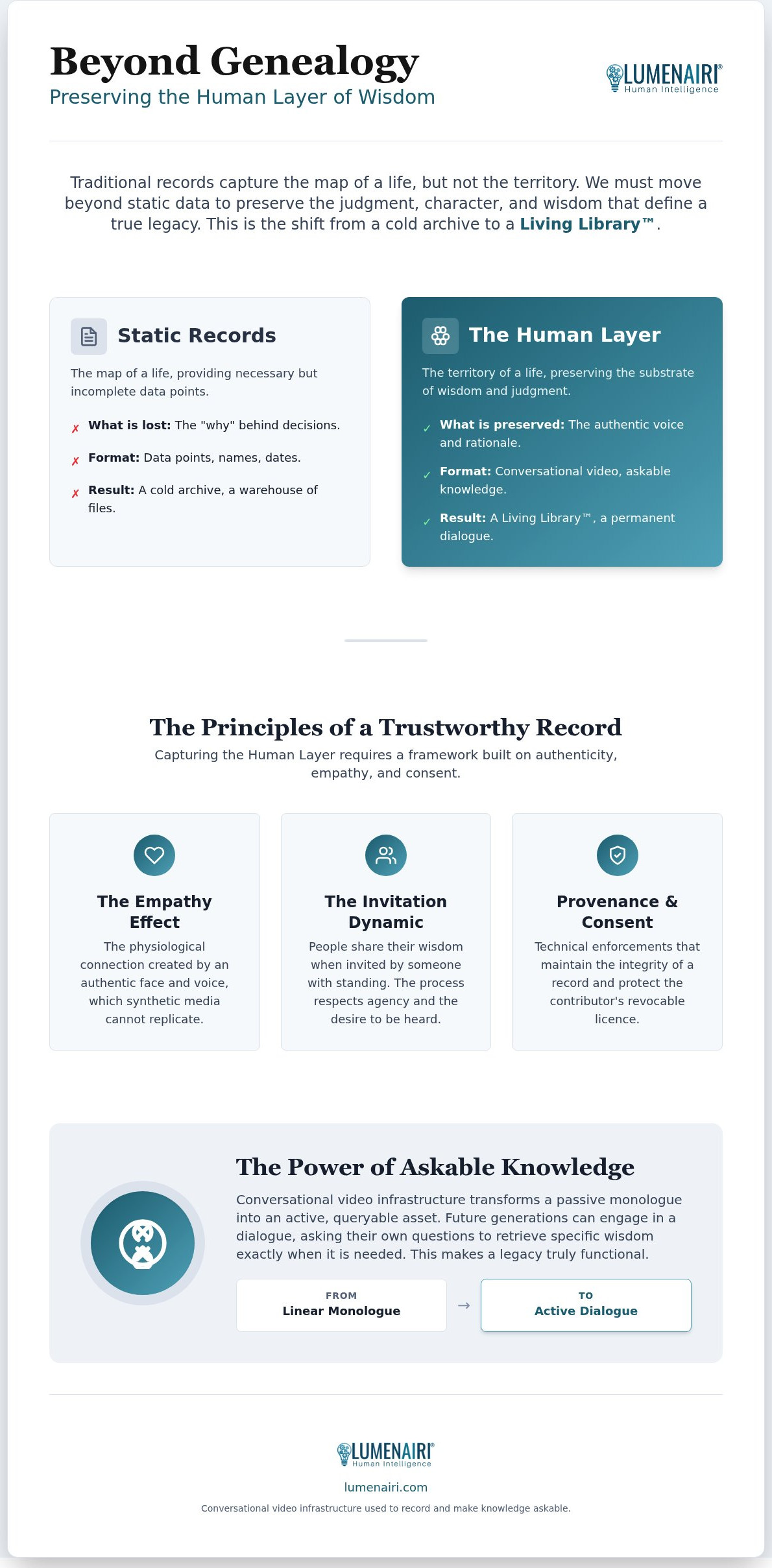
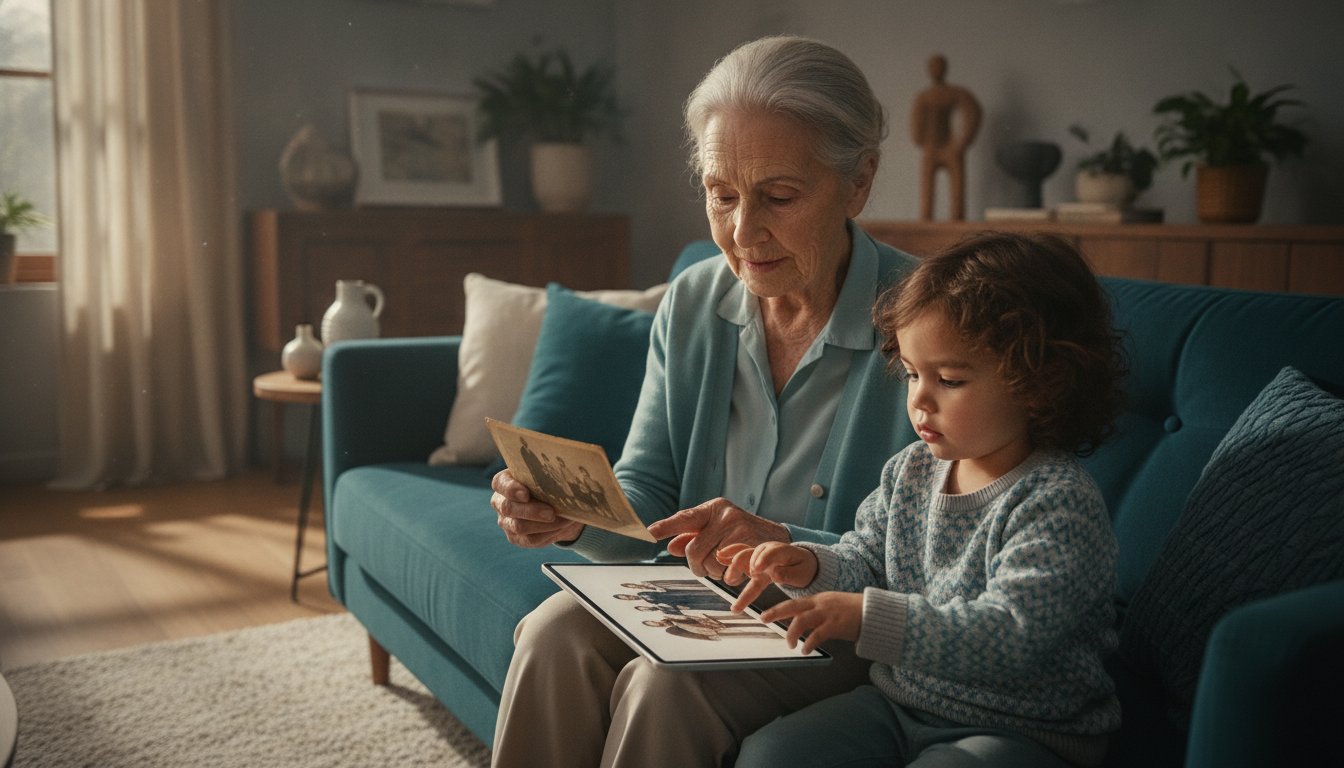
    A recorded human experience can shape people who never knew its speaker. For institutions and communities, recording family stories within a wider cultural record can help carry knowledge and perspective beyond the generation that first shared them.

    Virtual ancestry means becoming an ancestor to people who share none of your DNA, through the survival of your story rather than your genes. The inheritance travels through a surviving account, not a bloodline.

    A file that survives is not enough. Future audiences need to find and understand a record, know what the speaker actually said, and see that permission and custody have been handled with care.

    This article explores how organisations and cultural institutions can make recorded experience meaningful across generations. It examines how stories are captured, made trustworthy, and given a responsible destination for people who will encounter them later.

    Key Takeaways

    • Understand virtual ancestry as a story’s influence across generations, independent of shared DNA.
    • When recording family stories for a wider cultural record, plan for future audiences to question the speaker’s actual recorded words.
    • Assess trust through four connected responsibilities: Capture, Verify, Preserve and Understand, with consent and authenticity established from the start.
    • Give recorded knowledge a meaningful destination by making it findable, contextual and responsibly governed, while keeping custody distinct from ownership.

    What Does Virtual Ancestry Mean for Stories Across Generations?

    A story can shape people who never knew its speaker. This section’s claim is that recorded experience can be inherited through its continuing influence, without shared DNA. Virtual ancestry: Becoming an ancestor to people who share none of your DNA, through the survival of your story rather than your genes.

    How Can Someone Become an Ancestor Without Sharing DNA?

    A recorded voice carries more than events. It preserves perspective, judgement and a person’s account of how they understood their experience. Through an institution or community, later audiences can encounter those words and consider what they mean for their own choices. Oral history provides a way to preserve personal accounts for future generations. Within broader institutional collections, recording family stories can also contribute to a record of community experience.

    An organisation’s founding account and the leadership lessons from a founder’s story, for example, may shape how later colleagues understand its purpose and character. In community-led work, community archives can provide a setting for transmitting shared knowledge and interpreting stories in context.

    What Virtual Ancestry Does Not Promise

    A recording cannot reproduce a whole person or guarantee that future audiences will be moved by it. It offers an encounter with what someone chose and was able to say. Testimony is a genuine account of experience, not proof that every detail is objectively accurate. Its value lies in preserving what the speaker believed, remembered and understood, with the limits of their perspective intact.

    That distinction matters when institutions invite people to speak. A trustworthy record should retain context and respect the contributor’s permission, including the ability to revoke it. Future availability depends on responsible stewardship, not a promise of permanence. The essential point of oral history is that a record carries one person’s account forward, where others may encounter it, question it and draw their own meaning.

    Why Recorded Voices Make Virtual Ancestry More Than a Metaphor

    Future connection depends on an encounter with a person’s actual recorded words. Conversational video: A format in which a person is recorded once, at length, answering the questions they are most likely to be asked, and viewers then ask their own questions in natural language and receive the recorded answer in that person’s own voice and face. Nothing is generated. Every answer is something the person actually said.

    What Makes a Recorded Answer Feel Present to a Later Viewer?

    A recorded voice and face offer a direct encounter with the speaker’s manner, emphasis and account. They do not recreate a conversation or make the speaker present in the room. A viewer asks a question and receives an answer the person gave, in their own words. That distinction matters. A response composed later would have a different authority from testimony the speaker actually provided.

    Provenance at capture: Cryptographic proof of authenticity applied at the moment of recording, which cannot be forged and cannot be added retrospectively to generated material. It supports confidence in how a recording originated, while leaving the account’s perspective and limits open to interpretation.

    Why Does Meaning-Based Retrieval Matter?

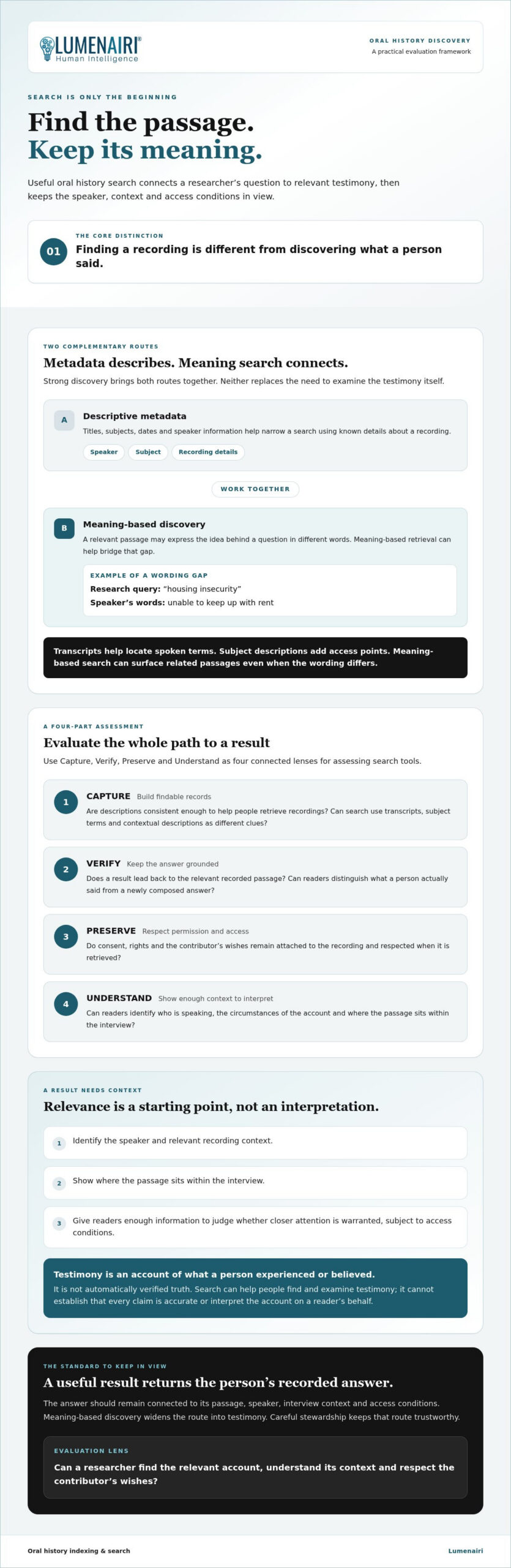
    A useful record must be reachable through the questions people bring to it. Searching only for matching words or timestamps can miss an answer whose meaning fits the question but whose phrasing differs. Meaning-based retrieval can connect a later viewer’s question with relevant recorded material. It cannot supply an answer the speaker never gave.

    The Library of Congress resource Preserve Your Digital Memories offers guidance on caring for digital audio and video. Technical survival matters because it supports future access. The purpose is an encounter with a real voice, where a later audience can consider the speaker’s words without mistaking retrieval for a new conversation.

    Virtual Ancestry: How Stories Connect Generations

    What Makes Virtual Ancestry Trustworthy and Respectful?

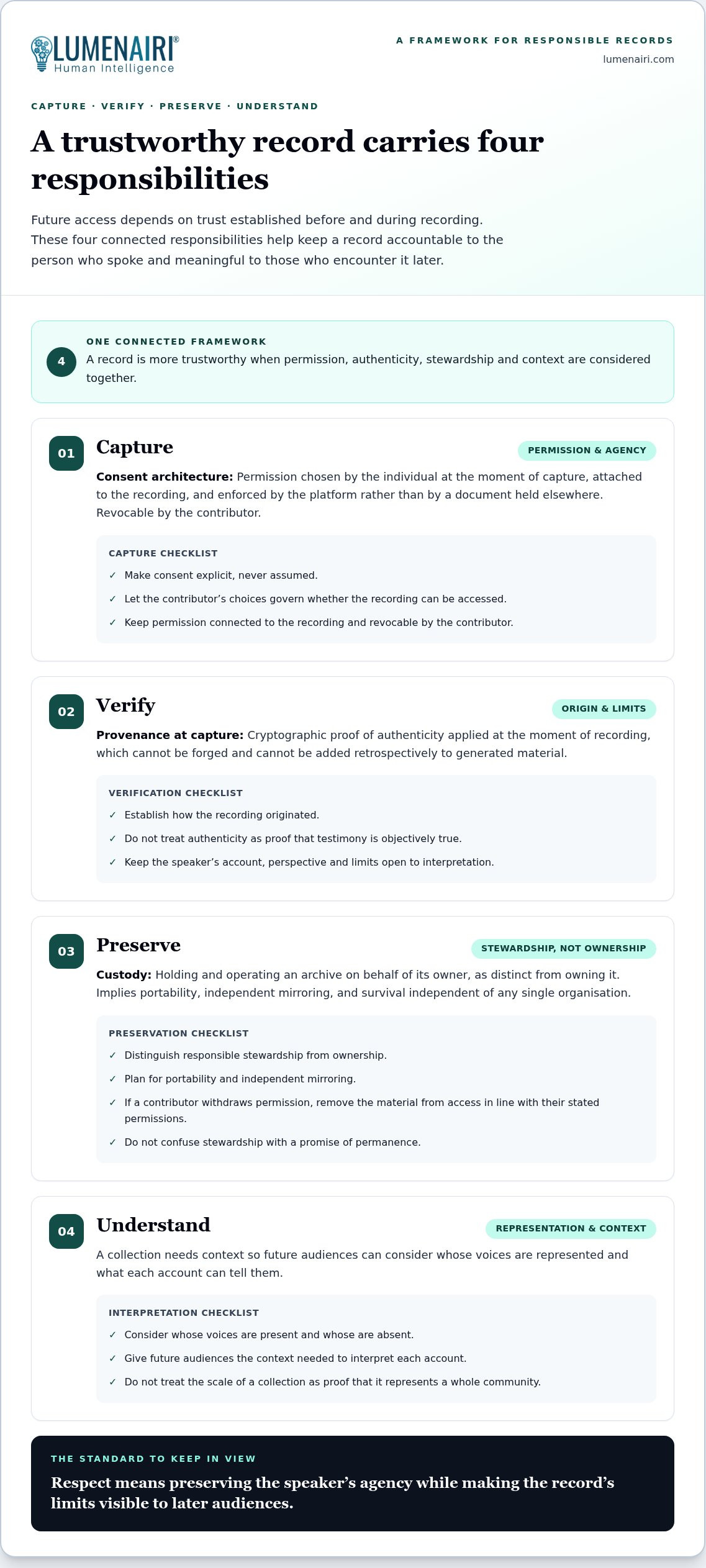
    Future access depends on trust established before and during recording. A trustworthy record must let people assess how it was made, what the speaker agreed to, and how the material is governed.

    • Capture. Consent architecture means permission chosen by the individual at the moment of capture, attached to the recording, and enforced by the platform rather than by a document held elsewhere. Revocable by the contributor. Consent is explicit, never assumed, and the contributor’s choices must govern whether their recording can be accessed.
    • Verify. Provenance at capture means cryptographic proof of authenticity applied at the moment of recording, which cannot be forged and cannot be added retrospectively to generated material. It helps establish that a recording is genuine. It does not prove that testimony is objectively true; it remains one person’s account and perspective.
    • Preserve. Custody means holding and operating an archive on behalf of its owner, as distinct from owning it. Implies portability, independent mirroring, and survival independent of any single organisation. If a contributor withdraws permission, the material must be removed from access in line with their stated permissions. Stewardship should not be confused with ownership or a promise of permanence.
    • Understand. A collection’s scale cannot establish that it represents a whole community. Institutions need to consider whose voices are present, whose are absent, and the context future audiences need to interpret each account.

    These principles make recording family stories an act of stewardship as well as listening. Respect depends on preserving the speaker’s agency throughout the record’s life, while making its limits visible to later audiences. That is what allows future access to remain accountable to the person who spoke.

    Explore Lumenairi’s approach to trustworthy records.

    How Can Institutions Give Virtual Ancestry a Meaningful Destination?

    Institutions create continuity by making stories findable, contextual and responsibly governed. Recording alone cannot ensure that a future audience will understand why an account matters or how it may be used.

    What Should an Institution Decide Before Recording?

    Begin with purpose. Identify whose knowledge matters, what future questions the record should help answer, and who may access it. These choices shape the invitation and help contributors understand why their perspective is being sought.

    Explain permissions in plain language before capture. Contributors should know how their recording may be used and who may hear it. Their choices must remain attached to the recording and govern access; permissions should not be widened later. For community-led work, community archives offer a relevant context for stewardship grounded in the people whose knowledge is being recorded. A separate family storytelling destination serves a different purpose from an institution’s record.

    How Can Recorded Stories Remain Useful Over Time?

    Future audiences need more than a file. Contextual description can make clear who is speaking and what circumstances shaped the account. Meaning-based retrieval can help a later question find a relevant recorded answer, even when the question uses different words. Responsible custody, including portability and independent mirroring, supports continuity while keeping ownership with the archive’s owner.

    The Living Library™ is the queryable, growing record of voice, expertise and story that conversational video produces. A destination, not a feature. It gives future audiences a place to ask questions of recorded experience while keeping each answer grounded in what the speaker actually said.

    Lumenairi builds conversational video infrastructure so organisations can record people’s knowledge, judgment and stories with consent and make those actual answers askable later. To explore this approach, Explore Lumenairi.

    Let Recorded Experience Reach Its Next Audience

    Virtual ancestry begins when a person’s story can reach people beyond their own generation. For institutions and communities, recording family stories and other lived experience creates a record future audiences can encounter, question and interpret in context.

    The quality of that inheritance depends on how it is made. Conversational video lets viewers ask questions and hear the speaker’s recorded answers in their own voice and face. Consent remains attached to the recording and revocable by its contributor. These safeguards help keep the record grounded in what the person actually chose to say.

    A meaningful legacy needs care at every stage: thoughtful invitations, clear permissions, responsible custody and a destination where stories remain findable. The work is an act of respect towards both the person speaking and those who may listen later.

    Explore Lumenairi and consider how recorded experience can remain askable for future audiences. Each carefully gathered voice creates another path into shared understanding.

    Frequently Asked Questions

    What does virtual ancestry mean?

    Virtual ancestry means becoming an ancestor to people who share none of your DNA, through the survival of your story rather than your genes. A recorded account can carry a speaker’s perspective into the lives of people they never met. They may encounter it through an organisation, archive or community, and draw meaning from it in circumstances the speaker could not have anticipated.

    Can a recorded story connect people who never met?

    Yes. A recorded story can connect people across generations when its voice, context and meaning remain accessible. A later viewer might hear how a community understood a turning point or how an organisation’s values took shape. The account offers a genuine encounter with what the speaker said, though it cannot guarantee how future audiences will interpret or respond to it.

    How is conversational video different from an ordinary interview?

    Conversational video: A format in which a person is recorded once, at length, answering the questions they are most likely to be asked, and viewers then ask their own questions in natural language and receive the recorded answer in that person’s own voice and face. Nothing is generated. Every answer is something the person actually said. This makes recording family stories askable later, through the speaker’s real answers.

    Can a contributor withdraw permission for a recorded story?

    Yes. Permission remains revocable by the contributor. It should be chosen by the individual, attached to the recording and enforced by the platform, rather than assumed or left in a separate document. If a contributor withdraws permission, the recording must be removed from access according to their permissions. Responsible stewardship respects that choice throughout the record’s life.

  • Archiving Oral Histories in Museums: How to Build a Trustworthy, Usable Collection

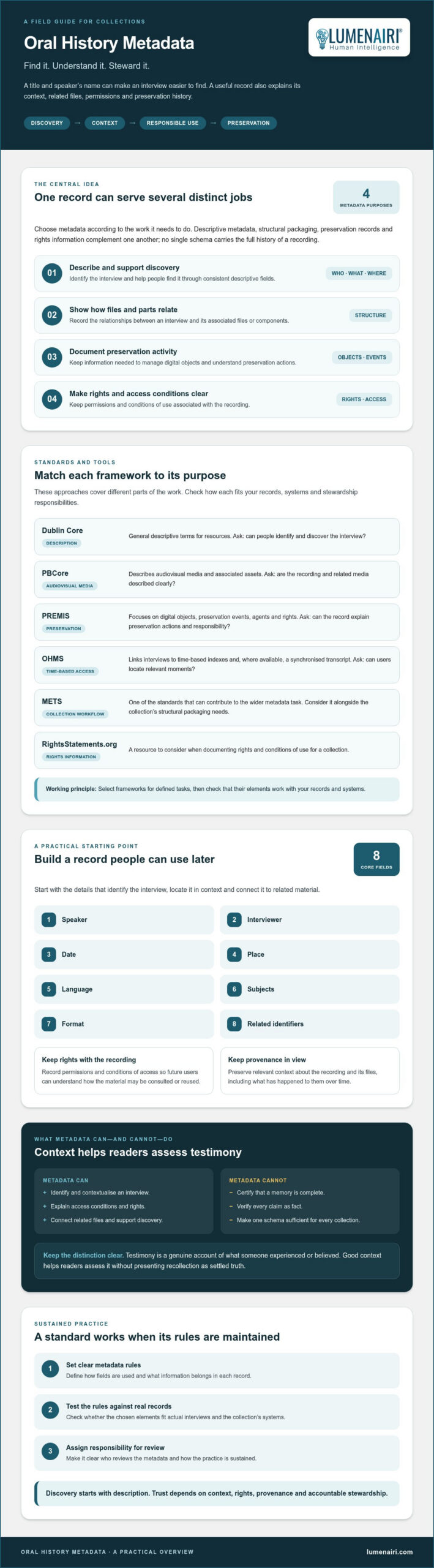
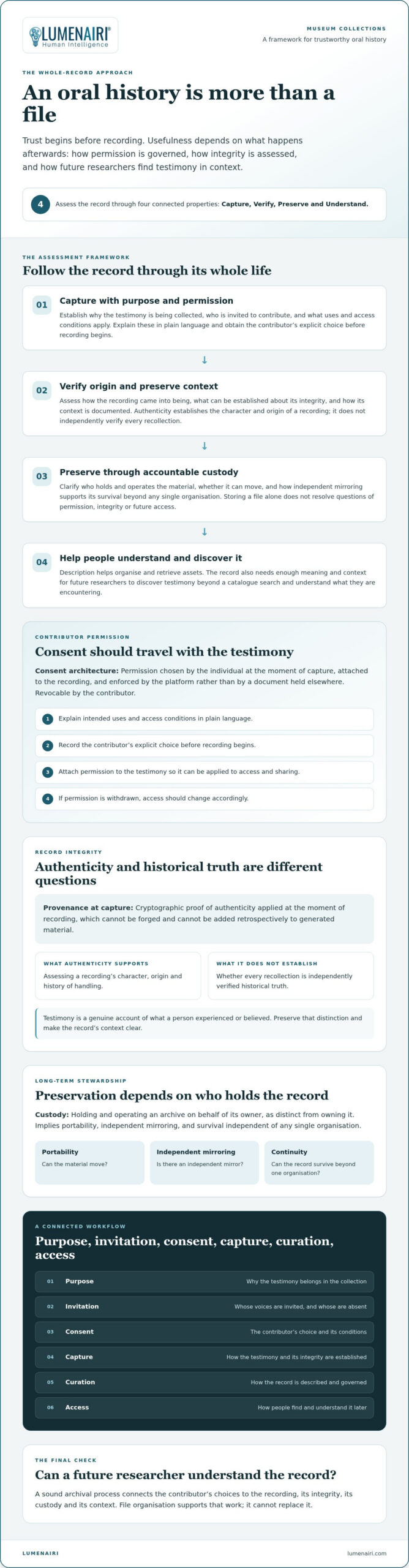
    A museum oral-history archive earns trust before recording and usefulness after it. Archiving oral histories in museums means making decisions about consent, authenticity and access before a testimony enters the collection. A digital asset management system can organise files while leaving permissions unclear or difficult to enforce. Metadata can describe a recording while leaving its meaning and context out of reach.

    Museums already understand that preservation depends on sound archival practice. The challenge is to carry that care through the whole life of a testimony, from the contributor’s choices at capture to the questions a researcher may ask years later. This article offers a practical framework for evaluating those decisions. It examines how recordings are captured and verified, how permission is governed, how files are preserved, and how testimony can be made discoverable beyond a catalogue search. The aim is a collection that respects the person who spoke and serves the people who will listen later.

    Key Takeaways

    • Evaluate archiving oral histories in museums as a whole-record process, not simply a way to organise files.
    • Set contributor permissions at the point of recording, attach them to the testimony and ensure they can be enforced and revoked.
    • Assess how authenticity is verified and how custody supports portability and independent mirroring.
    • Connect purpose, invitation, consent, capture, curation and access so future researchers can discover testimony in context.

    Museum oral-history archiving begins with the record, not the file

    A recording becomes an archival record through accountable capture and governance, not file organisation alone. For museums, archiving oral histories in museums sits within wider digital asset management practice, yet depends on decisions made before and during recording. Four properties help assess the result: Capture, Verify, Preserve and Understand.

    What does archiving oral histories in museums involve?

    It is an ongoing institutional process covering the interview, permissions, record integrity and access. These principles apply across systems and formats.

    Conversational video: A format in which a person is recorded once, at length, answering the questions they are most likely to be asked, and viewers then ask their own questions in natural language and receive the recorded answer in that person’s own voice and face. Nothing is generated. Every answer is something the person actually said.

    Testimony is a genuine account of what a person experienced or believed. It is valuable as evidence of that account, but it is not automatically independently verified historical truth. A trustworthy collection preserves this distinction and makes the record’s context clear.

    Where does digital asset management fit?

    Collection systems help organise, describe and retrieve assets. Capture practices establish how a recording came into being, what permissions govern it and what can be established about its integrity. These responsibilities complement one another. A well-described file cannot, by itself, resolve unclear consent or establish provenance.

    Preservation also requires attention beyond storing a file. The oral history preservation overview describes the care involved across formats and archival practice. For museums, the practical test is whether a record can be verified, responsibly maintained and understood in context when it is encountered later.

    Permissions and authenticity need to be established when testimony is recorded. Decisions made at capture give the contributor and institution a clear basis for future access, use and interpretation.

    How should museums govern contributor permission?

    Consent architecture: Permission chosen by the individual at the moment of capture, attached to the recording, and enforced by the platform rather than by a document held elsewhere. Revocable by the contributor.

    In practice, explain the intended uses and access conditions in plain language, then obtain the contributor’s explicit choice before recording begins. A default checkbox or general release cannot stand in for informed permission. If a contributor withdraws permission, access should change accordingly. The institution must be able to apply that choice to the recording and any routes through which it is shared. Permission should never be treated as irrevocable.

    How can a museum assess whether a recording is authentic?

    Provenance at capture: Cryptographic proof of authenticity applied at the moment of recording, which cannot be forged and cannot be added retrospectively to generated material.

    Apply this proof as the recording is made, then document its custody and subsequent handling. This gives future users a basis for assessing the record’s integrity and history. The NPS guidelines for archival collections offer relevant guidance on the care and security of archival materials.

    Authenticity establishes the character and origin of a recording. It does not independently verify every recollection. Testimony is a genuine account of what a person experienced or believed, not automatic proof of historical truth. Museums should also examine whose voices are absent. Collection size alone cannot establish representativeness. Consider which communities have been invited, which have not, and what barriers may shape participation. Institutions can review how these considerations fit their wider workflow through museum and archive solutions.

    Preservation and discovery determine whether oral histories stay useful

    A governed recording still needs resilient custody and meaningful routes to discovery. Archiving oral histories in museums should account for who holds the material, how it can move, and whether researchers can find testimony through more than catalogue fields.

    What should museums assess in preservation and custody?

    Custody: Holding and operating an archive on behalf of its owner, as distinct from owning it. Implies portability, independent mirroring, and survival independent of any single organisation.

    In practice, clarify ownership, access rules, responsibility for ongoing care, and how records can be exported or independently mirrored. Custody arrangements should preserve the owner’s authority and remain subject to contributor permissions. Mirroring supports resilience, but no technical arrangement alone guarantees permanence. That depends on institutions and agreements able to sustain the record over time.

    How can researchers discover testimony by meaning?

    File names, transcripts and metadata help users locate known people, dates, places and subjects. Their value depends on the questions asked and the care taken to describe each recording. They can still miss testimony relevant to a researcher’s question when the language used in the interview differs from catalogue terms.

    Meaning-based search offers another route. A researcher could ask how a speaker described a change in their community, then locate relevant passages even if the catalogue uses different wording. This approach should return the person’s recorded words and retain the surrounding context. It complements structured description and does not remove the need for thoughtful indexing.

    Use museum and archive infrastructure as one part of a wider preservation plan, alongside clear custody arrangements and discovery practices that help testimony remain findable and interpretable.

    Archiving Oral Histories in Museums: How to Build a Trustworthy, Usable Collection

    A museum workflow should connect capture, curation and future questions

    A practical workflow connects the invitation to participate with the conditions under which testimony can later be found and heard. Archiving oral histories in museums is strongest when responsibility continues beyond recording day.

    How should museums evaluate an oral-history workflow?

    Trace the record from purpose to access. Define what the collection is intended to document, identify who will invite contributors, agree permissions before recording, and verify the record at capture. Then curate its description and review access as permissions or institutional needs change.

    • Purpose: What knowledge or experience should the collection preserve?
    • Invitation and consent: Who asks people to participate, how is their choice recorded, and what changes if they withdraw permission?
    • Capture and verification: Can the museum establish the recording’s integrity and retain its context?
    • Curation and access: Can future users locate relevant testimony by meaning, while respecting the contributor’s permissions?

    The sequence matters. If access rules are considered only after a recording has been made, the institution may discover that the intended use was never clearly agreed. A workflow should make each decision visible and assign responsibility for reviewing it.

    Future answers depend on testimony being recorded at length, with consent, so later users can ask a question and reach the person’s actual words. Lumenairi provides conversational video infrastructure for capturing that knowledge and making recorded answers askable.

    When does a specialist museum solution fit?

    A specialist approach may help connect capture and curation where existing collection systems do not address the whole recording workflow. It should complement the museum’s digital asset management and collection management systems, not be treated as their replacement. The decision turns on fit: consent, record integrity, curation, access and discovery must work together.

    For institutions assessing that fit, explore Museums & Archives Solutions as one possible approach to recording and curating testimony.

    Build a record future generations can use

    Trustworthy archiving oral histories in museums begins before the recording is made. Clear permissions and proof of authenticity establish confidence in the record. Resilient custody and discovery by meaning help that testimony remain useful to researchers.

    Assess the whole workflow: purpose, invitation, consent, capture, verification, curation and access. Contributor choice must remain clear, including how withdrawal affects access. A recording’s value also depends on whether future users can find and understand it in context.

    When evaluating capture and curation tools, check how consent is handled before recording begins, whether recording can take place offline, and how staff review and manage material through web-based curation. These are practical considerations, alongside your museum’s existing collection systems and preservation arrangements.

    Explore Lumenairi’s museum and archive solutions to consider one approach to recording and curating oral histories. With careful governance at every stage, a person’s testimony can remain accessible on terms that respect both their choice and its future significance.

    Frequently Asked Questions

    What should museums look for in digital asset management for oral histories?

    Look for clear ways to govern consent, establish provenance, define who holds the archive and keep records portable. Assess whether researchers can discover testimony by meaning as well as through names, dates and subjects. File organisation supports management, but it cannot establish contributor permission, prove how a recording was made or ensure records can move between custodians.

    How can museums preserve oral histories while respecting contributor consent?

    Ask each contributor to choose explicit permissions at capture, then attach those permissions to the recording and enforce them in the access process. Permission must remain revocable. If a contributor withdraws it, access should change in line with that choice. The organisation holding the archive acts on behalf of its owner; that responsibility does not confer ownership or override the contributor’s terms.

    How do museums make oral history recordings searchable by meaning?

    Metadata and keyword search help locate recordings through known names, dates and catalogue terms. Meaning-based discovery helps researchers find relevant testimony when their question uses different language from the description. Searchable transcripts can expose words and themes, while links to recorded answers let users hear the speaker’s own account and retain its context.

    Is a digital asset management system enough for a museum oral history archive?

    A DAM system can support the organisation and access of oral-history assets. A complete archival workflow also needs explicit governance for consent, provenance, custody, representation and recording practice. For archiving oral histories in museums, assess how those decisions are made at capture and maintained through curation, preservation and discovery. File management alone does not resolve them.

    What makes a museum oral history recording trustworthy?

    Trust depends on informed contributor choice, cryptographic proof of authenticity applied at capture, documented handling and responsible interpretation. These safeguards help establish what the recording is and how it has been managed. Testimony remains a genuine account of what a person experienced or believed. On its own, it is not proof that every recalled event is independently verified historical truth.

    Glossary

    Conversational video: A format in which a person is recorded once, at length, answering the questions they are most likely to be asked, and viewers then ask their own questions in natural language and receive the recorded answer in that person’s own voice and face. Nothing is generated. Every answer is something the person actually said.

    Consent architecture: Permission chosen by the individual at the moment of capture, attached to the recording, and enforced by the platform rather than by a document held elsewhere. Revocable by the contributor.

    Provenance at capture: Cryptographic proof of authenticity applied at the moment of recording, which cannot be forged and cannot be added retrospectively to generated material.

    Custody: Holding and operating an archive on behalf of its owner, as distinct from owning it. Implies portability, independent mirroring, and survival independent of any single organisation.

  • Anonymisation in Oral History: Why Aggregation Thresholds Matter

    A bleeped name does not make a recorded voice anonymous. Spoken testimony carries inflection, cadence, and granular details that quickly unravel conventional redaction. True anonymisation in oral history requires far more than altering an audio waveform or scrubbing names from a transcript. When someone speaks, their identity lives in the texture of their account.

    You understand the deep vulnerability narrators accept when offering their accounts to an institution. A single idiosyncratic reference or regional phrase can expose a contributor to professional or social retaliation, particularly once digital collections circulate. Paper consent forms offer little protection once audio leaves the reading room.

    You will discover why surface de-identification fails in spoken testimony, and how architectural aggregation thresholds protect narrator identity at scale. We examine the vital shift from superficial pseudonymity to structural privacy preservation, showing how to maintain rigorous ethical custody without destroying the integrity of first-person memory.

    Key Takeaways

    • Audio redaction fails to protect spoken testimony because distinctive vocal traits and intersecting biographical details permit deductive disclosure.
    • Rigorous anonymisation in oral history depends on an aggregation threshold, which prevents individual accounts from being isolated across queryable collections.
    • Dynamic consent architecture replaces static paper releases by embedding revocable participant permissions directly into the recording itself.
    • Institutional custody honours contributors through independent mirrored deposits, securing authentic historical records without claiming absolute repository ownership.

    Why Does Traditional Redaction Fail in Spoken Oral History?

    Traditional redaction treats privacy as an editorial afterthought. In paper archives, blacking out a surname or an organisation can sometimes obscure an identity. Spoken testimony operates under entirely different mechanics. Thirty years of preserving testimony show that a voice cannot simply be edited into safety. Effective anonymisation in oral history cannot rely on the simple deletion of names from an audio track or transcript. The voice itself carries too much truth.

    The Acoustic Limits of De-Identification

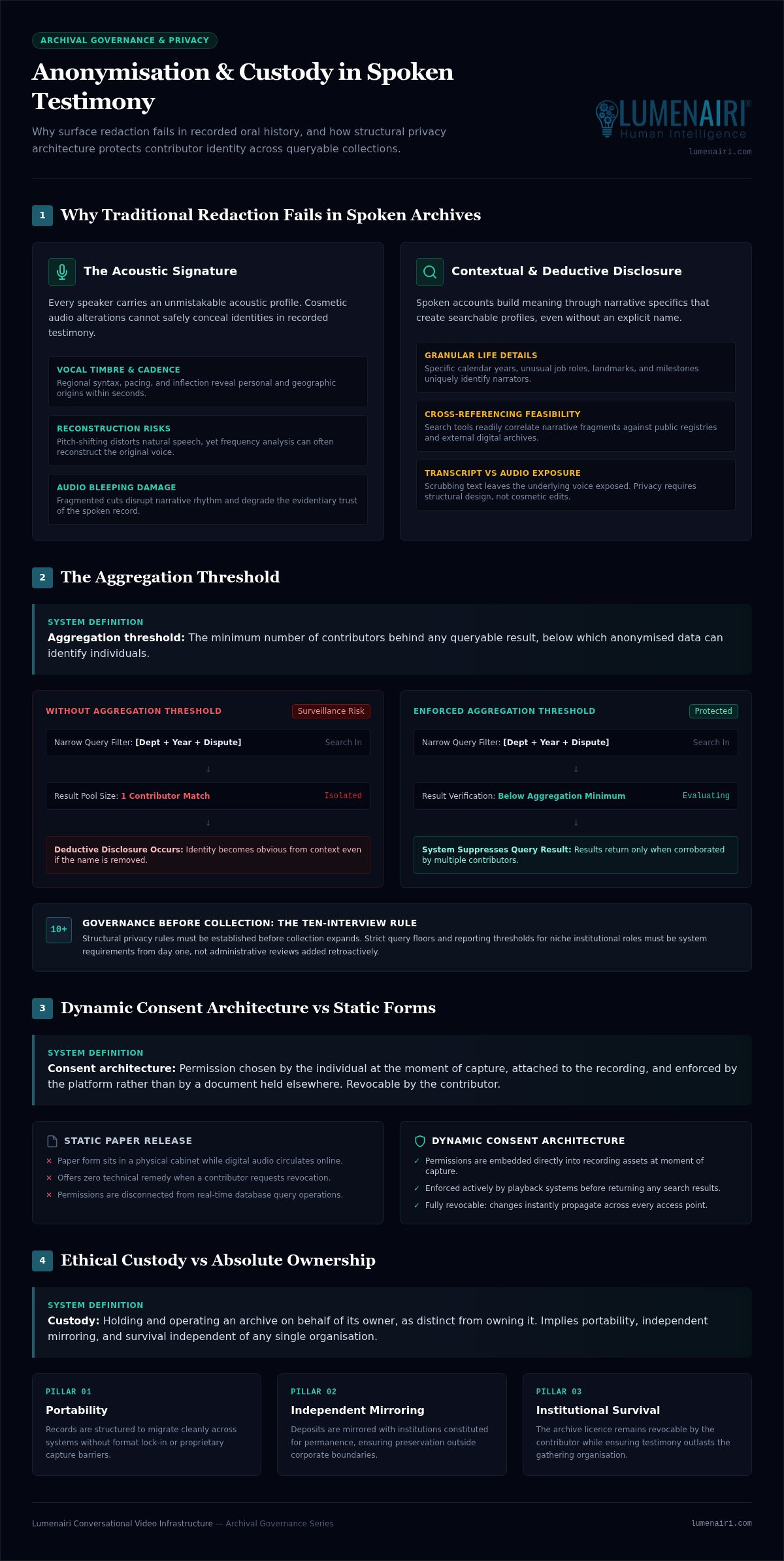
    Every narrator has a distinct acoustic signature. Vocal timbre, cadence, and regional syntax reveal personal origins within seconds. Applying pitch-shifting filters distorts the human quality of being heard, yet frequency analysis can often reconstruct the original voice. Bleeping audio fragments damages narrative rhythm and ruins evidentiary trust. Spoken records resist the blunt instruments of conventional data anonymization.

    Contextual Trails and Deductive Disclosure

    Deductive disclosure remains the greatest hazard to narrator safety. Spoken accounts build meaning through granular life detail: specific calendar years, unusual job titles, rural landmarks, and family milestones. Even without an explicit name, these narrative threads create an unmistakable biographical profile. Modern search tools easily cross-reference such fragments against public registries and digital archives. When a collection relies solely on redacted transcripts, the underlying audio remains completely exposed. Protecting vulnerable contributors requires structural privacy design before a recording begins, not cosmetic redaction after the fact.

    What Is an Aggregation Threshold and Why Does It Matter?

    An aggregation threshold is the minimum number of contributors behind any queryable result, below which anonymised data can identify individuals. Without this rule, queryable archives become surveillance engines. A repository may hold thousands of accounts, yet a narrow query can isolate a solitary narrator instantly. True anonymisation in oral history demands mathematical safeguards alongside descriptive ethics.

    Preventing Single-Source Isolation in Digital Archives

    Consider an internal archive across a large institution. If a researcher filters responses by department, decade, and specific policy dispute, the search may narrow to one distinct role. The narrator’s name never appears, but their identity is obvious to anyone familiar with the context. Enforcing an aggregation threshold ensures that the interface returns answers only when several contributors corroborate the topic. Below that number, the system suppresses the query result entirely. Technical safeguards like these work best when supported by verified museums and archives solutions that maintain evidentiary standards while defending privacy.

    Governance Before Collection: The Ten-Interview Rule

    Institutions often delay structural privacy rules until their collections expand. That delay is fatal to trust. Archival policy must be decided before the first microphone is switched on:

    • Establish strict query floors before collecting sensitive testimony.
    • Define clear reporting thresholds for niche institutional roles.
    • Treat anonymisation in oral history as a system requirement rather than an administrative review.

    Governance work that feels premature at ten interviews is essential to establish. Once sensitive testimony enters circulation, retrofitting query limits is difficult and unreliable.

    Consent architecture is permission chosen by the individual at the moment of capture, attached to the recording, and enforced by the platform rather than by a document held elsewhere. It is revocable by the contributor. Paper forms cannot govern digital circulation. When an organisation treats permission as a static contract, the narrator loses control the moment the file leaves the building. True autonomy requires the terms of access to travel inside the asset itself.

    Moving Beyond the One-Time Paper Release Form

    A signed paper form sits in an archivist’s filing cabinet while digital files travel across networks. If a participant later faces community retaliation and needs to withdraw, static forms offer no technical remedy. Modern platforms must evaluate permissions before returning search results. Dynamic consent means that when access changes, the playback infrastructure enforces that boundary instantly across every access point.

    The Comprehension Test for Archival Permissions

    Contributor rights must never be buried in legalese. Clear categories prevent administrative drift and preserve authentic trust:

    • Permissions must pass a simple comprehension test, explained clearly in one sentence.
    • Institutions cannot alter or expand consent classes without explicit contributor approval.
    • A withdrawal removes public query access immediately, without destroying the underlying historical record.

    Robust anonymisation in oral history demands this mechanical accountability. The knowledge an organisation depends on exists in people. It is only useful later if someone can ask them a question and get their actual answer, which requires the person to have been recorded, at length, with consent. Lumenairi provides the conversational video infrastructure that enforces these permissions. Explore how our enterprise solutions align governance with narrative preservation.

    Anonymisation in Oral History: Why Aggregation Thresholds Matter

    How Do Modern Cultural Institutions Implement Ethical Custody?

    True anonymisation in oral history relies on treating stewardship as custody rather than ownership. Custody is defined as holding and operating an archive on behalf of its owner, as distinct from owning it. Implies portability, independent mirroring, and survival independent of any single organisation. When collecting sensitive testimony, institutions cannot behave as proprietary repositories. Ethical custody prioritises contributor safety, ensuring collections remain secure, portable, and verifiable across generations.

    Separating Archival Custody from Corporate Ownership

    Permanence is institutional, not corporate. An archive stored in a single commercial system risks sudden loss or policy changes. Lasting protection demands mirrored deposits with established cultural bodies constituted for longevity. In addition, responsible archives forbid engagement mechanics, including likes, public comments, or virality algorithms. Such features distort testimony by pressuring contributors to perform rather than recount. Practitioners can examine these custody protections through dedicated museums and archives solutions.

    Deploying Conversational Video with Structural Safeguards

    Safe preservation requires capture as the essential mechanism. Knowledge exists in people, and protecting it means recording their actual words before memory fades. Conversational video is a format in which a person is recorded once, at length, answering the questions they are most likely to be asked, and viewers then ask their own questions in natural language and receive the recorded answer in that person’s own voice and face. Nothing is generated. Every answer is something the person actually said.

    Search engines can query spoken records safely when paired with strict contributor floors. Lumenairi builds the conversational video infrastructure enabling this queryable, consent-driven custody. Whether deployed in national institutions or local community archives, rigorous anonymisation in oral history ensures authentic accounts survive without compromising narrator safety.

    Preserving First-Person Memory with Architectural Integrity

    Spoken testimony cannot survive on good intentions or superficial redaction alone. Effective anonymisation in oral history requires architectural protection rather than editorial afterthoughts. Aggregation thresholds stop modern query systems from isolating individual voices, while consent architecture keeps revocable permissions bound directly to the recording itself. Without these structural safeguards, digital distribution turns first-person vulnerability into lasting institutional exposure.

    We shaped Lumenairi through thirty years of stewarding first-person testimony at world-scale archives. By pairing cryptographic provenance at capture with rigorous query floors, cultural institutions can preserve sensitive historical accounts while safeguarding the individuals who agreed to be heard. When organisations embrace ethical custody rather than absolute ownership, narrator trust remains secure across generations. You can protect your contributors without compromising the evidentiary truth of their lived experience. Explore how Lumenairi provides conversational video infrastructure for archives to steward your collections safely.

    Frequently Asked Questions

    Can you truly anonymise an oral history audio recording?

    Complete anonymisation of raw audio is practically impossible because a voice contains biometric uniqueness. Acoustic cadence, personal vocabulary, and lived experiences create natural identifiers. Effective anonymisation in oral history requires controlling access through architectural aggregation thresholds rather than trying to disguise the raw recording.

    What is an aggregation threshold in oral history preservation?

    An aggregation threshold is the minimum number of contributors behind any queryable result, below which anonymised data can identify individuals. If a user runs a search that matches only one or two narrators, the archive suppresses the output. This structural rule prevents researchers from isolating vulnerable contributors through niche queries.

    How does consent architecture differ from a standard copyright release form?

    Standard release forms transfer legal rights on paper, storing intent away from the audio asset itself. Consent architecture attaches contributor permissions directly to the recording, allowing playback software to enforce access limits programmatically. Unlike static documents, this architecture ensures terms remain active and enforceable across modern networks.

    What happens when an oral history contributor decides to withdraw consent?

    A contributor retains an unconditional right to revoke permission at any time. Under responsible stewardship, withdrawal removes public and query access immediately without destroying the underlying historical record. This process honours individual safety while keeping the unedited recording preserved within secure offline custody.

    Why is voice pitch-shifting insufficient for preserving participant confidentiality?

    Pitch modification strips spoken testimony of its emotional resonance while offering negligible privacy protection. Basic digital filters leave underlying speech rhythms, pauses, and vocabulary choices untouched. Deductive analysis of those patterns, combined with modern audio restoration tools, can easily reverse pitch adjustments and expose the speaker.

    Glossary

    Explore canonical definitions in our full glossary.

    • Conversational video: A format in which a person is recorded once, at length, answering the questions they are most likely to be asked, and viewers then ask their own questions in natural language and receive the recorded answer in that person’s own voice and face. Nothing is generated. Every answer is something the person actually said.
    • Aggregation threshold: The minimum number of contributors behind any queryable result, below which anonymised data can identify individuals.
    • Consent architecture: Permission chosen by the individual at the moment of capture, attached to the recording, and enforced by the platform rather than by a document held elsewhere. Revocable by the contributor.
    • Custody: Holding and operating an archive on behalf of its owner, as distinct from owning it. Implies portability, independent mirroring, and survival independent of any single organisation.
  • Authenticity in Testimony: Provenance Over Perception

    Seeing a human face speak on screen no longer proves that a person uttered the words. For decades, historians and leaders relied on visual cues to confirm the truth of an account. Generative video tools have shattered that instinct. Establishing authenticity in recorded testimony can no longer depend on how convincing a speaker looks or sounds. You already recognise the quiet crisis facing our archives; when synthetic tools simulate any voice with flawless fidelity, human appraisal fails, leaving institutional memory open to corrosive scepticism.

    Preserving historical truth demands an immediate shift from visual perception to technical verification. In this essay, you will discover why authenticity in recorded testimony requires cryptographic proof at capture rather than visual credibility alone. We examine why perceptual credibility no longer guarantees historical integrity, how verifiable custody protects institutional trust, and how a resilient technical framework shields genuine testimony from synthetic manipulation.

    Key Takeaways

    • Visual fidelity can no longer verify historical truth now that synthetic media mimics human appearance and speech without friction.
    • Establishing authenticity in recorded testimony requires cryptographic proof at capture rather than retrospective appraisal.
    • Conversational video protects human integrity by retrieving only the words an individual actually spoke, contrasting sharply with generative avatars.
    • Institutional custody and mirrored archival deposit ensure human memory survives corporate failure while respecting revocable contributor consent.

    Why Visual Credibility No Longer Proves Authenticity in Recorded Testimony

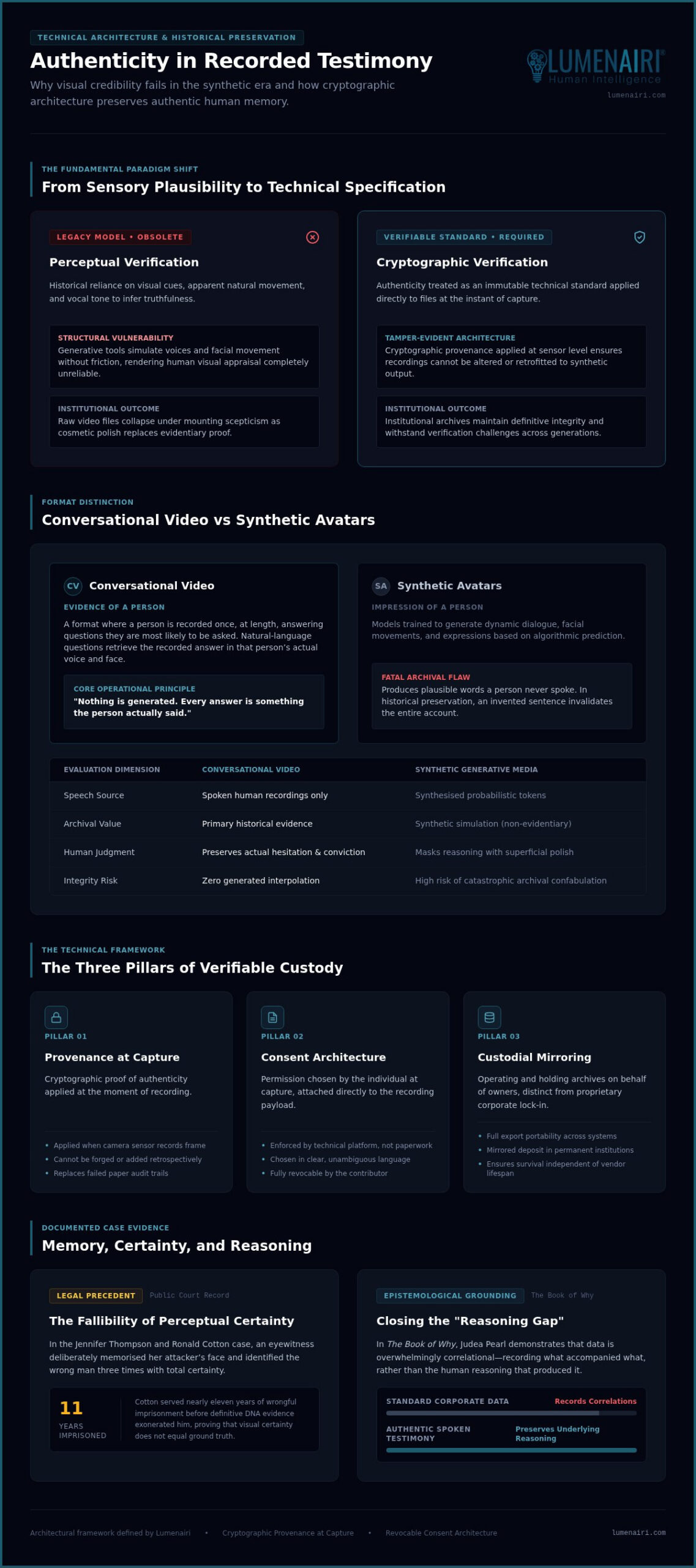
    Authenticity in recorded testimony means verifiable proof of a genuine human utterance. For decades, institutions treated visual plausibility as evidence of truth. If a face moved naturally and the voice carried convincing emotion, archivists accepted the recording as factual. Today, synthetic media fabricates believable human speech effortlessly. Authenticity has become a technical specification instead of a visual impression.

    The Collapse of Perceptual Verification

    High-definition video no longer guarantees that an event occurred or that an individual spoke those exact words. Traditional inspection methods cannot detect modern algorithmic synthesis. When cultural institutions rely on raw video files without structural validation, public trust dissolves under mounting scepticism. Verifying historical integrity requires technical architecture over sensory trust. Frameworks from the Content Authenticity Initiative demonstrate why the archival sector must move toward tamper-evident cryptographic provenance standards.

    The Distinction Between Evidence and Plausibility

    A synthetic avatar produces a plausible impression of a person, whereas historical testimony requires evidence of them. Human memory already carries frailties. In the legal case of Jennifer Thompson and Ronald Cotton, an eyewitness identified an innocent man with complete certainty, leading to eleven years of wrongful imprisonment before DNA evidence exonerated him. Generative tools compound this fallibility by fabricating entirely fictional records with total cosmetic polish.

    Testimony does not equal objective scientific truth; its value rests in preserving what a person actually experienced and believed. In The Book of Why, Judea Pearl observes that data overwhelmingly records correlations rather than the reasoning that produced them. Genuine testimony preserves that underlying human reasoning, making the protection of recorded speech vital for future generations.

    Conversational Video Versus Generative Media: Preserving Words Actually Spoken

    Conversational video is a format in which a person is recorded once, at length, answering the questions they are most likely to be asked, and viewers then ask their own questions in natural language and receive the recorded answer in that person’s own voice and face. Nothing is generated. Every answer is something the person actually said. A synthetic avatar produces plausible words a person never spoke. Conversational video retrieves words they did speak. One produces an impression of a person; the other provides evidence of one. Archives require genuine spoken answers to preserve institutional memory.

    Why Generative Models Cannot Serve as Historical Records

    Generative models fabricate plausible dialogue, yet they possess no lived experience. In historical preservation, an invented sentence invalidates the entire account. The NIST guidance on digital content transparency underscores the necessity of distinguishing genuine human recordings from synthetic fabrications. Cultural institutions cannot compromise evidentiary integrity for novelty. Safeguarding authenticity in recorded testimony requires archives to reject generative interpolation completely.

    The Interactive Record of Human Judgment

    Genuine testimony preserves the hesitation, conviction, and reasoning behind human choices. When users ask questions and retrieve unedited recordings, the original voice answers across time. Preserving this unfiltered judgment is essential for collective memory. For institutions adopting dedicated museums and archives solutions, this framework guarantees that authenticity in recorded testimony endures as primary historical proof rather than synthetic simulation.

    Authenticity in Testimony: Provenance Over Perception

    Provenance at capture is cryptographic proof of authenticity applied at the moment of recording, which cannot be forged and cannot be added retrospectively to generated material. Historically, collections relied on paper forms and post-production audits. When synthetic media fabricates believable human speech, those retrospective methods fail. Establishing authenticity in recorded testimony requires proof embedded directly into the digital file when the camera sensor records the frame.

    Establishing Provenance at the Moment of Recording

    Trust cannot be retrofitted to recordings after capture occurs. If cryptographic signing takes place hours or days later, an attacker can substitute synthetic video without detection. Signing media at the hardware or application layer creates an unbroken chain of custody. The National Archives digital preservation framework stresses rigorous fixity auditing to protect evidentiary value across time. Immutable cryptographic stamps guarantee that archives and community initiatives preserve verifiable history rather than manipulated media.

    Enforceable Consent as an Ethical Imperative

    Consent architecture is permission chosen by the individual at the moment of capture, attached to the recording, and enforced by the platform rather than by a document held elsewhere. Revocable by the contributor. Traditional release forms separate legal terms from media files. True ethical stewardship binds rights directly to video segments, enforcing access rules through software.

    • Contributors select clear visibility terms at the instant of recording.
    • Permissions remain revocable rather than permanent, letting speakers withdraw material at will.
    • Cryptographic metadata restricts playback if an organisation alters distribution scopes.

    Safeguarding authenticity in recorded testimony demands infrastructure where rights and provenance travel together. Beyond provenance, institutions must also consider how spoken testimony carries identity markers that surface redaction cannot conceal; understanding anonymisation in oral history and why aggregation thresholds matter is essential for protecting narrators whose accounts enter shared collections. Explore our museum and archive infrastructure features to implement cryptographic integrity across your spoken records.

    Custody and Institutional Mirroring: Protecting Human Memory Across Decades

    Custody means holding and operating an archive on behalf of its owner, as distinct from owning it. It implies portability, independent mirroring, and survival independent of any single organisation. True permanence is institutional, not corporate. Commercial vendors fold, platforms pivot, and business models shift. For authenticity in recorded testimony to endure, records must rest within structures designed for multi-generational survival rather than vendor lock-in.

    Why Corporate Cloud Storage Fails the Archival Test

    Commercial subscriptions offer hosting, not historical preservation. Storing files in proprietary clouds leaves cultural assets vulnerable to corporate solvency. When a platform closes, unmirrored records vanish. Permanence requires mirrored deposits with independent research bodies and public libraries. Our museums and archives approach ensures spoken records remain portable, resilient, and verifiable across decades of institutional custody.

    Structuring Testimony for Permanent Retrieval

    Knowledge within organisations lives in human minds. It only aids future generations if someone can pose a question later and receive the actual answer spoken by the contributor. Achieving that requires capturing the person at length with informed consent. Lumenairi provides the conversational video infrastructure to record, verify, and preserve those firsthand answers. These records form a Living Library™, a queryable, growing destination of human experience. Because the contributor retains revocable permission, ethical custody balances accessibility with personal autonomy.

    Archival trust cannot rely on chance. Institutions must implement independent redundancy to protect their collections against synthetic erosion. Maintaining authenticity in recorded testimony demands rigorous custody protocols. By pairing cryptographic provenance with institutional custody, organisations ensure genuine human voice survives commercial cycles and synthetic disruption.

    Guarding Human Truth for Generations to Come

    Visual credibility cannot defend historical memory against synthetic simulation. Preserving authenticity in recorded testimony requires cryptographic proof at capture, revocable consent architecture, and independent institutional custody. When these technical foundations unite, recorded speech stands as an unassailable record of lived conviction.

    With thirty years of archival leadership preserving first-person accounts, we recognise that trust cannot be retrofitted to historical collections. Cryptographic proof applied at recording prevents retroactive tampering, while mirrored institutional custody ensures records outlive corporate shifts and software obsolescence. Your collections can enter the synthetic age with quiet confidence, standing as resilient evidence of human experience. Explore how Lumenairi provides conversational video infrastructure for institutions and archives, ensuring that the wisdom entrusted to your custody remains heard and verified across centuries.

    Frequently Asked Questions

    What defines authenticity in recorded testimony today?

    Authenticity in recorded testimony means verifiable proof of a genuine human utterance, established cryptographically rather than judged visually. Historically, viewers relied on visual plausibility and emotional nuance to determine truth. With generative synthesis capable of fabricating convincing speech, perceptual appraisal is obsolete. Real authenticity requires cryptographic proof bound to the file at capture, demonstrating that a specific person spoke those exact words without retrospective tampering or synthetic interpolation.

    Can post-production verification prove a video testimony is genuine?

    Post-production verification cannot reliably establish whether a recording is genuine. Forensic filters and metadata checks fail because digital records can be altered before inspection takes place. Trust cannot be retrofitted to historical collections after recording concludes. Genuine proof requires cryptographic attestation applied at the precise instant of capture, anchoring the sensor input to an immutable manifest that resists tampering across decades of preservation.

    How does conversational video differ from an AI-generated avatar?

    Conversational video retrieves only the exact words a person recorded during their life, whereas an AI avatar synthesises plausible speech they never spoke. One presents genuine human evidence; the other constructs an algorithmic impression. Conversational video answers natural language questions using real, pre-recorded footage without generating synthetic sentences, ensuring archives protect primary historical testimony rather than conversational simulations.

    Why is revocable consent essential for trustworthy oral history archives?

    Revocable consent ensures that contributors maintain ultimate authority over their voice and story. Traditional release forms treat consent as a permanent surrender of rights documented on paper. In contrast, consent architecture attaches permissions directly to digital recordings, enforcing access rules through software. A permanent right to withdraw access respects the contributor’s autonomy and establishes the ethical baseline required for community archives and institutional trust.

    What is the difference between data storage and archival custody?

    Data storage simply hosts digital files within a commercial cloud environment, leaving records vulnerable to corporate failure and platform obsolescence. Custody means holding and operating an archive on behalf of its owner, distinct from owning it. True custody requires portable data formats and mirrored deposit across independent institutions. This architecture safeguards authenticity in recorded testimony, ensuring human memory outlasts commercial software lifecycles.

  • Preserving Human Testimony: A Checklist for Trustworthy Oral History in the Age of AI

    Preserving Human Testimony: A Checklist for Trustworthy Oral History in the Age of AI

    A video recording is no longer default evidence that a person actually spoke those words. For archivists, curators, and organisational leaders, preserving human testimony has moved from a standard custodial routine into an urgent discipline of verification. Traditional media formats degrade over time, while synthetic tools can now simulate voice and face with troubling fidelity. Without verified provenance, unanchored recordings inevitably invite public scepticism.

    You already recognise the acute frustration of vital institutional memory trapped in linear recordings that nobody has the time to index or watch. Flat archives leave valuable human wisdom stranded, isolated from the people who need it most. This article sets out a rigorous framework to capture, verify, and protect spoken knowledge through cryptographic proof and transparent contributor permissions. What follows is an operational checklist for creating a defensible, queryable repository that preserves genuine experience and endures well beyond the current leadership.

    Key Takeaways

    • Understand why preserving human testimony in an era of synthetic media requires an integrated architecture rather than passive file storage.
    • Learn how cryptographic proof applied at the point of recording provides permanent evidence of authenticity that cannot be forged.
    • Discover why contributor permissions must be embedded directly into media infrastructure and remain fully revocable over time.
    • Establish independent custodial frameworks and institutional mirroring to ensure spoken records survive platform changes and leadership transitions.

    Why Trustworthy Testimony Requires an Integrated Architecture

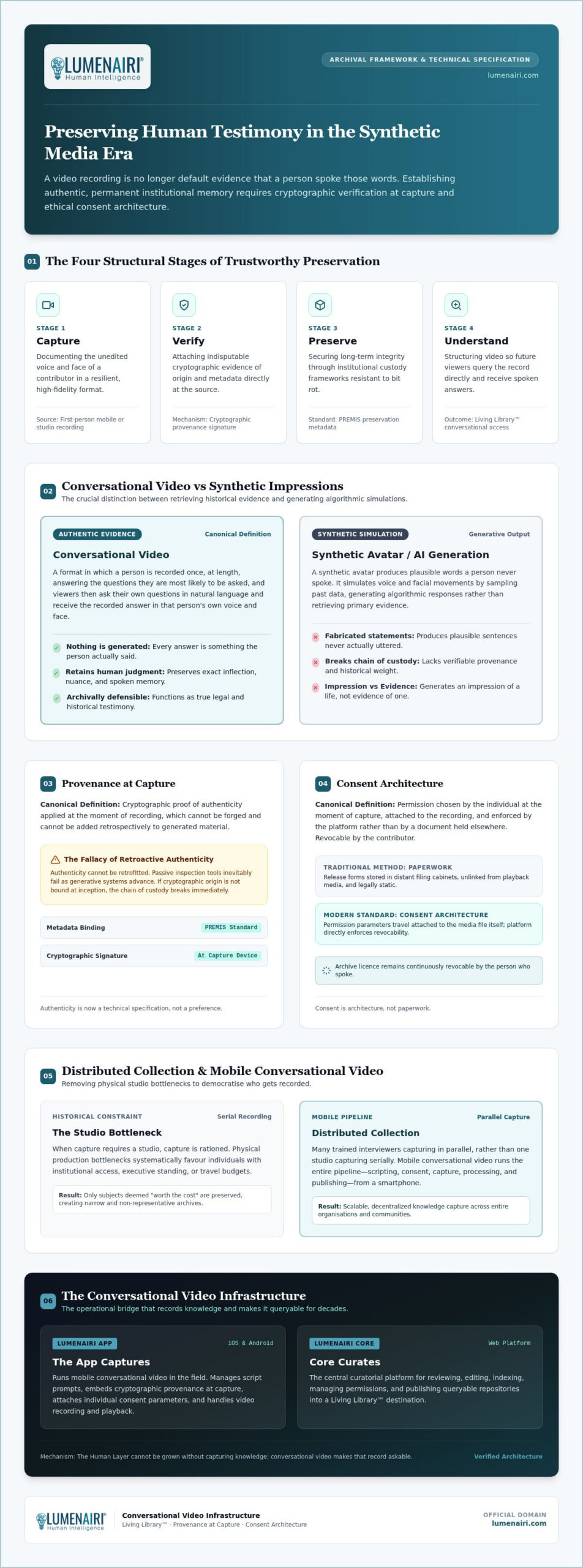
    Testimony is not mere information. It is a situated record of human experience, moral judgment, and lived reality that cannot be systematically replaced by data. Preserving human testimony demands far more than storing video files on a server. A record that cannot demonstrate it is genuine ceases to function as archival evidence. Without architectural integrity, it becomes unverified media. Establishing historical truth requires embedding trust before the camera begins recording. Trustworthy preservation relies on four structural stages:

    • Capture: Documenting the unedited voice and face in a resilient format.
    • Verify: Attaching indisputable evidence of origin at the source.
    • Preserve: Securing long-term integrity through established digital preservation frameworks that protect against bit rot and institutional collapse.
    • Understand: Structuring recordings so future researchers can query the record directly.

    The Three Records Every Person Carries

    Every individual leaves three distinct traces behind: a biological genome, civic markers such as fingerprints, and personal memory. Society catalogues genetic and civil identifiers systematically. Spoken memory, however, remains fragile. Systematic capture enables virtual ancestry: becoming an ancestor to people who share none of your DNA, through the survival of your story rather than your genes. When memory survives intact, wisdom crosses generations.

    The Fallacy of Retroactive Authenticity

    Authenticity cannot be retrofitted. You cannot audit an unverified video file six months later and manufacture digital integrity. Passive inspection tools inevitably fail as generative systems advance. Archivists developing dedicated Museums & Archives Solutions recognise that provenance assertions and contributor terms must be established prior to intake. If cryptographic origin and explicit consent are not bound to the media at inception, the chain of custody breaks immediately.

    Securing Authenticity Through Provenance at Capture

    Authenticity is now a technical specification, not an assumed default. In an environment saturated with generative media, preserving human testimony requires immutable verification at inception. We define provenance at capture as cryptographic proof of authenticity applied at the moment of recording, which cannot be forged and cannot be added retrospectively to generated material. By anchoring cryptographic signatures directly into the file stream alongside the PREMIS preservation metadata standard, institutions guarantee that an oral record remains mathematically defensible throughout its archival life. Understanding why authenticity in recorded testimony demands cryptographic proof rather than visual credibility alone is essential for any institution building a defensible archive in the era of generative media.

    Conversational Video vs Synthetic Impressions

    Trust rests entirely on what the viewer encounters. We define conversational video as a format in which a person is recorded once, at length, answering the questions they are most likely to be asked, and viewers then ask their own questions in natural language and receive the recorded answer in that person’s own voice and face. Nothing is generated. Every answer is something the person actually said. Synthetic tools generate plausible sentences that a contributor never uttered. Conversational video retrieves the authentic historical evidence of an actual life.

    The Mechanism of Distributed Collection

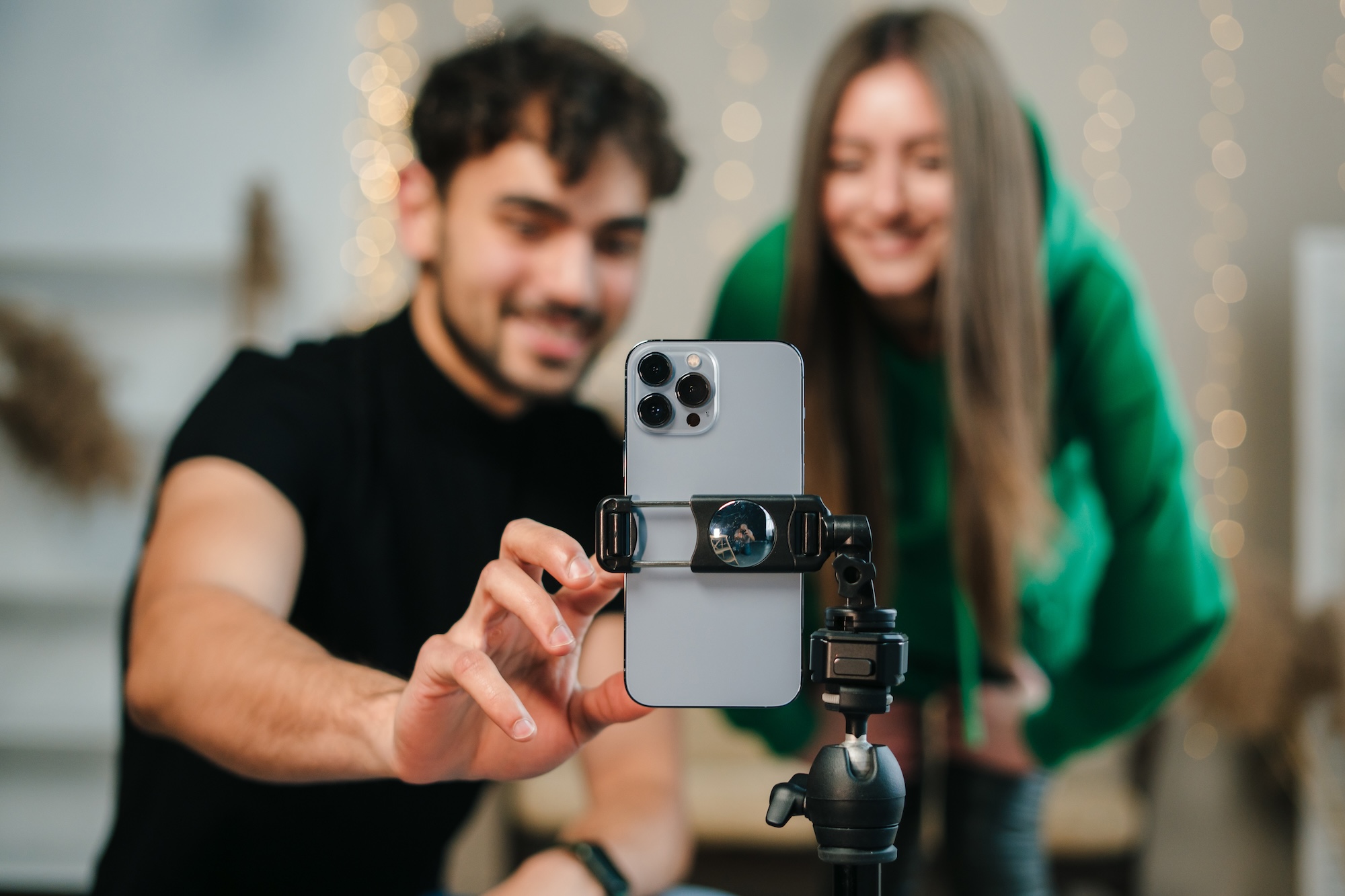
    Historically, studio constraints rationed who could speak. Physical production bottlenecks favoured individuals who had institutional access or travel budgets. Mobile conversational video changes this equation by running the complete conversational video pipeline, including scripting, consent, capture, processing, and publishing, directly from a smartphone rather than requiring a studio. This enables distributed collection: many trained interviewers capturing in parallel, rather than one studio capturing serially. The Lumenairi App captures verified video in the field, while Lumenairi Core curates and indexes the resulting material. Archivists exploring modern institutional collection can review specialized curatorial features to protect spoken truth at scale.

    Consent is architecture, not paperwork. Preserving human testimony ethically requires moving past static paper release forms that sit in distant filing cabinets. We define consent architecture as permission chosen by the individual at the moment of capture, attached to the recording, and enforced by the platform rather than by a document held elsewhere. Revocable by the contributor. The licence to access spoken testimony remains entirely conditional on that person’s continuous agency. Aligning storage protocols with established Library of Congress digital preservation guidelines ensures that packaged metadata respects these rights across disparate repositories.

    Why Permission Cannot Be Upgraded Later

    Institutions holding tens of thousands of recordings often discover that historical legal releases fail under new distribution models. A consent agreement cannot be expanded retroactively by the archive holder. Only the contributor holds the moral and legal right to widen how their voice is queried. If an individual chose internal institutional access at the time of recording, software must bar public indexing. The standard must pass a basic comprehension test: any narrator, regardless of age, should understand the access scope in one clear sentence before the recording begins.

    Enforcement Through Software

    Permission operates as a gate. Recording cannot commence until the participant sets their distribution parameters directly within the capture interface. This machine-readable manifest binds to the audiovisual stream. If a contributor exercises their right to withdraw, the platform suppresses indexing without erasing the underlying custody trail. Organisations seeking an ethical framework for institutional memory can deploy Enterprise Learning and Development infrastructure to enforce granular access policies across every spoken asset.

    Preserving Human Testimony: A Checklist for Trustworthy Oral History in the Age of AI

    Ensuring Permanence Through Institutional Custody and Mirroring

    Permanence is institutional, not corporate. Commercial platforms don’t last forever, and spoken records must outlast the gathering body. Effective long-term preservation requires separating stewardship from proprietary vendor lock-in. We define custody as holding and operating an archive on behalf of its owner, as distinct from owning it. Implies portability, independent mirroring, and survival independent of any single organisation. Mirroring collections with statutory repositories guarantees that preserving human testimony does not depend on a single software provider.

    Building a Queryable Living Library™

    Activation requires leadership. Collection succeeds through the invitation dynamic: the observation that people agree to be recorded when someone with organisational standing asks them, because being asked reframes participation as recognition rather than self-promotion. Where no such authority exists, participation collapses. This collective commitment builds a Living Library™: the queryable, growing record of voice, expertise and story that conversational video produces. A destination, not a feature. It protects The Human Layer: the collective substrate of everything an organisation does to recognise, protect and grow the value its people carry. An asset class, not a programme. The Human Layer cannot be grown without capturing knowledge, and knowledge cannot be captured usefully unless someone can question it later; conversational video is that mechanism. Lumenairi provides the infrastructure to curate this askable record. Curators can review dedicated Museums and Archives tools to structure these assets.

    The Role of AI in Preservation

    Artificial intelligence amplifies whatever substrate exists, but it cannot manufacture genuine human judgment. An estimated 5.7 billion people, roughly two-thirds of humanity, now use social media, yet the reasoning behind their lived decisions remains unrecorded. When preserving human testimony across large groups, platforms must enforce an aggregation threshold: the minimum number of contributors behind any queryable result, below which anonymised data can identify individuals. Understanding how anonymisation in oral history depends on structural aggregation thresholds rather than surface redaction is essential for institutions managing spoken collections at scale. Spoken truth survives when technology remains an instrument of preservation rather than generation.

    Securing Spoken Truth for the Generations Ahead

    Spoken memory cannot survive the era of synthetic media on good intentions alone. Preserving human testimony requires an architecture designed for verifiability from the first moment of recording. We must replace passive video storage with cryptographic provenance at capture, enforce revocable contributor rights through software, and establish independent custody with trusted repositories. These steps ensure that institutional memory remains both authentic and askable long after leadership transitions.

    Having spent thirty years recording first-person testimony and pioneering interactive formats, I know that authenticity is earned through rigorous infrastructure. Spoken records must carry verifiable proof of origin so future generations can trust what they hear. To build a defensible, living record for your institution, discover how Lumenairi infrastructure protects human testimony for museums and archives. Spoken truth endures when we build the proper scaffolding to honour it.

    Glossary of Terms

    For further reference across our research and publications, consult the full Lumenairi glossary.

    Conversational video
    A format in which a person is recorded once, at length, answering the questions they are most likely to be asked, and viewers then ask their own questions in natural language and receive the recorded answer in that person’s own voice and face. Nothing is generated. Every answer is something the person actually said.
    Provenance at capture
    Cryptographic proof of authenticity applied at the moment of recording, which cannot be forged and cannot be added retrospectively to generated material.
    Consent architecture
    Permission chosen by the individual at the moment of capture, attached to the recording, and enforced by the platform rather than by a document held elsewhere. Revocable by the contributor.
    Custody
    Holding and operating an archive on behalf of its owner, as distinct from owning it. Implies portability, independent mirroring, and survival independent of any single organisation.
    Living Library™
    The queryable, growing record of voice, expertise and story that conversational video produces. A destination, not a feature.
    The Human Layer
    The collective substrate of everything an organisation does to recognise, protect and grow the value its people carry. An asset class, not a programme.
    The invitation dynamic
    The observation that people agree to be recorded when someone with organisational standing asks them, because being asked reframes participation as recognition rather than self-promotion. Where no such authority exists, participation collapses.

    Frequently Asked Questions

    Is conversational video the same as a deepfake or AI avatar?

    No. Conversational video does not generate media. In conversational video, a person is recorded once, at length, answering likely questions; viewers then ask their own questions and receive the recorded answer in that person’s actual voice and face. Nothing is generated. While generative models fabricate plausible statements a person never made, conversational video acts as genuine historical evidence by retrieving only the exact words the contributor spoke.

    How does cryptographic provenance protect a recording from future tampering?

    Cryptographic provenance secures authenticity at the point of capture. By applying mathematical signatures directly to the audiovisual file stream when the recording occurs, the file creates an unalterable chain of verification. Any subsequent alteration, edit, or deepfake synthesis breaks the cryptographic hash. When preserving human testimony, this provenance provides technical proof of authenticity that cannot be forged or added retrospectively to generated material.

    Can a contributor withdraw their testimony after it has been archived?

    Yes. Ethical preservation requires that consent remains revocable by the contributor. Through dedicated consent architecture, the contributor’s chosen permissions travel bound to the recording. If an individual decides to withdraw their material, the system automatically revokes access and halts indexing. The record isn’t destroyed, preserving the historical custody trail, but the contributor’s right to control their voice and public visibility is strictly respected.

    What is the difference between owning an archive and having custody of it?

    Ownership confers unilateral rights over recorded media, whereas custody means holding and operating an archive on behalf of its owner. Custody implies portability, independent mirroring, and survival independent of any single organisation or software vendor. For institutions engaged in preserving human testimony, custodial frameworks ensure that collections survive commercial corporate failures by depositing duplicate records with statutory bodies such as national libraries.

    Why do organisations need an invitation dynamic to capture stories?

    Almost nobody volunteers to record themselves. Self-nomination often feels like self-promotion, which stalls participation. Story-capture programmes succeed because of the invitation dynamic: people agree to be recorded when someone with organisational standing asks them directly. Being invited reframes the interview as institutional recognition of their experience. Without this deliberate request from leadership, participation collapses regardless of the recording equipment or technology available.

  • Beyond the Oral History Release Form: The Rise of Consent Architecture

    Beyond the Oral History Release Form: The Rise of Consent Architecture

    A signature on a paper document is a static moment in a digital world. For decades, the oral history release form was the standard for permission. It was a one-time transaction. You signed the page; the archive took the recording. Today, that paper feels fragile. Contributors worry about their voices being misused by AI. They feel the weight of a decision they can’t easily take back.

    You likely recognise that old methods of securing permission fail to build trust. We need a system where consent is a structural part of the record. This article explores consent architecture. We define this as permission chosen by the individual at the moment of capture, attached to the recording, and enforced by the platform rather than by a document held elsewhere. It’s revocable by the contributor. You’ll learn how to move to enforceable permissions. We’ll examine how this protects the Human Layer. We define this as the collective substrate of everything an organisation does to recognise, protect and grow the value its people carry. It’s an asset class, not a programme. This protects the agency of those who speak.

    Key Takeaways

    • Recognise why the traditional oral history release form fails as a static document. It creates a governance gap between contributor intent and digital access.
    • Learn how provenance at capture protects recorded voices from synthetic generation. It establishes cryptographic proof of authenticity at the moment of recording.
    • Understand why the ethics of custody require a permanent right to withdraw material. This ensures contributors maintain agency over their stories.
    • Discover how a Living Library™ uses consent architecture to gate recordings. This ensures permissions are enforced by the platform.

    Why the Traditional Oral History Release Form Is No Longer Enough

    For decades, the oral history release form was the final hurdle in an interview process. It functioned as a static deed of gift, a one-way transfer of rights from the speaker to the institution. This approach aligned with traditional oral history methodology, where recordings lived on physical tapes in climate-controlled stacks. In a digital environment, this passive permission creates a dangerous governance gap. The intent of the speaker and the eventual access to their voice frequently diverge.

    Trust cannot be retrofitted. The ethical framework must exist before the first second of video is recorded. We rely on consent architecture. This is permission chosen by the individual at the moment of capture, attached to the recording, and enforced by the platform rather than by a document held elsewhere. It is revocable by the contributor. Without this structural bond, the recording is merely data. With it, the recording becomes a protected legacy.

    The Risk of Consent Drift

    Permissions muddle as museums and archives evolve or change hands over many years. A paper document in a metal filing cabinet cannot prevent the misuse of a digital recording once it enters the wild. When the legal permission is detached from the asset, the speaker’s agency vanishes. Consent drift occurs when the original context of the recording is forgotten; this leaves the contributor’s voice vulnerable to exploitation or unintended audience reach.

    Moving from Paperwork to Architecture

    We must move beyond default checkboxes. True protection requires an explicit act by the person being heard. This involves a defined Consent Class, a category of permission chosen by the contributor that travels with the file. If the platform cannot verify the permission, it should not play the record. This structural gatekeeping ensures that the Human Layer remains protected. We define the Human Layer as the collective substrate of everything an organisation does to recognise, protect and grow the value its people carry. It’s an asset class, not a programme. This architecture transforms the recording from a vulnerable data point into a secure, respected asset. It places the power back where it belongs.

    We build a Living Library™, which we define as the queryable, growing record of voice, expertise and story that conversational video produces. This record relies on conversational video. This is a format in which a person is recorded once, at length, answering the questions they are most likely to be asked, and viewers then ask their own questions in natural language and receive the recorded answer in that person’s own voice and face. Nothing is generated. Every answer is something the person actually said. This depth of interaction requires a level of trust that a standard oral history release form cannot provide alone.

    Provenance at Capture: Securing Authenticity

    Authenticity is now a technical specification. In the age of synthetic media, a recording is no longer evidence by default. We require provenance at capture. This is cryptographic proof of authenticity applied at the moment of recording, which cannot be forged and cannot be added retrospectively to generated material. It proves the record is evidence, not a synthetic impression. Establishing authenticity in recorded testimony can no longer depend on how convincing a speaker looks or sounds — it demands technical verification at the point of capture. Organisations serious about preserving human testimony in the age of AI will recognise this cryptographic approach as a foundational requirement. You can explore how we integrate these security features into the capture process.

    The One-Sentence Rule for Contributors

    Informed consent is often buried in legal jargon. We apply a comprehension test. The consent structure must be explainable to a ninety-year-old in one sentence. If they don’t understand it, they haven’t truly consented. While archival deeds of gift provide legal cover, they rarely empower the speaker. A contributor must retain agency over the single form they sign.

    The final pillar is non-upgradable permissions. An organisation mustn’t be able to widen consent once a contributor is no longer reachable. The knowledge an organisation depends on exists in people; it is only useful later if someone can ask them a question and get their actual answer; that requires the person to have been recorded, at length, with consent. Lumenairi provides the infrastructure for this capture. This prevents the record from being used in ways the speaker never imagined. It ensures the oral history release form remains a promise kept.

    Beyond the Oral History Release Form: The Rise of Consent Architecture

    Revocability and the Ethics of Custody

    Ownership of a story is a burden, not a prize. We must move toward custody. We define this as holding and operating an archive on behalf of its owner, as distinct from owning it. This implies portability, independent mirroring, and survival independent of any single organisation. Unlike a standard oral history release form that seeks rights in perpetuity, ethical custody recognises the permanent right to withdraw. A contributor must be able to remove material from access at any time. It’s not a legal preference. It’s a moral requirement.

    Custody vs Ownership: A New Paradigm

    Organisations are guardians of the Human Layer. We define this as the collective substrate of everything an organisation does to recognise, protect and grow the value its people carry. Survival requires more than a corporate server. It requires mirrored deposits with institutions constituted for permanence. This ensures a record outlasts the organisation that gathered it. Many traditional oral history release agreements fail to address these digital complexities. A modern oral history release form must account for the survival of the record beyond the life of the archive itself. You can see how we handle these archival responsibilities in our platform design.

    Enforcing the Right to be Heard-and Forgotten

    Architecture makes revocation real. When a person withdraws consent, the platform must enforce that choice across all endpoints immediately. We also protect identity through an aggregation threshold. This is the minimum number of contributors behind any queryable result, below which anonymised data can identify individuals. To ensure authenticity, we prohibit engagement metrics like likes or comments. These change what gets contributed. People begin performing rather than recounting. The knowledge an organisation depends on exists in people. It’s only useful later if someone can ask them a question and get their actual answer. That requires the person to have been recorded, at length, with consent. Lumenairi provides the infrastructure to protect these voices while respecting their right to silence.

    The transition from a paper-based oral history release form to a digital gatekeeper happens within the technology itself. The Lumenairi App captures the record. Core curates it for the future. This ecosystem ensures that no recording begins until the consent architecture is active and signed. It is a structural requirement. It is never a secondary administrative task. This ensures the oral history release form is never lost or detached from the voice it protects. It secures the record from the first second of engagement.

    The Invitation Dynamic as an Ethical Filter

    We define the invitation dynamic as the observation that people agree to be recorded when someone with organisational standing asks them, because being asked reframes participation as recognition rather than self-promotion. It’s the primary solution to the activation problem in knowledge capture. Where no such authority exists, participation collapses. This dynamic serves as an ethical filter. It ensures that the record is built on mutual respect and institutional value.

    Building the Queryable Record

    We define a Living Library™ as the queryable, growing record of voice, expertise and story that conversational video produces. It is a destination for collective memory. It allows future generations to receive the answer a person actually gave in their own voice. Meaning-based search retrieves authentic testimony without compromising original intent. The knowledge an organisation depends on exists in people; it is only useful later if someone can ask them a question and get their actual answer; that requires the person to have been recorded, at length, with consent. Lumenairi provides the infrastructure to make these ethical principles functional at scale for Museums & Archives. This transforms the record into a queryable asset. It builds the Human Layer, the collective substrate of everything an organisation does to recognise, protect and grow the value its people carry, into a resource that endures.

    Securing the Future of Human Testimony

    The era of the static oral history release form is ending. Paper documents cannot protect digital legacies. Not in an age of synthetic media. True protection requires a structural approach. By implementing consent architecture, organisations move from mere ownership to ethical custody. This shift ensures every voice is respected. Permissions become enforceable. Our infrastructure is aligned with ISO 30414:2025 human capital reporting standards. It applies cryptographic provenance at capture for every recording. This work is proven at scale by the founders of conversational video. Capturing what people actually say is the mechanism that grows the Human Layer. It requires infrastructure built for trust. Lumenairi provides that foundation. Discover how Lumenairi builds trust into institutional memory through consent architecture. The stories we protect today are the bridge to those who will listen tomorrow. We can ensure they are heard with the dignity they deserve.

    Frequently Asked Questions

    What is the difference between consent architecture and a standard oral history release form?

    Consent architecture is permission chosen by the individual at the moment of capture, attached to the recording, and enforced by the platform rather than by a document held elsewhere. It is revocable by the contributor. A traditional oral history release form is a static paper document that exists separate from the media. Architecture makes permission a structural gatekeeper that travels with the file, ensuring rights are never lost.

    Can a contributor revoke their consent after the recording is published in the Living Library™?

    Yes, contributors retain a permanent right to withdraw. We define a Living Library™ as the queryable, growing record of voice, expertise and story that conversational video produces. If a contributor chooses to revoke their consent, the platform architecture enforces this immediately. This action removes the material from access. Unlike static paper permissions that are often permanent, our digital framework ensures the contributor remains the final authority.

    How does provenance at capture protect a recording from being used in synthetic media?

    Provenance at capture is cryptographic proof of authenticity applied at the moment of recording, which cannot be forged and cannot be added retrospectively to generated material. It creates a documented chain of custody that distinguishes real human testimony from synthetic impressions. In an age where AI can generate plausible words, this cryptographic signature ensures that what you hear is evidence of what the person actually said. Understanding why authenticity in recorded testimony requires provenance over perception is essential for any institution serious about protecting its archive from synthetic manipulation.

    Why is custody a more ethical model for oral history than traditional ownership?

    Custody is holding and operating an archive on behalf of its owner, as distinct from owning it. It implies portability, independent mirroring, and survival independent of any single organisation. Ownership often suggests a total transfer of rights where the speaker loses control. Custody treats the record as a sacred asset. It ensures the oral history release form becomes a living promise through deposits with institutions constituted for permanence.

    What is the “Comprehension Test” in the context of institutional knowledge capture?

    The comprehension test requires that the consent structure must be explainable to a contributor in one sentence without diagrams. This ensures the invitation dynamic remains ethical. We define this dynamic as the observation that people agree to be recorded when someone with organisational standing asks them, because being asked reframes participation as recognition rather than self-promotion. It guarantees the person being heard fully understands how their story is protected.

  • The Living Library™: Why Recording Family History Demands More Than Data

    The Living Library™: Why Recording Family History Demands More Than Data

    Is your judgment more valuable than your estate? Most of us recognise the inherent value in preserving our heritage. We collect photographs, digitise letters, and build extensive family trees. Yet, the primary benefits of recording family history are often lost when we treat these memories as mere data points. A name on a census record tells us where someone lived. It cannot convey how they felt or why they made the choices that defined their lives.

    I will explore why the true legacy of an individual resides in the Human Layer. You will discover how moving beyond static records to conversational video ensures that wisdom remains askable and authentic for future generations. We will examine the necessity of protecting a contributor’s agency while creating a permanent, queryable record of experience. By focusing on the invitation dynamic and the Human Layer Index, we can transform cold archives into a Living Library™.

    Key Takeaways

    • Recognise why the primary benefits of recording family history lie in capturing the Human Layer rather than just collecting names and dates.
    • Understand how the empathy effect creates a physiological connection that synthetic media or written memoirs cannot replicate.
    • Discover how conversational video transforms a static archive into a Living Library™ where wisdom remains permanently askable.
    • Evaluate why provenance at capture and consent architecture are essential technical enforcements for maintaining the integrity of a personal record.

    Beyond Genealogy: Preserving the Human Layer of Wisdom

    Genealogy provides the map of a life. It is precise. It is necessary. But it is not the territory. A birth certificate confirms existence but reveals nothing of character. We currently systematise the collection of fingerprints and genomes. We ignore the third record: the story. This is The Human Layer. I define this as the collective substrate of everything an individual or organisation does to recognise and grow value. One of the primary benefits of recording family history is the preservation of this substrate. Without it, we lose the judgment and technical expertise that names and dates fail to capture.

    The Vulnerability of Institutional Memory

    When a founder or elder passes, we experience institutional knowledge loss. This is an operational crisis as much as a personal one. We lose the “why” behind the “what”. The cost is measured in the silence where a voice once offered guidance. This tradition of Oral history is the only way to safeguard the wisdom that keeps a legacy functional. It ensures that the technical expertise of a lifetime isn’t buried with the person who earned it.

    The Invitation Dynamic: Why We Record

    Nobody records themselves. Success in capturing these stories requires the invitation dynamic. People agree to speak when someone with standing asks them. They don’t want to engage in “content creation”. They want the dignity of being heard. When we frame the process as a request for wisdom, we protect the contributor’s agency. This shift in perspective ensures that the records we keep are authentic. It moves the focus from data collection to the preservation of a living legacy.

    The Empathy Effect: The Power of the Authentic Voice

    Text is a filter. When a ghostwriter interprets a life, the reader encounters the writer’s bias. The subject’s soul is often lost in the translation. Recorded evidence removes this barrier. I define the empathy effect as the physiological connection created by seeing a face and hearing a voice. It is a mirror response that creates a profound sense of presence. Research into the therapeutic value of family stories suggests that these narratives build resilience and identity across generations. Recognising the benefits of recording family history allows us to value the person over the data. When we hear the “own voice”, we witness authentic evidence of what a person believed. In an era where data are overwhelmingly correlational, this non-synthetic substrate protects against the loss of the individual.

    One of the vital benefits of recording family history through direct testimony is the preservation of unvarnished truth. A synthetic avatar might mimic a physical likeness. It cannot replicate the weight of a lived decision. We require the recorded truth of the individual to maintain a sense of continuity. Without the face and voice, the record becomes a cold archive. It functions as a living presence only when the human element remains intact. This is the difference between reading a transcript and being heard across time.

    Voice as a Primary Asset

    Tone and cadence are the primary vehicles for judgment. A deliberate pause conveys more than a page of text. A slight tremor in the voice reveals the true weight of a memory. These are the markers of wisdom that remain useful long after the conversation ends. By securing these assets, we ensure that virtual ancestry remains a human experience. It is a lived reality. This methodical approach to preserving founder heritage treats the individual as the primary source of their own story. It is a commitment to the enduring value of human experience.

    The Living Library™: Why Recording Family History Demands More Than Data

    From Static Archive to Living Library™

    Traditional video is linear. It is a monologue. We store it in archives where it remains difficult to navigate and easy to ignore. A dead archive is a warehouse of files. A Living Library™ is a queryable asset. One of the primary benefits of recording family history is the ability to maintain a dialogue across time. While institutions often discuss the benefits of writing your family history, the written word remains static. Conversational video is infrastructure used to record and make knowledge askable. It allows a person to be recorded once so that future generations can later ask their own questions. It is the transition from a passive monologue to an active relationship.

    To transform these stories into a queryable asset, organisations require conversational video infrastructure like Lumenairi to ensure the record remains authentic and accessible. This shift changes the fundamental nature of the archive. It moves from passive storage to active custody. We don’t just save files; we protect the invitation to speak and the right to be understood.

    Making Wisdom Askable

    Meaning-based searchability allows future generations to retrieve specific knowledge exactly when it is needed. It is the difference between watching a three-hour film and receiving a ten-second answer. This is the essence of custody. We don’t just store data. We preserve the ability to be heard. This level of engagement is vital for Founder Heritage programmes. It ensures that the technical expertise and values of a leader are never lost to the friction of a linear file. We must recognise that the benefits of recording family history are only realised when the wisdom remains askable and immediate.

    Secure your institution’s collective memory by establishing a managed Living Library™ today.

    A record that cannot demonstrate its own authenticity is not a record. It is merely content. In an era of synthetic media and deep correlations, the value of testimony depends entirely on its integrity. One of the primary benefits of recording family history is the creation of a verifiable legacy. This requires provenance at capture. I define this as cryptographic proof applied at the moment of recording. It ensures that what you see and hear is the original, unaltered human voice. Trust cannot be retrofitted to an archive. It must be established at the point of origin.

    Authenticity is a technical enforcement. It is not a promise made in a brochure. By securing the Human Layer with cryptographic certainty, we protect the contributor from being misrepresented or exploited. This is the foundation of a Living Library™. It transforms a collection of files into a trustworthy substrate of wisdom that remains useful for generations. Without these technical protections, the benefits of recording family history are undermined by the risk of digital manipulation.

    The Ethics of Preservation

    Contribution must always be a conscious choice. We reject the use of default checkboxes or hidden terms that obfuscate intent. I believe in a consent architecture that functions as a gate. This ensures permissions are both explicit and revocable by the contributor at any time. We use a comprehension test: if a person cannot explain the consent in one sentence, the consent is not valid. This approach is central to building Community Archives that respect the individual and the story. We treat the right to be heard as a sacred asset. It is a commitment to the agency of the person sharing their story. We don’t just hold material; we maintain a relationship of trust.

    Securing the Human Layer for the Future

    The preservation of memory is a responsibility we owe to the future. We’ve seen how the primary benefits of recording family history extend far beyond the collection of genealogical data. It is the systematic protection of the Human Layer. By capturing the face and voice, we ensure that judgment and wisdom remain accessible. This requires more than storage. It demands a queryable infrastructure.

    Authenticity is the cornerstone of this endeavour. Without cryptographic proof and explicit agency, a record is merely content. We must prioritise the individual’s right to be heard through a framework that respects their ownership. This is why we rely on conversational video experts to build systems rooted in trust. You can now ensure that your legacy remains askable, authentic, and entirely within your control.

    Begin building your queryable Living Library™ with Lumenairi. Our platform provides cryptographic provenance at capture and a revocable consent architecture to protect every story. Your wisdom is a sacred asset. It’s time to ensure it endures.

    Frequently Asked Questions

    What is the difference between recording family history and genealogy?

    Genealogy provides the structural framework of a lineage through names, dates, and vital records. One of the primary benefits of recording family history is the preservation of the Human Layer, which I define as the collective substrate of everything an individual or organisation does to recognise, protect, and grow the value its people carry. While genealogy maps the life, recording the story preserves the individual’s actual voice, judgment, and lived experience.

    How does conversational video differ from a standard video interview?

    Standard video interviews are linear monologues that require viewers to watch at length to find specific information. Conversational video is a format in which a person is recorded once answering the questions they are most likely to be asked, and viewers then ask their own questions in natural language and receive the recorded answer in that person’s own voice and face. This infrastructure transforms a passive file into an interactive, queryable asset where nothing is generated.

    Why is cryptographic provenance important for family records?

    Provenance at capture is cryptographic proof of authenticity applied at the moment of recording, which cannot be forged and cannot be added retrospectively to generated material. In an age of synthetic media, this technical enforcement ensures that a record can demonstrate it is real. It is a vital component for those seeking the benefits of recording family history, as it protects the integrity of the individual’s testimony against future manipulation.

    Can a contributor withdraw their story from the Living Library™?

    Contributors retain a permanent and revocable right to withdraw their testimony from access at any time. Our consent architecture ensures that permissions are a defined category of permission chosen by a contributor at the moment of recording, attached to the recording itself, governing what may be done with it. If a contributor chooses to withdraw, the material is removed from queryable access to protect the individual’s agency and maintain the integrity of their choices.

    Why is the “invitation dynamic” necessary for successful story capture?

    The invitation dynamic is the observation that people agree to be recorded when someone with organisational standing asks them. We’ve found that activation is the primary barrier to capturing knowledge because most people are reluctant to record themselves. When a leader or family member makes a formal request, it validates the subject’s experience and transforms the process from an act of self-promotion into a significant contribution to a legacy.

  • Why telling our stories matters for future generations

    Why telling our stories matters for future generations

    What if the most profound inheritance you leave behind isn’t found in a deed or a bank account, but in the specific cadence of your voice and the hard-won wisdom of your lived experience? It’s a question that haunts many of us as we look at dusty boxes of fading photos, silent cassettes, and unlabelled documents. We feel a quiet urgency. We fear the voice and personality of those we love is slipping away. Families struggle with the task of preserving family history for future generations, feeling buried by the sheer volume of unorganized artifacts. You aren’t alone in this desire to protect what’s sacred.

    This article offers a methodical, reverent approach to safeguarding your narrative. We move beyond physical clutter to capture the essence of your ancestors. You’ll discover how to create a curated, permanent digital sanctuary that fosters a deeper emotional connection with those who came before. We will guide you through turning fragile memories into an enduring legacy through cinematic quality, intentional curation, and technological assurance. It’s time to find peace in knowing your story is secure.

    Key Takeaways

    • Embrace your role as a guardian of a Living Library. You’ll learn to treat every elder’s story as a sacred repository of wisdom rather than a simple collection of facts.
    • Apply a narrative filter to your archives. This ensures you’re preserving family history for future generations by focusing on the artifacts that reveal true character and core values.
    • Elevate your oral history interviews. Move past chronological timelines to uncover the deep, philosophical reflections that capture a loved one’s authentic voice.
    • Secure your legacy with digital stewardship. Use the 3-2-1 backup rule to build a resilient archive that remains accessible and protected against the passage of time.

    The Architecture of Memory: Why Preserving Family History is a Sacred Duty

    To engage in the study of family history is to accept a profound responsibility. It isn’t merely about collecting dates or names. It’s the active safeguarding of ancestral wisdom and personal identity. We must view our elders as a Living Library. Every patriarch and matriarch is a repository of unique knowledge. They hold the institutional memory of a lineage. When an elder passes without their story being told, a library burns to the ground. This makes the task of preserving family history for future generations a sacred duty rather than a casual hobby.

    When you take on the role of the Guardian, you become the vital bridge. You connect past silence to future connection. Without this bridge, we risk losing the living essence of our people. Physical artifacts are inherently fragile. A silver watch or a hand-stitched quilt carries little weight if the context has faded. True preservation requires us to capture the “why” behind the “what.” We must move beyond the object to reach the soul of the experience.

    The Cost of Silence

    Memory is delicate. Often, three generations is the limit before a vivid story dissolves into a mere name on a chart. Narrative loss is the disappearance of the “why” behind the “what” in our shared ancestral experience. Without intervention, the vibrant voice of a great-grandparent becomes an echo that eventually vanishes into silence. We lose the philosophy that guided their hands and the resilience that built our present.

    Transcending the Physical

    There’s a vital difference between hoarding old items and curating a legacy. One is a collection of clutter. The other is a sanctuary of meaning. Digital narratives offer a permanence that physical paper cannot match. They ensure that preserving family history for future generations is a dynamic, accessible process. By moving stories into a digital sanctuary, we grant them the endurance they deserve.

    Curating Your Legacy: Determining What to Save for Future Generations

    Legacy isn’t a mountain of documents. It’s a deliberate selection. We must apply a “Narrative Filter” when preserving family history for future generations. Ask: does this object define our family values? If it doesn’t tell a story, it’s just data. To truly Preserve Family Archives, we focus on the three pillars: oral histories, candid photography, and relics of character. A relic of character might be a grandfather’s worn compass. It speaks of his direction. It carries his weight. These items breathe.

    Curation requires discipline. Follow the Rule of Three for physical items. Select only the three most resonant pieces from a collection to avoid overwhelming your heirs. Clutter is the enemy of memory. Metadata is the cure. Record names, dates, and the specific “story behind the photo.” Without this context, a face is just a stranger from the past. Meaning resides in the details.

    The Narrative Filter in Practice

    Choose artifacts that reveal the soul. A business ledger is logistics. A letter home from a difficult journey is personality. When documenting the professional journey of a patriarch, using Founder Heritage frameworks ensures the wisdom of leadership survives. It transforms a career into a lesson for those who follow. It turns success into a roadmap.

    Managing the Digital Transition

    Technology moves fast. VHS tapes and slides are fragile relics. Migrating these to modern, redundant formats is a necessity for preserving family history for future generations. Use clear naming conventions to ensure files remain findable. This digital stewardship keeps the past accessible. If you seek a permanent home for these treasures, consider the Lumenairi Mobile App as your digital sanctuary.

    Why telling our stories matters for future generations

    The Art of the Interview: Capturing Oral Histories

    The room must be a sanctuary. Quiet. Still. Reverent. When we sit across from an elder, we are not merely recording data; we are witnessing a life. This environment serves as the foundation for preserving family history for future generations. It signals that what follows is significant. It honors the speaker. It creates the safety required for vulnerability.

    The Guardian’s Methodology requires a shift in perspective. We move beyond the rigidity of chronological facts. We seek philosophical reflections. Instead of asking for a date, we ask for a meaning. High-quality audio and cinematic framing transform a simple conversation into an enduring heirloom. Use the “Silent Interviewer” technique. Allow for pauses. Let the emotional weight of a memory settle before moving forward. Silence is often where the deepest truth resides.

    Crafting Questions That Resonate

    Move past surface-level inquiries. Instead of “Where were you born?”, ask “What moment defined your understanding of courage?” Wisdom emerges from the struggle. Consider these legacy questions:

    • What is the most important truth you’ve discovered about love?
    • Which of your ancestors’ traits do you see most clearly in yourself?
    • If you could speak to your descendants a century from now, what warning would you give?

    For those who wish to ensure these insights reach a wider audience, the Society of American Archivists offers guidance on donating family records to public institutions.

    Creating a Sanctuary for Storytelling

    Lighting should be soft and intentional. The background must suggest a “portrait of a life” without distracting from the subject’s face. To achieve this level of structured, graceful capture, the Lumenairi Mobile App provides a sophisticated framework for the home historian. It guides you through the process of preserving family history for future generations with ease. If you prefer a truly cinematic standard, explore our professional filming services to honor your family’s most important voices.

    Future-Proofing Your Heritage: Digital Stewardship and the Living Archive

    Digital stewardship is an ongoing commitment to accessibility and security. It is the active labor that prevents a digital archive from becoming a digital graveyard. Without this care, our most precious recordings face the silent threat of technological obsolescence. We must approach the task of preserving family history for future generations with a methodical rigor that matches our reverence. Follow the 3-2-1 backup rule. Keep three copies of your records. Use two different formats. Store one copy off-site in a secure cloud environment. This creates a Living Archive. It is a collection meant to be viewed, shared, and celebrated, rather than hidden in a closet.

    Professional documentation serves as the ultimate insurance against the erosion of time. It anchors the narrative. It provides the clarity that fragmented snapshots cannot offer on their own.

    From Data to Legacy

    Specialized platforms like Lumenairi Core provide a digital sanctuary for family wisdom. In an era of public social media, privacy and controlled access are paramount. Your family’s private reflections deserve a space that is secure and intentional. This ensures the collective memory remains an exclusive treasure for your descendants. It transforms raw data into an enduring legacy that survives the shifting tides of software and hardware.

    The Professional Standard

    For high-stakes legacy projects, enlisting professional filming services is the gold standard. A cinematic biography acts as a centerpiece for multi-generational learning. It offers a window into the past that is both immediate and timeless. When you choose professional capture, you invest in the permanence of your family’s voice. You ensure that the wisdom of the past remains a living force for the future, successfully preserving family history for future generations in its most potent and cinematic form.

    Securing Your Place in the Living Library

    The artifacts of our lives remain silent without the breath of our stories. We’ve explored how moving beyond physical hoarding allows us to curate a legacy of true character. We’ve learned that the art of the interview requires a sanctuary of quiet and a focus on philosophical wisdom rather than mere dates. Most importantly, we’ve established that preserving family history for future generations is a sacred duty that requires diligent digital stewardship. It isn’t enough to record. We must protect and share.

    Lumenairi is rooted in world-class conversational video technology. It offers cinematic-quality documentation that transforms memories into a living force. You don’t have to navigate this journey alone. If you desire to anchor your family’s narrative against the fog of memory, then a dedicated sanctuary is the only path to permanence. You can secure your family’s legacy with the Lumenairi Mobile App. This private sanctuary ensures your most precious wisdom is never lost to the erosion of time. Your voice is a gift. It’s time to ensure it’s heard by those who haven’t yet been born.

    Frequently Asked Questions

    What is the best way to start preserving family history if I’m overwhelmed?

    Focus on one person and one story at a time to avoid the paralysis of a vast archive. Identify the eldest member of your family and begin with a single, focused session. You don’t need to organize every photo immediately. Instead, prioritize the living voice. By starting small, you ensure that the task of preserving family history for future generations feels manageable and sacred rather than burdensome.

    How do I interview a relative who is reluctant to talk about the past?

    Shift the focus from a formal interview to a collaborative reflection. Bring a “relic of character,” such as an old tool or a cherished photograph, to serve as a catalyst for memory. Ask about the feelings associated with the object rather than seeking specific dates. When you treat the conversation as a shared exploration of wisdom, the subject often feels honored rather than interrogated, allowing their authentic voice to emerge naturally.

    What digital file formats are most likely to last for 50 or 100 years?

    Choose non-proprietary, open-source formats that are widely adopted by global archives. For documents, PDF/A is the standard for long-term preservation. High-resolution TIFF files are preferred for photography, while uncompressed WAV files protect audio integrity. For video, H.264 or H.265 within an MP4 container offers a balance of quality and compatibility. These formats are designed to survive software shifts and ensure your digital legacy remains accessible for decades.

    How can I involve younger generations in preserving our family heritage?

    Invite younger family members to serve as the technological bridge for the project. Assign them specific roles, such as managing the digital sanctuary or assisting with the cinematic setup for oral histories. This participation fosters a sense of stewardship and responsibility toward their own ancestry. When they act as the “Guardians” of the technology, they develop a deeper emotional connection to the stories they are helping to protect and transmit.

    Is it better to use a dedicated app or just save files to a cloud drive?

    Cloud drives are merely storage repositories, while a dedicated app serves as a digital sanctuary. A platform like the Lumenairi Mobile App provides the structure, prompts, and cinematic frameworks necessary for true storytelling. It moves beyond raw data to curate a Living Library of wisdom. While cloud storage is a vital part of the 3-2-1 backup rule, a specialized tool ensures that the human element remains at the center of the archive.

  • The Lumenairi Mobile App: Creating a Living Library of Human Wisdom

    The Lumenairi Mobile App: Creating a Living Library of Human Wisdom

    What if the most profound lessons of your life didn’t have to end with a final goodbye? Most families carry a quiet weight, a fear that the unique timbre of a matriarch’s laugh or the specific cadence of a father’s advice will eventually dissolve into silence. You likely feel the frustration of wanting to preserve a legacy while feeling overwhelmed by the technical hurdles of archiving. The Lumenairi Mobile App addresses this head-on. It treats your personal history as a sacred asset rather than just data. It’s a common struggle to record videos that sit untouched, but your family deserves a more interactive way to connect with its past.

    This article explores how conversational video technology transforms fleeting moments into a living library of human wisdom. We promise to show you how to create a permanent, digital sanctuary that allows future descendants to engage in a real dialogue with their ancestors. By using this professional-grade tool, the process of recording becomes both simple and significant. We’ll walk through the ways this innovation acts as a bridge between generations. It ensures that the weight of experience is preserved with the dignity it deserves. It turns passive memories into an enduring presence.

    Key Takeaways

    • Moving beyond passive archives is essential. Create an interactive legacy that future generations can actually talk to.
    • Discover how the Lumenairi Mobile App uses patented conversational video technology to map recorded answers to future questions.
    • Master the art of the interview using our oral history tool to capture the deep resonance and wisdom of your loved ones.
    • Understand the ethical framework that treats your family stories as sacred assets. Protect your digital sanctuary with visionary care.
    • Shift your perspective from merely collecting data to building a living library that serves as a bridge between the present and the future.

    Beyond Video: The Philosophy of the Digital Sanctuary

    The silence that follows a life is often filled with questions we simply forgot to ask. It’s a heavy, lingering weight. Most digital archives treat these moments as mere files to be stored and forgotten, but we believe your stories are a sacred asset. The Lumenairi Mobile App serves as a bridge between the present and the future, ensuring that human wisdom isn’t lost to the passage of time. We’re moving away from the era of the passive archive. Instead, we’re building a living library where the past remains present and accessible. This shift represents a fundamental change in how we perceive memory. A passive archive is often a graveyard of files, but a living library is a vibrant conversation that never truly ends.

    Data is a secondary concern here. While other platforms focus on bitrates and storage limits, our focus remains on the preservation of the human spirit. There’s an emotional imperative at play. If we don’t capture these stories now, they’ll eventually dissolve into the noise of history. We provide the means to turn fleeting conversations into a permanent legacy. It’s a commitment to the future. It’s a promise that the voices of those we love will continue to echo with clarity and purpose.

    The Burden of the Unasked Question

    A Living Library is a conversational asset that allows descendants to engage in a meaningful dialogue with their ancestors. Traditional video often fails future generations because it’s a one-way street. It’s a monologue that lacks the context of a real-time inquiry. When a grandchild watches a static video, they’re a spectator. Through our technology, they become a participant. There’s immense psychological value in hearing a founder or matriarch’s voice in direct response to a question. It provides a sense of continuity that a simple recording cannot match. It’s about the cadence, the warmth, and the specific wisdom that only their voice can carry. We don’t just record answers; we preserve the essence of a person’s presence. Understanding the empathy effect in recorded testimony reveals why this kind of authentic human connection is far more powerful than any synthetic approximation.

    A Sanctuary for Collective Memory

    We’ve designed the app to be a private, secure repository for what matters most. Unlike social media, where stories are often traded for engagement, this is a dedicated sanctuary. It’s a space where the Guardian of the family or institution manages the lore. This role is vital for maintaining the integrity of the collective memory. By grounding our approach in the traditions of oral history, we ensure that every contribution is treated with reverence. We aren’t just another cloud storage service. Generic storage is often a digital junk drawer, but our app is a curated gallery of the human experience. We differentiate ourselves by offering a purposeful environment where legacy is protected, not just hosted.

    The Science of Conversational Video: How It Works

    The magic of conversational video lies in its ability to collapse the distance between generations. It’s an intricate dance between recorded truth and future curiosity. The Lumenairi Mobile App facilitates this through a sophisticated mapping system that goes far beyond simple video storage. It doesn’t just hold files; it organizes them into a responsive, intuitive network. When you record a response, the Lumenairi Mobile App identifies the core intent and emotional resonance of your message. This ensures that when a descendant asks a specific question years from now, the technology retrieves the exact moment of wisdom they need. It’s a simulation of presence that feels startlingly real, turning a static recording into a vibrant, ongoing dialogue.

    This process transforms the user from a passive subject into an active contributor to a Living Library. By mapping individual prompts to a wide array of potential inquiries, the system creates a seamless conversational loop. The transition from your mobile device to the permanent library is instantaneous. There’s no need for complex editing or technical expertise. The innovation lies in the simplicity of the interface, which masks the complex algorithms working beneath the surface to preserve your voice, your image, and your unique perspective for the ages.

    From Recording to Interaction

    The logic of our platform is designed to be both simple and profound. You follow carefully curated prompts that are intended to elicit deep, unscripted narratives. Authenticity is our highest priority. We believe that Digital storytelling is most effective when it captures the raw, unfiltered essence of the speaker. This isn’t just for families. In an enterprise context, the app allows leaders to share specialized skills and institutional knowledge through interactive modules. It creates a loop of continuous learning and skills-sharing. Once the recording is complete, the app handles the heavy lifting of indexing and publishing. If you’re ready to see how this looks in practice, you can book a demo to explore the interface.

    Patented Innovation for Longevity

    Lumenairi Core is the foundation of this technical endurance. We’ve built this system to outlast the hardware of today, ensuring that stories remain accessible even as devices evolve. It’s a commitment to technical continuity that spans decades. Our pending patents for mobile conversational video ensure that the architecture is both unique and incredibly robust. Security protocols are equally rigorous. We treat your corporate heritage and personal memories as sacred assets. This means employing high-level encryption and ethical frameworks that protect your data from exploitation. We aren’t just storing information for next year. We’re guarding it for the next millennium, providing a sanctuary that remains unshakeable in a changing digital world.

    Legacy vs. Data: Why Lumenairi is the Prestige Choice

    Choosing a guardian for your personal history is a matter of profound weight. While text-based legacy tools provide a valuable record, they often lack the sensory richness of a lived experience. The Lumenairi Mobile App offers a higher register of preservation. It isn’t just about recording facts; it’s about capturing the specific resonance of a human life. We believe that true ancestry is felt, not just read. This is why we position our technology as the definitive choice for those who value the weight of experience over the mere accumulation of data. It is a commitment to the endurance of the spirit.

    There’s a vital distinction between a standard video memoir and an interactive digital legacy. A memoir is a static artifact that often fades into the background of a digital folder. An interactive legacy, supported by our Professional Filming Services, remains a vibrant part of the family dialogue. We treat your communication as a sacred asset. It is an investment in a presence that never truly leaves the room. By moving beyond passive archives, you ensure that your stories remain as lively and engaging as the day they were first told.

    The Founder Heritage Advantage

    Business leaders understand that institutional knowledge is the lifeblood of strategic continuity. They utilize our Founder Heritage solutions to secure the “Founder’s Blueprint.” This isn’t just a history of corporate milestones. It’s a living resource for new hires and future leadership. By using the app, a founder provides a permanent bridge for mentorship that transcends their physical tenure. It ensures that the wisdom that built the company remains unshakeable. It turns a leader’s experience into a strategic asset that continues to guide the organization for generations. The empathy effect in recorded testimony is especially critical here, as it explains how authentic human voice preserves the tacit judgment that no written document can fully replicate.

    Museum-Grade Preservation for Families

    We apply the same rigor found in our Museums & Archives Solutions to your personal family lore. When comparing the Lumenairi Mobile App to traditional journaling platforms or generic cloud storage, the difference in quality and intent is clear. Prestige matters when protecting collective memory. You aren’t just looking for a storage folder; you’re looking for a visionary guardian. Our archival methodology ensures that your most precious stories are treated with the same reverence as a museum artifact, providing a sanctuary that remains unshakeable for the next millennium.

    The Lumenairi Mobile App: Creating a Living Library of Human Wisdom

    Capturing the Spark: Using the Lumenairi Mobile App

    Recording a legacy requires more than a camera; it requires profound intention. Before you open the Lumenairi Mobile App, consider the environment. Find a space where the light is soft and the silence is absolute. This isn’t just about capturing data. It’s about creating an atmosphere where resonance can flourish. By treating the recording session as a sacred ritual, you ensure that the speaker feels the weight and value of their contribution. The app acts as your silent partner, providing the technological assurance needed to turn a simple smartphone into a professional-grade archival tool. It’s a bridge between a fleeting moment and an eternal presence.

    The process is designed to be methodical and thorough, never rushing the storyteller. We believe that the best stories emerge when the speaker feels truly heard. This is why our Oral History Tool is built around the concept of patience. It invites the user into a process that feels both easy and significant. By following the rhythmic flow of the app, you can capture the essence of a person’s life without the stress of technical complexity. You are not just filming; you are guarding a piece of human history. It’s an act of responsibility toward the future.

    Your First Conversation

    To begin, simply navigate to the recording module within the interface. The design is elegant and accessible, ensuring that even the most tech-hesitant elders feel at home. You’ll find a curated list of legacy video interview questions. These aren’t just icebreakers. They are keys designed to unlock hidden wisdom, ancestral lore, and deep-seated memories. To achieve cinematic quality on your smartphone, we recommend a few simple steps. Position the subject in natural, front-facing light. Ensure the background is serene and uncluttered. If possible, use a small external microphone to capture the specific timbre of the voice. These small details transform a casual video into a permanent, high-status asset.

    Interacting with the Past

    Once the narrative is preserved, the true magic begins. Descendants don’t just watch; they engage. Within the interface, a grandchild can ask a question, and the system retrieves the corresponding wisdom in real time. It’s the experience of “talking back” to history. This interactive dialogue ensures that the story remains a vibrant part of the family’s daily life. As the Guardian, you can add curators to help manage the collection or set specific access levels for different family branches. This collective contribution allows your Living Library to grow over time, ensuring that every voice is heard and every story is protected. If you’re ready to begin this journey, get started with the Lumenairi Mobile App today.

    Securing Your Story: The Guardian’s Methodology

    The act of preservation is a heavy mantle. It requires a methodology that honors the past while securing the future. We believe that when you record a story using the Lumenairi Mobile App, you’re not just creating digital content. You’re entrusting us with a fragment of your soul. We treat these contributions as sacred assets. They are not data points for an algorithm to exploit. They are the bedrock of your family or institutional lore. This commitment to institutional-grade security ensures that your digital sanctuary remains unbreachable. We take this responsibility seriously because we understand that once a voice is lost, it can never be truly recovered. It’s a sacred trust.

    Ethics and AI Policies

    Our ethical framework is built on the principle of absolute integrity. We use AI solely as a bridge for retrieval, ensuring that the conversational video experience remains grounded in reality. We firmly stand against the “uncanny” misuse of likeness. Our technology is designed to honor the speaker, not replace them. We don’t generate new content; we facilitate the discovery of recorded truth. In an era of synthetic media, establishing provenance at capture is the cryptographic foundation that guarantees every recorded moment is verifiably authentic and cannot be forged or fabricated. Users retain total control over their narratives at every stage of the process. You decide who listens, who asks, and who guards the library. It’s your story, and it remains your property forever. This ensures that the dignity of the individual is never sacrificed for technological novelty.

    The Future of Your Legacy

    A legacy is only as valuable as its accessibility. We plan for the next century of access by ensuring our architecture is forward-compatible. This vision extends beyond the family circle. The same technology that protects your personal history integrates seamlessly with Enterprise Learning and Development and museum archives. It creates a unified standard for human wisdom. Whether it’s a CEO’s strategic blueprint or a grandmother’s secret recipe, the weight of the experience is preserved with equal dignity. It’s a bridge that spans across time and space. It connects the wisdom of the past with the curiosity of the future.

    The current generation has a unique opportunity to act as visionary historians. We invite you to step into this role with quiet confidence. It’s time to treat your family’s history with the reverence it deserves. Don’t let the technical difficulty of archiving stop you. Begin your Living Library today with the Lumenairi Mobile App and ensure your story endures for the next millennium. It’s an investment in your collective memory that will pay dividends for generations to come. Be the guardian your ancestors hoped for.

    Guarding the Echoes of Experience

    The decision to preserve a life story is an act of profound responsibility. We’ve moved beyond the limitations of static video to embrace a future where your wisdom remains an active, conversational presence. By choosing the Lumenairi Mobile App, you’re selecting a platform built by the pioneers of Dimensions in Testimony. This isn’t just software; it’s a digital sanctuary trusted by global museums and archives to protect the most significant narratives of our time. Capture cinematic quality recordings directly from your smartphone to ensure the specific cadence of your voice and the depth of your insight are never lost.

    This technology serves as a bridge, turning fleeting moments into an enduring Living Library for those who follow. It’s a commitment to the next century. We treat your communication as a sacred asset, protected by rigorous ethical standards and institutional-grade security. The burden of the unasked question no longer needs to haunt your descendants. You have the tools to ensure your legacy is both permanent and interactive. It’s time to step into your role as the guardian of your family’s lore. Download the Lumenairi Mobile App to Start Your Legacy and begin the journey of securing your story today.

    Frequently Asked Questions

    Is the Lumenairi Mobile App different from a standard video recorder?

    The Lumenairi Mobile App is fundamentally different because it prioritizes interaction over passive storage. Traditional recorders create static files that remain one-way monologues. Our platform transforms these recordings into a Living Library. It allows future generations to ask questions and receive answers in real time. We treat your stories as a bridge between eras. This ensures that the human element remains vibrant and accessible for decades. It’s a sanctuary for wisdom.

    How does the conversational video technology actually work?

    This technology functions through a sophisticated mapping system that identifies the core intent of your recorded narratives. When you use the app, you respond to specific prompts designed to capture your unique wisdom. Our patented process then maps these responses to a wide array of potential inquiries. When a descendant asks a question, the system retrieves the exact moment of wisdom they need. It creates a seamless, unscripted dialogue that simulates your physical presence.

    Can I use the app for corporate heritage and founder stories?

    We offer dedicated Founder Heritage and Business Solutions specifically for the corporate world. Leaders use these tools to document institutional knowledge and strategic blueprints. It’s a vital asset for Enterprise Learning and Development. By recording their insights, founders become a living resource for new hires and future executives. This ensures that the core values and pivotal lessons that built the organization are never lost to time or leadership transitions.

    Is my data secure and who owns the stories I record?

    You retain absolute ownership and total control over every narrative you record. We treat your contributions as sacred assets rather than mere data points. Our platform employs institutional-grade security protocols and rigorous encryption to protect your digital sanctuary. We don’t exploit your likeness or information for external purposes. Your legacy remains private and secure. It’s a sanctuary designed to honor the dignity of the individual and the integrity of the story.

    What happens to the Living Library if the technology changes in the future?

    We’ve built Lumenairi Core with a focus on longevity and technical continuity. Our architecture is designed to be forward-compatible. This ensures that your stories remain accessible even as hardware and software evolve. We aren’t just planning for the next decade. We’re planning for the next millennium. By using museum-grade preservation standards, we ensure that the weight of your experience is protected against the inevitable shifts in the digital landscape. Your story endures.

    Can I integrate professional filming services with the mobile app?

    You can certainly combine our Professional Filming Services with the Lumenairi Mobile App for a comprehensive legacy experience. Many families and institutions choose cinematic filming to establish a high-status foundation for their archive. These professional recordings are then integrated into the app’s interactive interface. This combination offers the visual depth of a documentary with the responsive nature of conversational video. It provides the most profound and enduring way to preserve a collective memory.

    How many people can access my family or organization’s library?

    Access is managed entirely by the designated Guardian of the library. You have the authority to add curators and set specific access levels for different family branches or organizational departments. This ensures that sensitive stories are shared only with the intended audience. Whether you’re managing a small family circle or a large institution, the platform provides the flexibility needed to grow your collection. It’s a collaborative space for collective memory.

    What makes Lumenairi a better alternative to text-based story apps?

    Text-based apps often lack the visual and auditory resonance that defines a human life. While written words are valuable, they can’t capture the specific sparkle of an eye or the comforting timbre of a voice. Lumenairi offers an interactive experience that text simply cannot match. We provide a sense of presence and continuity. It’s the difference between reading a history book and having a real conversation with the person who lived it.