Tag: institutional knowledge

  • Exit Interview Knowledge Transfer Best Practices Start Before the Interview

    An exit interview can explain why someone is leaving and still leave the next person unprepared. The knowledge most likely to matter often sits in judgement: the warning sign an experienced colleague recognises, the exception that changes a process, the context behind a decision.

    The most useful exit interview knowledge transfer best practices begin before the meeting. Standard questions tend to capture sentiment, while a departing employee may not know which details a successor will need. A better process separates departure feedback from practical knowledge, invites the employee to share it without pressure, and makes permission clear and revocable.

    This article explores how to prepare for that handover, ask about the work itself, and preserve answers so they remain findable after the employee leaves. The aim is a respectful record that helps the next person understand how work gets done, including the judgement that a checklist alone cannot carry.

    Key Takeaways

    • Separate departure feedback from knowledge a successor will need, and shape questions around the work that must continue.
    • Apply exit interview knowledge transfer best practices by inviting participation with organisational standing, a clear purpose and permission the contributor controls.
    • Trace responsibilities, decisions, exceptions and lessons to surface the judgement that routine documentation can miss.
    • Make recorded answers useful after departure by ensuring future colleagues can ask questions and reach what the person actually said.

    Exit interviews lose knowledge when they focus only on why someone is leaving

    Departure feedback and transferable knowledge require different questions. One explores why an employee chose to leave. The other helps people inheriting the work understand how to carry it forward. Knowledge transfer means making experience usable by those who take on the responsibilities, decisions and relationships that remain. A broader account of knowledge transfer includes the movement of knowledge between people and groups. In an exit, the urgent task is to make that movement deliberate.

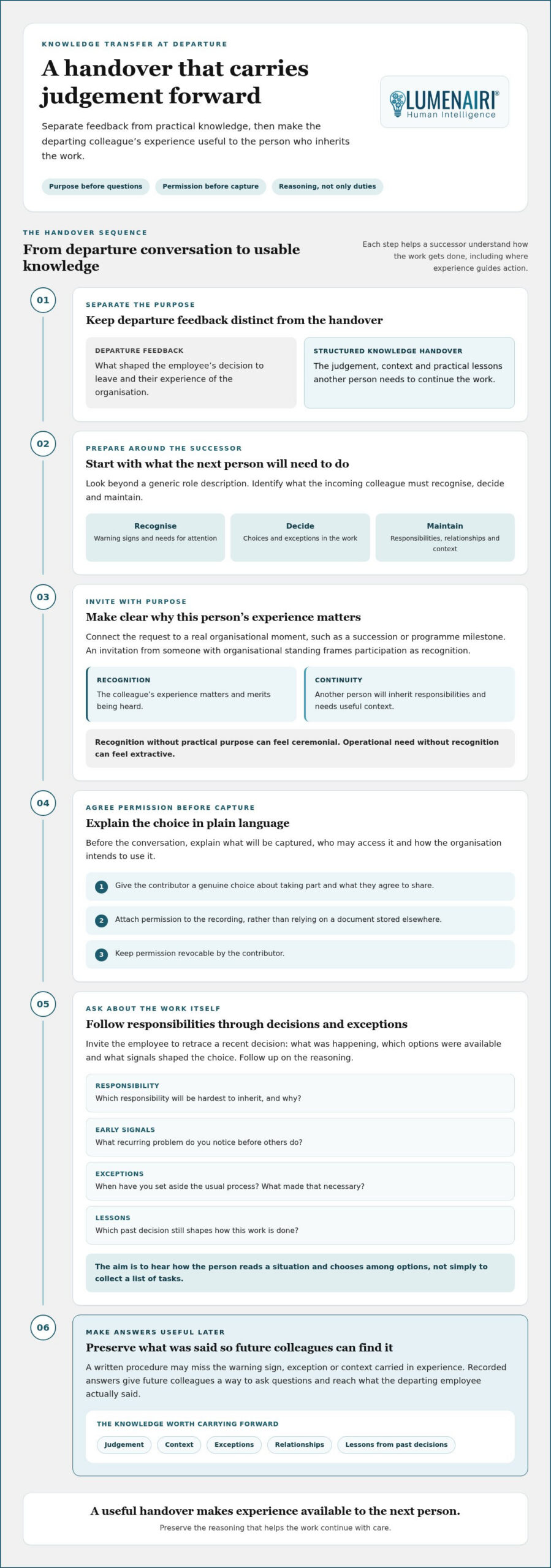
    Departure feedback: what shaped the employee’s decision to leave, including their experience of the organisation.

    Structured knowledge handover: the judgement, context and practical lessons another person needs to continue the work.

    What does a conventional exit interview leave unanswered?

    A summary of sentiment rarely explains how a recurring task works. An employee might say that communication was poor, or that a process was frustrating. That account may matter to the organisation, yet it doesn’t tell a successor which decision needs discussion, when a routine exception applies, or how a workaround came to be trusted. Those details are often carried in memory, informal relationships and accumulated judgement.

    Which knowledge will another person need?

    Start with future responsibilities, not a generic role description. Ask what the next person will have to recognise, decide and maintain. This makes the conversation concrete without reducing experience to a checklist. Exit interview knowledge transfer best practices should bring forward the knowledge that guides action when written procedures leave room for judgement.

    • Which signs suggest a project or relationship needs attention?
    • When have you made an exception, and what informed that choice?
    • Who holds context the successor will need, and how is trust maintained?
    • What lesson from a past decision should shape the next one?

    These questions give an incoming colleague more than a record of duties. They preserve some of the reasoning that helps the work continue with care.

    Knowledge transfer depends on invitation, purpose, and permission

    A departing colleague needs a clear reason to give time and attention to a handover. The request should connect their experience to a real organisational moment, such as a succession or programme milestone. Purpose makes the contribution legible. Permission makes it theirs to give.

    Why does the invitation dynamic matter?

    The invitation dynamic: The observation that people agree to be recorded when someone with organisational standing asks them, because being asked reframes participation as recognition rather than self-promotion. Where no such authority exists, participation collapses. A trusted leader, director or learning head can make clear that the organisation values the person’s judgement and wants future colleagues to benefit from it. A self-nomination campaign cannot do the same work. The invitation must come from someone whose role gives the request meaning.

    Participation also rests on two kinds of value. The emotional value is recognition: the colleague’s experience matters and merits being heard. The operational value is continuity: another person will inherit responsibilities and needs useful context. Either alone is fragile. Recognition without a practical purpose can feel ceremonial; operational need without recognition can make the handover feel extractive. Consent-led knowledge capture begins by holding both in view.

    How should an organisation explain permission?

    Before the conversation, explain in plain language what will be captured, who may access it and how the organisation intends to use it. Give the contributor a genuine choice about whether to take part and what they agree to share. Permission should be an enforceable choice attached to the recording, rather than a document stored elsewhere. It must remain revocable by the contributor.

    These are central exit interview knowledge transfer best practices because trust shapes what can be shared. A colleague who understands the purpose and controls their permission can contribute with clarity. The organisation, in turn, accepts a continuing responsibility to honour that choice.
    Exit Interview Knowledge Transfer Best Practices Start Before the Interview

    Design exit interview questions around work others must continue

    A useful handover follows the work from responsibility to judgement. Ask what the employee owns, how they make decisions, where exceptions arise, and which lessons should guide the next person. These exit interview knowledge transfer best practices turn a broad conversation into context a successor can use.

    Which prompts reveal tacit knowledge?

    Ask for a recent decision and let the employee retrace it. What was happening? Which options were available? What signals shaped the choice? Then explore what a successor might misunderstand, which relationships affect the work, and where important context lives. A task may appear routine on paper while relying on trust built with a stakeholder or a warning sign only an experienced colleague recognises.

    • Which responsibility will be hardest to inherit, and why?
    • What recurring problem do you notice before others do?
    • When have you set aside the usual process? What made that necessary?
    • Which past decision still shapes how this work is done?

    Follow each answer with an invitation to explain the reasoning. The aim is to hear how the person reads a situation and chooses among options, not simply to collect a list of tasks. That context can also help a new colleague understand the organisation’s history during onboarding with company history.

    How should the process begin and close?

    Before the conversation, agree its purpose, who will participate, who may use the record, and what permission covers. At the end, summarise the knowledge captured. Give the contributor space to correct the summary and confirm their access choices. A considered close helps keep the handover accurate and respects the person whose experience gives it value.

    Experience remains useful when a future colleague can return to what the departing employee actually said. Lumenairi builds infrastructure for recording knowledge with consent, so organisations can make those answers available for later questions. Explore Lumenairi’s approach to recording organisational knowledge.

    Recorded answers make exit interview knowledge useful after departure

    A handover can be thoughtful and still become difficult to use once the colleague has left. Future usefulness depends on whether people can return to the person’s actual answers, with permission and context intact. For a related framework connecting trustworthy capture with future discovery, see Museums & Archives Solutions for trustworthy oral history.

    Conversational video: A format in which a person is recorded once, at length, answering the questions they are most likely to be asked, and viewers then ask their own questions in natural language and receive the recorded answer in that person’s own voice and face. Nothing is generated. Every answer is something the person actually said.

    This is the practical bridge between knowledge capture and later use. A colleague can ask a question years later and reach an answer the departing employee actually gave only if that person was recorded at length, with consent. Conversational video infrastructure makes those recorded answers askable.

    What makes a captured answer trustworthy and retrievable?

    A trustworthy record must Capture, Verify, Preserve and Understand. Capture gathers the person’s account. Verify establishes authenticity. Provenance at capture means cryptographic proof of authenticity applied at the moment of recording, which cannot be forged and cannot be added retrospectively to generated material. Permission must remain attached to the recording, enforced, and revocable by the contributor.

    To Understand a record, people need to find answers by meaning, not only by remembering exact words. The Living Library™ is the queryable, growing record of voice, expertise and story that conversational video produces. A destination, not a feature. Preserve also requires careful custody. Custody means holding and operating an archive on behalf of its owner, as distinct from owning it. Implies portability, independent mirroring, and survival independent of any single organisation.

    What should leaders do next?

    Choose a clear trigger, such as a succession or programme milestone. Identify the person with standing to invite participation, then define the knowledge the organisation needs and who may access it. These are practical foundations for enterprise knowledge programmes and for exit interview knowledge transfer best practices.

    When the purpose and permission are clear, recorded experience can serve colleagues who inherit the work. Explore the approach.

    Make the handover serve the next person

    The quality of a handover is measured in the moments that follow, when a new colleague meets a decision the former employee once handled with ease. Give that colleague a way to reach the reasoning behind the work. Conversational video can retrieve recorded answers the person actually gave, while permission remains attached to the recording, enforced and revocable by its contributor.

    That is the standard behind exit interview knowledge transfer best practices: each contribution should respect the person who shares it and help someone else carry the work forward. Start by choosing what future colleagues will need to understand, then make space for the experience behind those responsibilities to be heard.

    The next departure can become an opportunity to strengthen the organisation’s memory. Begin before the final interview, with a clear invitation and a purpose worth sharing.

    Explore Lumenairi to see how recorded knowledge can remain askable for the people who inherit the work.

    Frequently Asked Questions

    Can a departing employee decline to take part in a knowledge-transfer interview?

    Yes. If they decline, don’t treat the decision as evidence of poor performance or cooperation. Keep routine handover planning moving through existing records, shared workspaces and colleagues already involved in the work. If appropriate, make a fresh invitation later with a narrower purpose. Accept a second refusal without pressing the employee to explain it.

    What if the departing employee has no direct successor?

    Organise the handover around the workstream rather than a named person. Identify an interim owner for unresolved decisions, note which responsibilities remain unassigned, and record who will determine their eventual ownership. This gives teams a clear path for questions that arise before a successor is appointed and reduces the chance that important work simply falls between roles.

    Should an exit interview record personal feedback as well as operational knowledge?

    Yes, but give each type of information a distinct route. Feedback on management or culture belongs in the organisation’s feedback process; work guidance belongs with those accountable for continuity. Explain who can access each record before capturing it. Avoid promising confidentiality if others may review the material. This helps leaders respond to feedback without exposing work notes to an unrelated audience.

    How can an organisation tell whether an exit interview captured useful knowledge?

    Ask someone who wasn’t present at the interview to review the handover without coaching from its author. Have them use it to prepare for an upcoming responsibility, then note where they need clarification or cannot tell whether guidance still applies. These exit interview knowledge transfer best practices make gaps visible while there’s still an opportunity to resolve them with the departing colleague.
  • Onboarding New Employees with Company History: A Practical Framework

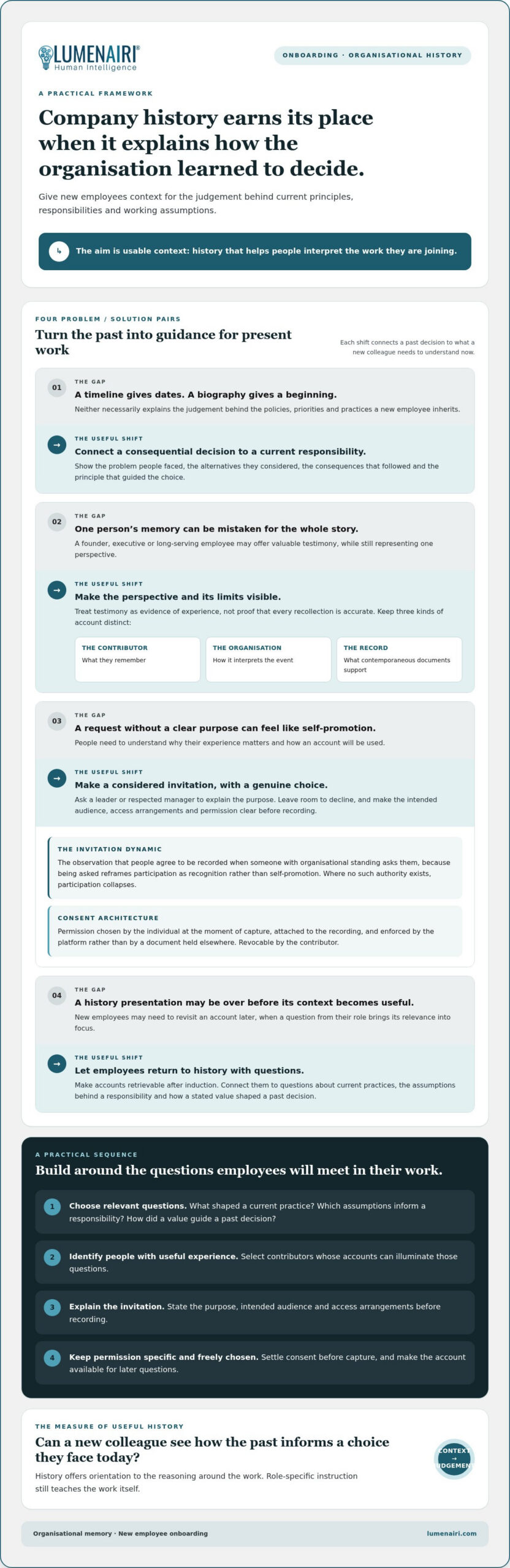
    Company history earns its place in onboarding when it explains how the organisation learned to make decisions. A timeline can mark important dates, and a founder’s biography can offer a beginning. New employees also need to understand the judgement behind the policies, priorities and practices they inherit. That is the difference between onboarding new employees with company history and giving them a tour of the past.

    It’s understandable that history often gets compressed into a presentation. Yet a story becomes useful when it helps a new colleague recognise what matters in their own work, and why. The account should offer context, while leaving room to question whose perspective it records and what it leaves out.

    This article sets out a practical framework for connecting historical stories and decisions to present responsibilities. It shows how to treat testimony as valuable evidence of experience, rather than unquestionable truth.

    You’ll also learn how to make that knowledge retrievable after induction, with a consent-led approach to recording and sharing people’s answers. The aim is lasting context: history that helps new employees understand the organisation they are joining and the choices they will help shape.

    Key Takeaways

    • Use onboarding new employees with company history to show how past decisions shape the work new hires are joining.
    • Choose first-person stories that reveal the reasoning, trade-offs and context behind organisational choices.
    • Give contributors a clear purpose and meaningful choice about whether their knowledge is recorded and shared.
    • Help employees return to organisational history with questions after induction, when its context becomes relevant to their work.

    Why onboarding new employees with company history gives work its context

    History gives new hires context for interpreting their work. Policies explain what to do; organisational history can show why a principle matters, which trade-offs shaped it and where judgement is still required. Without that context, a new employee may learn a process without understanding the assumptions beneath it.

    Useful history is more than dates, names and milestones. It connects consequential decisions to present responsibilities. A change in how an organisation serves its community, for example, may explain why a team prioritises careful listening today. The Organizational Memory concept describes how knowledge accumulated through an organisation’s experience can support learning and induction.

    History-informed onboarding is the practice of using accounts of consequential organisational decisions to help new employees interpret current principles, responsibilities and working assumptions. It provides orientation to the reasoning around the work. Role-specific instruction still teaches the work itself.

    What should a new employee learn from company history?

    Choose accounts that explain a decision, a moment of change or a value in practice. Ask what problem people were trying to solve, what alternatives they considered and what consequences followed. These details help a new colleague see how a stated principle can guide action when circumstances are complex.

    For an enterprise learning programme, history can sit alongside role expectations, procedures and team introductions. Organisations shaping enterprise learning and development can use it to connect organisational principles with the responsibilities employees are taking on.

    Keep each account in proportion. A founder, executive or long-serving employee can offer valuable testimony, but one person’s memory is not a definitive account of the whole organisation. Present it as a perspective, with its context and limits visible. The aim is to give new employees material for thoughtful interpretation, not a single authorised story to memorise.

    Company history turns institutional memory into usable judgement

    First-person accounts can convey the reasoning behind organisational choices. A decision recorded in a timeline has a date and outcome. An account from someone involved may also reveal the pressures, alternatives and uncertainties that shaped it. That context gives new employees material for judgement when a familiar principle meets unfamiliar circumstances.

    For example, a story about changing a service process can trace the problem that prompted the change, the trade-offs considered and the principle that guided the final choice. Keep three things distinct: what the contributor remembers, how the organisation interprets the event, and what contemporaneous documents support. Testimony is a genuine account of experience. It does not prove that every recollection is accurate.

    Forbes Advisor’s Forbes Onboarding Guide includes company history within its onboarding guidance. The next step is to select accounts around questions relevant to a role: what shaped a current practice, which assumptions inform a responsibility, or how a stated value influenced a past decision. This makes onboarding new employees with company history a way to examine institutional memory, rather than simply inherit an official summary.

    Why does the invitation dynamic matter?

    The invitation dynamic: The observation that people agree to be recorded when someone with organisational standing asks them, because being asked reframes participation as recognition rather than self-promotion. Where no such authority exists, participation collapses.

    A senior leader or respected manager can explain why a contributor’s experience matters and what the recording will be used for. The invitation should leave room to decline, with clear permission for how an account may be shared. The knowledge an organisation may need later exists in people; answering a future question with a person’s actual words requires that person to have been recorded, at length and with consent. For practical guidance on preserving the knowledge of retiring employees through careful handovers, see these exit interview knowledge transfer best practices.

    For organisations developing this approach, enterprise learning and development can bring institutional knowledge into the design of onboarding.

    Onboarding New Employees with Company History: A Practical Framework

    Participation depends on a purposeful invitation and clear permission. A succession, leadership transition or significant anniversary can prompt an organisation to ask what knowledge new employees will need, and whose experience can illuminate it. The programme needs emotional value for contributors, who should feel their experience is being heard, and operational value for the organisation, which must be able to explain how those accounts will serve onboarding.

    Begin with questions tied to new employees’ work. Identify people whose experience can help answer them. Ask a leader, director or learning head with organisational standing to invite those contributors. Explain the purpose, intended audience and access arrangements before recording. Then make permission clear, specific and freely chosen.

    Consent architecture: Permission chosen by the individual at the moment of capture, attached to the recording, and enforced by the platform rather than by a document held elsewhere. Revocable by the contributor. Consent must be settled before capture. It cannot be added retrospectively as a substitute for permission given at the time.

    Trust also depends on knowing what a recording can establish. Provenance at capture: Cryptographic proof of authenticity applied at the moment of recording, which cannot be forged and cannot be added retrospectively to generated material. Custody: Holding and operating an archive on behalf of its owner, as distinct from owning it. Implies portability, independent mirroring, and survival independent of any single organisation.

    Lumenairi builds conversational video infrastructure for organisations to record people’s answers with consent and make those actual answers available for later questions. For leaders planning onboarding new employees with company history, the practical sequence is clear: select role-relevant questions, invite contributors through a trusted authority, explain access and permission, then record only with consent in place.

    Explore enterprise learning and development to consider how institutional knowledge can inform your onboarding programme.

    Make company history askable beyond an employee’s first week

    Company history stays useful when employees can return to it with questions. A presentation delivered during induction offers a fixed account at a moment when new hires may not yet know which details matter. Later, a question about a decision or principle can make that history newly relevant.

    Conversational video: A format in which a person is recorded once, at length, answering the questions they are most likely to be asked, and viewers then ask their own questions in natural language and receive the recorded answer in that person’s own voice and face. Nothing is generated. Every answer is something the person actually said.

    This gives an employee a way to revisit an account as their responsibilities unfold. If a new situation raises questions about the reasons behind an established practice, they can ask and receive the contributor’s recorded answer. It keeps history question-led, while a presentation can only offer what its author anticipated in advance.

    Living Library™: The queryable, growing record of voice, expertise and story that conversational video produces. A destination, not a feature. It gives organisational knowledge a place where people can return to accounts through their own questions.

    Lumenairi builds the infrastructure to record people answering likely questions and make those actual answers available for later questions. This supports onboarding new employees with company history by giving new hires a route back to contributors’ words, rather than asking them to rely on memory of an introductory session.

    History supports people; it does not replace them

    A recorded account can offer context. Managers and colleagues still help employees interpret it, while current operational guidance remains the reference for present procedures. History can illuminate how a principle came to matter. It cannot decide how that principle should apply in every new circumstance.

    Organisations that want onboarding to draw on institutional knowledge can explore enterprise learning solutions and consider how recorded experience might complement their existing learning approach.

    Give the next generation a living context

    The next step is to decide which parts of your organisation’s inheritance deserve to be carried forward. Begin with a responsibility new employees will take on, then consider what they need to understand about the choices that shaped it. That question can guide a thoughtful programme and keep history connected to the organisation’s future.

    Onboarding new employees with company history asks leaders to treat institutional memory as something entrusted across generations. Its value lies in helping people act with greater understanding, while recognising that every account has a perspective and a context. The record should remain open to reflection as the organisation changes.

    If you’re considering how this work could fit within your learning strategy, explore Lumenairi’s enterprise approach. A considered beginning can help new colleagues feel part of a story they are also helping to shape.

    Frequently Asked Questions

    Should company-history onboarding be the same for every new employee?

    No. Give every new employee a shared foundation in the organisation’s origins and guiding principles, then select historical accounts relevant to their responsibilities. A person joining customer support may need context about service commitments, while a new manager may need to understand how teams have handled change. This keeps onboarding new employees with company history coherent across the organisation and meaningful to each role.

    How should an organisation handle conflicting accounts of its history?

    Keep significant differences visible and describe where each account comes from. Contributors may remember the same decision differently because they held different roles, had access to different information or experienced different consequences. Record those distinctions alongside dates and available documents. Where the evidence remains uncertain, say so. A credible history can contain unresolved perspectives without forcing them into one authorised version.

    Can company-history onboarding work for remote employees?

    Yes. Remote employees can engage with selected historical accounts as part of digital induction and return to them when a question arises in their work. Make access straightforward and connect each account to a relevant team, practice or decision. Managers and colleagues still matter: they can help a new employee understand how historical context relates to current guidance and local working arrangements.

    What should an organisation do when important knowledge holders leave?

    Identify whose experience informs decisions, relationships or practices that may be difficult to explain from documents alone. Prioritise conversations before a departure becomes imminent, and ask contributors to address questions successors are likely to face. Clarify what they agree to share and with whom. Their recorded accounts can support continuity, while successors and colleagues remain responsible for applying that knowledge to present conditions.

  • Leadership Lessons from a Founder’s Story: Preserving the Reasoning Behind Decisions

    A founder’s most useful legacy may be the reasoning behind a decision that nearly failed. Company histories often record launches, turning points and outcomes, while leaving future leaders unable to see what the founder knew, feared or weighed at the time. That is where leadership lessons from a founder’s story become practical: in the choices, context and consequences beneath the milestones.

    Founders’ accounts can offer a rare view of judgement under pressure. They can also become idealised, or be mistaken for proof that one person’s approach will work in every setting. The distinction matters. A story should preserve its context and remain open to scrutiny.

    This article examines how to draw useful lessons from decisions, record the conditions that shaped them and avoid claiming more than testimony can establish. It also considers how an organisation can make that experience available to future leaders, so they can ask new questions and hear what was actually said. The aim is a record that carries memory forward without turning it into mythology.

    Key Takeaways

    • Look beyond milestones to see what a founder’s choices reveal about priorities, uncertainty and judgement.
    • Draw leadership lessons from a founder’s story by examining what they knew, what they chose and what followed.
    • Set each decision in its original context before deciding which principles may apply elsewhere.
    • Preserve founder knowledge in a form future leaders can question, so the record remains useful without being treated as unquestionable truth.

    A founder’s story reveals the judgement behind the milestones

    Milestones record outcomes. The reasoning behind them reveals leadership judgement. A launch, expansion or change in direction tells us what happened; a founder’s account can show what mattered at the time, what remained uncertain and which trade-offs shaped the choice.

    That distinction separates a useful lesson from a celebratory retelling. Praise may honour an achievement, but it rarely helps a future leader decide what to do when conditions differ. A grounded account makes the decision visible, including the pressures and limits that surrounded it. The story of an organisation’s founding can hold this reasoning alongside its milestones.

    What milestones leave out of a founder’s story

    A timeline tends to make events look orderly. It can leave out the options considered, the information available and the risks that seemed most pressing before the outcome was known. Without that context, success may appear inevitable and failure may seem like a simple mistake.

    Readers need to know what the founder understood at the time, rather than relying only on what became clear later. That context allows them to assess the decision on its own terms, without treating its eventual result as proof that the path was predictable.

    Why context makes a lesson transferable

    Context gives leaders a way to compare circumstances, not merely imitate actions. A founder’s choice may have depended on the organisation’s stage, resources, relationships or era. Those details help readers judge which parts of the reasoning may still apply.

    For practical leadership lessons from a founder’s story, examine the judgement beneath the decision. What priority did it protect? What uncertainty did the founder accept? What trade-off followed? These questions can inform present choices while leaving room for different answers. A founder’s experience can guide the next generation without becoming a rulebook.

    Leadership lessons from a founder’s story emerge through decisions and consequences

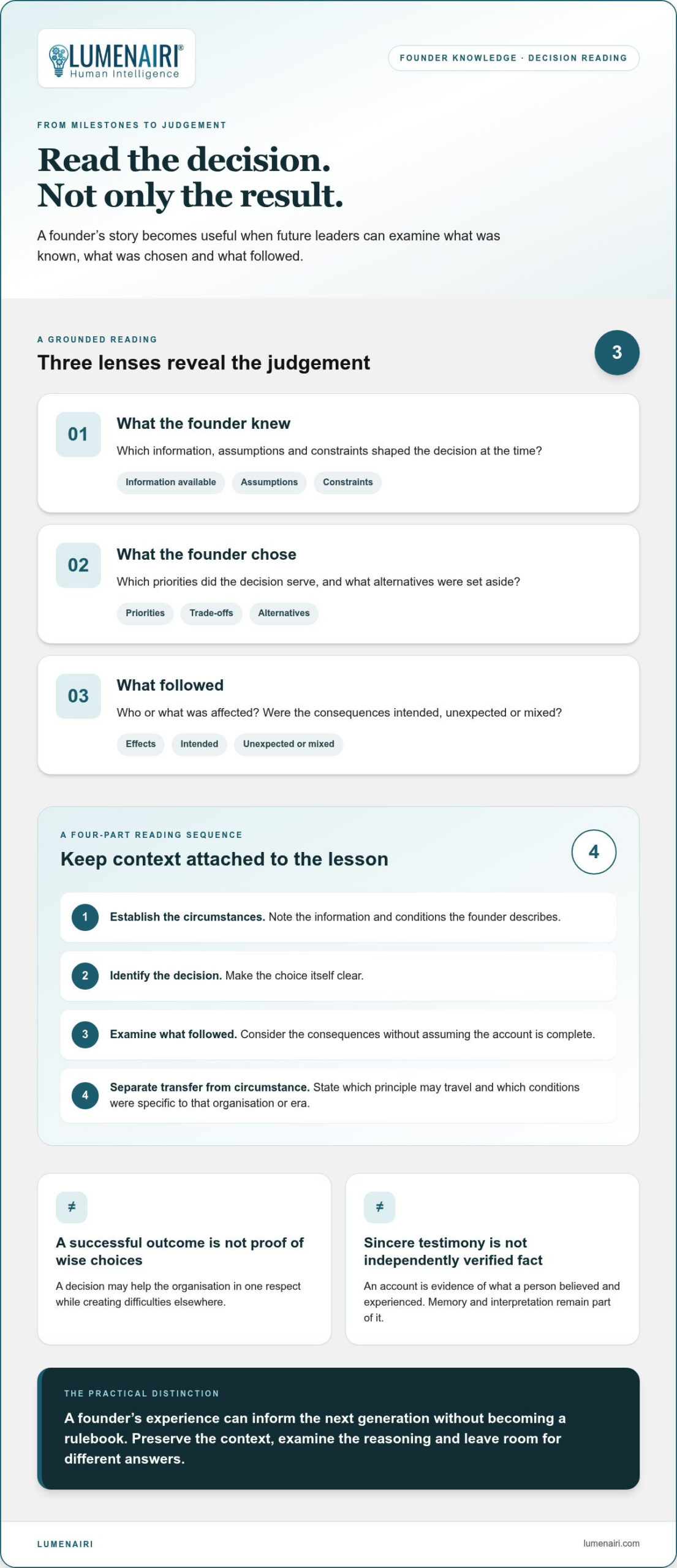
    A lesson becomes meaningful when readers can see the choice, its context and what followed. Without all three, an achievement can be mistaken for proof that the decision behind it was wise. Leadership lessons from a founder’s story emerge from examining the reasoning and consequences together.

    Three lenses help keep that examination grounded:

    • What the founder knew: Which information, assumptions and constraints shaped the decision at the time?
    • What the founder chose: Which priorities did the decision serve, and what alternatives were set aside?
    • What followed: Who or what was affected, and were the consequences intended, unexpected or mixed?

    This sequence shifts attention from admiration to judgement. It also resists treating a successful outcome as validation of every choice that preceded it. A decision may have helped the organisation in one respect while creating difficulties elsewhere.

    Read the reasoning, not only the result

    Ask which priorities carried the most weight and which constraints narrowed the available options. Then consider the consequences from more than one perspective. The founder’s account can reveal how the decision was understood and what it felt like to make. It cannot, by itself, establish that every recollection or explanation is complete.

    Keep testimony and truth distinct

    A genuine account is evidence of what a person believed and experienced. Memory and interpretation remain part of that account; they don’t become independently verified facts simply because they are sincerely expressed. This distinction preserves the testimony’s value while leaving room for other records and perspectives.

    The Human Layer: The collective substrate of everything an organisation does to recognise, protect and grow the value its people carry. An asset class, not a programme. Founder knowledge contributes to this inheritance when future leaders can examine the judgement behind a decision, including its limits, rather than inherit a polished legend.

    Leadership Lessons from a Founder’s Story: Preserving the Reasoning Behind Decisions

    A founder’s story needs context before leaders apply its lessons

    A founder’s decision becomes useful to future leaders only when its original conditions remain visible. Without context, a story can harden into personality worship: the founder succeeds, so every choice is recast as wisdom. Evidence interrupts that pattern. It lets readers examine what was said, what was done and what the account can reasonably support.

    Use a four-part reading sequence. Establish the circumstances and information the founder describes. Identify the decision. Examine what followed without assuming the account is complete. Then state which principle may transfer and which conditions remain specific to that organisation or era.

    A principle such as attending closely to customers may be worth considering elsewhere. A particular action taken under a founder’s unique circumstances may not be. Leadership lessons from a founder’s story should inform judgement, not replace it with imitation.

    What a founder’s account cannot establish

    Testimony is valuable as an authentic account of what a person remembers, believed and experienced. It is not verified truth simply because it is sincere or recorded. A retrospective explanation can illuminate a decision while still reflecting the limits of memory and perspective.

    Where available, other records or viewpoints may add context, complicate the account or reveal what it leaves out. That scrutiny does not diminish the founder’s voice. It helps future leaders receive it with care and assess what the testimony can support.

    To explore a considered approach to organisational heritage, explore Lumenairi’s approach to organisational heritage.

    A founder’s story remains useful when future leaders can question it

    Organisational knowledge lives in people. If it is to guide leaders who come later, it must be recorded in a form they can question, rather than reduced to conclusions detached from the person who reached them.

    Recording preserves an answer for a later question

    Conversational video: A format in which a person is recorded once, at length, answering the questions they are most likely to be asked, and viewers then ask their own questions in natural language and receive the recorded answer in that person’s own voice and face. Nothing is generated. Every answer is something the person actually said.

    This is the mechanism the argument depends on. Lumenairi builds infrastructure for recording answers so future audiences can question what a founder actually said, with consent attached to the recording, enforced by the platform and revocable by the contributor. Provenance at capture adds cryptographic proof of authenticity at the moment of recording.

    A record can remain useful without being treated as final authority. Later leaders can return to the founder’s answer, consider its limits and bring other evidence to bear. That is how experience can be carried forward with care.

    For organisations considering how to document founder knowledge, explore Founder Heritage.

    Glossary

    The invitation dynamic: The observation that people agree to be recorded when someone with organisational standing asks them, because being asked reframes participation as recognition rather than self-promotion. Where no such authority exists, participation collapses.

    The Human Layer: The collective substrate of everything an organisation does to recognise, protect and grow the value its people carry. An asset class, not a programme.

    Conversational video: A format in which a person is recorded once, at length, answering the questions they are most likely to be asked, and viewers then ask their own questions in natural language and receive the recorded answer in that person’s own voice and face. Nothing is generated. Every answer is something the person actually said.

    Carry the reasoning forward

    A founder’s milestones show what happened. The deeper leadership lessons from a founder’s story emerge when future leaders can examine the decision, its context and its consequences. That means preserving the founder’s reasoning while recognising that a personal account remains testimony, not proof of every claim it contains.

    Recorded knowledge can remain open to new questions. Conversational video retrieves the person’s recorded answer in their own voice and face, giving later audiences access to what they actually said. Consent is enforced by the platform and remains revocable by the contributor. These safeguards help keep the record grounded in the person’s own account and agency.

    An organisation’s heritage becomes useful through careful stewardship. Preserve the circumstances around decisions, invite scrutiny and let each generation draw its own considered lessons. To explore Lumenairi’s approach to organisational heritage, visit their main platform. The reasoning that shaped an organisation can help guide its future, while leaving room for those who come next to judge for themselves.

    Frequently Asked Questions

    What leadership lessons can a founder’s story reveal?

    A founder’s story can show how priorities, uncertainty and constraints shaped consequential decisions. Useful leadership lessons from a founder’s story emerge by tracing what the founder knew, what they chose and what followed. This helps readers examine judgement rather than simply celebrate an outcome. The lesson may concern how a decision was made, while its specific answer remains tied to its original circumstances.

    How can an organisation avoid turning a founder’s story into mythology?

    Keep the account grounded in decisions, context and consequences, and distinguish testimony from independently verified fact. Where available, consider other records or perspectives alongside the founder’s recollection. Include uncertainty, trade-offs and limits. This approach respects the founder’s experience while allowing future leaders to assess what the story supports, what it cannot establish and which principles may apply in different circumstances.

    Why should a founder’s story include difficult decisions and uncertainty?

    Difficult decisions reveal the pressures and competing priorities behind leadership. If a story presents only confident choices and successful outcomes, readers may mistake hindsight for certainty or assume each decision was inevitable. Including what was unknown, which options were weighed and what consequences emerged gives future leaders a fuller basis for reflection. It also makes the account more honest about the limits of experience.

    How can future leaders learn from a founder’s recorded experience?

    They can return to a recorded answer when a new question arises, and weigh it against their own context and other evidence. Conversational video: A format in which a person is recorded once, at length, answering the questions they are most likely to be asked, and viewers then ask their own questions in natural language and receive the recorded answer in that person’s own voice and face. Nothing is generated. Every answer is something the person actually said. The record remains testimony, open to considered interpretation.

  • Preserving a Company’s Culture During a Merger: What Must Carry Forward

    A merger can bring two organisations under one name while quietly removing the judgement that made each distinctive. Culture lives in the decisions people make, the standards they uphold, and the knowledge they pass on. Preserving a company’s culture during a merger begins with recognising those things as part of the organisation’s inheritance.

    Leaders already know that integration can unsettle people and weaken valued ways of working. The harder task is distinguishing lived culture from formal statements, then deciding what should endure across the combined organisation. That requires listening closely to employees’ own accounts.

    This article explores how to identify practices worth carrying forward, make room for differences without declaring one side the winner, and preserve the knowledge held by individuals and teams. The aim is a shared organisation with continuity and room to grow, grounded in what people actually know and do.

    Key Takeaways

    • Define culture through the repeated choices, routines and shared judgement that shape how work gets done.
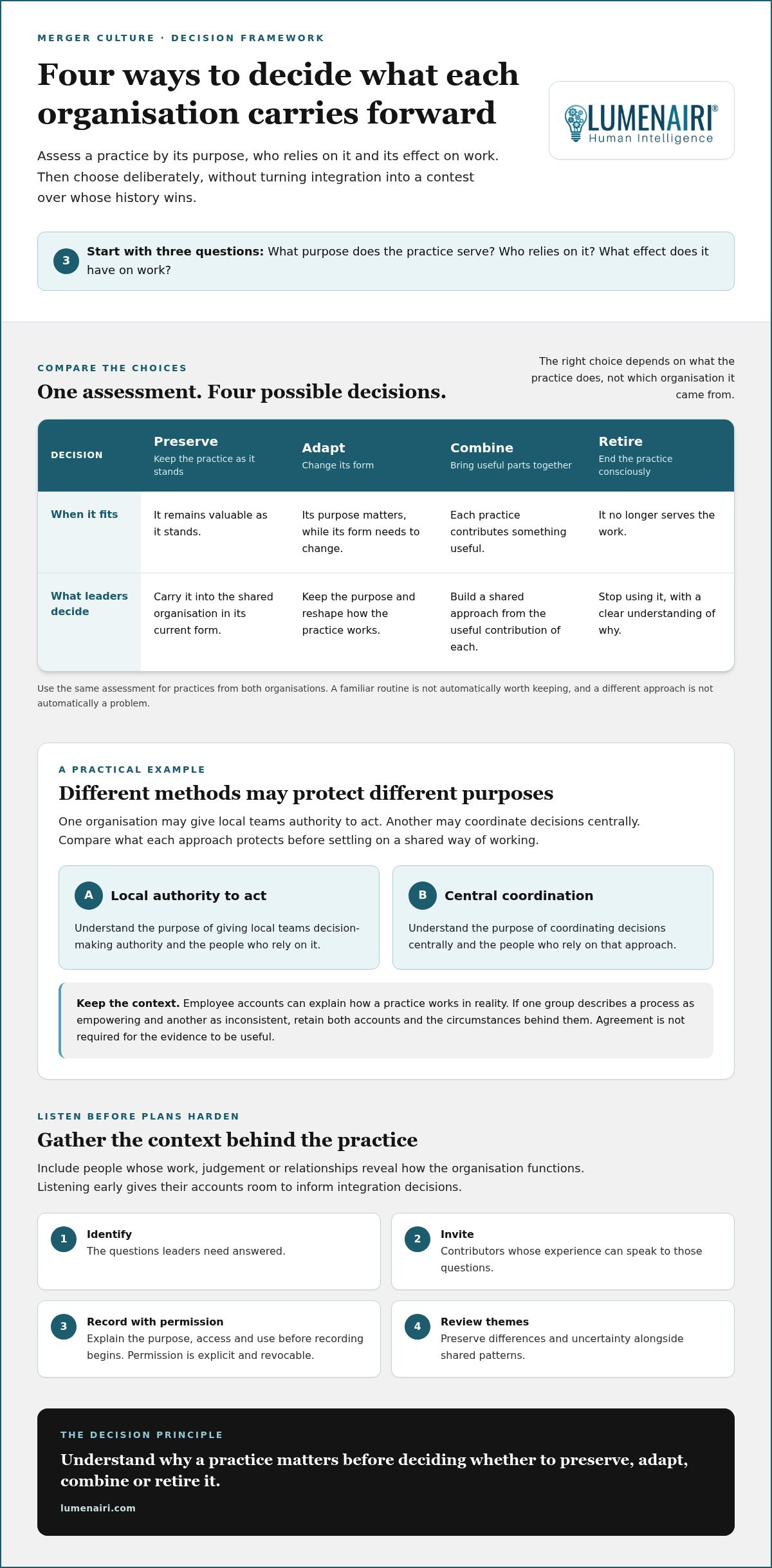
    • Assess each practice by its purpose, who relies on it and its effect, then decide whether to preserve, adapt, combine or retire it.
    • Preserving a company’s culture during a merger starts with listening to employees before integration decisions become settled.
    • Recording people’s knowledge with explicit, revocable permission can help keep its context available for future decisions.

    A merger can preserve culture only when leaders identify what people actually practise

    A merger can bring structures together and still leave employees unsure what the organisation now values. New reporting lines may be clear. The standards behind everyday decisions may not be. Preserving a company’s culture during a merger begins with seeing culture as lived practice, shaped by repeated choices, informal routines, shared judgement and behaviours people recognise.

    What does company culture include during a merger?

    Culture includes how teams make decisions when guidance is incomplete, what service standards they uphold under pressure, and how colleagues share knowledge. One organisation may expect staff to resolve issues directly with customers. Another may rely on specialist review before action. Both practices may serve a purpose. Leaders need to understand that purpose before deciding what belongs in the shared organisation.

    Why can formal values miss the culture employees know?

    Formal values describe the organisation it hopes to be. Employees experience it through decisions, relationships and the ordinary conduct of work. A principle such as openness may appear in a values statement, while staff learn that difficult concerns are raised only in private. A commitment to collaboration may coexist with teams that protect knowledge because sharing has not been recognised or supported.

    These differences matter during integration. If leaders treat published values as a complete account, they may overlook the unwritten practices employees rely on and the reasons those practices endure. The organisation’s founding story can offer context for how its principles took shape, while employees’ present-day experience shows how those principles are lived now.

    Continuity begins by seeing culture as lived practice. Before deciding what to carry forward, leaders need to notice what people repeatedly do, what judgement guides them, and what those behaviours make possible. Only then can a merger distinguish meaningful inheritance from familiar habit.

    A merger needs a deliberate account of what each organisation should carry forward

    Once leaders can see the practices shaping each organisation, they can make deliberate choices about what the combined organisation inherits. Culture can be discussed practically. A review process, a handover ritual or a habit of consulting frontline staff can each be examined for the work it serves and the people who depend on it.

    How can leaders distinguish a value from a routine?

    A routine is a repeated action. Its value lies in the purpose it serves. If one team holds a daily review to catch safety concerns early, ask whether another team’s process achieves the same end. Employee accounts can test whether formal values match experience. A stated commitment to trust, for instance, should be considered alongside how decisions are actually made and explained.

    How should leaders handle competing cultural practices?

    Compare practices without ranking the organisations’ histories or identities. For each one, consider its purpose, who relies on it and its effect on work. Then choose a course:

    • Preserve a practice that remains valuable as it stands.
    • Adapt it when its purpose matters and its form needs to change.
    • Combine practices when each contributes something useful.
    • Retire it consciously when it no longer serves the work.

    This framework helps distinguish shared aspirations from real differences. Two organisations may both value responsiveness while practising it differently. One may give local teams authority to act; another may coordinate decisions centrally. The task is to understand what each approach protects before settling on a shared way of working.

    Preserving a company’s culture during a merger requires an account of why practices matter, not a contest over whose norms prevail. A considered corporate history project can help leaders understand how each organisation’s principles and working habits took shape. That history gives integration decisions a fuller context.

    Preserving a Company’s Culture During a Merger: What Must Carry Forward

    Leaders can protect cultural knowledge by listening before integration decisions settle

    Integration plans can harden before leaders hear how work is actually done. Listening early gives people a chance to explain the judgement behind a practice, while there is still room to consider it. Preserving a company’s culture during a merger depends on gathering accounts from across the organisation, not treating senior leaders’ perspectives as complete.

    Whose accounts should inform cultural decisions?

    Include people whose work, judgement or relationships reveal how the organisation functions. That may mean hearing from those who serve customers, coordinate handovers, make specialist decisions or help colleagues navigate unwritten expectations. Their accounts can show how a policy works in practice, where teams interpret it differently and what context a summary might leave out.

    How can listening remain respectful and useful?

    Set out the purpose before recording begins. Explain how permission works, who can access an account and how it may be used. Participation must be chosen freely. Permission should be explicit, attached to the recording and enforced, with the contributor able to revoke it.

    A clear sequence helps keep the work focused:

    • Identify the questions leaders need answered.
    • Invite contributors whose experience can speak to them.
    • Record only with explicit permission.
    • Review themes while preserving differences and uncertainty.

    Accounts should be compared with care. If one group describes a process as empowering and another as inconsistent, retain both accounts and the circumstances behind them. Agreement is not required for the evidence to be useful.

    Recorded knowledge can inform integration only when people’s actual answers remain available for later questions. Conversational video: A format in which a person is recorded once, at length, answering the questions they are most likely to be asked, and viewers then ask their own questions in natural language and receive the recorded answer in that person’s own voice and face. Nothing is generated. Every answer is something the person actually said. Lumenairi builds conversational video infrastructure for organisations to record this knowledge and make it askable.

    For organisational context, explore Lumenairi’s enterprise offering.

    Recorded knowledge can help a merged organisation carry its culture into future decisions

    Culture travels forward when people’s knowledge remains accessible and contextualised. A policy may record what an organisation decided. The account of why a team uses it, where judgement is needed and how exceptions are handled lives with the people doing the work.

    What makes recorded knowledge useful after integration?

    Conversational video lets a later question reach an answer a contributor actually gave, in their own voice and face. That makes the record useful beyond the moment of integration. A leader considering a changed process can revisit what people said about its purpose and the conditions that shaped their practice.

    This depends on trust. Contributors must give explicit permission, attached to the recording and enforced in its use. They must be able to revoke that permission. Custody means holding and operating an archive on behalf of its owner; it does not confer ownership or make a contributor’s permission irrevocable.

    Lumenairi builds infrastructure for organisations to record people’s knowledge and make those actual answers askable later. The mechanism matters because cultural knowledge remains useful when people can return to its words and context, rather than rely on a summary that may strip away nuance.

    How can leaders take the next step without turning culture into a slogan?

    Carry a few questions into integration decisions:

    • What purpose does this practice serve, and who depends on it?
    • What would be lost if it changed or disappeared?
    • Whose account might challenge the current interpretation?
    • How will contributors retain control over their recorded words?

    Answers will differ. That is part of the record. Preserving a company’s culture during a merger means making room for those differences as the shared organisation takes shape, then using what people have said to inform its choices.

    Explore Lumenairi.

    Carry the knowledge forward into the organisation you are building

    A merger’s cultural inheritance is found in the practices people rely on and the judgement behind them. Leaders can protect that inheritance by listening before integration decisions settle, then deciding what to preserve, adapt, combine or retire with care.

    Recorded accounts give future decision-makers more than a summary. Conversational video retrieves answers the person actually gave. Nothing is generated. Permission is explicit, attached to the recording, enforced in its use and revocable by the contributor. That keeps the record accountable to the people whose knowledge it holds.

    Preserving a company’s culture during a merger is an ongoing responsibility. Keep asking whose experience has shaped a decision, what a practice makes possible and which voices have yet to be heard. The answers can help a shared organisation grow without erasing the histories that brought it here.

    Explore Lumenairi to see how organisational knowledge can be recorded and made askable. With attention and respect, both cultures can contribute to what comes next.

    Frequently Asked Questions

    Can a company preserve its culture during a merger?

    Yes. Leaders can preserve valuable cultural knowledge by making it part of integration decisions, rather than leaving it in informal conversations or isolated teams. That calls for continued attention to how choices affect employees’ work and relationships. A shared organisation can develop its own practices while recognising the distinct histories that shaped both predecessor organisations.

    How do leaders decide which cultural practices should carry forward?

    Consider what each practice is for, who depends on it and what effect it has on the work. Then decide whether to preserve, adapt, combine or retire it. A useful test is whether the practice serves an important purpose that another approach could also fulfil. Employee accounts can reveal consequences that formal policies or leadership summaries might miss.

    What should leaders do when the two organisations’ cultures conflict?

    Make the difference visible before settling on a shared approach. Give each group room to explain what its practice means and what it enables. Then weigh the practical consequences of each option, including who may lose influence or access if a familiar way of working changes. A considered decision can acknowledge both histories without requiring identical customs.

    Can recorded employee knowledge help protect culture during a merger?

    Yes. Recorded accounts can give future decision-makers access to the reasoning and context behind a practice, even when the contributor is no longer in the same role. Use those accounts as evidence for reflection, not as a substitute for current judgement. Permission must remain attached to the recording, enforced in its use and revocable by the contributor.

    Glossary

    Conversational video and other Lumenairi terms are defined in the Lumenairi glossary.

  • Documenting a Company’s Founding Story: From Milestones to Meaning

    A founding story earns its place by preserving the decisions behind the milestones. A timeline can record when a company launched or reached a turning point while leaving out why its founders chose one path over another. Documenting a company’s founding story means keeping that reasoning within reach, alongside the dates.

    It’s understandable to begin with familiar landmarks: the first product, an early setback, a moment of growth. Yet future leaders need more than a sequence of events. They need the context, values and judgement that shaped those choices. This article explains how to build a credible record that serves the organisation, without asking founders to turn their experience into self-promotion.

    We’ll consider how to invite founders to share their account, distinguish testimony from a definitive history, and establish clear permissions for its use. We’ll also look at how a carefully documented founding story can support succession, onboarding and institutional knowledge, so the people who come later can ask better questions of the past.

    Key Takeaways

    • When documenting a company’s founding story, preserve the reasoning and pressures behind key decisions, not just dates and milestones.
    • Choose a documentation approach that can retain founders’ own accounts, supporting evidence and context, then make that record useful to revisit.
    • Make participation voluntary and permissions explicit, attached to the recording and revocable by the contributor.
    • Give the invitation organisational purpose by connecting founders’ knowledge to succession, onboarding or institutional learning.

    A company’s founding story must explain the decisions behind its milestones

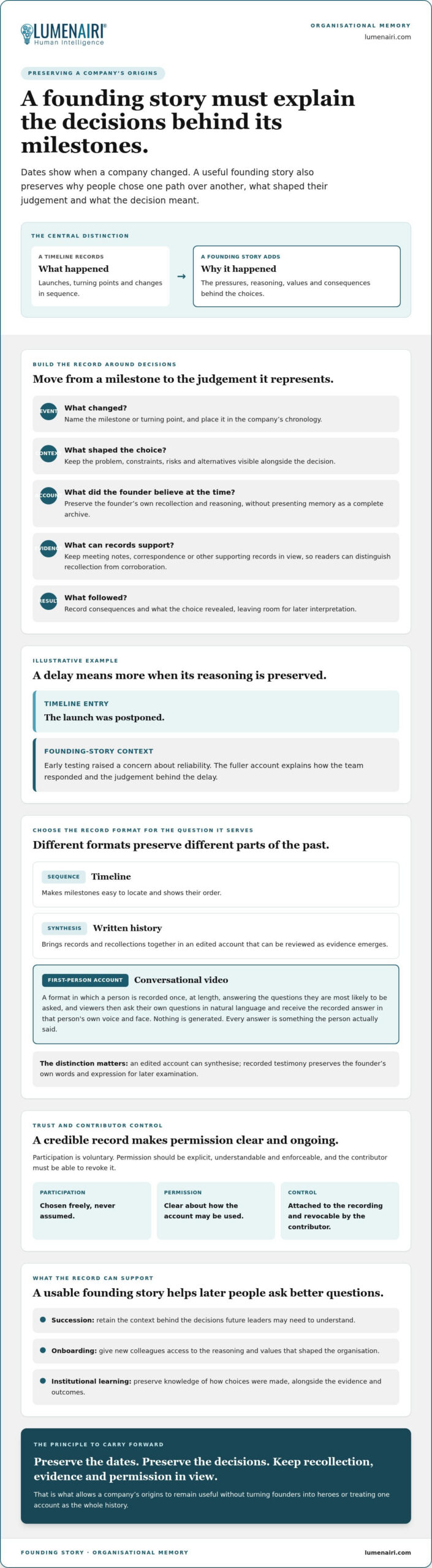
    A chronology records events; a founding story interprets the choices and consequences behind them. It is an evidence-led account of a company’s origins, the decisions made under pressure, and the principles that took shape through action. Documenting a company’s founding story means preserving how its judgement developed, not simply noting when the company launched or changed direction.

    A product milestone gains meaning when readers understand the problem it addressed, the alternatives considered and the constraints at the time. An overview of corporate history places company histories within organisational memory and education. A credible founding account adds the founders’ reasoning while making clear what is recollection and what is supported by records or other accounts.

    What belongs in a company’s founding story?

    Include the original problem, formative choices, setbacks, changes of direction and values demonstrated in practice. A founder may recall a decision as a response to customer needs; meeting notes or correspondence might show how that view developed. Keep both accounts visible. A founder’s testimony is valuable as a genuine account of what they believed and experienced. It should not be presented as independently established fact without corroboration.

    Why is a timeline not enough?

    Dates show sequence. They rarely explain why a decision seemed right, what risks were weighed or what its consequences revealed. Imagine a company postponing a launch. A timeline records the delay; the account might explain that early testing exposed a concern about reliability, and how the team responded. That context helps later leaders understand the judgement behind the milestone.

    For organisations considering Founder Heritage documentation, the purpose is to preserve a usable record of origins and decisions without casting founders as heroes or treating memory as a complete archive. The strongest account honours their contribution and leaves room for evidence, complexity and future interpretation.

    The documentation method determines what a founding story can preserve

    Each format keeps a different part of the past. A written narrative can synthesise evidence into a concise account. A dated timeline makes sequence easy to scan. Recorded testimony preserves the founder’s voice and reasoning, including details an editor might leave out. When documenting a company’s founding story, assess whether the chosen method can hold context, evidence and a person’s own account, then make each discoverable later.

    What can written histories and timelines capture?

    A written history can bring records and recollections together, explain turning points and give readers an edited account of the organisation’s development. A timeline is useful for locating milestones quickly. Both can be reviewed and revised as evidence emerges.

    Their brevity has limits. A summary may record that a company changed direction without retaining how the founder weighed competing options or described the pressures involved. Pairing a narrative with source references and a timeline can clarify what is documented, while leaving room for the founder’s fuller account.

    What makes conversational video distinct?

    Conversational video: A format in which a person is recorded once, at length, answering the questions they are most likely to be asked, and viewers then ask their own questions in natural language and receive the recorded answer in that person’s own voice and face. Nothing is generated. Every answer is something the person actually said.

    This format preserves speech and expression, while question-led access helps later viewers find relevant answers. A generated representation may offer an impression of someone; conversational video retrieves the person’s recorded words. That distinction matters when the record is meant to show what a founder actually said, rather than supply a plausible account in their likeness. Choose the format according to what future readers will need to examine: sequence, editorial synthesis, or the founder’s own testimony.

    Documenting a Company's Founding Story: From Milestones to Meaning

    A founding record deserves trust only when contributors retain meaningful control and future readers can assess what they are hearing. Participation is chosen, never assumed. Permission must be explicit, understandable and enforceable.

    How should an organisation establish permission?

    Consent should be chosen in plain language during capture, attached to the recording and enforced wherever that recording is managed or shared. The contributor must be able to revoke permission. A signed form held elsewhere cannot, on its own, ensure that access follows the contributor’s choices over time.

    Authenticity also needs attention at the moment of recording. Cryptographic proof applied at capture can help establish that a recording has not been substituted or altered. It cannot be added retrospectively to generated material. This matters because a recording alone no longer proves that a person actually said what it contains.

    What does trustworthy preservation require?

    Use four connected responsibilities to assess the record:

    • Capture: Record the founder’s own account with explicit consent.
    • Verify: Apply cryptographic proof of authenticity at capture.
    • Preserve: Holding and operating an archive on behalf of its owner, as distinct from owning it. Implies portability, independent mirroring, and survival independent of any single organisation.
    • Understand: Keep enough context for later readers to interpret what was said and distinguish recollection from corroborated evidence.

    Testimony is a contributor’s genuine account of what they believed and experienced. It is valuable as evidence of that perspective, not automatic proof of objective truth. In documenting a company’s founding story, responsible governance protects both the speaker’s agency and the record’s credibility.

    Lumenairi provides conversational video infrastructure for recording people’s knowledge at length, with consent, so later viewers can ask questions and receive the answers actually given. Explore Founder Heritage as a structured approach to preserving that knowledge.

    A founding-story programme succeeds when the invitation has purpose

    Founders are more likely to take part when the request comes from someone with organisational standing and a clear reason for asking. The invitation should recognise their contribution, not ask them to promote themselves. That distinction matters. Being heard as part of the organisation’s memory gives participation a purpose beyond personal reputation.

    The invitation dynamic: The observation that people agree to be recorded when someone with organisational standing asks them, because being asked reframes participation as recognition rather than self-promotion. Where no such authority exists, participation collapses.

    How should leaders invite a founder to take part?

    Begin with a genuine trigger, such as a leadership transition, succession planning or a need to strengthen onboarding. Explain what knowledge the organisation hopes to retain and how it may be used. Then make space for the founder to decide freely.

    A practical sequence keeps the work grounded:

    • Identify the trigger and define the organisational use.
    • Invite the founder through a person whose role gives the request meaning.
    • Agree permissions before recording, including how the contributor can revoke them.
    • Record the account and plan who can access it, and for what purpose.

    How can the record remain useful after the conversation?

    A record becomes useful when future colleagues can bring their own questions to it and retrieve answers the founder actually gave. The knowledge an organisation depends on lives in people; capturing it at length with consent makes it available for later questioning. Lumenairi provides conversational video infrastructure for this purpose.

    That approach connects recognition with practical value. It can help carry founding judgement into succession, onboarding and institutional learning. For organisations considering a structured approach to this work, Founder Heritage offers a relevant starting point.

    Give the founding story a future

    Documenting a company’s founding story means preserving the reasoning behind its milestones, alongside the founder’s own account and the evidence that helps future readers assess it. The method matters: a timeline shows sequence, while recorded testimony can retain voice, context and considered judgement.

    Trust begins with choice. Make permission explicit, attach it to the recording and respect the contributor’s right to revoke it. Apply cryptographic proof of authenticity at capture, and plan responsible custody and access from the outset.

    A purposeful invitation connects recognition with practical use, from succession to onboarding and institutional learning. Founder Heritage is Lumenairi’s solution for documenting professional legacies and institutional knowledge. Its conversational video records actual answers, with cryptographic proof of authenticity applied at capture.

    Explore Lumenairi to consider how your organisation can preserve the decisions, values and knowledge behind its beginnings. A carefully made record can help future colleagues understand not only what happened, but the judgement that shaped what came next.

    Frequently Asked Questions

    How do you document a company’s founding story?

    Begin by defining what the organisation needs to understand or carry forward, such as decisions relevant to succession or knowledge useful for onboarding. Invite the founder through someone with organisational standing. Agree permissions before recording, then capture the original problem, key choices, setbacks and changes in direction. Bring the account together with relevant records, and decide how future colleagues can find and use it.

    What should a company’s founding story include?

    Include the problem the company set out to address, the pressures and alternatives behind formative decisions, setbacks, changes in direction and values demonstrated through action. Keep the founder’s recollections distinct from documents and corroborating accounts. This helps readers understand the founder’s perspective and what other evidence supports it. A credible story preserves complexity rather than smoothing the past into a simple tale of inevitable success.

    Is a written company history enough to preserve a founder’s knowledge?

    A written history can organise evidence, explain milestones and provide a clear account of events. It may still condense the founder’s reasoning and leave out their own spoken account. Pair it with recorded testimony when preserving voice, expression and fuller answers matters. The formats serve different purposes: writing offers editorial synthesis, while a recording lets future colleagues hear the founder’s actual words and consider them in context.

    How do you make a founder comfortable being recorded?

    Ask a trusted leader to explain why the organisation is inviting the founder, what knowledge it hopes to preserve and how the record may be used. Make participation voluntary, describe permissions in plain language and explain that they remain revocable by the contributor. Share the topics in advance and allow time for questions and a decision. The invitation should recognise their contribution, not ask them to promote themselves.

    Glossary

    Conversational video: A format in which a person is recorded once, at length, answering the questions they are most likely to be asked, and viewers then ask their own questions in natural language and receive the recorded answer in that person’s own voice and face. Nothing is generated. Every answer is something the person actually said.

    The invitation dynamic: The observation that people agree to be recorded when someone with organisational standing asks them, because being asked reframes participation as recognition rather than self-promotion. Where no such authority exists, participation collapses.

    Custody: Holding and operating an archive on behalf of its owner, as distinct from owning it. Implies portability, independent mirroring, and survival independent of any single organisation.