
Is your judgment more valuable than your estate? Most of us recognise the inherent value in preserving our heritage. We collect photographs, digitise letters, and build extensive family trees. Yet, the primary benefits of recording family history are often lost when we treat these memories as mere data points. A name on a census record tells us where someone lived. It cannot convey how they felt or why they made the choices that defined their lives.
I will explore why the true legacy of an individual resides in the Human Layer. You will discover how moving beyond static records to conversational video ensures that wisdom remains askable and authentic for future generations. We will examine the necessity of protecting a contributor’s agency while creating a permanent, queryable record of experience. By focusing on the invitation dynamic and the Human Layer Index, we can transform cold archives into a Living Library™.
Key Takeaways
- Recognise why the primary benefits of recording family history lie in capturing the Human Layer rather than just collecting names and dates.
- Understand how the empathy effect creates a physiological connection that synthetic media or written memoirs cannot replicate.
- Discover how conversational video transforms a static archive into a Living Library™ where wisdom remains permanently askable.
- Evaluate why provenance at capture and consent architecture are essential technical enforcements for maintaining the integrity of a personal record.
Beyond Genealogy: Preserving the Human Layer of Wisdom
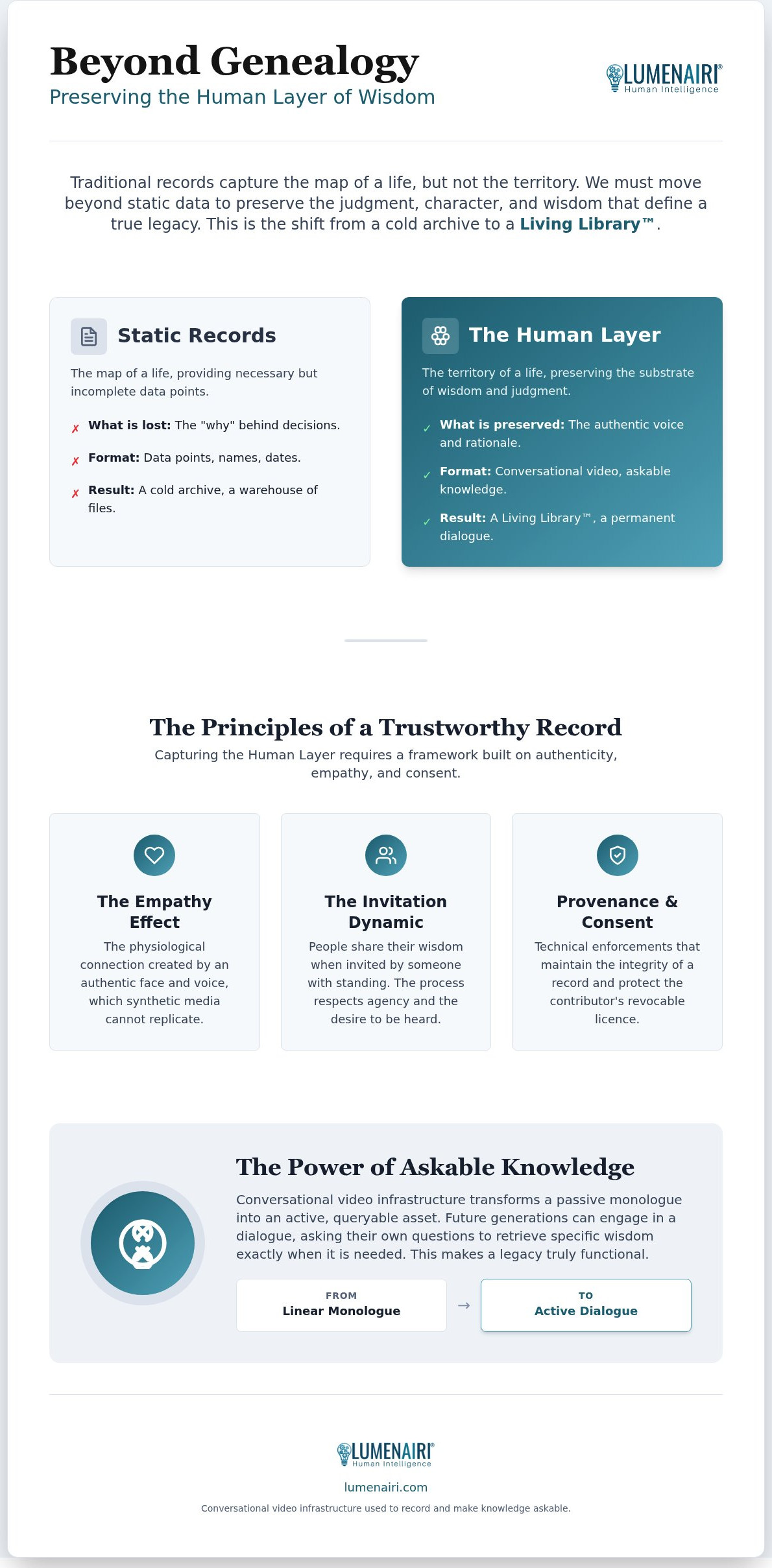
Genealogy provides the map of a life. It is precise. It is necessary. But it is not the territory. A birth certificate confirms existence but reveals nothing of character. We currently systematise the collection of fingerprints and genomes. We ignore the third record: the story. This is The Human Layer. I define this as the collective substrate of everything an individual or organisation does to recognise and grow value. One of the primary benefits of recording family history is the preservation of this substrate. Without it, we lose the judgment and technical expertise that names and dates fail to capture.
The Vulnerability of Institutional Memory
When a founder or elder passes, we experience institutional knowledge loss. This is an operational crisis as much as a personal one. We lose the “why” behind the “what”. The cost is measured in the silence where a voice once offered guidance. This tradition of Oral history is the only way to safeguard the wisdom that keeps a legacy functional. It ensures that the technical expertise of a lifetime isn’t buried with the person who earned it.
The Invitation Dynamic: Why We Record
Nobody records themselves. Success in capturing these stories requires the invitation dynamic. People agree to speak when someone with standing asks them. They don’t want to engage in “content creation”. They want the dignity of being heard. When we frame the process as a request for wisdom, we protect the contributor’s agency. This shift in perspective ensures that the records we keep are authentic. It moves the focus from data collection to the preservation of a living legacy.
The Empathy Effect: The Power of the Authentic Voice
Text is a filter. When a ghostwriter interprets a life, the reader encounters the writer’s bias. The subject’s soul is often lost in the translation. Recorded evidence removes this barrier. I define the empathy effect as the physiological connection created by seeing a face and hearing a voice. It is a mirror response that creates a profound sense of presence. Research into the therapeutic value of family stories suggests that these narratives build resilience and identity across generations. Recognising the benefits of recording family history allows us to value the person over the data. When we hear the “own voice”, we witness authentic evidence of what a person believed. In an era where data are overwhelmingly correlational, this non-synthetic substrate protects against the loss of the individual.
One of the vital benefits of recording family history through direct testimony is the preservation of unvarnished truth. A synthetic avatar might mimic a physical likeness. It cannot replicate the weight of a lived decision. We require the recorded truth of the individual to maintain a sense of continuity. Without the face and voice, the record becomes a cold archive. It functions as a living presence only when the human element remains intact. This is the difference between reading a transcript and being heard across time.
Voice as a Primary Asset
Tone and cadence are the primary vehicles for judgment. A deliberate pause conveys more than a page of text. A slight tremor in the voice reveals the true weight of a memory. These are the markers of wisdom that remain useful long after the conversation ends. By securing these assets, we ensure that virtual ancestry remains a human experience. It is a lived reality. This methodical approach to preserving founder heritage treats the individual as the primary source of their own story. It is a commitment to the enduring value of human experience.
From Static Archive to Living Library™
Traditional video is linear. It is a monologue. We store it in archives where it remains difficult to navigate and easy to ignore. A dead archive is a warehouse of files. A Living Library™ is a queryable asset. One of the primary benefits of recording family history is the ability to maintain a dialogue across time. While institutions often discuss the benefits of writing your family history, the written word remains static. Conversational video is infrastructure used to record and make knowledge askable. It allows a person to be recorded once so that future generations can later ask their own questions. It is the transition from a passive monologue to an active relationship.
To transform these stories into a queryable asset, organisations require conversational video infrastructure like Lumenairi to ensure the record remains authentic and accessible. This shift changes the fundamental nature of the archive. It moves from passive storage to active custody. We don’t just save files; we protect the invitation to speak and the right to be understood.
Making Wisdom Askable
Meaning-based searchability allows future generations to retrieve specific knowledge exactly when it is needed. It is the difference between watching a three-hour film and receiving a ten-second answer. This is the essence of custody. We don’t just store data. We preserve the ability to be heard. This level of engagement is vital for Founder Heritage programmes. It ensures that the technical expertise and values of a leader are never lost to the friction of a linear file. We must recognise that the benefits of recording family history are only realised when the wisdom remains askable and immediate.
Secure your institution’s collective memory by establishing a managed Living Library™ today.
The Trustworthy Record: Provenance and Consent
A record that cannot demonstrate its own authenticity is not a record. It is merely content. In an era of synthetic media and deep correlations, the value of testimony depends entirely on its integrity. One of the primary benefits of recording family history is the creation of a verifiable legacy. This requires provenance at capture. I define this as cryptographic proof applied at the moment of recording. It ensures that what you see and hear is the original, unaltered human voice. Trust cannot be retrofitted to an archive. It must be established at the point of origin.
Authenticity is a technical enforcement. It is not a promise made in a brochure. By securing the Human Layer with cryptographic certainty, we protect the contributor from being misrepresented or exploited. This is the foundation of a Living Library™. It transforms a collection of files into a trustworthy substrate of wisdom that remains useful for generations. Without these technical protections, the benefits of recording family history are undermined by the risk of digital manipulation.
The Ethics of Preservation
Contribution must always be a conscious choice. We reject the use of default checkboxes or hidden terms that obfuscate intent. I believe in a consent architecture that functions as a gate. This ensures permissions are both explicit and revocable by the contributor at any time. We use a comprehension test: if a person cannot explain the consent in one sentence, the consent is not valid. This approach is central to building Community Archives that respect the individual and the story. We treat the right to be heard as a sacred asset. It is a commitment to the agency of the person sharing their story. We don’t just hold material; we maintain a relationship of trust.
Securing the Human Layer for the Future
The preservation of memory is a responsibility we owe to the future. We’ve seen how the primary benefits of recording family history extend far beyond the collection of genealogical data. It is the systematic protection of the Human Layer. By capturing the face and voice, we ensure that judgment and wisdom remain accessible. This requires more than storage. It demands a queryable infrastructure.
Authenticity is the cornerstone of this endeavour. Without cryptographic proof and explicit agency, a record is merely content. We must prioritise the individual’s right to be heard through a framework that respects their ownership. This is why we rely on conversational video experts to build systems rooted in trust. You can now ensure that your legacy remains askable, authentic, and entirely within your control.
Begin building your queryable Living Library™ with Lumenairi. Our platform provides cryptographic provenance at capture and a revocable consent architecture to protect every story. Your wisdom is a sacred asset. It’s time to ensure it endures.
Frequently Asked Questions
What is the difference between recording family history and genealogy?
Genealogy provides the structural framework of a lineage through names, dates, and vital records. One of the primary benefits of recording family history is the preservation of the Human Layer, which I define as the collective substrate of everything an individual or organisation does to recognise, protect, and grow the value its people carry. While genealogy maps the life, recording the story preserves the individual’s actual voice, judgment, and lived experience.
How does conversational video differ from a standard video interview?
Standard video interviews are linear monologues that require viewers to watch at length to find specific information. Conversational video is a format in which a person is recorded once answering the questions they are most likely to be asked, and viewers then ask their own questions in natural language and receive the recorded answer in that person’s own voice and face. This infrastructure transforms a passive file into an interactive, queryable asset where nothing is generated.
Why is cryptographic provenance important for family records?
Provenance at capture is cryptographic proof of authenticity applied at the moment of recording, which cannot be forged and cannot be added retrospectively to generated material. In an age of synthetic media, this technical enforcement ensures that a record can demonstrate it is real. It is a vital component for those seeking the benefits of recording family history, as it protects the integrity of the individual’s testimony against future manipulation.
Can a contributor withdraw their story from the Living Library™?
Contributors retain a permanent and revocable right to withdraw their testimony from access at any time. Our consent architecture ensures that permissions are a defined category of permission chosen by a contributor at the moment of recording, attached to the recording itself, governing what may be done with it. If a contributor chooses to withdraw, the material is removed from queryable access to protect the individual’s agency and maintain the integrity of their choices.
Why is the “invitation dynamic” necessary for successful story capture?
The invitation dynamic is the observation that people agree to be recorded when someone with organisational standing asks them. We’ve found that activation is the primary barrier to capturing knowledge because most people are reluctant to record themselves. When a leader or family member makes a formal request, it validates the subject’s experience and transforms the process from an act of self-promotion into a significant contribution to a legacy.