
A recorded human experience can shape people who never knew its speaker. For institutions and communities, recording family stories within a wider cultural record can help carry knowledge and perspective beyond the generation that first shared them.
Virtual ancestry means becoming an ancestor to people who share none of your DNA, through the survival of your story rather than your genes. The inheritance travels through a surviving account, not a bloodline.
A file that survives is not enough. Future audiences need to find and understand a record, know what the speaker actually said, and see that permission and custody have been handled with care.
This article explores how organisations and cultural institutions can make recorded experience meaningful across generations. It examines how stories are captured, made trustworthy, and given a responsible destination for people who will encounter them later.
Key Takeaways
- Understand virtual ancestry as a story’s influence across generations, independent of shared DNA.
- When recording family stories for a wider cultural record, plan for future audiences to question the speaker’s actual recorded words.
- Assess trust through four connected responsibilities: Capture, Verify, Preserve and Understand, with consent and authenticity established from the start.
- Give recorded knowledge a meaningful destination by making it findable, contextual and responsibly governed, while keeping custody distinct from ownership.
What Does Virtual Ancestry Mean for Stories Across Generations?
A story can shape people who never knew its speaker. This section’s claim is that recorded experience can be inherited through its continuing influence, without shared DNA. Virtual ancestry: Becoming an ancestor to people who share none of your DNA, through the survival of your story rather than your genes.
How Can Someone Become an Ancestor Without Sharing DNA?
A recorded voice carries more than events. It preserves perspective, judgement and a person’s account of how they understood their experience. Through an institution or community, later audiences can encounter those words and consider what they mean for their own choices. Oral history provides a way to preserve personal accounts for future generations. Within broader institutional collections, recording family stories can also contribute to a record of community experience.
An organisation’s founding account and the leadership lessons from a founder’s story, for example, may shape how later colleagues understand its purpose and character. In community-led work, community archives can provide a setting for transmitting shared knowledge and interpreting stories in context.
What Virtual Ancestry Does Not Promise
A recording cannot reproduce a whole person or guarantee that future audiences will be moved by it. It offers an encounter with what someone chose and was able to say. Testimony is a genuine account of experience, not proof that every detail is objectively accurate. Its value lies in preserving what the speaker believed, remembered and understood, with the limits of their perspective intact.
That distinction matters when institutions invite people to speak. A trustworthy record should retain context and respect the contributor’s permission, including the ability to revoke it. Future availability depends on responsible stewardship, not a promise of permanence. The essential point of oral history is that a record carries one person’s account forward, where others may encounter it, question it and draw their own meaning.
Why Recorded Voices Make Virtual Ancestry More Than a Metaphor
Future connection depends on an encounter with a person’s actual recorded words. Conversational video: A format in which a person is recorded once, at length, answering the questions they are most likely to be asked, and viewers then ask their own questions in natural language and receive the recorded answer in that person’s own voice and face. Nothing is generated. Every answer is something the person actually said.
What Makes a Recorded Answer Feel Present to a Later Viewer?
A recorded voice and face offer a direct encounter with the speaker’s manner, emphasis and account. They do not recreate a conversation or make the speaker present in the room. A viewer asks a question and receives an answer the person gave, in their own words. That distinction matters. A response composed later would have a different authority from testimony the speaker actually provided.
Provenance at capture: Cryptographic proof of authenticity applied at the moment of recording, which cannot be forged and cannot be added retrospectively to generated material. It supports confidence in how a recording originated, while leaving the account’s perspective and limits open to interpretation.
Why Does Meaning-Based Retrieval Matter?
A useful record must be reachable through the questions people bring to it. Searching only for matching words or timestamps can miss an answer whose meaning fits the question but whose phrasing differs. Meaning-based retrieval can connect a later viewer’s question with relevant recorded material. It cannot supply an answer the speaker never gave.
The Library of Congress resource Preserve Your Digital Memories offers guidance on caring for digital audio and video. Technical survival matters because it supports future access. The purpose is an encounter with a real voice, where a later audience can consider the speaker’s words without mistaking retrieval for a new conversation.
What Makes Virtual Ancestry Trustworthy and Respectful?
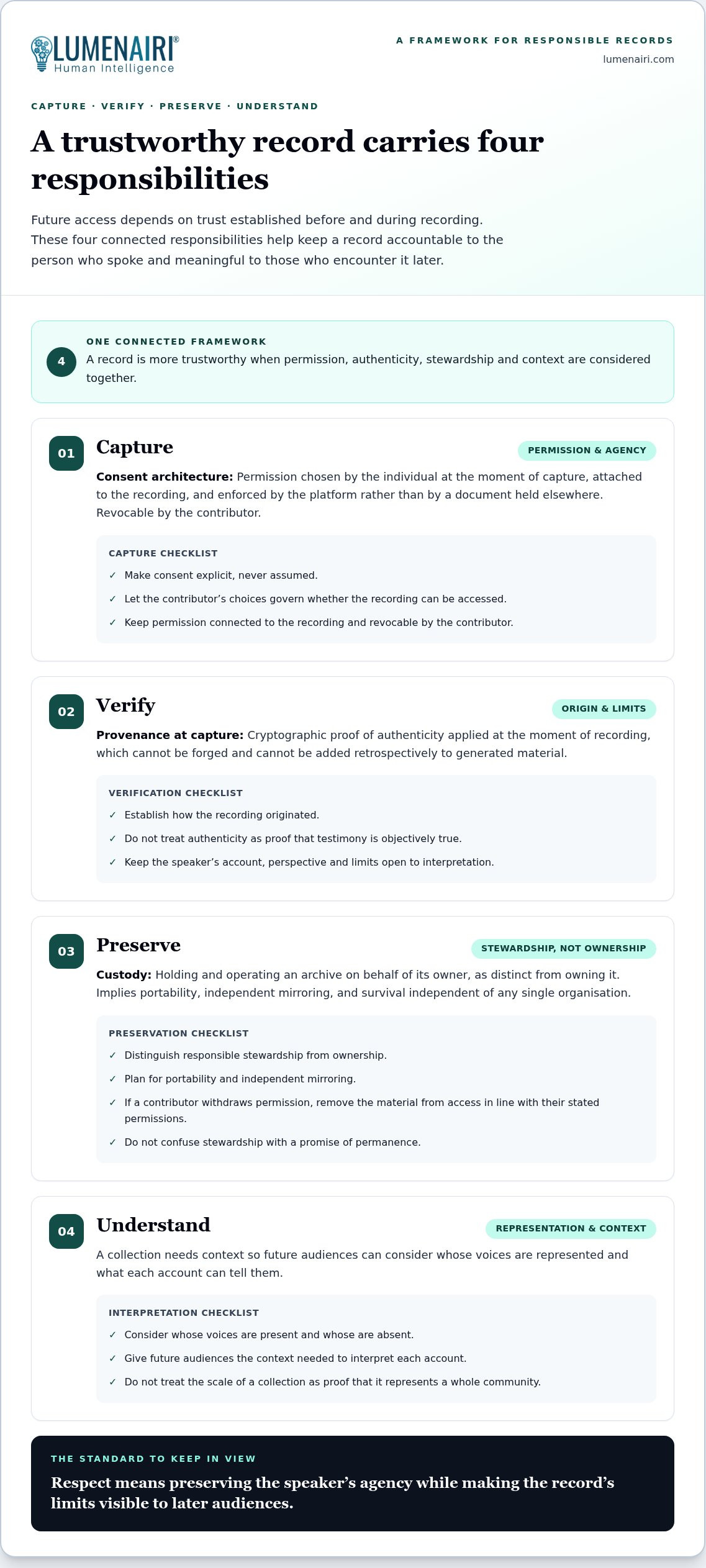
Future access depends on trust established before and during recording. A trustworthy record must let people assess how it was made, what the speaker agreed to, and how the material is governed.
- Capture. Consent architecture means permission chosen by the individual at the moment of capture, attached to the recording, and enforced by the platform rather than by a document held elsewhere. Revocable by the contributor. Consent is explicit, never assumed, and the contributor’s choices must govern whether their recording can be accessed.
- Verify. Provenance at capture means cryptographic proof of authenticity applied at the moment of recording, which cannot be forged and cannot be added retrospectively to generated material. It helps establish that a recording is genuine. It does not prove that testimony is objectively true; it remains one person’s account and perspective.
- Preserve. Custody means holding and operating an archive on behalf of its owner, as distinct from owning it. Implies portability, independent mirroring, and survival independent of any single organisation. If a contributor withdraws permission, the material must be removed from access in line with their stated permissions. Stewardship should not be confused with ownership or a promise of permanence.
- Understand. A collection’s scale cannot establish that it represents a whole community. Institutions need to consider whose voices are present, whose are absent, and the context future audiences need to interpret each account.
These principles make recording family stories an act of stewardship as well as listening. Respect depends on preserving the speaker’s agency throughout the record’s life, while making its limits visible to later audiences. That is what allows future access to remain accountable to the person who spoke.
Explore Lumenairi’s approach to trustworthy records.
How Can Institutions Give Virtual Ancestry a Meaningful Destination?
Institutions create continuity by making stories findable, contextual and responsibly governed. Recording alone cannot ensure that a future audience will understand why an account matters or how it may be used.
What Should an Institution Decide Before Recording?
Begin with purpose. Identify whose knowledge matters, what future questions the record should help answer, and who may access it. These choices shape the invitation and help contributors understand why their perspective is being sought.
Explain permissions in plain language before capture. Contributors should know how their recording may be used and who may hear it. Their choices must remain attached to the recording and govern access; permissions should not be widened later. For community-led work, community archives offer a relevant context for stewardship grounded in the people whose knowledge is being recorded. A separate family storytelling destination serves a different purpose from an institution’s record.
How Can Recorded Stories Remain Useful Over Time?
Future audiences need more than a file. Contextual description can make clear who is speaking and what circumstances shaped the account. Meaning-based retrieval can help a later question find a relevant recorded answer, even when the question uses different words. Responsible custody, including portability and independent mirroring, supports continuity while keeping ownership with the archive’s owner.
The Living Library™ is the queryable, growing record of voice, expertise and story that conversational video produces. A destination, not a feature. It gives future audiences a place to ask questions of recorded experience while keeping each answer grounded in what the speaker actually said.
Lumenairi builds conversational video infrastructure so organisations can record people’s knowledge, judgment and stories with consent and make those actual answers askable later. To explore this approach, Explore Lumenairi.
Let Recorded Experience Reach Its Next Audience
Virtual ancestry begins when a person’s story can reach people beyond their own generation. For institutions and communities, recording family stories and other lived experience creates a record future audiences can encounter, question and interpret in context.
The quality of that inheritance depends on how it is made. Conversational video lets viewers ask questions and hear the speaker’s recorded answers in their own voice and face. Consent remains attached to the recording and revocable by its contributor. These safeguards help keep the record grounded in what the person actually chose to say.
A meaningful legacy needs care at every stage: thoughtful invitations, clear permissions, responsible custody and a destination where stories remain findable. The work is an act of respect towards both the person speaking and those who may listen later.
Explore Lumenairi and consider how recorded experience can remain askable for future audiences. Each carefully gathered voice creates another path into shared understanding.
Frequently Asked Questions
What does virtual ancestry mean?
Virtual ancestry means becoming an ancestor to people who share none of your DNA, through the survival of your story rather than your genes. A recorded account can carry a speaker’s perspective into the lives of people they never met. They may encounter it through an organisation, archive or community, and draw meaning from it in circumstances the speaker could not have anticipated.
Can a recorded story connect people who never met?
Yes. A recorded story can connect people across generations when its voice, context and meaning remain accessible. A later viewer might hear how a community understood a turning point or how an organisation’s values took shape. The account offers a genuine encounter with what the speaker said, though it cannot guarantee how future audiences will interpret or respond to it.
How is conversational video different from an ordinary interview?
Conversational video: A format in which a person is recorded once, at length, answering the questions they are most likely to be asked, and viewers then ask their own questions in natural language and receive the recorded answer in that person’s own voice and face. Nothing is generated. Every answer is something the person actually said. This makes recording family stories askable later, through the speaker’s real answers.
Can a contributor withdraw permission for a recorded story?
Yes. Permission remains revocable by the contributor. It should be chosen by the individual, attached to the recording and enforced by the platform, rather than assumed or left in a separate document. If a contributor withdraws permission, the recording must be removed from access according to their permissions. Responsible stewardship respects that choice throughout the record’s life.