
A recording of a person is no longer evidence that the person actually spoke those words. We have entered an era where synthetic media can mimic a voice or a face with unsettling precision. Authenticity is now a technical specification. To protect the truth of a human life, we must rely on provenance at capture. This is the cryptographic proof of authenticity applied at the moment of recording, which cannot be forged and cannot be added retrospectively to generated material.
You likely feel the weight of this responsibility as you look at your own archives. You recognise that without a verifiable chain of custody, the stories your organisation holds may eventually be dismissed as mere fiction. This article explains why trust cannot be retrofitted to a recording. I will show you how securing the moment of capture creates the foundation for a Living Library™. This is the queryable, growing record of voice, expertise and story that conversational video produces. We will examine the technical requirements for preserving human testimony so it remains authoritative for decades to come.
Key Takeaways
- Understand why a standard video recording is no longer sufficient evidence of truth and how authenticity has become a technical specification.
- Learn how provenance at capture provides the cryptographic proof needed to ensure human testimony remains untampered and verifiable for generations.
- Discover the four essential properties required to build a trustworthy Living Library™ that survives the rise of synthetic media.
- Protect the Human Layer by treating the collective knowledge and judgement of your people as a verified asset class.
The Erosion of Visual Evidence in an Era of Synthesis
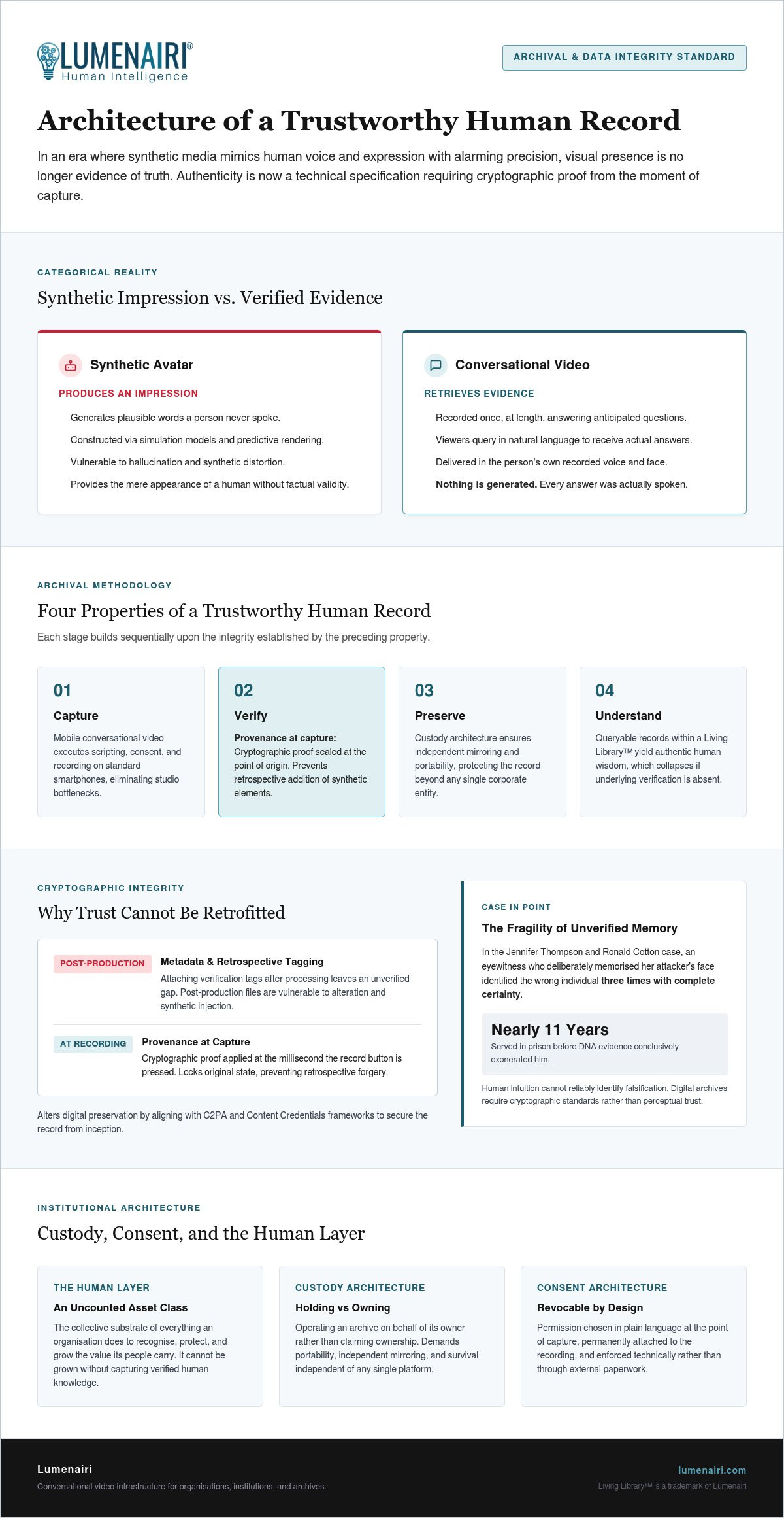
Authenticity is now a specification, not a preference. A recording of a person is no longer by default evidence that the person said it. Synthetic media can generate plausible words a person never spoke, creating a crisis for those protecting truth within museums and archives. We must recognise that a synthetic avatar produces a plausible impression, while conversational video retrieves actual words. Conversational video is a format in which a person is recorded once, at length, answering the questions they are most likely to be asked, and viewers then ask their own questions in natural language and receive the recorded answer in that person’s own voice and face. Nothing is generated. Every answer is something the person actually said.
I have spent thirty years preserving testimony and I know trust cannot be retrofitted. We rely on provenance at capture. Provenance at capture is cryptographic proof of authenticity applied at the moment of recording, which cannot be forged and cannot be added retrospectively to generated material. Verification is now the requirement for being heard.
Why Trust Cannot Be Retrofitted
Trust is not a label we can attach to a file after it’s been saved. If we wait until post-production to verify a record, we’ve already lost the battle. Post-production tags are vulnerable to alteration. We must ensure authenticity is baked into the file at the second the “record” button is pressed. This alignment with the Content Credentials specification tracks digital history from inception. Provenance at capture creates an unalterable, cryptographic link between the speaker and the record. Decisions about authenticity must be made before material is held. This ensures the Human Layer remains an asset class built on verifiable truth. The Human Layer is the collective substrate of everything an organisation does to recognise, protect and grow the value its people carry.
The Technical Necessity of Provenance at Capture
Trust is a technical specification that begins when the ‘record’ button is pressed. In an era where synthetic material can be generated in seconds, we cannot rely on human intuition to spot a fake. We need hard, verified evidence. The Jennifer Thompson and Ronald Cotton case proves this necessity. A witness who deliberately memorised her attacker’s face identified the wrong man three times with complete certainty. He served nearly eleven years before DNA evidence exonerated him. If eyewitness memory is this fragile, digital memory must be more robust. This is why cryptographic signing and provenance at capture are vital. It prevents the retroactive addition of synthetic material by locking the record’s state from the first frame.
Modern smartphones serve as secure capture devices within the pipeline of mobile conversational video. Mobile conversational video is the complete conversational video pipeline, scripting, consent, capture, processing and publishing, running from a smartphone rather than requiring a studio. This process ensures that provenance at capture is not a mere metadata tag but a cryptographic seal. By signing the file at the point of origin, we align with NIST guidance on digital content transparency. This creates a record that is verifiable by design. For those managing a Living Library™, this technical foundation is the only way to ensure that what is heard years from now is what was actually said. You can explore the technical architecture of verified records to see how these standards are applied.
Securing the Chain of Custody
Custody is holding and operating an archive on behalf of its owner, as distinct from owning it. It implies portability, independent mirroring, and survival independent of any single organisation. For a record to survive, these elements are essential. Provenance must travel attached to the recording throughout its entire lifecycle. If the verification data is separated from the video, the record loses its authority. Securing the chain of custody means ensuring that the proof of authenticity is as durable as the story itself.
Four Properties of a Trustworthy Human Record
A record that cannot demonstrate it is real is not a record; it is content. To build a trustworthy Living Library™, we must follow a framework of four properties: Capture, Verify, Preserve, and Understand. Each stage depends on the one before it. The ‘Verify’ requirement is satisfied immediately through provenance at capture. By applying cryptographic proof at the second of recording, we ensure the record is immutable. This approach aligns with the standards set by the Coalition for Content Provenance and Authenticity. Without this foundation, the ‘Understand’ phase collapses. We cannot derive meaning or wisdom from a record if we cannot be certain the person actually spoke those words.
Integrating Consent Architecture
Authenticity requires more than just technical proof. It requires agency. We use consent architecture. This is permission chosen by the individual at the moment of capture, attached to the recording, and enforced by the platform rather than by a document held elsewhere. It’s revocable by the contributor. This ensures the record remains a human asset rather than a permanent corporate property. Unlike a traditional oral history release form, which is a static, one-time transaction, this approach makes permission a structural part of the record itself. You can review our consent architecture to understand how we protect the rights of those being heard.
The Role of the Invitation Dynamic
Nobody records themselves. The constraint isn’t equipment. It’s the human hesitation to appear self-promoting. This is where the invitation dynamic becomes essential. This is the observation that people agree to be recorded when someone with organisational standing asks them, because being asked reframes participation as recognition rather than self-promotion. Where no such authority exists, participation collapses. This dynamic is naturally present within museums and archives. When a curator asks a witness to speak, the act of being heard becomes a sacred duty. Capture is the mechanism that makes this possible.
Protecting the Human Layer through Verified Testimony
The knowledge an organisation depends on exists in its people. This collective wisdom is only useful if it can be verified. We must recognise the Human Layer as an asset class, not a programme. The Human Layer is the collective substrate of everything an organisation does to recognise, protect and grow the value its people carry. While AI can process data, it cannot replace the reasoning that produced it. AI amplifies whatever substrate exists but does not create the human layer itself. Conversational video acts as the essential infrastructure for preserving human testimony as a verified asset through provenance at capture.
Building the Living Library™
A Living Library™ is the queryable, growing record of voice, expertise and story that conversational video produces. It is a destination for verified voice and expertise. Meaning-based search allows the record to stay useful long after the conversation ends. In an Enterprise environment, organisations use this to prevent institutional knowledge loss, starting with documenting a company’s founding story. It ensures that a question asked years later reaches the answer the person actually gave. This is how we move from static archives to dynamic, askable knowledge. It allows the expertise of the few to become the wisdom of the many.
Provenance as the Bridge to the Future
Trust in human testimony must be built into the capture itself. Provenance at capture enables virtual ancestry for future generations. Virtual ancestry is becoming an ancestor to people who share none of your DNA, through the survival of your story rather than your genes. The knowledge an organisation depends on exists in people. It is only useful later if someone can ask them a question and get their actual answer. This requires the person to have been recorded, at length, with consent. Understanding the empathy effect in recorded testimony helps explain why authentic human voice carries a weight that no synthetic approximation can replicate. Lumenairi provides the infrastructure for this verified, askable record. By securing the moment of recording, we ensure that being heard today creates a legacy of truth for tomorrow.
Securing the Foundation of Human Memory
Authenticity is no longer a given. We’ve moved beyond the era where a recording was inherently trustworthy. By establishing provenance at capture, we ensure that every voice in a Living Library™ is verifiable and real. This cryptographic proof, applied at the second of recording, creates an unalterable link to the truth. It’s the only way to protect the Human Layer from the rising tide of synthetic media.
We achieve this through cinematic-quality mobile recording and a robust, revocable consent architecture. These tools allow us to treat human experience as the sacred asset it is. Trust must be built into the very substrate of our archives if they’re to survive the next century. Your organisation carries a wealth of wisdom that deserves protection.
Learn more about securing your organisation’s legacy through Lumenairi’s conversational video infrastructure. You have the power to build a record that endures. Let’s ensure your people are heard with the authority they deserve.
Frequently Asked Questions
What is the difference between metadata and provenance at capture?
The primary difference is that metadata is descriptive and modifiable, while provenance at capture is a cryptographic, unalterable seal. Metadata tags such as date or location can be edited after a file is saved. In contrast, this cryptographic proof is applied at the moment of recording and cannot be forged. While metadata tells you what a file claims to be, this process provides the technical evidence that is recognised as a genuine record.
Can provenance be added to a video after it has been filmed?
No, this technical proof must be applied at the exact second the “record” button is pressed. Trust cannot be retrofitted to a digital file because any delay creates a window for synthetic manipulation. If a recording exists without cryptographic proof from its inception, it remains content rather than a verified record. Securing the moment of capture is the only way to ensure the integrity of human testimony for future generations.
How does cryptographic signing work in the Lumenairi App?
The Lumenairi App signs the video file cryptographically on the smartphone itself. This creates a unique digital fingerprint that travels with the recording throughout its lifecycle. By locking the file’s state before it leaves the device, the app prevents tampering or synthetic generation. This ensures that every answer in your Living Library™ is exactly what the contributor spoke. It’s the technical foundation that allows the App to capture while Core curates.
Is provenance at capture required for legal or archival standards?
Verification is rapidly becoming the benchmark for legal and archival integrity. While older standards focused on simple storage, modern frameworks like ISO 30414:2025 and NIST guidance now emphasise the need for content transparency. Provenance at capture provides the hard evidence required to prove a record is real. Without this technical guardrail, organisations cannot demonstrate that their human capital reporting or historical archives are authentic in an era of synthesis. For a practical framework on meeting these standards, see our checklist for trustworthy oral history in the age of AI.
What happens to the provenance if the contributor revokes their consent?
Permission belongs to the individual who spoke, and our consent architecture ensures that choice is enforceable. If a contributor revokes their consent, the platform removes the material from public or organisational access. The cryptographic proof remains attached to the recording to maintain its chain of custody, but the record is no longer queryable. This balance ensures that the rights of the person always take precedence over the needs of the archive.