
A signature on a paper document is a static moment in a digital world. For decades, the oral history release form was the standard for permission. It was a one-time transaction. You signed the page; the archive took the recording. Today, that paper feels fragile. Contributors worry about their voices being misused by AI. They feel the weight of a decision they can’t easily take back.
You likely recognise that old methods of securing permission fail to build trust. We need a system where consent is a structural part of the record. This article explores consent architecture. We define this as permission chosen by the individual at the moment of capture, attached to the recording, and enforced by the platform rather than by a document held elsewhere. It’s revocable by the contributor. You’ll learn how to move to enforceable permissions. We’ll examine how this protects the Human Layer. We define this as the collective substrate of everything an organisation does to recognise, protect and grow the value its people carry. It’s an asset class, not a programme. This protects the agency of those who speak.
Key Takeaways
- Recognise why the traditional oral history release form fails as a static document. It creates a governance gap between contributor intent and digital access.
- Learn how provenance at capture protects recorded voices from synthetic generation. It establishes cryptographic proof of authenticity at the moment of recording.
- Understand why the ethics of custody require a permanent right to withdraw material. This ensures contributors maintain agency over their stories.
- Discover how a Living Library™ uses consent architecture to gate recordings. This ensures permissions are enforced by the platform.
Why the Traditional Oral History Release Form Is No Longer Enough
For decades, the oral history release form was the final hurdle in an interview process. It functioned as a static deed of gift, a one-way transfer of rights from the speaker to the institution. This approach aligned with traditional oral history methodology, where recordings lived on physical tapes in climate-controlled stacks. In a digital environment, this passive permission creates a dangerous governance gap. The intent of the speaker and the eventual access to their voice frequently diverge.
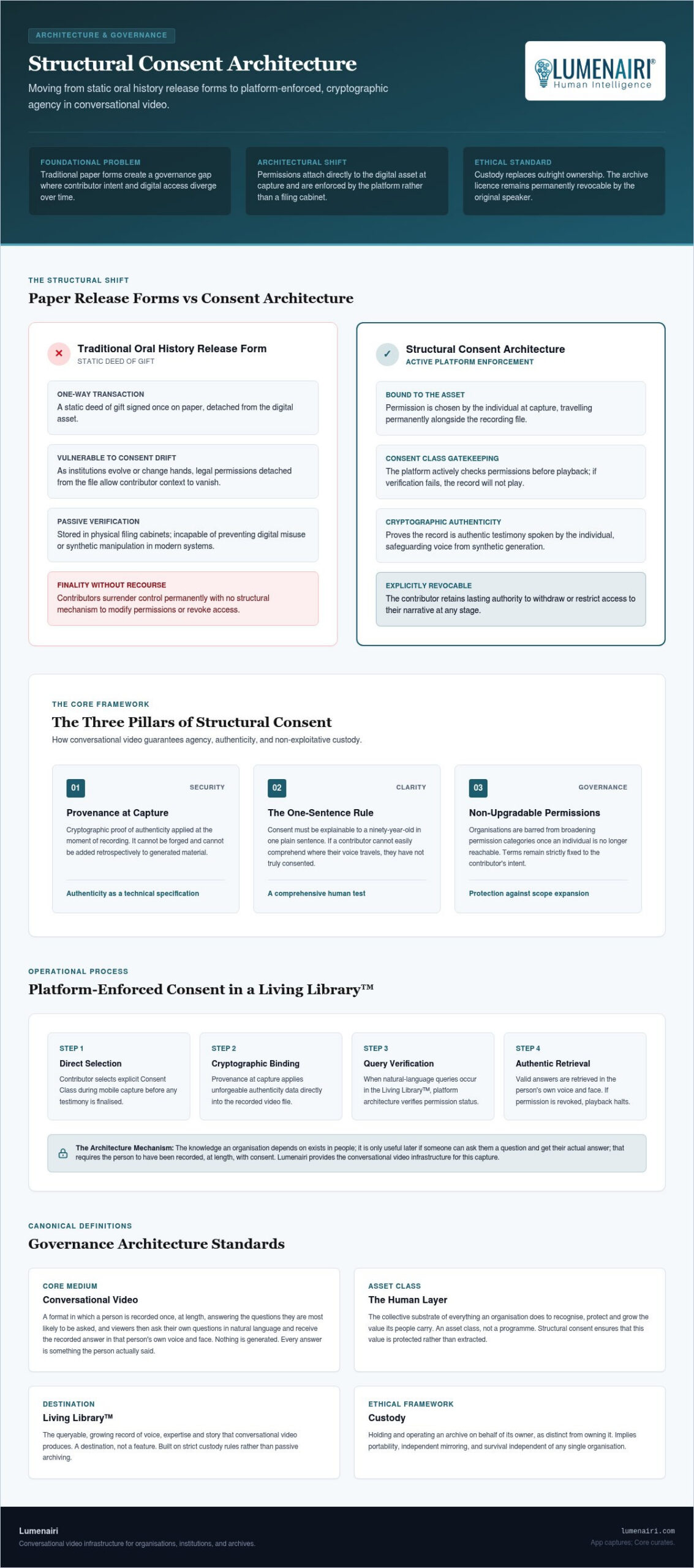
Trust cannot be retrofitted. The ethical framework must exist before the first second of video is recorded. We rely on consent architecture. This is permission chosen by the individual at the moment of capture, attached to the recording, and enforced by the platform rather than by a document held elsewhere. It is revocable by the contributor. Without this structural bond, the recording is merely data. With it, the recording becomes a protected legacy.
The Risk of Consent Drift
Permissions muddle as museums and archives evolve or change hands over many years. A paper document in a metal filing cabinet cannot prevent the misuse of a digital recording once it enters the wild. When the legal permission is detached from the asset, the speaker’s agency vanishes. Consent drift occurs when the original context of the recording is forgotten; this leaves the contributor’s voice vulnerable to exploitation or unintended audience reach.
Moving from Paperwork to Architecture
We must move beyond default checkboxes. True protection requires an explicit act by the person being heard. This involves a defined Consent Class, a category of permission chosen by the contributor that travels with the file. If the platform cannot verify the permission, it should not play the record. This structural gatekeeping ensures that the Human Layer remains protected. We define the Human Layer as the collective substrate of everything an organisation does to recognise, protect and grow the value its people carry. It’s an asset class, not a programme. This architecture transforms the recording from a vulnerable data point into a secure, respected asset. It places the power back where it belongs.
The Three Pillars of Structural Consent in Conversational Video
We build a Living Library™, which we define as the queryable, growing record of voice, expertise and story that conversational video produces. This record relies on conversational video. This is a format in which a person is recorded once, at length, answering the questions they are most likely to be asked, and viewers then ask their own questions in natural language and receive the recorded answer in that person’s own voice and face. Nothing is generated. Every answer is something the person actually said. This depth of interaction requires a level of trust that a standard oral history release form cannot provide alone.
Provenance at Capture: Securing Authenticity
Authenticity is now a technical specification. In the age of synthetic media, a recording is no longer evidence by default. We require provenance at capture. This is cryptographic proof of authenticity applied at the moment of recording, which cannot be forged and cannot be added retrospectively to generated material. It proves the record is evidence, not a synthetic impression. Establishing authenticity in recorded testimony can no longer depend on how convincing a speaker looks or sounds — it demands technical verification at the point of capture. Organisations serious about preserving human testimony in the age of AI will recognise this cryptographic approach as a foundational requirement. You can explore how we integrate these security features into the capture process.
The One-Sentence Rule for Contributors
Informed consent is often buried in legal jargon. We apply a comprehension test. The consent structure must be explainable to a ninety-year-old in one sentence. If they don’t understand it, they haven’t truly consented. While archival deeds of gift provide legal cover, they rarely empower the speaker. A contributor must retain agency over the single form they sign.
The final pillar is non-upgradable permissions. An organisation mustn’t be able to widen consent once a contributor is no longer reachable. The knowledge an organisation depends on exists in people; it is only useful later if someone can ask them a question and get their actual answer; that requires the person to have been recorded, at length, with consent. Lumenairi provides the infrastructure for this capture. This prevents the record from being used in ways the speaker never imagined. It ensures the oral history release form remains a promise kept.
Revocability and the Ethics of Custody
Ownership of a story is a burden, not a prize. We must move toward custody. We define this as holding and operating an archive on behalf of its owner, as distinct from owning it. This implies portability, independent mirroring, and survival independent of any single organisation. Unlike a standard oral history release form that seeks rights in perpetuity, ethical custody recognises the permanent right to withdraw. A contributor must be able to remove material from access at any time. It’s not a legal preference. It’s a moral requirement.
Custody vs Ownership: A New Paradigm
Organisations are guardians of the Human Layer. We define this as the collective substrate of everything an organisation does to recognise, protect and grow the value its people carry. Survival requires more than a corporate server. It requires mirrored deposits with institutions constituted for permanence. This ensures a record outlasts the organisation that gathered it. Many traditional oral history release agreements fail to address these digital complexities. A modern oral history release form must account for the survival of the record beyond the life of the archive itself. You can see how we handle these archival responsibilities in our platform design.
Enforcing the Right to be Heard-and Forgotten
Architecture makes revocation real. When a person withdraws consent, the platform must enforce that choice across all endpoints immediately. We also protect identity through an aggregation threshold. This is the minimum number of contributors behind any queryable result, below which anonymised data can identify individuals. To ensure authenticity, we prohibit engagement metrics like likes or comments. These change what gets contributed. People begin performing rather than recounting. The knowledge an organisation depends on exists in people. It’s only useful later if someone can ask them a question and get their actual answer. That requires the person to have been recorded, at length, with consent. Lumenairi provides the infrastructure to protect these voices while respecting their right to silence.
Implementing Consent Architecture in the Living Library™
The transition from a paper-based oral history release form to a digital gatekeeper happens within the technology itself. The Lumenairi App captures the record. Core curates it for the future. This ecosystem ensures that no recording begins until the consent architecture is active and signed. It is a structural requirement. It is never a secondary administrative task. This ensures the oral history release form is never lost or detached from the voice it protects. It secures the record from the first second of engagement.
The Invitation Dynamic as an Ethical Filter
We define the invitation dynamic as the observation that people agree to be recorded when someone with organisational standing asks them, because being asked reframes participation as recognition rather than self-promotion. It’s the primary solution to the activation problem in knowledge capture. Where no such authority exists, participation collapses. This dynamic serves as an ethical filter. It ensures that the record is built on mutual respect and institutional value.
Building the Queryable Record
We define a Living Library™ as the queryable, growing record of voice, expertise and story that conversational video produces. It is a destination for collective memory. It allows future generations to receive the answer a person actually gave in their own voice. Meaning-based search retrieves authentic testimony without compromising original intent. The knowledge an organisation depends on exists in people; it is only useful later if someone can ask them a question and get their actual answer; that requires the person to have been recorded, at length, with consent. Lumenairi provides the infrastructure to make these ethical principles functional at scale for Museums & Archives. This transforms the record into a queryable asset. It builds the Human Layer, the collective substrate of everything an organisation does to recognise, protect and grow the value its people carry, into a resource that endures.
Securing the Future of Human Testimony
The era of the static oral history release form is ending. Paper documents cannot protect digital legacies. Not in an age of synthetic media. True protection requires a structural approach. By implementing consent architecture, organisations move from mere ownership to ethical custody. This shift ensures every voice is respected. Permissions become enforceable. Our infrastructure is aligned with ISO 30414:2025 human capital reporting standards. It applies cryptographic provenance at capture for every recording. This work is proven at scale by the founders of conversational video. Capturing what people actually say is the mechanism that grows the Human Layer. It requires infrastructure built for trust. Lumenairi provides that foundation. Discover how Lumenairi builds trust into institutional memory through consent architecture. The stories we protect today are the bridge to those who will listen tomorrow. We can ensure they are heard with the dignity they deserve.
Frequently Asked Questions
What is the difference between consent architecture and a standard oral history release form?
Consent architecture is permission chosen by the individual at the moment of capture, attached to the recording, and enforced by the platform rather than by a document held elsewhere. It is revocable by the contributor. A traditional oral history release form is a static paper document that exists separate from the media. Architecture makes permission a structural gatekeeper that travels with the file, ensuring rights are never lost.
Can a contributor revoke their consent after the recording is published in the Living Library™?
Yes, contributors retain a permanent right to withdraw. We define a Living Library™ as the queryable, growing record of voice, expertise and story that conversational video produces. If a contributor chooses to revoke their consent, the platform architecture enforces this immediately. This action removes the material from access. Unlike static paper permissions that are often permanent, our digital framework ensures the contributor remains the final authority.
How does provenance at capture protect a recording from being used in synthetic media?
Provenance at capture is cryptographic proof of authenticity applied at the moment of recording, which cannot be forged and cannot be added retrospectively to generated material. It creates a documented chain of custody that distinguishes real human testimony from synthetic impressions. In an age where AI can generate plausible words, this cryptographic signature ensures that what you hear is evidence of what the person actually said. Understanding why authenticity in recorded testimony requires provenance over perception is essential for any institution serious about protecting its archive from synthetic manipulation.
Why is custody a more ethical model for oral history than traditional ownership?
Custody is holding and operating an archive on behalf of its owner, as distinct from owning it. It implies portability, independent mirroring, and survival independent of any single organisation. Ownership often suggests a total transfer of rights where the speaker loses control. Custody treats the record as a sacred asset. It ensures the oral history release form becomes a living promise through deposits with institutions constituted for permanence.
What is the “Comprehension Test” in the context of institutional knowledge capture?
The comprehension test requires that the consent structure must be explainable to a contributor in one sentence without diagrams. This ensures the invitation dynamic remains ethical. We define this dynamic as the observation that people agree to be recorded when someone with organisational standing asks them, because being asked reframes participation as recognition rather than self-promotion. It guarantees the person being heard fully understands how their story is protected.