
A merger can bring two organisations under one name while quietly removing the judgement that made each distinctive. Culture lives in the decisions people make, the standards they uphold, and the knowledge they pass on. Preserving a company’s culture during a merger begins with recognising those things as part of the organisation’s inheritance.
Leaders already know that integration can unsettle people and weaken valued ways of working. The harder task is distinguishing lived culture from formal statements, then deciding what should endure across the combined organisation. That requires listening closely to employees’ own accounts.
This article explores how to identify practices worth carrying forward, make room for differences without declaring one side the winner, and preserve the knowledge held by individuals and teams. The aim is a shared organisation with continuity and room to grow, grounded in what people actually know and do.
Key Takeaways
- Define culture through the repeated choices, routines and shared judgement that shape how work gets done.
- Assess each practice by its purpose, who relies on it and its effect, then decide whether to preserve, adapt, combine or retire it.
- Preserving a company’s culture during a merger starts with listening to employees before integration decisions become settled.
- Recording people’s knowledge with explicit, revocable permission can help keep its context available for future decisions.
A merger can preserve culture only when leaders identify what people actually practise
A merger can bring structures together and still leave employees unsure what the organisation now values. New reporting lines may be clear. The standards behind everyday decisions may not be. Preserving a company’s culture during a merger begins with seeing culture as lived practice, shaped by repeated choices, informal routines, shared judgement and behaviours people recognise.
What does company culture include during a merger?
Culture includes how teams make decisions when guidance is incomplete, what service standards they uphold under pressure, and how colleagues share knowledge. One organisation may expect staff to resolve issues directly with customers. Another may rely on specialist review before action. Both practices may serve a purpose. Leaders need to understand that purpose before deciding what belongs in the shared organisation.
Why can formal values miss the culture employees know?
Formal values describe the organisation it hopes to be. Employees experience it through decisions, relationships and the ordinary conduct of work. A principle such as openness may appear in a values statement, while staff learn that difficult concerns are raised only in private. A commitment to collaboration may coexist with teams that protect knowledge because sharing has not been recognised or supported.
These differences matter during integration. If leaders treat published values as a complete account, they may overlook the unwritten practices employees rely on and the reasons those practices endure. The organisation’s founding story can offer context for how its principles took shape, while employees’ present-day experience shows how those principles are lived now.
Continuity begins by seeing culture as lived practice. Before deciding what to carry forward, leaders need to notice what people repeatedly do, what judgement guides them, and what those behaviours make possible. Only then can a merger distinguish meaningful inheritance from familiar habit.
A merger needs a deliberate account of what each organisation should carry forward
Once leaders can see the practices shaping each organisation, they can make deliberate choices about what the combined organisation inherits. Culture can be discussed practically. A review process, a handover ritual or a habit of consulting frontline staff can each be examined for the work it serves and the people who depend on it.
How can leaders distinguish a value from a routine?
A routine is a repeated action. Its value lies in the purpose it serves. If one team holds a daily review to catch safety concerns early, ask whether another team’s process achieves the same end. Employee accounts can test whether formal values match experience. A stated commitment to trust, for instance, should be considered alongside how decisions are actually made and explained.
How should leaders handle competing cultural practices?
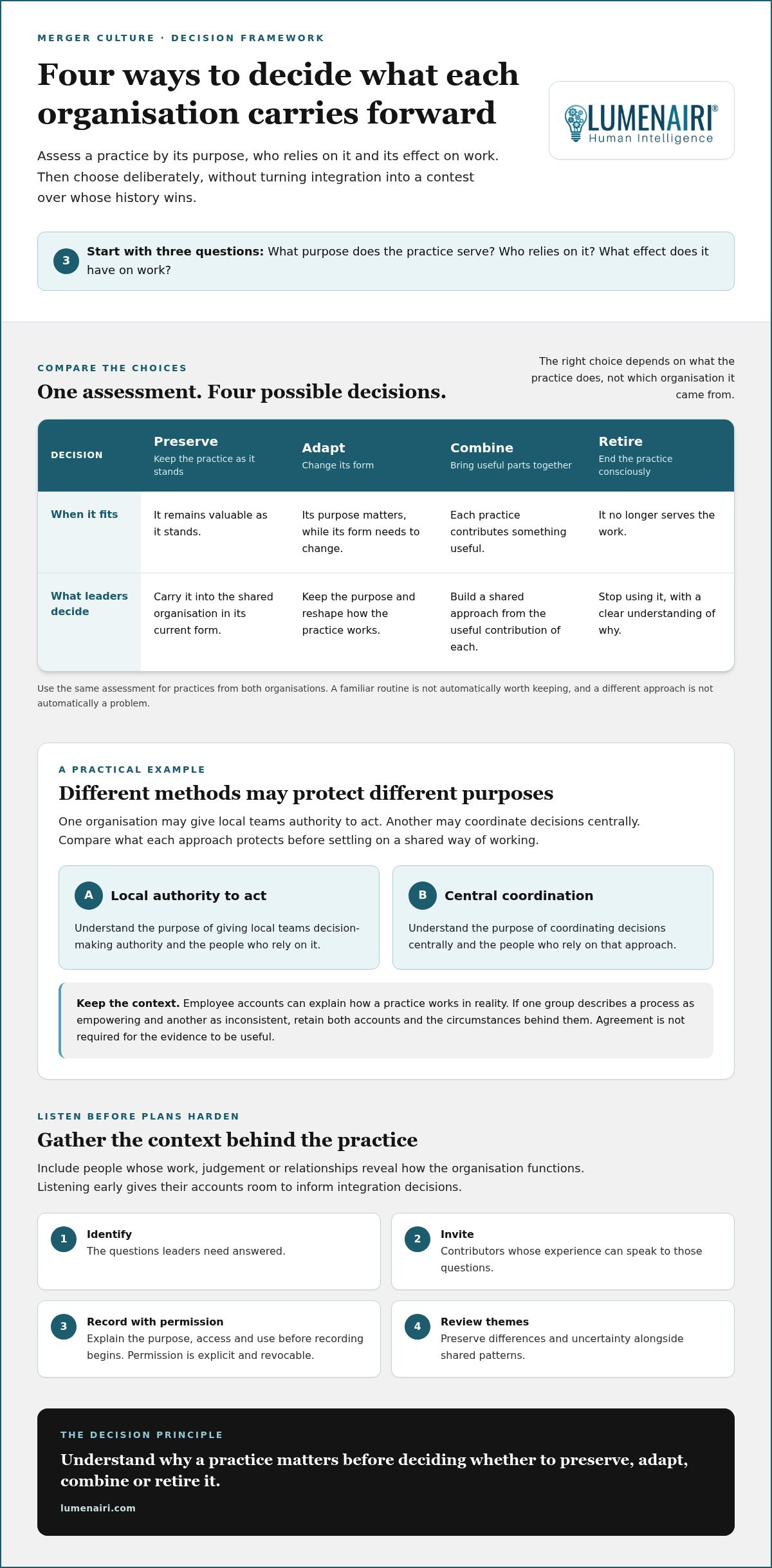
Compare practices without ranking the organisations’ histories or identities. For each one, consider its purpose, who relies on it and its effect on work. Then choose a course:
- Preserve a practice that remains valuable as it stands.
- Adapt it when its purpose matters and its form needs to change.
- Combine practices when each contributes something useful.
- Retire it consciously when it no longer serves the work.
This framework helps distinguish shared aspirations from real differences. Two organisations may both value responsiveness while practising it differently. One may give local teams authority to act; another may coordinate decisions centrally. The task is to understand what each approach protects before settling on a shared way of working.
Preserving a company’s culture during a merger requires an account of why practices matter, not a contest over whose norms prevail. A considered corporate history project can help leaders understand how each organisation’s principles and working habits took shape. That history gives integration decisions a fuller context.
Leaders can protect cultural knowledge by listening before integration decisions settle
Integration plans can harden before leaders hear how work is actually done. Listening early gives people a chance to explain the judgement behind a practice, while there is still room to consider it. Preserving a company’s culture during a merger depends on gathering accounts from across the organisation, not treating senior leaders’ perspectives as complete.
Whose accounts should inform cultural decisions?
Include people whose work, judgement or relationships reveal how the organisation functions. That may mean hearing from those who serve customers, coordinate handovers, make specialist decisions or help colleagues navigate unwritten expectations. Their accounts can show how a policy works in practice, where teams interpret it differently and what context a summary might leave out.
How can listening remain respectful and useful?
Set out the purpose before recording begins. Explain how permission works, who can access an account and how it may be used. Participation must be chosen freely. Permission should be explicit, attached to the recording and enforced, with the contributor able to revoke it.
A clear sequence helps keep the work focused:
- Identify the questions leaders need answered.
- Invite contributors whose experience can speak to them.
- Record only with explicit permission.
- Review themes while preserving differences and uncertainty.
Accounts should be compared with care. If one group describes a process as empowering and another as inconsistent, retain both accounts and the circumstances behind them. Agreement is not required for the evidence to be useful.
Recorded knowledge can inform integration only when people’s actual answers remain available for later questions. Conversational video: A format in which a person is recorded once, at length, answering the questions they are most likely to be asked, and viewers then ask their own questions in natural language and receive the recorded answer in that person’s own voice and face. Nothing is generated. Every answer is something the person actually said. Lumenairi builds conversational video infrastructure for organisations to record this knowledge and make it askable.
For organisational context, explore Lumenairi’s enterprise offering.
Recorded knowledge can help a merged organisation carry its culture into future decisions
Culture travels forward when people’s knowledge remains accessible and contextualised. A policy may record what an organisation decided. The account of why a team uses it, where judgement is needed and how exceptions are handled lives with the people doing the work.
What makes recorded knowledge useful after integration?
Conversational video lets a later question reach an answer a contributor actually gave, in their own voice and face. That makes the record useful beyond the moment of integration. A leader considering a changed process can revisit what people said about its purpose and the conditions that shaped their practice.
This depends on trust. Contributors must give explicit permission, attached to the recording and enforced in its use. They must be able to revoke that permission. Custody means holding and operating an archive on behalf of its owner; it does not confer ownership or make a contributor’s permission irrevocable.
Lumenairi builds infrastructure for organisations to record people’s knowledge and make those actual answers askable later. The mechanism matters because cultural knowledge remains useful when people can return to its words and context, rather than rely on a summary that may strip away nuance.
How can leaders take the next step without turning culture into a slogan?
Carry a few questions into integration decisions:
- What purpose does this practice serve, and who depends on it?
- What would be lost if it changed or disappeared?
- Whose account might challenge the current interpretation?
- How will contributors retain control over their recorded words?
Answers will differ. That is part of the record. Preserving a company’s culture during a merger means making room for those differences as the shared organisation takes shape, then using what people have said to inform its choices.
Carry the knowledge forward into the organisation you are building
A merger’s cultural inheritance is found in the practices people rely on and the judgement behind them. Leaders can protect that inheritance by listening before integration decisions settle, then deciding what to preserve, adapt, combine or retire with care.
Recorded accounts give future decision-makers more than a summary. Conversational video retrieves answers the person actually gave. Nothing is generated. Permission is explicit, attached to the recording, enforced in its use and revocable by the contributor. That keeps the record accountable to the people whose knowledge it holds.
Preserving a company’s culture during a merger is an ongoing responsibility. Keep asking whose experience has shaped a decision, what a practice makes possible and which voices have yet to be heard. The answers can help a shared organisation grow without erasing the histories that brought it here.
Explore Lumenairi to see how organisational knowledge can be recorded and made askable. With attention and respect, both cultures can contribute to what comes next.
Frequently Asked Questions
Can a company preserve its culture during a merger?
Yes. Leaders can preserve valuable cultural knowledge by making it part of integration decisions, rather than leaving it in informal conversations or isolated teams. That calls for continued attention to how choices affect employees’ work and relationships. A shared organisation can develop its own practices while recognising the distinct histories that shaped both predecessor organisations.
How do leaders decide which cultural practices should carry forward?
Consider what each practice is for, who depends on it and what effect it has on the work. Then decide whether to preserve, adapt, combine or retire it. A useful test is whether the practice serves an important purpose that another approach could also fulfil. Employee accounts can reveal consequences that formal policies or leadership summaries might miss.
What should leaders do when the two organisations’ cultures conflict?
Make the difference visible before settling on a shared approach. Give each group room to explain what its practice means and what it enables. Then weigh the practical consequences of each option, including who may lose influence or access if a familiar way of working changes. A considered decision can acknowledge both histories without requiring identical customs.
Can recorded employee knowledge help protect culture during a merger?
Yes. Recorded accounts can give future decision-makers access to the reasoning and context behind a practice, even when the contributor is no longer in the same role. Use those accounts as evidence for reflection, not as a substitute for current judgement. Permission must remain attached to the recording, enforced in its use and revocable by the contributor.
Glossary
Conversational video and other Lumenairi terms are defined in the Lumenairi glossary.