
Tag: employee offboarding

  • Exit Interview Knowledge Transfer Best Practices Start Before the Interview

    An exit interview can explain why someone is leaving and still leave the next person unprepared. The knowledge most likely to matter often sits in judgement: the warning sign an experienced colleague recognises, the exception that changes a process, the context behind a decision.

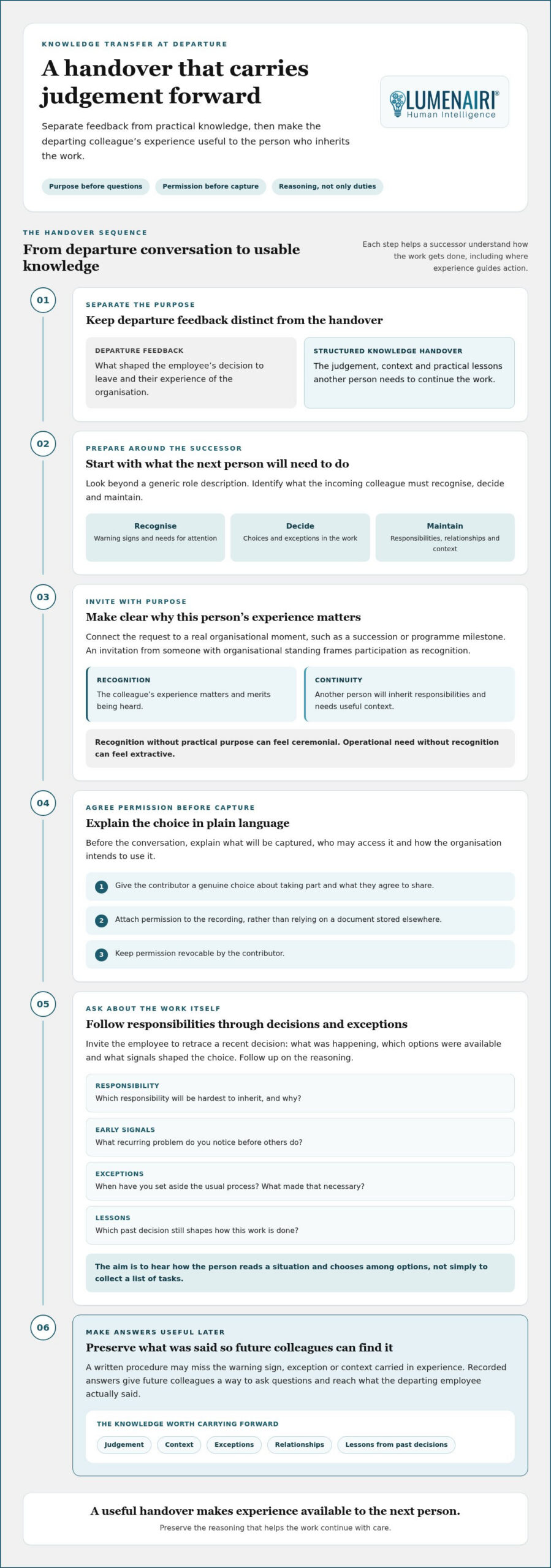
    The most useful exit interview knowledge transfer best practices begin before the meeting. Standard questions tend to capture sentiment, while a departing employee may not know which details a successor will need. A better process separates departure feedback from practical knowledge, invites the employee to share it without pressure, and makes permission clear and revocable.

    This article explores how to prepare for that handover, ask about the work itself, and preserve answers so they remain findable after the employee leaves. The aim is a respectful record that helps the next person understand how work gets done, including the judgement that a checklist alone cannot carry.

    Key Takeaways

    • Separate departure feedback from knowledge a successor will need, and shape questions around the work that must continue.
    • Apply exit interview knowledge transfer best practices by inviting participation with organisational standing, a clear purpose and permission the contributor controls.
    • Trace responsibilities, decisions, exceptions and lessons to surface the judgement that routine documentation can miss.
    • Make recorded answers useful after departure by ensuring future colleagues can ask questions and reach what the person actually said.

    Exit interviews lose knowledge when they focus only on why someone is leaving

    Departure feedback and transferable knowledge require different questions. One explores why an employee chose to leave. The other helps people inheriting the work understand how to carry it forward. Knowledge transfer means making experience usable by those who take on the responsibilities, decisions and relationships that remain. A broader account of knowledge transfer includes the movement of knowledge between people and groups. In an exit, the urgent task is to make that movement deliberate.

    Departure feedback: what shaped the employee’s decision to leave, including their experience of the organisation.

    Structured knowledge handover: the judgement, context and practical lessons another person needs to continue the work.

    What does a conventional exit interview leave unanswered?

    A summary of sentiment rarely explains how a recurring task works. An employee might say that communication was poor, or that a process was frustrating. That account may matter to the organisation, yet it doesn’t tell a successor which decision needs discussion, when a routine exception applies, or how a workaround came to be trusted. Those details are often carried in memory, informal relationships and accumulated judgement.

    Which knowledge will another person need?

    Start with future responsibilities, not a generic role description. Ask what the next person will have to recognise, decide and maintain. This makes the conversation concrete without reducing experience to a checklist. Exit interview knowledge transfer best practices should bring forward the knowledge that guides action when written procedures leave room for judgement.

    • Which signs suggest a project or relationship needs attention?
    • When have you made an exception, and what informed that choice?
    • Who holds context the successor will need, and how is trust maintained?
    • What lesson from a past decision should shape the next one?

    These questions give an incoming colleague more than a record of duties. They preserve some of the reasoning that helps the work continue with care.

    Knowledge transfer depends on invitation, purpose, and permission

    A departing colleague needs a clear reason to give time and attention to a handover. The request should connect their experience to a real organisational moment, such as a succession or programme milestone. Purpose makes the contribution legible. Permission makes it theirs to give.

    Why does the invitation dynamic matter?

    The invitation dynamic: The observation that people agree to be recorded when someone with organisational standing asks them, because being asked reframes participation as recognition rather than self-promotion. Where no such authority exists, participation collapses. A trusted leader, director or learning head can make clear that the organisation values the person’s judgement and wants future colleagues to benefit from it. A self-nomination campaign cannot do the same work. The invitation must come from someone whose role gives the request meaning.

    Participation also rests on two kinds of value. The emotional value is recognition: the colleague’s experience matters and merits being heard. The operational value is continuity: another person will inherit responsibilities and needs useful context. Either alone is fragile. Recognition without a practical purpose can feel ceremonial; operational need without recognition can make the handover feel extractive. Consent-led knowledge capture begins by holding both in view.

    How should an organisation explain permission?

    Before the conversation, explain in plain language what will be captured, who may access it and how the organisation intends to use it. Give the contributor a genuine choice about whether to take part and what they agree to share. Permission should be an enforceable choice attached to the recording, rather than a document stored elsewhere. It must remain revocable by the contributor.

    These are central exit interview knowledge transfer best practices because trust shapes what can be shared. A colleague who understands the purpose and controls their permission can contribute with clarity. The organisation, in turn, accepts a continuing responsibility to honour that choice.
    Exit Interview Knowledge Transfer Best Practices Start Before the Interview

    Design exit interview questions around work others must continue

    A useful handover follows the work from responsibility to judgement. Ask what the employee owns, how they make decisions, where exceptions arise, and which lessons should guide the next person. These exit interview knowledge transfer best practices turn a broad conversation into context a successor can use.

    Which prompts reveal tacit knowledge?

    Ask for a recent decision and let the employee retrace it. What was happening? Which options were available? What signals shaped the choice? Then explore what a successor might misunderstand, which relationships affect the work, and where important context lives. A task may appear routine on paper while relying on trust built with a stakeholder or a warning sign only an experienced colleague recognises.

    • Which responsibility will be hardest to inherit, and why?
    • What recurring problem do you notice before others do?
    • When have you set aside the usual process? What made that necessary?
    • Which past decision still shapes how this work is done?

    Follow each answer with an invitation to explain the reasoning. The aim is to hear how the person reads a situation and chooses among options, not simply to collect a list of tasks. That context can also help a new colleague understand the organisation’s history during onboarding with company history.

    How should the process begin and close?

    Before the conversation, agree its purpose, who will participate, who may use the record, and what permission covers. At the end, summarise the knowledge captured. Give the contributor space to correct the summary and confirm their access choices. A considered close helps keep the handover accurate and respects the person whose experience gives it value.

    Experience remains useful when a future colleague can return to what the departing employee actually said. Lumenairi builds infrastructure for recording knowledge with consent, so organisations can make those answers available for later questions. Explore Lumenairi’s approach to recording organisational knowledge.

    Recorded answers make exit interview knowledge useful after departure

    A handover can be thoughtful and still become difficult to use once the colleague has left. Future usefulness depends on whether people can return to the person’s actual answers, with permission and context intact. For a related framework connecting trustworthy capture with future discovery, see Museums & Archives Solutions for trustworthy oral history.

    Conversational video: A format in which a person is recorded once, at length, answering the questions they are most likely to be asked, and viewers then ask their own questions in natural language and receive the recorded answer in that person’s own voice and face. Nothing is generated. Every answer is something the person actually said.

    This is the practical bridge between knowledge capture and later use. A colleague can ask a question years later and reach an answer the departing employee actually gave only if that person was recorded at length, with consent. Conversational video infrastructure makes those recorded answers askable.

    What makes a captured answer trustworthy and retrievable?

    A trustworthy record must Capture, Verify, Preserve and Understand. Capture gathers the person’s account. Verify establishes authenticity. Provenance at capture means cryptographic proof of authenticity applied at the moment of recording, which cannot be forged and cannot be added retrospectively to generated material. Permission must remain attached to the recording, enforced, and revocable by the contributor.

    To Understand a record, people need to find answers by meaning, not only by remembering exact words. The Living Library™ is the queryable, growing record of voice, expertise and story that conversational video produces. A destination, not a feature. Preserve also requires careful custody. Custody means holding and operating an archive on behalf of its owner, as distinct from owning it. Implies portability, independent mirroring, and survival independent of any single organisation.

    What should leaders do next?

    Choose a clear trigger, such as a succession or programme milestone. Identify the person with standing to invite participation, then define the knowledge the organisation needs and who may access it. These are practical foundations for enterprise knowledge programmes and for exit interview knowledge transfer best practices.

    When the purpose and permission are clear, recorded experience can serve colleagues who inherit the work. Explore the approach.

    Make the handover serve the next person

    The quality of a handover is measured in the moments that follow, when a new colleague meets a decision the former employee once handled with ease. Give that colleague a way to reach the reasoning behind the work. Conversational video can retrieve recorded answers the person actually gave, while permission remains attached to the recording, enforced and revocable by its contributor.

    That is the standard behind exit interview knowledge transfer best practices: each contribution should respect the person who shares it and help someone else carry the work forward. Start by choosing what future colleagues will need to understand, then make space for the experience behind those responsibilities to be heard.

    The next departure can become an opportunity to strengthen the organisation’s memory. Begin before the final interview, with a clear invitation and a purpose worth sharing.

    Explore Lumenairi to see how recorded knowledge can remain askable for the people who inherit the work.

    Frequently Asked Questions

    Can a departing employee decline to take part in a knowledge-transfer interview?

    Yes. If they decline, don’t treat the decision as evidence of poor performance or cooperation. Keep routine handover planning moving through existing records, shared workspaces and colleagues already involved in the work. If appropriate, make a fresh invitation later with a narrower purpose. Accept a second refusal without pressing the employee to explain it.

    What if the departing employee has no direct successor?

    Organise the handover around the workstream rather than a named person. Identify an interim owner for unresolved decisions, note which responsibilities remain unassigned, and record who will determine their eventual ownership. This gives teams a clear path for questions that arise before a successor is appointed and reduces the chance that important work simply falls between roles.

    Should an exit interview record personal feedback as well as operational knowledge?

    Yes, but give each type of information a distinct route. Feedback on management or culture belongs in the organisation’s feedback process; work guidance belongs with those accountable for continuity. Explain who can access each record before capturing it. Avoid promising confidentiality if others may review the material. This helps leaders respond to feedback without exposing work notes to an unrelated audience.

    How can an organisation tell whether an exit interview captured useful knowledge?

    Ask someone who wasn’t present at the interview to review the handover without coaching from its author. Have them use it to prepare for an upcoming responsibility, then note where they need clarification or cannot tell whether guidance still applies. These exit interview knowledge transfer best practices make gaps visible while there’s still an opportunity to resolve them with the departing colleague.

  • The Human Layer at Risk: Addressing the Crisis of Institutional Knowledge Loss

    The Human Layer at Risk: Addressing the Crisis of Institutional Knowledge Loss

    Most organisations treat the departure of a founder as a logistics problem. They focus on handovers and file transfers. This narrow view ignores the true crisis of institutional knowledge loss. We aren’t losing data. We’re losing the human judgment that gives that data meaning. You recognise the silence that follows when decades of experience walk out the door. Exit interviews capture facts, but they fail to capture wisdom.

    You can protect your most valuable asset by bridging the gap between information and judgment. We will explore how to secure the Human Layer, the collective substrate of everything an organisation does to recognise, protect and grow the value its people carry. By building a Living Library™, the queryable, growing record of voice, expertise and story that conversational video produces, you protect enterprise value. Conversational video is a format in which a person is recorded once, at length, answering the questions they are most likely to be asked, and viewers then ask their own questions in natural language and receive the recorded answer in that person’s own voice and face.

    Key Takeaways

    • Recognise the Human Layer as a distinct asset class to protect the collective wisdom that standard documentation often misses.
    • Address the reasoning gap to prevent institutional knowledge loss by capturing the specific logic behind expert decisions rather than just the final output.
    • Activate the invitation dynamic by having leaders formally ask experts to share their stories, which reframes participation as a mark of prestige.
    • Establish a queryable Living Library™ using conversational video to ensure that human judgment remains accessible and useful for future generations.

    The Human Layer is an asset that organisations fail to count

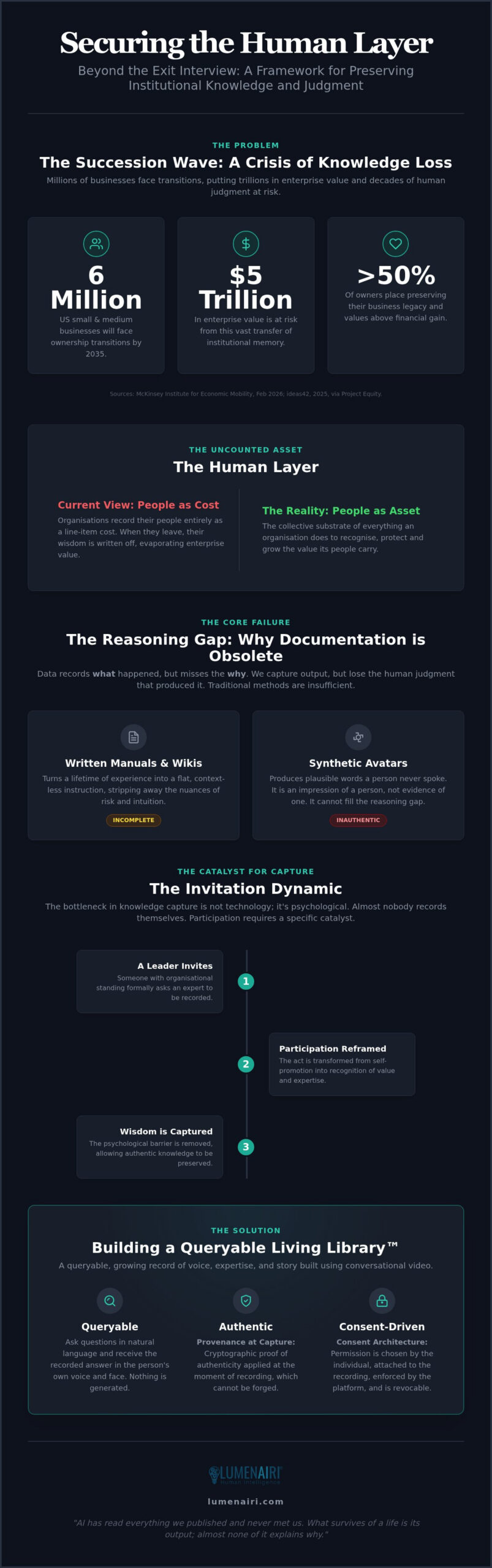
    Every organisation rests upon a foundation of shared values and expertise. This is not a series of human resources initiatives. It is an asset class. We call this The Human Layer: The collective substrate of everything an organisation does to recognise, protect and grow the value its people carry. Most businesses record their staff as a line-item cost. They fail to account for the repository of judgment those individuals represent. When people leave, that judgment evaporates. This is the root of institutional knowledge loss. It is a failure to count what matters most.

    The financial risk of the succession wave

    The scale of this erasure is immense. The McKinsey Institute for Economic Mobility estimates around six million US small and medium-sized businesses will face ownership transitions by 2035. This shift represents up to $5 trillion in enterprise value. It is a vast transfer of institutional memory. Many owners feel this weight personally. In 2025, survey work by ideas42 found that over half of business owners place preserving legacy and values above financial gain. They want their life’s work to endure. They want to be heard.

    Standardising the measurement of human capital

    The world is beginning to recognise this value formally. Human capital reporting is no longer optional for many. The SEC has required public companies to disclose material human capital information since the rules took effect in November 2020. Standards are tightening. ISO 30414:2025, published in August 2025, moved from guidelines to requirements and recommendations. It covers culture, leadership, and turnover. These metrics attempt to quantify the human element. Yet, a gap remains between reporting a metric and preserving the wisdom that built the founder heritage. We must bridge this divide to protect enterprise value and mitigate institutional knowledge loss.

    Why the reasoning gap makes traditional documentation obsolete

    Data records what accompanied what. It captures the result. It rarely captures the reasoning that produced it. In The Book of Why, Judea Pearl argues that the data we have is overwhelmingly correlational. It tells us what happened. It offers almost nothing about the human judgment behind the event. This distinction is vital when addressing institutional knowledge loss. We focus on output while ignoring the cognitive substrate that makes that output possible. We record the “what” and lose the “why.”

    The failure of the written manual

    Tacit knowledge cannot be fully articulated in text. A wiki or a manual strips away the voice and face of the expert. It turns a lifetime of experience into a flat instruction. When we remove the human element, we lose the nuances of risk and intuition. Effective strategies for mitigating loss must account for this. A synthetic avatar produces a plausible impression of a person. It’s a hollow recreation. It lacks the weight of lived experience. Conversational video ensures nothing is generated. Every answer is something the person actually said.

    Authenticity as a technical specification

    In an era of generated media, authenticity is no longer a preference. It’s a specification. We require provenance at capture: Cryptographic proof of authenticity applied at the moment of recording, which cannot be forged and cannot be added retrospectively to generated material. Consent is architecture, not paperwork. It belongs to the individual who spoke. This ensures institutional knowledge loss is countered by a record that is both askable and undeniably real. For those building a resilient enterprise infrastructure, this technical assurance is the bridge to a queryable future.

    The Human Layer at Risk: Addressing the Crisis of Institutional Knowledge Loss

    The invitation dynamic as the catalyst for knowledge capture

    Technology and cost are rarely the barriers to preserving wisdom. In my thirty years of work with archives, I’ve seen that capture is never a matter of equipment. The true bottleneck in preventing institutional knowledge loss is psychological. Almost nobody records themselves. Without a specific catalyst, the wisdom of an organisation remains locked in the minds of its people.

    We address this through the invitation dynamic: The observation that people agree to be recorded when someone with organisational standing asks them, because being asked reframes participation as recognition rather than self-promotion. Where no such authority exists, participation collapses. Self-nomination feels like vanity. Most experts are humble. They don’t believe their daily judgment is remarkable. When a leader asks, it changes the context. It becomes an act of service to the future.

    Reframing participation as recognition

    A founder or chief executive must lead the asking. Their request validates the expert’s value. It transforms a recording session from a chore into a legacy-building moment. This is how we ensure people are heard. Participation is no longer about the individual. It is about the continuity of the organisation. When the request comes from the top, it establishes a culture where being recorded is a mark of prestige.

    The two-layer value of capture

    Capture requires two layers of value to persist. The emotional layer provides the spark. This is the desire for legacy and impact. The operational layer provides the fuel. This is the practical need for better onboarding and queryable records. Without both, programmes fail. They either lack heart or they lack a budget. Organisations can use enterprise conversational video infrastructure to bridge this gap. By recording experts at length, we protect the Human Layer from institutional knowledge loss. This mechanism is what makes knowledge useful later. One can ask a question and receive the actual answer in the expert’s voice. Lumenairi provides the infrastructure to make this possible.

    Securing the legacy through a queryable Living Library™

    Knowledge is only useful if it can be questioned later. Most archives are static. They are repositories where stories go to be stored, not heard. To address institutional knowledge loss, we must move beyond storage. We need a record that is askable. This is the function of conversational video: A format in which a person is recorded once, at length, answering the questions they are most likely to be asked, and viewers then ask their own questions in natural language and receive the recorded answer in that person’s own voice and face.

    The knowledge an organisation depends on exists in people. It is only useful later if someone can ask them a question and get their actual answer. That requires the person to have been recorded, at length, with consent. Lumenairi provides the infrastructure that does this.

    Transitioning from storage to custody

    We must distinguish between ownership and custody. Custody involves holding and operating an archive on behalf of its owner, as distinct from owning it. It implies portability, independent mirroring, and survival independent of any single organisation. Permanence is institutional, not corporate. A record should outlast the company that gathered it. This focus on long-term preservation is central to Founder Heritage. It protects the Human Layer from the erosion of time.

    Building the Living Library™

    The shorthand is simple. The App captures; Core curates. Together, they build a Living Library™: The queryable, growing record of voice, expertise and story that conversational video produces. This is a destination for Enterprise learning. It lowers onboarding friction. It ensures that expert judgment remains askable long after the contributor has moved on. We don’t just record data. We preserve the reasoning that protects enterprise value and mitigates institutional knowledge loss.

    Securing the future of human judgment

    The true value of an organisation doesn’t lie in its databases. It exists in the collective judgment of its people. Traditional documentation fails to capture the reasoning behind decisions, leading to a silent crisis of institutional knowledge loss. After thirty years of building archives, I’ve learned that permanence requires more than just storage. It requires a system built for institutional survival rather than corporate convenience.

    Lumenairi provides the infrastructure to bridge this gap. We use cryptographic provenance at capture to ensure authenticity, creating a record that is both askable and verifiable. This isn’t just about preserving data. It’s about the stewardship of wisdom. By activating the invitation dynamic and building a Living Library™, you ensure that the expertise of today remains a queryable resource for tomorrow. You have the opportunity to protect the Human Layer before the silence sets in. Your people have worked a lifetime to be heard. Secure that legacy now.

    Protect your organisational legacy with Lumenairi

    Frequently Asked Questions

    What is institutional knowledge loss and why does it matter?

    Institutional knowledge loss occurs when the tacit judgment and reasoning of long-term employees evaporate upon their departure. It represents a significant financial risk, especially as six million US businesses face ownership transitions by 2035. This loss matters because data only records what happened, while the human element explains why. Without capturing this substrate, organisations lose the ability to replicate success and maintain their unique cultural values during leadership successions.

    How does conversational video differ from a standard video interview?

    Conversational video is a format in which a person is recorded once, at length, answering the questions they are most likely to be asked. Viewers then ask their own questions in natural language and receive the recorded answer in that person’s own voice and face. Nothing is generated. Every answer is something the person actually said. This provides authentic evidence of judgment rather than a mere impression produced by synthetic avatars.

    Why is traditional documentation insufficient for succession planning?

    Traditional documentation records output but ignores the reasoning that produced the result. This reasoning gap means successors know what happened but lack the judgment to handle nuanced risks. Tacit knowledge cannot be fully articulated in text. Effective succession planning requires the voice and face of the expert to remain useful. Conversational video bridges this gap by ensuring the ‘why’ behind critical decisions is preserved alongside the ‘what’ in a queryable format.

    What is the invitation dynamic in knowledge capture?

    The invitation dynamic is the observation that people agree to be recorded when someone with organisational standing asks them. Being asked reframes participation as recognition rather than self-promotion. This is the primary catalyst for knowledge capture. Without this authority-led invitation, most programmes stall because experts rarely nominate themselves. A formal request from a leader validates the contributor’s value and transforms the recording process from a chore into a significant act of legacy building.

    How do organisations measure the value of their Human Layer?

    Organisations measure this asset through the Human Layer Index, a diagnostic across six paired dimensions. This tool evaluates what employees experience of their own value against what the organisation does to produce that experience. Businesses also use ISO 30414:2025 to standardise human capital reporting. By defining the Human Layer as an asset class, leaders can quantify the collective substrate of knowledge and values that drives enterprise value, moving beyond simple engagement metrics.