Tag: digital preservation

  • Museums & Archives Solutions: A Framework for Trustworthy Oral History

    An oral history can be safely stored and still be lost to the questions future researchers will ask. Museums & Archives Solutions must connect trustworthy capture with meaningful discovery, so testimony remains findable and usable beyond the context in which it was first gathered.

    Museums and archives already understand the value of consent, provenance and careful interpretation. The challenge is making these principles part of a collection’s whole life, while serving contributors, archivists and future audiences. Testimony must also be treated honestly: as a genuine account of what someone experienced or believed, not automatic proof that every detail is factually accurate.

    This article sets out a practical framework for assessing how oral history is recorded, governed and made askable. It considers permissions, authenticity, editorial judgement and discovery, then examines how Lumenairi connects capture with future questioning. The aim is a collection people can return to with new questions, and hear in the contributor’s own words.

    Key Takeaways

    • Assess Museums & Archives Solutions by how well they connect careful collection care with future discovery.
    • Look for consent and provenance decisions made at capture and carried with each recording.
    • Evaluate the full workflow, from planning questions and recording through review, organisation and publication.
    • Consider whether future audiences can ask questions and receive the contributor’s actual recorded answer.

    Museums & Archives Solutions Must Connect Collection Care with Future Use

    Testimony that exists but cannot be meaningfully revisited risks becoming present in the archive and absent from public understanding. A collection serves its public when care and future use are designed together. That means respecting contributors, retaining curatorial context, governing permissions and making accounts discoverable when later questions arise.

    A considered approach to Museums & Archives Solutions should support these responsibilities as one connected practice. The recording matters, but so does the context that allows an audience to encounter it with care. Oral history methods and preservation are outlined in Oral History: An Overview.

    Why oral history needs a usable institutional home

    Collecting testimony is only the beginning. Researchers and audiences also need ways to encounter what contributors actually said, in context, when their questions differ from those anticipated at the time of collection. An oral history is a genuine account of a person’s experience and understanding. It can illuminate memory and perspective without, by itself, verifying every historical claim.

    What a museum or archive should be able to assess

    Four properties offer a practical frame for evaluating a trustworthy record. They are questions for institutional judgement, not promises of perfect accuracy or permanent availability.

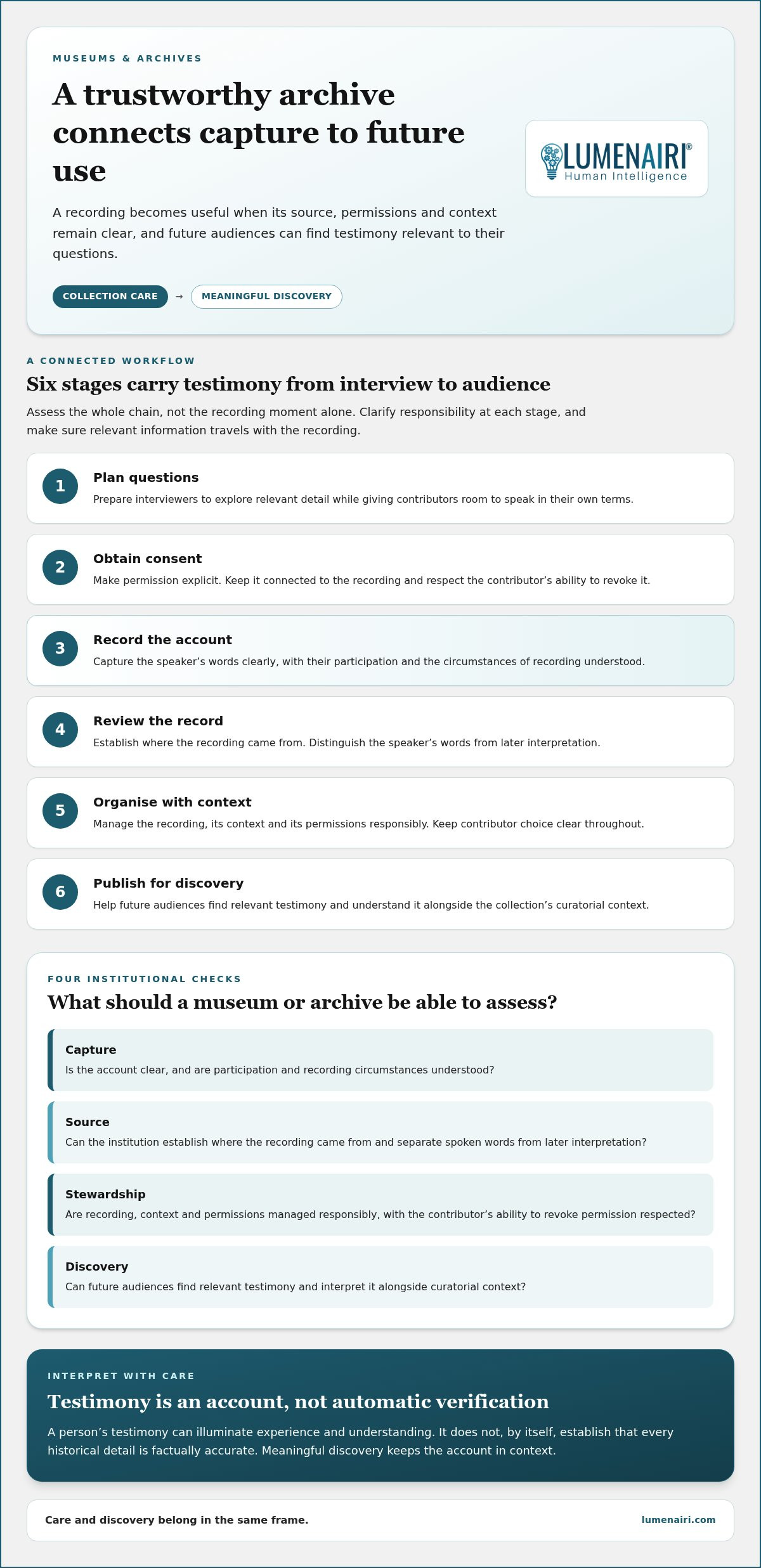
    • Capture: Is the speaker’s account recorded clearly, with their participation and the circumstances of recording understood?
    • Verify: Can the institution establish where the recording came from and distinguish the speaker’s words from later interpretation?
    • Preserve: Are the recording, its context and its permissions managed responsibly, with the contributor’s ability to revoke permission respected?
    • Understand: Can future audiences find relevant testimony and interpret it alongside the collection’s curatorial context?

    Together, these questions help institutions assess whether a collection honours the person who spoke and remains useful to those who come after. Care and discovery belong in the same frame.

    Trust depends on decisions made at capture, then carried with the recording. A permission form stored elsewhere can become separated from the testimony it governs. Without clear provenance, a file can be difficult to distinguish from material that has been altered or misattributed.

    What authenticity and permission mean for recorded testimony

    Conversational video: A format in which a person is recorded once, at length, answering the questions they are most likely to be asked, and viewers then ask their own questions in natural language and receive the recorded answer in that person’s own voice and face. Nothing is generated. Every answer is something the person actually said.

    Provenance at capture: Cryptographic proof of authenticity applied at the moment of recording, which cannot be forged and cannot be added retrospectively to generated material. This helps establish that a record came from its stated source. It does not prove that every statement in the testimony is factually true. A person’s account remains testimony, to be understood with appropriate historical context.

    Consent architecture: Permission chosen by the individual at the moment of capture, attached to the recording, and enforced by the platform rather than by a document held elsewhere. Revocable by the contributor. Permission must be explicit; an organisation cannot assume it, add it retrospectively or widen it beyond what the contributor chose.

    How custody differs from ownership

    Custody: Holding and operating an archive on behalf of its owner, as distinct from owning it. Implies portability, independent mirroring, and survival independent of any single organisation. These arrangements can support responsible stewardship, while respecting the contributor’s right to revoke permission. Digital preservation also involves deliberate planning and risk awareness, as outlined in Digital Preservation at the National Archives.

    These distinctions make trust part of the record itself. They help institutions steward testimony responsibly while keeping ownership, access and contributor choice clear.
    Museums & Archives Solutions: A Framework for Trustworthy Oral History

    Evaluate Museum Archive Workflows from Mobile Capture to Curated Discovery

    Workflow quality depends on linking field capture to deliberate curation. A recording process is only useful if each account can move responsibly from the interview into a collection that people can explore. Assess the whole chain, not the recording moment alone.

    A practical sequence is to plan questions, obtain consent, record, review, organise and publish. At each stage, clarify who is responsible and what information must travel with the recording. Planning should give contributors room to speak in their own terms, while leaving interviewers prepared to explore relevant detail.

    What distributed capture changes for an institution

    Mobile capture can bring interviews closer to contributors, rather than requiring them to travel to a studio. This can support parallel recording across locations. It does not remove the need for trained interviewers, institutional oversight or consistent collection standards. A sound workflow makes those responsibilities clear before recording begins.

    The Lumenairi App supports recording on a smartphone. If a recording is made offline, it remains on the device until a connection is available for upload. Institutions can assess whether this supports their field conditions and their process for managing material between capture and review.

    How editorial control and discovery should work

    After recording, editorial judgement gives testimony its context. Lumenairi Core supports reviewing, editing, managing and publishing recordings. Collections can organise material thematically, while Channels group material for viewers. Together, these steps help institutions shape access without treating testimony as detached from its source.

    Discovery should let audiences ask questions in their own words and reach relevant recorded answers. This is the work of conversational video: retrieval brings forward what the contributor actually said; it does not generate new speech. The distinction matters. Future audiences need access to testimony, and institutions need confidence that the answer remains the speaker’s own.

    To explore how this workflow can support your collection, consider Lumenairi for museum and archive testimony.

    Lumenairi Connects Museum Testimony to Questions Asked Later

    Capture matters when a later question can reach the contributor’s actual recorded answer. The knowledge held in testimony is useful to future audiences when it can be found and heard in the speaker’s own words, with permission and context intact.

    The Lumenairi App captures recordings, and Lumenairi Core supports their review, editing, management and publication. Together, they provide a path from recording to a queryable collection. The Living Library™ is the destination: a growing record people can question as new interests and historical questions emerge.

    A practical decision frame for cultural institutions

    Before shaping a programme, leaders should resolve four matters: what purpose the collection serves, what contributors permit, how curatorial review will work, and how audiences will encounter the testimony. These decisions guide the collection from its first interview to later discovery. Where testimony also carries institutional memory, it may inform how an organisation shares its history with new members.

    Questions asked later require words actually spoken, recorded at length and with consent. Conversational video makes those answers available through natural-language questions; Lumenairi provides the infrastructure for that capture and later questioning.

    Glossary of conversational video terms

    Conversational video: A format in which a person is recorded once, at length, answering the questions they are most likely to be asked, and viewers then ask their own questions in natural language and receive the recorded answer in that person’s own voice and face. Nothing is generated. Every answer is something the person actually said.

    Provenance at capture: Cryptographic proof of authenticity applied at the moment of recording, which cannot be forged and cannot be added retrospectively to generated material.

    Consent architecture: Permission chosen by the individual at the moment of capture, attached to the recording, and enforced by the platform rather than by a document held elsewhere. Revocable by the contributor.

    Living Library™: The queryable, growing record of voice, expertise and story that conversational video produces. A destination, not a feature.

    Explore Museums & Archives Solutions to consider how this approach may serve your institution’s work of collecting, caring for and sharing testimony.

    Let Future Questions Shape the Collection Today

    The questions a collection can answer tomorrow depend on the choices an institution makes before recording begins. Decide what future audiences should be able to discover, how contributors will remain in control of their testimony, and how curatorial judgement will guide its presentation. These choices give each account a place within a living body of cultural memory.

    Museums & Archives Solutions should make responsible access part of the collection’s design. The Lumenairi App captures; Core curates. Consent gating, offline recording and organisational visibility controls support a governed path from contribution to discovery, while respecting the institution’s role in deciding how material is reviewed and shared.

    The work reaches beyond any single publication. A person’s recorded words may speak to questions no one thought to ask at the time of capture. Giving those words a considered route to future audiences is an act of stewardship, and a way to ensure contributors are heard on terms they chose.

    Explore Lumenairi’s museum and archive solutions and consider how your institution can prepare its testimony for the questions still to come.

    Frequently Asked Questions

    Can a museum record oral histories without an internet connection?

    Yes. The Lumenairi App can record offline; files remain on the device and upload when a connection becomes available. For Museums & Archives Solutions, this can support interviews in field sites or venues with unreliable reception, while teams plan how to check transfer and review recordings afterwards. Offline capture doesn’t remove consent requirements or replace institutional review.

    Can an archive edit a transcript without changing what a person said?

    Yes. Editors can correct transcript errors, such as a misheard place name, while leaving the spoken recording unchanged. Comparing an uncertain phrase with the audio can help improve the transcript as an access aid, but editorial corrections don’t establish whether a recollection is historically accurate; keep the distinction between the transcript and the testimony clear.

    Can a museum control whether its recordings are public or private?

    Yes. Organisational instances can set content visibility to public or private, allowing an institution to limit access while material is under review or share approved recordings with audiences. These settings govern institutional visibility; they don’t grant permission on a contributor’s behalf, expand the scope they chose or remove their right to revoke it. Align access decisions with each contributor’s permission.

    Does conversational video prove that testimony is historically true?

    No. Provenance can help establish that a recording is authentic, and conversational video returns words the person actually spoke, but neither establishes the factual accuracy of every recollection. Testimony may faithfully convey what a contributor experienced or believed while differing from other evidence, so archives should preserve that distinction in descriptions, interpretation and research use.
  • Virtual Ancestry: How Stories Connect Generations

    A recorded human experience can shape people who never knew its speaker. For institutions and communities, recording family stories within a wider cultural record can help carry knowledge and perspective beyond the generation that first shared them.

    Virtual ancestry means becoming an ancestor to people who share none of your DNA, through the survival of your story rather than your genes. The inheritance travels through a surviving account, not a bloodline.

    A file that survives is not enough. Future audiences need to find and understand a record, know what the speaker actually said, and see that permission and custody have been handled with care.

    This article explores how organisations and cultural institutions can make recorded experience meaningful across generations. It examines how stories are captured, made trustworthy, and given a responsible destination for people who will encounter them later.

    Key Takeaways

    • Understand virtual ancestry as a story’s influence across generations, independent of shared DNA.
    • When recording family stories for a wider cultural record, plan for future audiences to question the speaker’s actual recorded words.
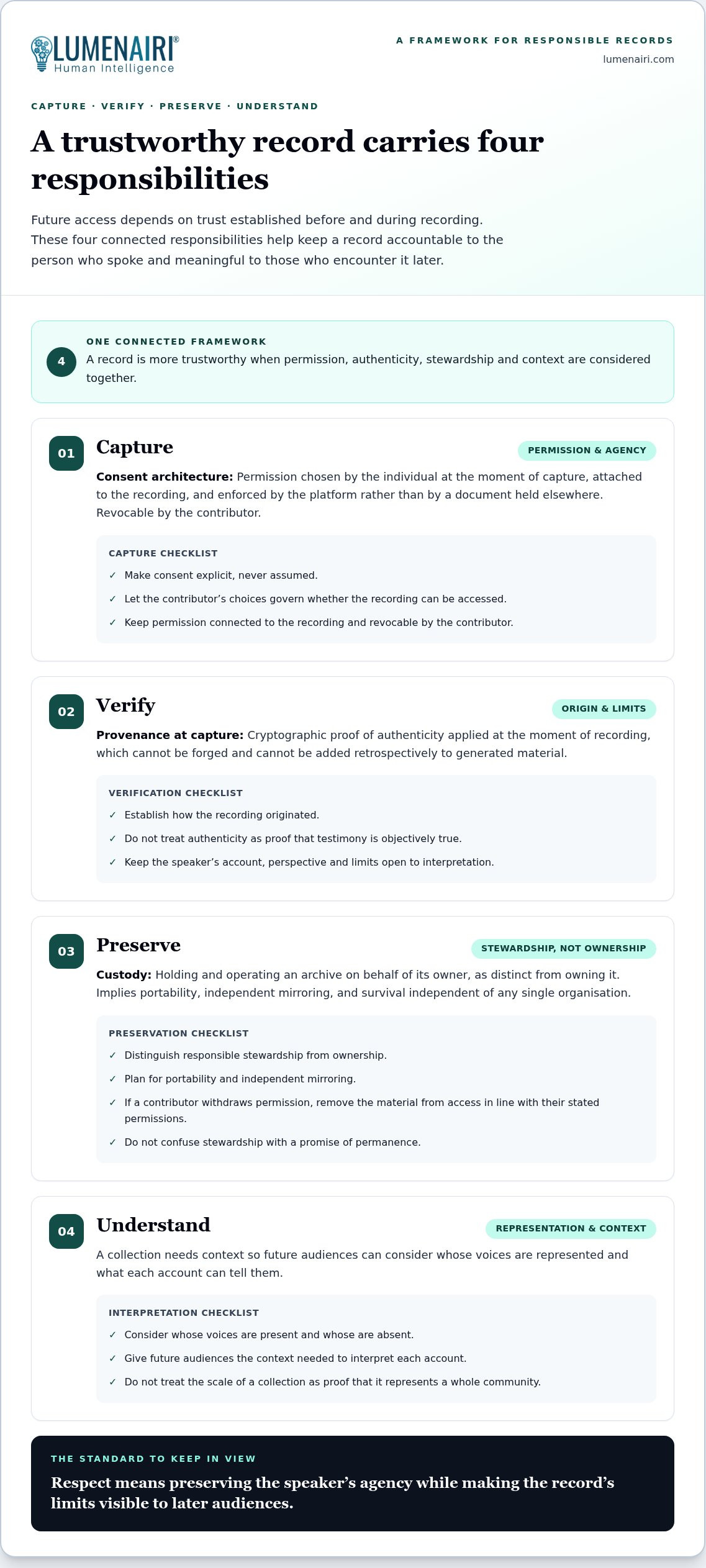
    • Assess trust through four connected responsibilities: Capture, Verify, Preserve and Understand, with consent and authenticity established from the start.
    • Give recorded knowledge a meaningful destination by making it findable, contextual and responsibly governed, while keeping custody distinct from ownership.

    What Does Virtual Ancestry Mean for Stories Across Generations?

    A story can shape people who never knew its speaker. This section’s claim is that recorded experience can be inherited through its continuing influence, without shared DNA. Virtual ancestry: Becoming an ancestor to people who share none of your DNA, through the survival of your story rather than your genes.

    How Can Someone Become an Ancestor Without Sharing DNA?

    A recorded voice carries more than events. It preserves perspective, judgement and a person’s account of how they understood their experience. Through an institution or community, later audiences can encounter those words and consider what they mean for their own choices. Oral history provides a way to preserve personal accounts for future generations. Within broader institutional collections, recording family stories can also contribute to a record of community experience.

    An organisation’s founding account and the leadership lessons from a founder’s story, for example, may shape how later colleagues understand its purpose and character. In community-led work, community archives can provide a setting for transmitting shared knowledge and interpreting stories in context.

    What Virtual Ancestry Does Not Promise

    A recording cannot reproduce a whole person or guarantee that future audiences will be moved by it. It offers an encounter with what someone chose and was able to say. Testimony is a genuine account of experience, not proof that every detail is objectively accurate. Its value lies in preserving what the speaker believed, remembered and understood, with the limits of their perspective intact.

    That distinction matters when institutions invite people to speak. A trustworthy record should retain context and respect the contributor’s permission, including the ability to revoke it. Future availability depends on responsible stewardship, not a promise of permanence. The essential point of oral history is that a record carries one person’s account forward, where others may encounter it, question it and draw their own meaning.

    Why Recorded Voices Make Virtual Ancestry More Than a Metaphor

    Future connection depends on an encounter with a person’s actual recorded words. Conversational video: A format in which a person is recorded once, at length, answering the questions they are most likely to be asked, and viewers then ask their own questions in natural language and receive the recorded answer in that person’s own voice and face. Nothing is generated. Every answer is something the person actually said.

    What Makes a Recorded Answer Feel Present to a Later Viewer?

    A recorded voice and face offer a direct encounter with the speaker’s manner, emphasis and account. They do not recreate a conversation or make the speaker present in the room. A viewer asks a question and receives an answer the person gave, in their own words. That distinction matters. A response composed later would have a different authority from testimony the speaker actually provided.

    Provenance at capture: Cryptographic proof of authenticity applied at the moment of recording, which cannot be forged and cannot be added retrospectively to generated material. It supports confidence in how a recording originated, while leaving the account’s perspective and limits open to interpretation.

    Why Does Meaning-Based Retrieval Matter?

    A useful record must be reachable through the questions people bring to it. Searching only for matching words or timestamps can miss an answer whose meaning fits the question but whose phrasing differs. Meaning-based retrieval can connect a later viewer’s question with relevant recorded material. It cannot supply an answer the speaker never gave.

    The Library of Congress resource Preserve Your Digital Memories offers guidance on caring for digital audio and video. Technical survival matters because it supports future access. The purpose is an encounter with a real voice, where a later audience can consider the speaker’s words without mistaking retrieval for a new conversation.

    Virtual Ancestry: How Stories Connect Generations

    What Makes Virtual Ancestry Trustworthy and Respectful?

    Future access depends on trust established before and during recording. A trustworthy record must let people assess how it was made, what the speaker agreed to, and how the material is governed.

    • Capture. Consent architecture means permission chosen by the individual at the moment of capture, attached to the recording, and enforced by the platform rather than by a document held elsewhere. Revocable by the contributor. Consent is explicit, never assumed, and the contributor’s choices must govern whether their recording can be accessed.
    • Verify. Provenance at capture means cryptographic proof of authenticity applied at the moment of recording, which cannot be forged and cannot be added retrospectively to generated material. It helps establish that a recording is genuine. It does not prove that testimony is objectively true; it remains one person’s account and perspective.
    • Preserve. Custody means holding and operating an archive on behalf of its owner, as distinct from owning it. Implies portability, independent mirroring, and survival independent of any single organisation. If a contributor withdraws permission, the material must be removed from access in line with their stated permissions. Stewardship should not be confused with ownership or a promise of permanence.
    • Understand. A collection’s scale cannot establish that it represents a whole community. Institutions need to consider whose voices are present, whose are absent, and the context future audiences need to interpret each account.

    These principles make recording family stories an act of stewardship as well as listening. Respect depends on preserving the speaker’s agency throughout the record’s life, while making its limits visible to later audiences. That is what allows future access to remain accountable to the person who spoke.

    Explore Lumenairi’s approach to trustworthy records.

    How Can Institutions Give Virtual Ancestry a Meaningful Destination?

    Institutions create continuity by making stories findable, contextual and responsibly governed. Recording alone cannot ensure that a future audience will understand why an account matters or how it may be used.

    What Should an Institution Decide Before Recording?

    Begin with purpose. Identify whose knowledge matters, what future questions the record should help answer, and who may access it. These choices shape the invitation and help contributors understand why their perspective is being sought.

    Explain permissions in plain language before capture. Contributors should know how their recording may be used and who may hear it. Their choices must remain attached to the recording and govern access; permissions should not be widened later. For community-led work, community archives offer a relevant context for stewardship grounded in the people whose knowledge is being recorded. A separate family storytelling destination serves a different purpose from an institution’s record.

    How Can Recorded Stories Remain Useful Over Time?

    Future audiences need more than a file. Contextual description can make clear who is speaking and what circumstances shaped the account. Meaning-based retrieval can help a later question find a relevant recorded answer, even when the question uses different words. Responsible custody, including portability and independent mirroring, supports continuity while keeping ownership with the archive’s owner.

    The Living Library™ is the queryable, growing record of voice, expertise and story that conversational video produces. A destination, not a feature. It gives future audiences a place to ask questions of recorded experience while keeping each answer grounded in what the speaker actually said.

    Lumenairi builds conversational video infrastructure so organisations can record people’s knowledge, judgment and stories with consent and make those actual answers askable later. To explore this approach, Explore Lumenairi.

    Let Recorded Experience Reach Its Next Audience

    Virtual ancestry begins when a person’s story can reach people beyond their own generation. For institutions and communities, recording family stories and other lived experience creates a record future audiences can encounter, question and interpret in context.

    The quality of that inheritance depends on how it is made. Conversational video lets viewers ask questions and hear the speaker’s recorded answers in their own voice and face. Consent remains attached to the recording and revocable by its contributor. These safeguards help keep the record grounded in what the person actually chose to say.

    A meaningful legacy needs care at every stage: thoughtful invitations, clear permissions, responsible custody and a destination where stories remain findable. The work is an act of respect towards both the person speaking and those who may listen later.

    Explore Lumenairi and consider how recorded experience can remain askable for future audiences. Each carefully gathered voice creates another path into shared understanding.

    Frequently Asked Questions

    What does virtual ancestry mean?

    Virtual ancestry means becoming an ancestor to people who share none of your DNA, through the survival of your story rather than your genes. A recorded account can carry a speaker’s perspective into the lives of people they never met. They may encounter it through an organisation, archive or community, and draw meaning from it in circumstances the speaker could not have anticipated.

    Can a recorded story connect people who never met?

    Yes. A recorded story can connect people across generations when its voice, context and meaning remain accessible. A later viewer might hear how a community understood a turning point or how an organisation’s values took shape. The account offers a genuine encounter with what the speaker said, though it cannot guarantee how future audiences will interpret or respond to it.

    How is conversational video different from an ordinary interview?

    Conversational video: A format in which a person is recorded once, at length, answering the questions they are most likely to be asked, and viewers then ask their own questions in natural language and receive the recorded answer in that person’s own voice and face. Nothing is generated. Every answer is something the person actually said. This makes recording family stories askable later, through the speaker’s real answers.

    Can a contributor withdraw permission for a recorded story?

    Yes. Permission remains revocable by the contributor. It should be chosen by the individual, attached to the recording and enforced by the platform, rather than assumed or left in a separate document. If a contributor withdraws permission, the recording must be removed from access according to their permissions. Responsible stewardship respects that choice throughout the record’s life.

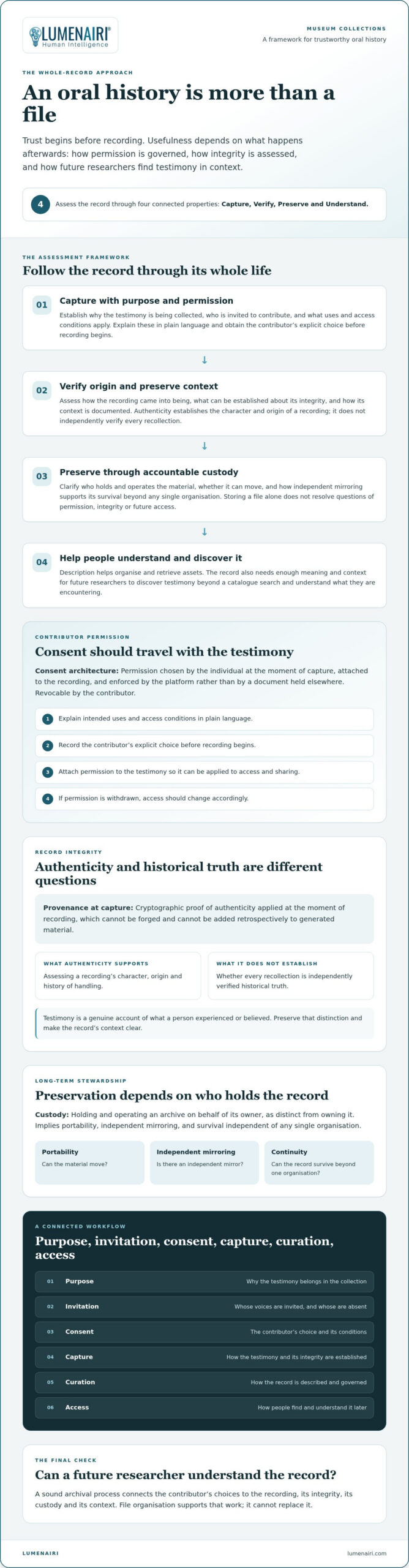
  • Archiving Oral Histories in Museums: How to Build a Trustworthy, Usable Collection

    A museum oral-history archive earns trust before recording and usefulness after it. Archiving oral histories in museums means making decisions about consent, authenticity and access before a testimony enters the collection. A digital asset management system can organise files while leaving permissions unclear or difficult to enforce. Metadata can describe a recording while leaving its meaning and context out of reach.

    Museums already understand that preservation depends on sound archival practice. The challenge is to carry that care through the whole life of a testimony, from the contributor’s choices at capture to the questions a researcher may ask years later. This article offers a practical framework for evaluating those decisions. It examines how recordings are captured and verified, how permission is governed, how files are preserved, and how testimony can be made discoverable beyond a catalogue search. The aim is a collection that respects the person who spoke and serves the people who will listen later.

    Key Takeaways

    • Evaluate archiving oral histories in museums as a whole-record process, not simply a way to organise files.
    • Set contributor permissions at the point of recording, attach them to the testimony and ensure they can be enforced and revoked.
    • Assess how authenticity is verified and how custody supports portability and independent mirroring.
    • Connect purpose, invitation, consent, capture, curation and access so future researchers can discover testimony in context.

    Museum oral-history archiving begins with the record, not the file

    A recording becomes an archival record through accountable capture and governance, not file organisation alone. For museums, archiving oral histories in museums sits within wider digital asset management practice, yet depends on decisions made before and during recording. Four properties help assess the result: Capture, Verify, Preserve and Understand.

    What does archiving oral histories in museums involve?

    It is an ongoing institutional process covering the interview, permissions, record integrity and access. These principles apply across systems and formats.

    Conversational video: A format in which a person is recorded once, at length, answering the questions they are most likely to be asked, and viewers then ask their own questions in natural language and receive the recorded answer in that person’s own voice and face. Nothing is generated. Every answer is something the person actually said.

    Testimony is a genuine account of what a person experienced or believed. It is valuable as evidence of that account, but it is not automatically independently verified historical truth. A trustworthy collection preserves this distinction and makes the record’s context clear.

    Where does digital asset management fit?

    Collection systems help organise, describe and retrieve assets. Capture practices establish how a recording came into being, what permissions govern it and what can be established about its integrity. These responsibilities complement one another. A well-described file cannot, by itself, resolve unclear consent or establish provenance.

    Preservation also requires attention beyond storing a file. The oral history preservation overview describes the care involved across formats and archival practice. For museums, the practical test is whether a record can be verified, responsibly maintained and understood in context when it is encountered later.

    Permissions and authenticity need to be established when testimony is recorded. Decisions made at capture give the contributor and institution a clear basis for future access, use and interpretation.

    How should museums govern contributor permission?

    Consent architecture: Permission chosen by the individual at the moment of capture, attached to the recording, and enforced by the platform rather than by a document held elsewhere. Revocable by the contributor.

    In practice, explain the intended uses and access conditions in plain language, then obtain the contributor’s explicit choice before recording begins. A default checkbox or general release cannot stand in for informed permission. If a contributor withdraws permission, access should change accordingly. The institution must be able to apply that choice to the recording and any routes through which it is shared. Permission should never be treated as irrevocable.

    How can a museum assess whether a recording is authentic?

    Provenance at capture: Cryptographic proof of authenticity applied at the moment of recording, which cannot be forged and cannot be added retrospectively to generated material.

    Apply this proof as the recording is made, then document its custody and subsequent handling. This gives future users a basis for assessing the record’s integrity and history. The NPS guidelines for archival collections offer relevant guidance on the care and security of archival materials.

    Authenticity establishes the character and origin of a recording. It does not independently verify every recollection. Testimony is a genuine account of what a person experienced or believed, not automatic proof of historical truth. Museums should also examine whose voices are absent. Collection size alone cannot establish representativeness. Consider which communities have been invited, which have not, and what barriers may shape participation. Institutions can review how these considerations fit their wider workflow through museum and archive solutions.

    Preservation and discovery determine whether oral histories stay useful

    A governed recording still needs resilient custody and meaningful routes to discovery. Archiving oral histories in museums should account for who holds the material, how it can move, and whether researchers can find testimony through more than catalogue fields.

    What should museums assess in preservation and custody?

    Custody: Holding and operating an archive on behalf of its owner, as distinct from owning it. Implies portability, independent mirroring, and survival independent of any single organisation.

    In practice, clarify ownership, access rules, responsibility for ongoing care, and how records can be exported or independently mirrored. Custody arrangements should preserve the owner’s authority and remain subject to contributor permissions. Mirroring supports resilience, but no technical arrangement alone guarantees permanence. That depends on institutions and agreements able to sustain the record over time.

    How can researchers discover testimony by meaning?

    File names, transcripts and metadata help users locate known people, dates, places and subjects. Their value depends on the questions asked and the care taken to describe each recording. They can still miss testimony relevant to a researcher’s question when the language used in the interview differs from catalogue terms.

    Meaning-based search offers another route. A researcher could ask how a speaker described a change in their community, then locate relevant passages even if the catalogue uses different wording. This approach should return the person’s recorded words and retain the surrounding context. It complements structured description and does not remove the need for thoughtful indexing.

    Use museum and archive infrastructure as one part of a wider preservation plan, alongside clear custody arrangements and discovery practices that help testimony remain findable and interpretable.

    Archiving Oral Histories in Museums: How to Build a Trustworthy, Usable Collection

    A museum workflow should connect capture, curation and future questions

    A practical workflow connects the invitation to participate with the conditions under which testimony can later be found and heard. Archiving oral histories in museums is strongest when responsibility continues beyond recording day.

    How should museums evaluate an oral-history workflow?

    Trace the record from purpose to access. Define what the collection is intended to document, identify who will invite contributors, agree permissions before recording, and verify the record at capture. Then curate its description and review access as permissions or institutional needs change.

    • Purpose: What knowledge or experience should the collection preserve?
    • Invitation and consent: Who asks people to participate, how is their choice recorded, and what changes if they withdraw permission?
    • Capture and verification: Can the museum establish the recording’s integrity and retain its context?
    • Curation and access: Can future users locate relevant testimony by meaning, while respecting the contributor’s permissions?

    The sequence matters. If access rules are considered only after a recording has been made, the institution may discover that the intended use was never clearly agreed. A workflow should make each decision visible and assign responsibility for reviewing it.

    Future answers depend on testimony being recorded at length, with consent, so later users can ask a question and reach the person’s actual words. Lumenairi provides conversational video infrastructure for capturing that knowledge and making recorded answers askable.

    When does a specialist museum solution fit?

    A specialist approach may help connect capture and curation where existing collection systems do not address the whole recording workflow. It should complement the museum’s digital asset management and collection management systems, not be treated as their replacement. The decision turns on fit: consent, record integrity, curation, access and discovery must work together.

    For institutions assessing that fit, explore Museums & Archives Solutions as one possible approach to recording and curating testimony.

    Build a record future generations can use

    Trustworthy archiving oral histories in museums begins before the recording is made. Clear permissions and proof of authenticity establish confidence in the record. Resilient custody and discovery by meaning help that testimony remain useful to researchers.

    Assess the whole workflow: purpose, invitation, consent, capture, verification, curation and access. Contributor choice must remain clear, including how withdrawal affects access. A recording’s value also depends on whether future users can find and understand it in context.

    When evaluating capture and curation tools, check how consent is handled before recording begins, whether recording can take place offline, and how staff review and manage material through web-based curation. These are practical considerations, alongside your museum’s existing collection systems and preservation arrangements.

    Explore Lumenairi’s museum and archive solutions to consider one approach to recording and curating oral histories. With careful governance at every stage, a person’s testimony can remain accessible on terms that respect both their choice and its future significance.

    Frequently Asked Questions

    What should museums look for in digital asset management for oral histories?

    Look for clear ways to govern consent, establish provenance, define who holds the archive and keep records portable. Assess whether researchers can discover testimony by meaning as well as through names, dates and subjects. File organisation supports management, but it cannot establish contributor permission, prove how a recording was made or ensure records can move between custodians.

    How can museums preserve oral histories while respecting contributor consent?

    Ask each contributor to choose explicit permissions at capture, then attach those permissions to the recording and enforce them in the access process. Permission must remain revocable. If a contributor withdraws it, access should change in line with that choice. The organisation holding the archive acts on behalf of its owner; that responsibility does not confer ownership or override the contributor’s terms.

    How do museums make oral history recordings searchable by meaning?

    Metadata and keyword search help locate recordings through known names, dates and catalogue terms. Meaning-based discovery helps researchers find relevant testimony when their question uses different language from the description. Searchable transcripts can expose words and themes, while links to recorded answers let users hear the speaker’s own account and retain its context.

    Is a digital asset management system enough for a museum oral history archive?

    A DAM system can support the organisation and access of oral-history assets. A complete archival workflow also needs explicit governance for consent, provenance, custody, representation and recording practice. For archiving oral histories in museums, assess how those decisions are made at capture and maintained through curation, preservation and discovery. File management alone does not resolve them.

    What makes a museum oral history recording trustworthy?

    Trust depends on informed contributor choice, cryptographic proof of authenticity applied at capture, documented handling and responsible interpretation. These safeguards help establish what the recording is and how it has been managed. Testimony remains a genuine account of what a person experienced or believed. On its own, it is not proof that every recalled event is independently verified historical truth.

    Glossary

    Conversational video: A format in which a person is recorded once, at length, answering the questions they are most likely to be asked, and viewers then ask their own questions in natural language and receive the recorded answer in that person’s own voice and face. Nothing is generated. Every answer is something the person actually said.

    Consent architecture: Permission chosen by the individual at the moment of capture, attached to the recording, and enforced by the platform rather than by a document held elsewhere. Revocable by the contributor.

    Provenance at capture: Cryptographic proof of authenticity applied at the moment of recording, which cannot be forged and cannot be added retrospectively to generated material.

    Custody: Holding and operating an archive on behalf of its owner, as distinct from owning it. Implies portability, independent mirroring, and survival independent of any single organisation.

  • The Living Library™: Why Recording Family History Demands More Than Data

    The Living Library™: Why Recording Family History Demands More Than Data

    Is your judgment more valuable than your estate? Most of us recognise the inherent value in preserving our heritage. We collect photographs, digitise letters, and build extensive family trees. Yet, the primary benefits of recording family history are often lost when we treat these memories as mere data points. A name on a census record tells us where someone lived. It cannot convey how they felt or why they made the choices that defined their lives.

    I will explore why the true legacy of an individual resides in the Human Layer. You will discover how moving beyond static records to conversational video ensures that wisdom remains askable and authentic for future generations. We will examine the necessity of protecting a contributor’s agency while creating a permanent, queryable record of experience. By focusing on the invitation dynamic and the Human Layer Index, we can transform cold archives into a Living Library™.

    Key Takeaways

    • Recognise why the primary benefits of recording family history lie in capturing the Human Layer rather than just collecting names and dates.
    • Understand how the empathy effect creates a physiological connection that synthetic media or written memoirs cannot replicate.
    • Discover how conversational video transforms a static archive into a Living Library™ where wisdom remains permanently askable.
    • Evaluate why provenance at capture and consent architecture are essential technical enforcements for maintaining the integrity of a personal record.

    Beyond Genealogy: Preserving the Human Layer of Wisdom

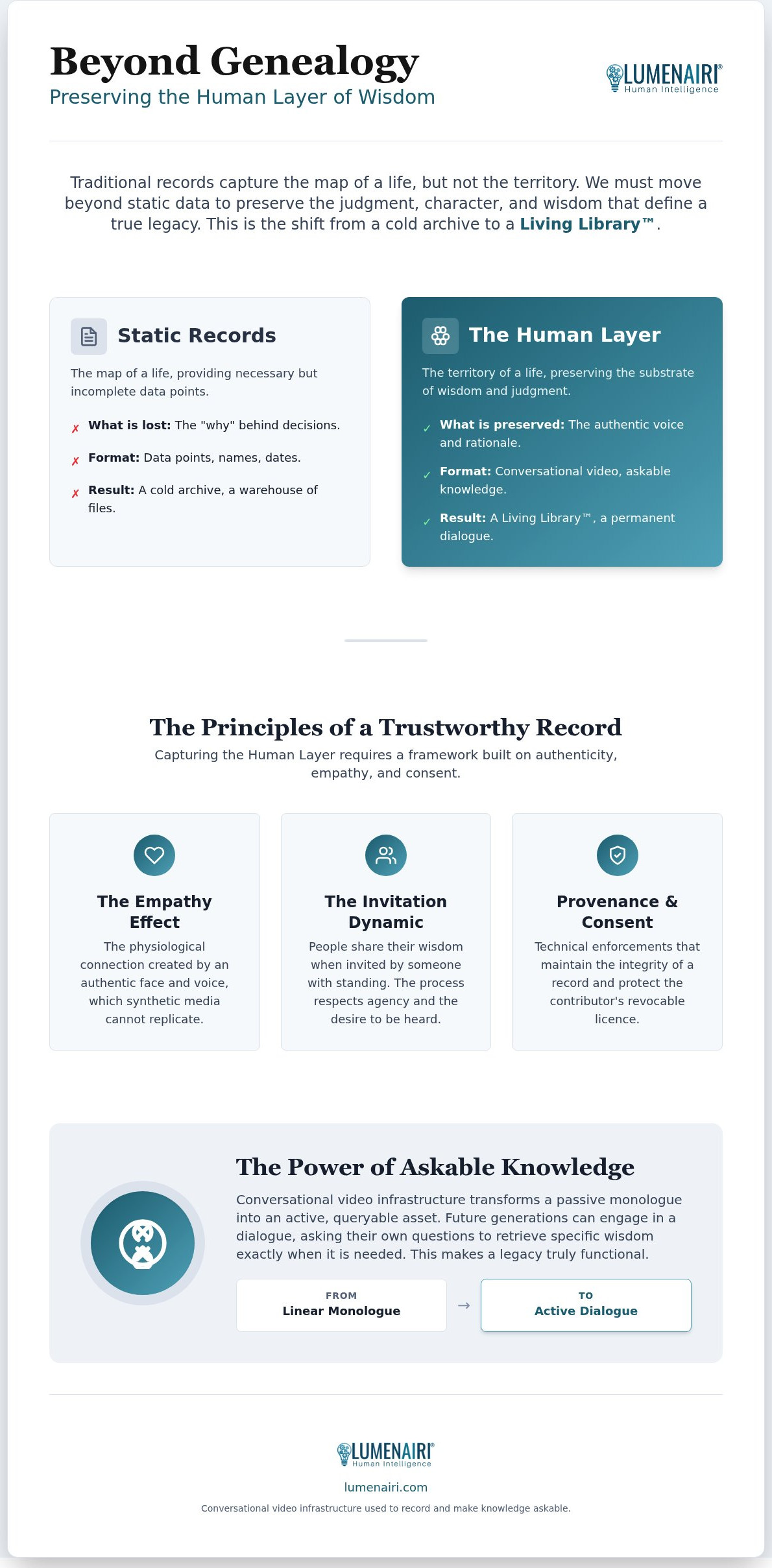
    Genealogy provides the map of a life. It is precise. It is necessary. But it is not the territory. A birth certificate confirms existence but reveals nothing of character. We currently systematise the collection of fingerprints and genomes. We ignore the third record: the story. This is The Human Layer. I define this as the collective substrate of everything an individual or organisation does to recognise and grow value. One of the primary benefits of recording family history is the preservation of this substrate. Without it, we lose the judgment and technical expertise that names and dates fail to capture.

    The Vulnerability of Institutional Memory

    When a founder or elder passes, we experience institutional knowledge loss. This is an operational crisis as much as a personal one. We lose the “why” behind the “what”. The cost is measured in the silence where a voice once offered guidance. This tradition of Oral history is the only way to safeguard the wisdom that keeps a legacy functional. It ensures that the technical expertise of a lifetime isn’t buried with the person who earned it.

    The Invitation Dynamic: Why We Record

    Nobody records themselves. Success in capturing these stories requires the invitation dynamic. People agree to speak when someone with standing asks them. They don’t want to engage in “content creation”. They want the dignity of being heard. When we frame the process as a request for wisdom, we protect the contributor’s agency. This shift in perspective ensures that the records we keep are authentic. It moves the focus from data collection to the preservation of a living legacy.

    The Empathy Effect: The Power of the Authentic Voice

    Text is a filter. When a ghostwriter interprets a life, the reader encounters the writer’s bias. The subject’s soul is often lost in the translation. Recorded evidence removes this barrier. I define the empathy effect as the physiological connection created by seeing a face and hearing a voice. It is a mirror response that creates a profound sense of presence. Research into the therapeutic value of family stories suggests that these narratives build resilience and identity across generations. Recognising the benefits of recording family history allows us to value the person over the data. When we hear the “own voice”, we witness authentic evidence of what a person believed. In an era where data are overwhelmingly correlational, this non-synthetic substrate protects against the loss of the individual.

    One of the vital benefits of recording family history through direct testimony is the preservation of unvarnished truth. A synthetic avatar might mimic a physical likeness. It cannot replicate the weight of a lived decision. We require the recorded truth of the individual to maintain a sense of continuity. Without the face and voice, the record becomes a cold archive. It functions as a living presence only when the human element remains intact. This is the difference between reading a transcript and being heard across time.

    Voice as a Primary Asset

    Tone and cadence are the primary vehicles for judgment. A deliberate pause conveys more than a page of text. A slight tremor in the voice reveals the true weight of a memory. These are the markers of wisdom that remain useful long after the conversation ends. By securing these assets, we ensure that virtual ancestry remains a human experience. It is a lived reality. This methodical approach to preserving founder heritage treats the individual as the primary source of their own story. It is a commitment to the enduring value of human experience.

    The Living Library™: Why Recording Family History Demands More Than Data

    From Static Archive to Living Library™

    Traditional video is linear. It is a monologue. We store it in archives where it remains difficult to navigate and easy to ignore. A dead archive is a warehouse of files. A Living Library™ is a queryable asset. One of the primary benefits of recording family history is the ability to maintain a dialogue across time. While institutions often discuss the benefits of writing your family history, the written word remains static. Conversational video is infrastructure used to record and make knowledge askable. It allows a person to be recorded once so that future generations can later ask their own questions. It is the transition from a passive monologue to an active relationship.

    To transform these stories into a queryable asset, organisations require conversational video infrastructure like Lumenairi to ensure the record remains authentic and accessible. This shift changes the fundamental nature of the archive. It moves from passive storage to active custody. We don’t just save files; we protect the invitation to speak and the right to be understood.

    Making Wisdom Askable

    Meaning-based searchability allows future generations to retrieve specific knowledge exactly when it is needed. It is the difference between watching a three-hour film and receiving a ten-second answer. This is the essence of custody. We don’t just store data. We preserve the ability to be heard. This level of engagement is vital for Founder Heritage programmes. It ensures that the technical expertise and values of a leader are never lost to the friction of a linear file. We must recognise that the benefits of recording family history are only realised when the wisdom remains askable and immediate.

    Secure your institution’s collective memory by establishing a managed Living Library™ today.

    A record that cannot demonstrate its own authenticity is not a record. It is merely content. In an era of synthetic media and deep correlations, the value of testimony depends entirely on its integrity. One of the primary benefits of recording family history is the creation of a verifiable legacy. This requires provenance at capture. I define this as cryptographic proof applied at the moment of recording. It ensures that what you see and hear is the original, unaltered human voice. Trust cannot be retrofitted to an archive. It must be established at the point of origin.

    Authenticity is a technical enforcement. It is not a promise made in a brochure. By securing the Human Layer with cryptographic certainty, we protect the contributor from being misrepresented or exploited. This is the foundation of a Living Library™. It transforms a collection of files into a trustworthy substrate of wisdom that remains useful for generations. Without these technical protections, the benefits of recording family history are undermined by the risk of digital manipulation.

    The Ethics of Preservation

    Contribution must always be a conscious choice. We reject the use of default checkboxes or hidden terms that obfuscate intent. I believe in a consent architecture that functions as a gate. This ensures permissions are both explicit and revocable by the contributor at any time. We use a comprehension test: if a person cannot explain the consent in one sentence, the consent is not valid. This approach is central to building Community Archives that respect the individual and the story. We treat the right to be heard as a sacred asset. It is a commitment to the agency of the person sharing their story. We don’t just hold material; we maintain a relationship of trust.

    Securing the Human Layer for the Future

    The preservation of memory is a responsibility we owe to the future. We’ve seen how the primary benefits of recording family history extend far beyond the collection of genealogical data. It is the systematic protection of the Human Layer. By capturing the face and voice, we ensure that judgment and wisdom remain accessible. This requires more than storage. It demands a queryable infrastructure.

    Authenticity is the cornerstone of this endeavour. Without cryptographic proof and explicit agency, a record is merely content. We must prioritise the individual’s right to be heard through a framework that respects their ownership. This is why we rely on conversational video experts to build systems rooted in trust. You can now ensure that your legacy remains askable, authentic, and entirely within your control.

    Begin building your queryable Living Library™ with Lumenairi. Our platform provides cryptographic provenance at capture and a revocable consent architecture to protect every story. Your wisdom is a sacred asset. It’s time to ensure it endures.

    Frequently Asked Questions

    What is the difference between recording family history and genealogy?

    Genealogy provides the structural framework of a lineage through names, dates, and vital records. One of the primary benefits of recording family history is the preservation of the Human Layer, which I define as the collective substrate of everything an individual or organisation does to recognise, protect, and grow the value its people carry. While genealogy maps the life, recording the story preserves the individual’s actual voice, judgment, and lived experience.

    How does conversational video differ from a standard video interview?

    Standard video interviews are linear monologues that require viewers to watch at length to find specific information. Conversational video is a format in which a person is recorded once answering the questions they are most likely to be asked, and viewers then ask their own questions in natural language and receive the recorded answer in that person’s own voice and face. This infrastructure transforms a passive file into an interactive, queryable asset where nothing is generated.

    Why is cryptographic provenance important for family records?

    Provenance at capture is cryptographic proof of authenticity applied at the moment of recording, which cannot be forged and cannot be added retrospectively to generated material. In an age of synthetic media, this technical enforcement ensures that a record can demonstrate it is real. It is a vital component for those seeking the benefits of recording family history, as it protects the integrity of the individual’s testimony against future manipulation.

    Can a contributor withdraw their story from the Living Library™?

    Contributors retain a permanent and revocable right to withdraw their testimony from access at any time. Our consent architecture ensures that permissions are a defined category of permission chosen by a contributor at the moment of recording, attached to the recording itself, governing what may be done with it. If a contributor chooses to withdraw, the material is removed from queryable access to protect the individual’s agency and maintain the integrity of their choices.

    Why is the “invitation dynamic” necessary for successful story capture?

    The invitation dynamic is the observation that people agree to be recorded when someone with organisational standing asks them. We’ve found that activation is the primary barrier to capturing knowledge because most people are reluctant to record themselves. When a leader or family member makes a formal request, it validates the subject’s experience and transforms the process from an act of self-promotion into a significant contribution to a legacy.