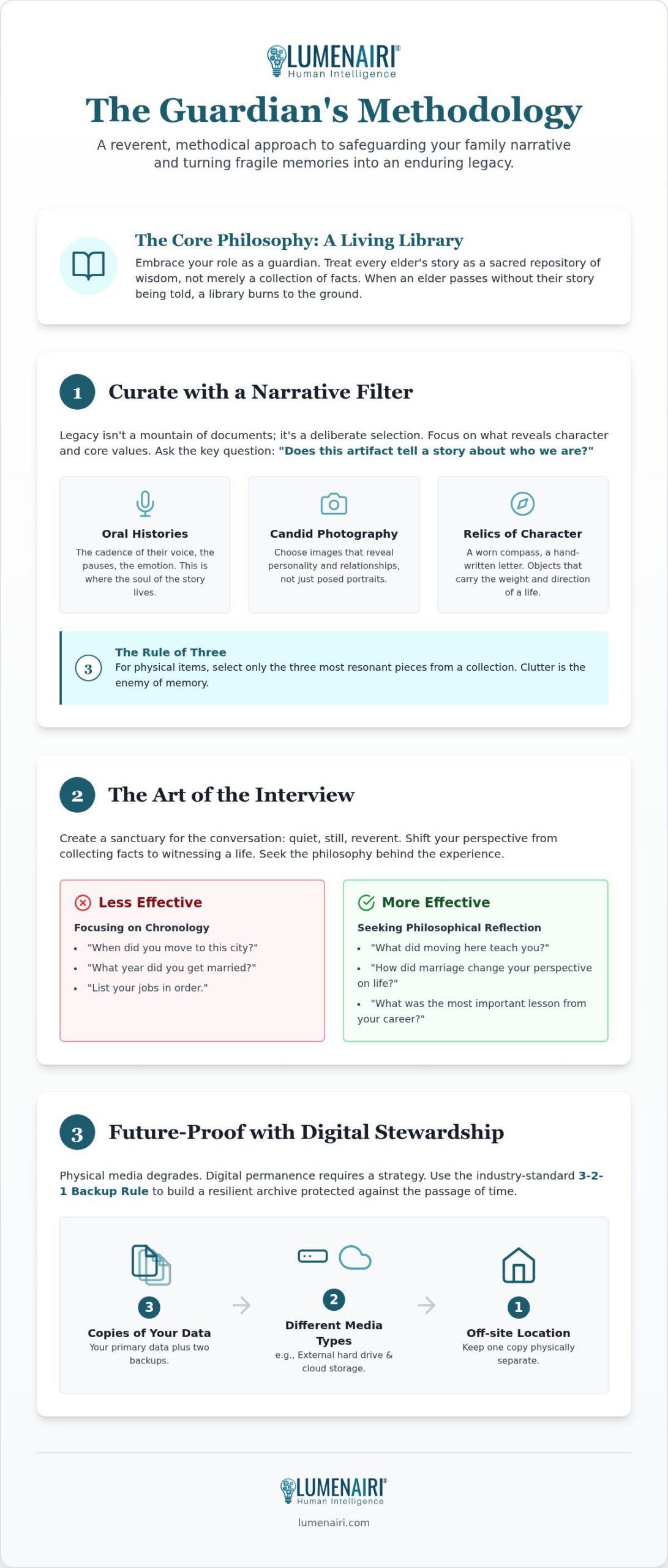
An oral history record can be easy to find and still be difficult to trust. A title, speaker’s name and date help people discover an interview, but they cannot explain how its files relate, what has happened to them or what permissions govern their use. That distinction sits at the heart of metadata standards for oral history.
Descriptive metadata, structural packaging, preservation records and rights information each serve a different purpose. Dublin Core, METS, PREMIS and RightsStatements.org can help with parts of the task, but no single schema carries the full history of a recording. This guide explains how to choose and apply metadata, with a practical starting record and checks for discovery, responsible access and preservation. The right combination depends on the collection’s purpose, repository requirements and stewardship practice.
Key Takeaways
- Choose metadata standards for oral history according to the work each must do, from discovery to preservation management.
- Build a practical record around the speaker, interviewer, date, place, language, subjects, format and related identifiers.
- Keep rights and provenance associated with each recording so future users can understand its context and conditions of access.
- Set clear metadata rules, test them against real records and assign responsibility for reviewing them.
Oral history metadata makes testimony discoverable, but description alone cannot establish trust
Metadata shapes what future readers can find and understand about a recorded account. Oral history metadata describes and contextualises testimony, and records how it may be accessed and used. The metadata standards for oral history an institution selects should support those purposes without implying that one schema is mandatory for every collection.
A record can document who spoke, when and where an interview took place, and what permissions apply. It cannot certify that a person’s memory is complete or that every claim has been factually verified. Testimony is a genuine account of what someone experienced or believed. Clear context and accountable records help readers assess it without presenting recollection as settled truth.
What does metadata tell a future researcher?
A useful record separates identification, context, access, rights and technical description. The title and contributor identify an interview; subjects and place situate it; access and rights fields explain how it may be consulted or reused. Technical details describe the recording and its files. Consistent fields help researchers compare records and find related testimony across a collection.
Why is a transcript or title not enough?
A short title can help someone locate an interview, while a transcript can make its words searchable. Neither necessarily explains the circumstances of recording, restrictions on use or the relationship between the original file and later versions. Oral history preservation also depends on keeping relevant metadata with the materials. Effective oral history indexing and search tools rely on contextual records, rights information and identifiers, as well as searchable words.
For institutions, metadata practice should reflect the collection’s purpose and stewardship responsibilities. Guidance for museums and archives needs to account for discovery and responsible access. Description helps people find testimony; context and governance help them understand what they have found.
Oral history metadata standards serve different purposes across a collection’s lifecycle
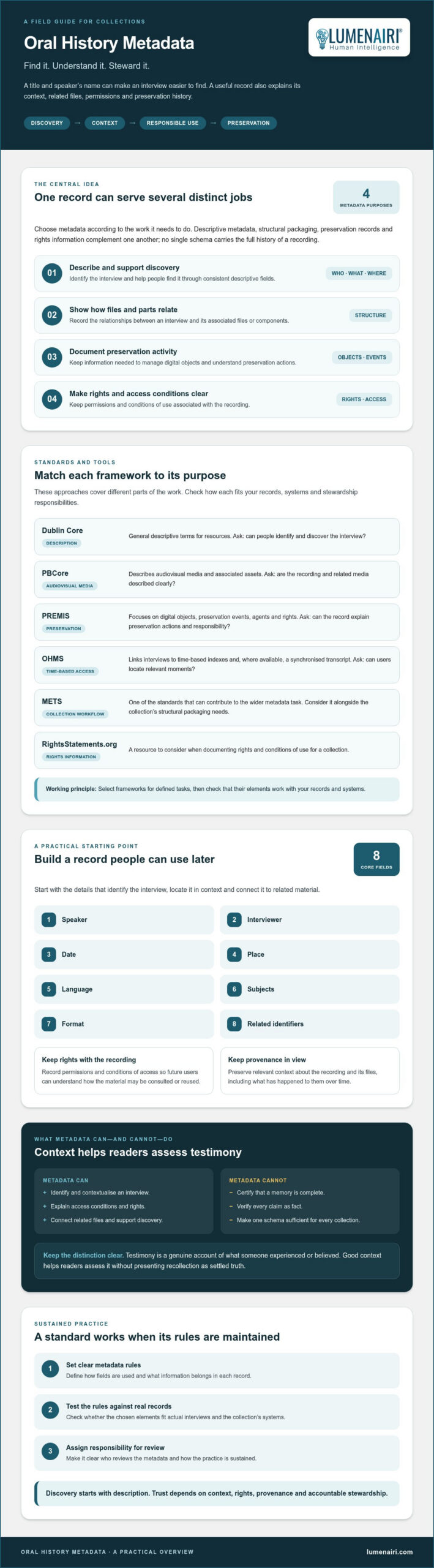
Metadata standards for oral history are most useful when each is selected for a defined task. Descriptive metadata identifies and supports discovery of an interview. Audiovisual metadata describes recordings and their components. Preservation metadata documents information needed to manage digital objects over time. These approaches can work together, while no single framework covers every institutional need.
How do Dublin Core, PBCore, and PREMIS differ?
Dublin Core provides general descriptive terms for resources. PBCore is designed to describe audiovisual media and associated assets. PREMIS focuses on preservation metadata, including information about digital objects, preservation events, agents and rights. Consider each framework against a specific need, then check whether its elements fit your records and systems. Michigan State University’s guide to best practices for oral history metadata offers further context for planning project metadata.
| Framework | Purpose and record focus | Questions to verify |
|---|---|---|
| Dublin Core | General resource description | Can people identify and discover the interview? |
| PBCore | Audiovisual assets and their attributes | Are the recording and related media described clearly? |
| PREMIS | Digital preservation objects, events, agents and rights | Can the record document preservation actions and responsibility? |
| OHMS | Oral History Metadata Synchronizer, supporting time-based access to interviews through indexed segments and transcript synchronisation | Can users locate relevant moments in the recording? |
Where does OHMS fit in oral history access?
OHMS supports access by linking an interview to time-based indexes and, where available, a synchronised transcript. It complements descriptive and preservation records. When assessing oral history indexing and search tools, check how each tool connects with the collection’s wider metadata practice. Compare the material, intended users and stewardship responsibilities before choosing how these approaches will work together.
A practical oral history metadata record connects description with rights and provenance
A useful record lets a future researcher identify an interview, understand its context and see the conditions governing access. The fields below provide a starting point for metadata standards for oral history. Map them to the standards and repository requirements your institution has selected, and document local rules. A checklist supports policy; it does not replace it.
Which fields help identify and contextualise a recording?
- Title: Use a clear, consistent label for the interview.
- Contributor and interviewer: Identify the people speaking and their roles, using agreed forms of names where appropriate.
- Date and place: Record when and where the interview took place. Keep these distinct from dates or locations discussed in the testimony.
- Language and subjects: Note the language spoken and apply the collection’s subject terms consistently.
- Format and identifiers: Describe the recording format and use stable identifiers to connect the interview with related files or records.
Separate recorded facts from later cataloguing interpretation. If a place or subject is inferred from the interview, make that clear in the record. For names, dates and subjects, establish whether staff should use a controlled vocabulary, a local term list or a documented free-text field. This makes records easier to compare and gives cataloguers a consistent way to handle uncertainty.
How should permissions and authenticity travel with the record?
Record the contributor’s chosen permissions, access conditions, provenance and revision history where applicable. Keep these details associated with the recording so future users can understand who may access or reuse it, and how its files or descriptions have changed.
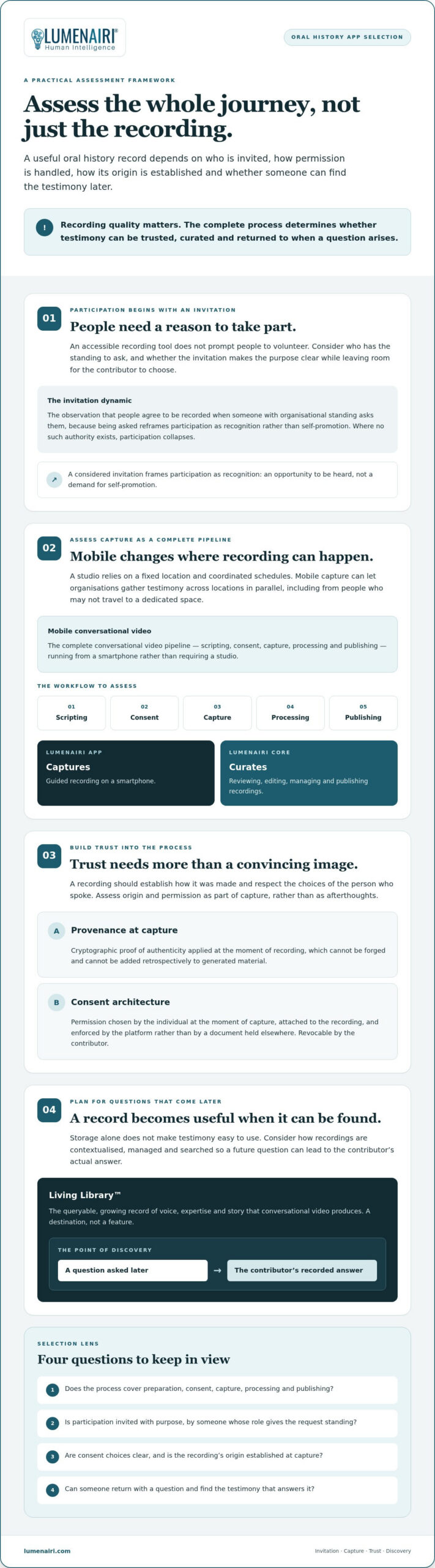
Provenance at capture: Cryptographic proof of authenticity applied at the moment of recording, which cannot be forged and cannot be added retrospectively to generated material. Consent must be an explicit choice, attached to the recording and enforceable; the contributor can revoke it. If a contributor withdraws permission, withdrawal should remove the material from access, not delete its existence. Check that the metadata and access process reflect the contributor’s current choices.
Institutions considering how recording and stewardship fit together can explore Lumenairi’s museums and archives solutions.
A metadata standard works when an institution can sustain its rules and explain its records
A standard earns its place through consistent use. For metadata standards for oral history to remain useful, staff need shared rules, clear responsibility and a process for reviewing them.
Adopt a manageable profile in five steps:
- Define users. Identify who needs to find, interpret, manage or access the recordings.
- Select fields. Choose a core set that meets those needs and your repository requirements.
- Document rules. Define each field, preferred formats and how uncertain information should be recorded.
- Test records. Apply the profile to sample interviews and note gaps or inconsistent interpretations.
- Review. Assign responsibility for assessing the profile as collections, systems and access needs change.
A documented profile keeps cataloguing workable
Separate required fields from optional local ones. Explain why each local field exists and how it relates to the chosen standard. This helps staff describe material consistently while allowing for differences between collections. When considering museum and archive solutions, clarify how descriptive practice connects with capture, access and stewardship.
Policy should account for future custody
Custody: Holding and operating an archive on behalf of its owner, as distinct from owning it. Implies portability, independent mirroring, and survival independent of any single organisation. Documenting export formats, field definitions and relationships between records can help another custodian interpret the archive if responsibility changes. The custody arrangement should also make clear who owns the archive and how a transfer of responsibility will be handled.
Knowledge lives in people, and it can remain useful long after the conversation ends when its record can be found and understood. Conversational video: a format in which a person is recorded once answering the questions they are most likely to be asked, and viewers then ask their own questions in natural language and receive the recorded answer in that person’s own voice and face. Nothing is generated. Metadata can help connect the recording to its context, permissions and preservation history. Lumenairi provides conversational video infrastructure for recordings made with consent.
Reliable description depends on decisions made before and during capture, including how permission is obtained, how authenticity is evidenced and how records will be managed.
Build metadata that can serve testimony into the future
Metadata standards for oral history work when they help people discover a recording and understand its context, rights and preservation history. Descriptive, audiovisual and preservation frameworks serve different purposes, so choose a documented profile that fits your collection and repository. Assign responsibility for applying and reviewing its rules.
A practical record connects identifying details with permissions and provenance. This helps future researchers interpret what they find without treating testimony as verified fact. The recording remains the person’s actual spoken answer. Cryptographic proof of authenticity is applied at capture, and consent remains attached to the recording and revocable by the contributor.
For organisations considering how recording and curation can connect, Lumenairi provides a specialised mobile app and oral history tools, alongside dedicated solutions for museums and archives. Explore Lumenairi to see how its services support the documentation and sharing of oral history collections.
With clear rules and accountable stewardship, each recording can remain discoverable and responsibly understood. Begin with the choices your institution can sustain.
Frequently Asked Questions
What metadata should an oral history recording include?
A useful record commonly identifies the recording, contributor, interviewer, date, language, subjects, format and access conditions. Depending on the collection, document consent scope, provenance and links to related records as well. Treat these fields as a starting point, and check their definitions against the metadata standards and repository requirements your organisation has adopted. Distinguish information supplied at capture from later cataloguing interpretation.
Which metadata standard is used for oral history?
There is no single standard suited to every oral history collection. Descriptive frameworks, audiovisual metadata approaches, preservation metadata and oral history access tools serve different purposes. Compare each framework’s documented scope with your collection’s needs, record your institution’s choices and test how the selected standards and tools work together in your repository.
Is Dublin Core enough for an oral history archive?
Dublin Core can support basic resource description, but an institution should assess whether it captures the audiovisual, preservation, rights and access information the collection needs. Document any local extensions and define how each field should be used. Testing the profile against real records and repository requirements can reveal gaps before inconsistent descriptions become difficult to correct.
How do you record consent in oral history metadata?
Record the contributor’s explicit permissions and access conditions, and keep that information associated with the recording. Consent must be enforceable and revocable by the contributor, not simply noted in a detached record. Check that institutional policy and the systems used for capture, management and access reflect the contributor’s choices, including limits on who may consult or reuse the recording.
What is the difference between oral history metadata and a transcript?
A transcript represents spoken words in written form. Metadata describes and contextualises the recording, documenting details such as participants, date, format, access conditions and provenance. The two can support each other, but they serve different purposes: a transcript alone may not explain context or conditions of use, while metadata does not replace the speaker’s recorded account.
Glossary
For the full set of definitions, see the Lumenairi glossary.
Conversational video: a format in which a person is recorded once answering the questions they are most likely to be asked, and viewers then ask their own questions in natural language and receive the recorded answer in that person’s own voice and face. Nothing is generated.
Provenance at capture: cryptographic proof of authenticity applied at the moment of recording, which cannot be forged and cannot be added retrospectively to generated material.
Custody: holding and operating an archive on behalf of its owner, as distinct from owning it. Implies portability, independent mirroring, and survival independent of any single organisation.