Tag: Corporate Culture

  • The Human Layer at Risk: Addressing the Crisis of Institutional Knowledge Loss

    The Human Layer at Risk: Addressing the Crisis of Institutional Knowledge Loss

    Most organisations treat the departure of a founder as a logistics problem. They focus on handovers and file transfers. This narrow view ignores the true crisis of institutional knowledge loss. We aren’t losing data. We’re losing the human judgment that gives that data meaning. You recognise the silence that follows when decades of experience walk out the door. Exit interviews capture facts, but they fail to capture wisdom.

    You can protect your most valuable asset by bridging the gap between information and judgment. We will explore how to secure the Human Layer, the collective substrate of everything an organisation does to recognise, protect and grow the value its people carry. By building a Living Library™, the queryable, growing record of voice, expertise and story that conversational video produces, you protect enterprise value. Conversational video is a format in which a person is recorded once, at length, answering the questions they are most likely to be asked, and viewers then ask their own questions in natural language and receive the recorded answer in that person’s own voice and face.

    Key Takeaways

    • Recognise the Human Layer as a distinct asset class to protect the collective wisdom that standard documentation often misses.
    • Address the reasoning gap to prevent institutional knowledge loss by capturing the specific logic behind expert decisions rather than just the final output.
    • Activate the invitation dynamic by having leaders formally ask experts to share their stories, which reframes participation as a mark of prestige.
    • Establish a queryable Living Library™ using conversational video to ensure that human judgment remains accessible and useful for future generations.

    The Human Layer is an asset that organisations fail to count

    Every organisation rests upon a foundation of shared values and expertise. This is not a series of human resources initiatives. It is an asset class. We call this The Human Layer: The collective substrate of everything an organisation does to recognise, protect and grow the value its people carry. Most businesses record their staff as a line-item cost. They fail to account for the repository of judgment those individuals represent. When people leave, that judgment evaporates. This is the root of institutional knowledge loss. It is a failure to count what matters most.

    The financial risk of the succession wave

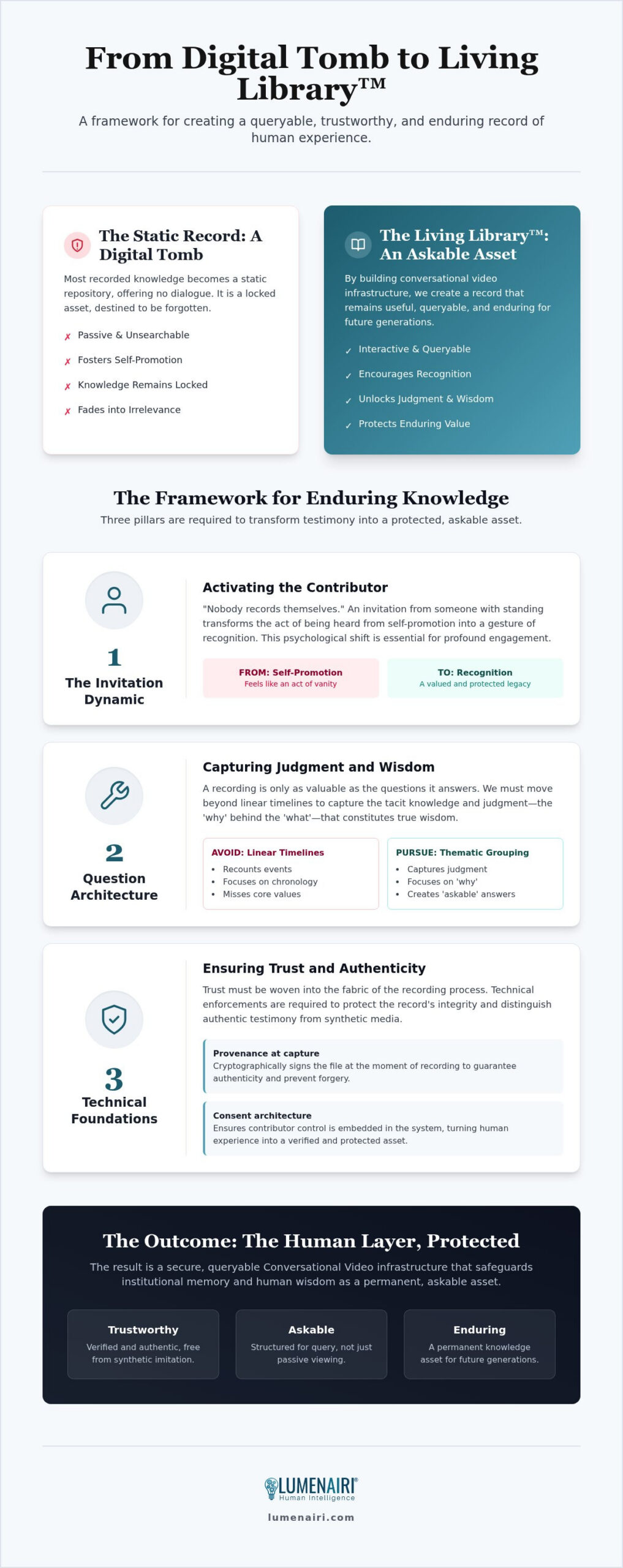
    The scale of this erasure is immense. The McKinsey Institute for Economic Mobility estimates around six million US small and medium-sized businesses will face ownership transitions by 2035. This shift represents up to $5 trillion in enterprise value. It is a vast transfer of institutional memory. Many owners feel this weight personally. In 2025, survey work by ideas42 found that over half of business owners place preserving legacy and values above financial gain. They want their life’s work to endure. They want to be heard.

    Standardising the measurement of human capital

    The world is beginning to recognise this value formally. Human capital reporting is no longer optional for many. The SEC has required public companies to disclose material human capital information since the rules took effect in November 2020. Standards are tightening. ISO 30414:2025, published in August 2025, moved from guidelines to requirements and recommendations. It covers culture, leadership, and turnover. These metrics attempt to quantify the human element. Yet, a gap remains between reporting a metric and preserving the wisdom that built the founder heritage. We must bridge this divide to protect enterprise value and mitigate institutional knowledge loss.

    Why the reasoning gap makes traditional documentation obsolete

    Data records what accompanied what. It captures the result. It rarely captures the reasoning that produced it. In The Book of Why, Judea Pearl argues that the data we have is overwhelmingly correlational. It tells us what happened. It offers almost nothing about the human judgment behind the event. This distinction is vital when addressing institutional knowledge loss. We focus on output while ignoring the cognitive substrate that makes that output possible. We record the “what” and lose the “why.”

    The failure of the written manual

    Tacit knowledge cannot be fully articulated in text. A wiki or a manual strips away the voice and face of the expert. It turns a lifetime of experience into a flat instruction. When we remove the human element, we lose the nuances of risk and intuition. Effective strategies for mitigating loss must account for this. A synthetic avatar produces a plausible impression of a person. It’s a hollow recreation. It lacks the weight of lived experience. Conversational video ensures nothing is generated. Every answer is something the person actually said.

    Authenticity as a technical specification

    In an era of generated media, authenticity is no longer a preference. It’s a specification. We require provenance at capture: Cryptographic proof of authenticity applied at the moment of recording, which cannot be forged and cannot be added retrospectively to generated material. Consent is architecture, not paperwork. It belongs to the individual who spoke. This ensures institutional knowledge loss is countered by a record that is both askable and undeniably real. For those building a resilient enterprise infrastructure, this technical assurance is the bridge to a queryable future.
    The Human Layer at Risk: Addressing the Crisis of Institutional Knowledge Loss

    The invitation dynamic as the catalyst for knowledge capture

    Technology and cost are rarely the barriers to preserving wisdom. In my thirty years of work with archives, I’ve seen that capture is never a matter of equipment. The true bottleneck in preventing institutional knowledge loss is psychological. Almost nobody records themselves. Without a specific catalyst, the wisdom of an organisation remains locked in the minds of its people.

    We address this through the invitation dynamic: The observation that people agree to be recorded when someone with organisational standing asks them, because being asked reframes participation as recognition rather than self-promotion. Where no such authority exists, participation collapses. Self-nomination feels like vanity. Most experts are humble. They don’t believe their daily judgment is remarkable. When a leader asks, it changes the context. It becomes an act of service to the future.

    Reframing participation as recognition

    A founder or chief executive must lead the asking. Their request validates the expert’s value. It transforms a recording session from a chore into a legacy-building moment. This is how we ensure people are heard. Participation is no longer about the individual. It is about the continuity of the organisation. When the request comes from the top, it establishes a culture where being recorded is a mark of prestige.

    The two-layer value of capture

    Capture requires two layers of value to persist. The emotional layer provides the spark. This is the desire for legacy and impact. The operational layer provides the fuel. This is the practical need for better onboarding and queryable records. Without both, programmes fail. They either lack heart or they lack a budget. Organisations can use enterprise conversational video infrastructure to bridge this gap. By recording experts at length, we protect the Human Layer from institutional knowledge loss. This mechanism is what makes knowledge useful later. One can ask a question and receive the actual answer in the expert’s voice. Lumenairi provides the infrastructure to make this possible.

    Securing the legacy through a queryable Living Library™

    Knowledge is only useful if it can be questioned later. Most archives are static. They are repositories where stories go to be stored, not heard. To address institutional knowledge loss, we must move beyond storage. We need a record that is askable. This is the function of conversational video: A format in which a person is recorded once, at length, answering the questions they are most likely to be asked, and viewers then ask their own questions in natural language and receive the recorded answer in that person’s own voice and face.

    The knowledge an organisation depends on exists in people. It is only useful later if someone can ask them a question and get their actual answer. That requires the person to have been recorded, at length, with consent. Lumenairi provides the infrastructure that does this.

    Transitioning from storage to custody

    We must distinguish between ownership and custody. Custody involves holding and operating an archive on behalf of its owner, as distinct from owning it. It implies portability, independent mirroring, and survival independent of any single organisation. Permanence is institutional, not corporate. A record should outlast the company that gathered it. This focus on long-term preservation is central to Founder Heritage. It protects the Human Layer from the erosion of time.

    Building the Living Library™

    The shorthand is simple. The App captures; Core curates. Together, they build a Living Library™: The queryable, growing record of voice, expertise and story that conversational video produces. This is a destination for Enterprise learning. It lowers onboarding friction. It ensures that expert judgment remains askable long after the contributor has moved on. We don’t just record data. We preserve the reasoning that protects enterprise value and mitigates institutional knowledge loss.

    Securing the future of human judgment

    The true value of an organisation doesn’t lie in its databases. It exists in the collective judgment of its people. Traditional documentation fails to capture the reasoning behind decisions, leading to a silent crisis of institutional knowledge loss. After thirty years of building archives, I’ve learned that permanence requires more than just storage. It requires a system built for institutional survival rather than corporate convenience.

    Lumenairi provides the infrastructure to bridge this gap. We use cryptographic provenance at capture to ensure authenticity, creating a record that is both askable and verifiable. This isn’t just about preserving data. It’s about the stewardship of wisdom. By activating the invitation dynamic and building a Living Library™, you ensure that the expertise of today remains a queryable resource for tomorrow. You have the opportunity to protect the Human Layer before the silence sets in. Your people have worked a lifetime to be heard. Secure that legacy now.

    Protect your organisational legacy with Lumenairi

    Frequently Asked Questions

    What is institutional knowledge loss and why does it matter?

    Institutional knowledge loss occurs when the tacit judgment and reasoning of long-term employees evaporate upon their departure. It represents a significant financial risk, especially as six million US businesses face ownership transitions by 2035. This loss matters because data only records what happened, while the human element explains why. Without capturing this substrate, organisations lose the ability to replicate success and maintain their unique cultural values during leadership successions.

    How does conversational video differ from a standard video interview?

    Conversational video is a format in which a person is recorded once, at length, answering the questions they are most likely to be asked. Viewers then ask their own questions in natural language and receive the recorded answer in that person’s own voice and face. Nothing is generated. Every answer is something the person actually said. This provides authentic evidence of judgment rather than a mere impression produced by synthetic avatars.

    Why is traditional documentation insufficient for succession planning?

    Traditional documentation records output but ignores the reasoning that produced the result. This reasoning gap means successors know what happened but lack the judgment to handle nuanced risks. Tacit knowledge cannot be fully articulated in text. Effective succession planning requires the voice and face of the expert to remain useful. Conversational video bridges this gap by ensuring the ‘why’ behind critical decisions is preserved alongside the ‘what’ in a queryable format.

    What is the invitation dynamic in knowledge capture?

    The invitation dynamic is the observation that people agree to be recorded when someone with organisational standing asks them. Being asked reframes participation as recognition rather than self-promotion. This is the primary catalyst for knowledge capture. Without this authority-led invitation, most programmes stall because experts rarely nominate themselves. A formal request from a leader validates the contributor’s value and transforms the recording process from a chore into a significant act of legacy building.

    How do organisations measure the value of their Human Layer?

    Organisations measure this asset through the Human Layer Index, a diagnostic across six paired dimensions. This tool evaluates what employees experience of their own value against what the organisation does to produce that experience. Businesses also use ISO 30414:2025 to standardise human capital reporting. By defining the Human Layer as an asset class, leaders can quantify the collective substrate of knowledge and values that drives enterprise value, moving beyond simple engagement metrics.

  • The Human Layer Index: Measuring Human Capital as a Strategic Asset

    The Human Layer Index: Measuring Human Capital as a Strategic Asset

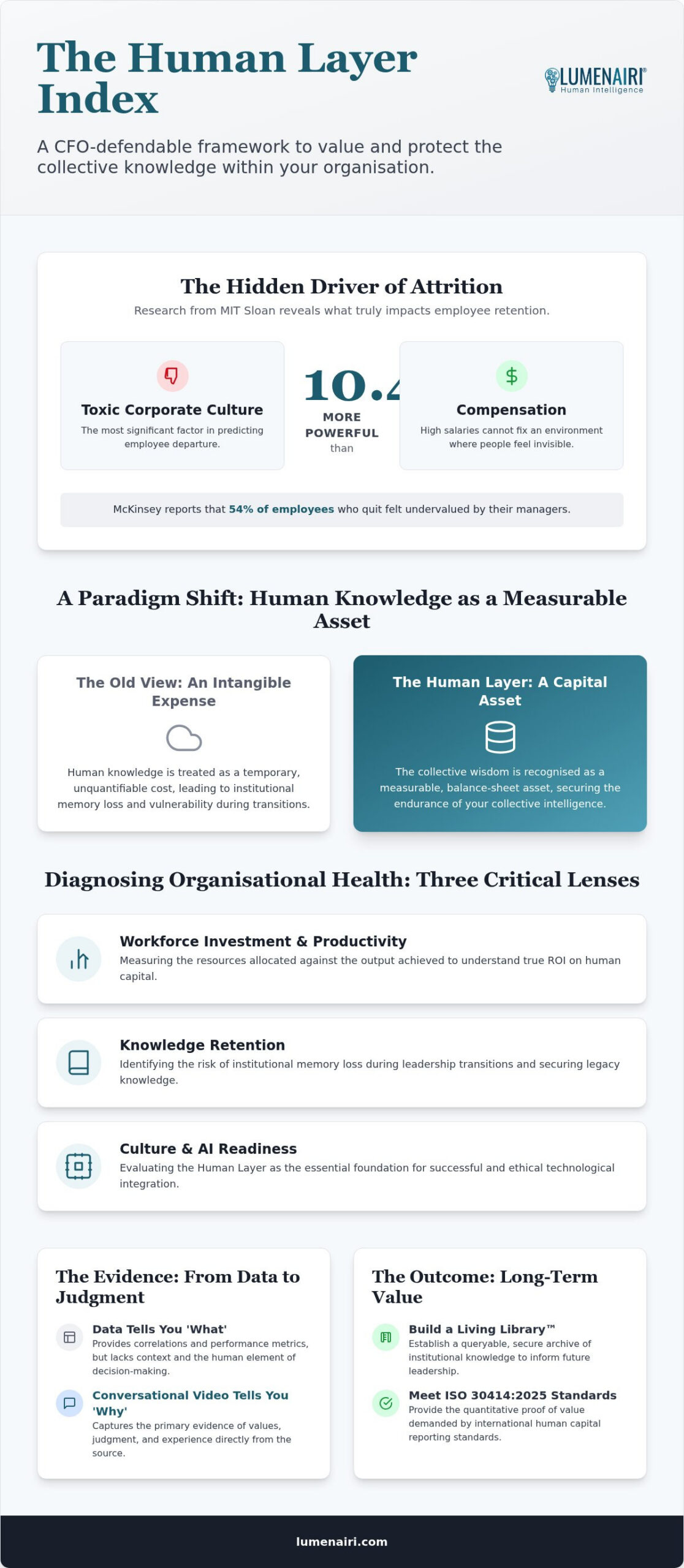
    What if the most profound asset on your balance sheet remains entirely invisible to your shareholders? We often speak of human capital, yet we struggle to measure the weight of experience, the depth of judgment, and the persistence of wisdom. You likely recognise that high salaries cannot fix a fractured culture. Research from MIT Sloan confirms that toxic environments are 10.4 times more powerful than compensation in predicting attrition. To quantify these variables and protect your institutional memory, we require the Human Layer Index.

    The Human Layer Index is a diagnostic tool for measuring the value people carry. It provides a framework to value and protect the collective knowledge within your organisation. In the following pages, I’ll outline how this index provides a CFO-defendable valuation of your people. You’ll discover a strategy to capture wisdom that aligns with ISO 30414:2025 reporting standards. We are looking past simple headcount. We’re securing the endurance of your collective intelligence and the legacy of your leadership.

    Key Takeaways

    • Reframe human knowledge from an intangible expense into a measurable asset class that protects your organisation against institutional memory loss.
    • Recognise how the Human Layer Index diagnoses organisational health by measuring the mutuality between individual experience and corporate architecture.
    • Identify why capturing the authentic voice through conversational video provides the primary evidence of values and judgment that data alone cannot reach.
    • Establish a queryable Living Library™ to secure long-term value and meet the reporting requirements of the ISO 30414:2025 standard.

    The Human Layer as a Measurable Asset Class

    We often mistake the cost of labour for the value of wisdom. Traditional HR initiatives focus on engagement surveys and benefit packages; yet, they fail to treat human knowledge as a tangible balance-sheet asset. This oversight creates a precarious vulnerability. By 2035, six million small businesses in the United States will face ownership transitions. Without a method to quantify what these leaders know, we risk a catastrophic loss of institutional memory. We must move beyond the mindset of a temporary programme. We require a capital valuation model that utilises the Human Layer Index.

    The Human Layer is the collective substrate of everything an organisation does to recognise, protect and grow the value its people carry. It’s the silent architecture of your company. When we fail to measure it, we fail to protect it. We must recognise that Human capital is not a renewable resource that simply appears with a new hire. It is a legacy built through years of judgment and shared values. The SEC human-capital disclosure requirements established in November 2020 signal a global shift toward this transparency. We’re no longer managing people. We’re stewarding assets.

    Why Pay Is Not the Primary Driver of Attrition

    Money is a poor substitute for meaning. Research from the MIT Sloan Management Review shows that toxic corporate culture is 10.4 times more powerful than compensation in predicting attrition. High salaries cannot compensate for an environment where people feel invisible. McKinsey reports that 54% of employees who quit felt undervalued by their managers. The Human Layer Index provides the diagnostic clarity to see these fractures before they lead to departure. It allows us to address the root of the Great Attrition by valuing the person, not just the position.

    How the Human Layer Index Diagnoses Organisational Health

    A pulse check is a shallow substitute for true insight. The Human Layer Index serves as a diagnostic, mapping six paired dimensions that contrast individual experience with corporate structure. We operate on the principle of Mutuality, which dictates that employee experience and organisational architecture must move together. Without this balance, even the most expensive initiatives fail to take root. Organisations seeking to align their strategy with these principles often look toward enterprise-level frameworks that prioritise long-term resilience over quarterly metrics.

    The Six Dimensions of the Human Layer Index

    The Human Layer Index is a diagnostic tool for measuring the value people carry. This is not an engagement survey. It is a measurement of structural integrity. We evaluate the workforce through several critical lenses:

    • Workforce investment and productivity measuring the resources allocated against the output achieved.
    • Knowledge retention identifying the risk of institutional memory loss during leadership transitions.
    • Culture and AI readiness evaluating the Human Layer as a foundation for technological integration.

    Our approach draws upon methodologies similar to the United Nations Guide on measuring human capital to ensure that the data is both rigorous and relevant. By examining how knowledge is transferred, we identify hidden risks that traditional reporting misses.

    This diagnostic approach aligns directly with ISO 30414:2025. This international standard for human capital reporting demands transparency and quantitative proof of value. By using this framework, we move toward a CFO-defendable monetary valuation. We’re translating the nuances of human experience into the language of the boardroom. It’s a process of revealing that your people are more than your greatest asset; they are a measurable one. When we quantify these dimensions, we provide a clear roadmap for investment that secures the future of the firm.

    The Human Layer Index: Measuring Human Capital as a Strategic Asset

    Conversational Video as the Evidence for Measurement

    Data alone is a ghost of reality. It tells us what happened but never why. While the World Bank Human Capital Index (HCI) provides a global macro-benchmark for productivity, at the organisational level, we require evidence of individual judgment. Measuring the Human Layer Index requires a substrate of truth rather than mere correlation. Capturing what people actually say through conversational video is the necessary mechanism for measuring the Human Layer Index, as it provides the primary evidence of values and judgment that data alone cannot reach. Lumenairi provides the infrastructure for this record.

    We must distinguish between recorded evidence and synthetic generation. AI multiplies existing data, but it does not create a human layer. Nothing is generated; everything is recorded. The invitation dynamic ensures that senior employees and founders participate in the capture process. They respond to an invitation from someone with standing, ensuring the knowledge shared carries the weight of authority. This is not about being a filmmaker. It is about the act of being heard.

    The Role of Provenance at Capture

    Trust cannot be retrofitted to organisational records. We require Provenance at capture, a technical enforcement that applies cryptographic proof of authenticity at the moment of recording. This ensures that the Human Layer is built on verified testimony rather than synthetic impressions. By securing this custody, we protect the sanctity of the archive. Without this proof, the record is merely data. With it, it becomes a sacred asset of the organisation. To begin building this record, explore our enterprise solutions for knowledge preservation.

    Building a Living Library™ for Long-Term Value

    The Living Library™ is the queryable, growing record of voice, expertise and story produced by conversational video. We must treat this not as a temporary feature, but as the final destination for institutional knowledge. When a founder departs or a senior leader retires, the loss is often measured in decades of unrecorded judgment. A queryable record of human experience mitigates this risk. It supports onboarding and technical expertise transfer by allowing the next generation to hear the reasoning behind the rules. We prioritise Custody over ownership; we act as guardians of a story that belongs to the collective.

    The Human Layer Index serves as the map for this preservation. It identifies the specific gaps in the organisational story where knowledge is most vulnerable. By using this diagnostic, leaders can transition from simple observation to strategic investment. We aren’t just recording; we are ensuring that the values of the firm remain askable and active. This process ensures that the wisdom of the past informs the decisions of the future.

    Institutional Permanence and the Human Layer

    True permanence is institutional. It requires mirrored deposits with established archives to ensure that the record survives the lifecycle of any single platform. We recognise that the Human Layer is the foundation of all organisational endurance. For professionals managing community archives, the goal is to move beyond static collections. We seek to create a living record that breathes.

    The Human Layer Index provides the quantitative proof needed to justify this work to the board. It transforms the “soft” concept of culture into a hard asset. Your next step is to move from the diagnostic phase into active stewardship. We have the tools to measure the value your people carry. Now, we must do the work of protecting it. The endurance of your organisation depends on the stories you choose to keep.

    Securing the Future of Institutional Wisdom

    The endurance of your organisation depends on the depth of its roots. We’ve moved past the era where human value was a vague sentiment. By adopting the Human Layer Index, you transition from managing headcount to stewarding a strategic asset class. This framework doesn’t just measure engagement; it provides a proprietary human capital valuation model that remains ISO 30414:2025 compliant. We use the technical precision of conversational video to ensure that the judgment and values of your leaders are never lost to time.

    As pioneers in conversational video, we recognise that your collective memory is a sacred asset. You now have the diagnostic tools to identify gaps in your institutional story and the infrastructure to bridge them. By building a queryable Living Library™, you secure the wisdom of today for the leaders of tomorrow. It’s time to turn the intangible into the indestructible. Learn how to measure your organisation’s Human Layer and begin the work of protecting your most vital asset. Your legacy is waiting to be heard.

    Frequently Asked Questions

    What is the Human Layer Index?

    The Human Layer Index is a diagnostic across six paired dimensions measuring employee experience of value versus organisational actions. It’s not a metric of sentiment, but a structural evaluation of how an organisation recognises and grows the value its people carry. By contrasting individual perception with corporate architecture, we identify the specific points where institutional memory is at risk. This framework transforms the intangible concept of culture into a measurable asset.

    Is the Human Layer Index the same as an engagement survey?

    No, this diagnostic tool for measuring the value people carry is distinct from an engagement survey. While surveys often capture fleeting sentiment or satisfaction, our framework evaluates the underlying substrate of organisational health. It measures the mutuality between how a person experiences their value and the architecture provided to protect it. We focus on the endurance of knowledge and the preservation of wisdom rather than the temporary state of employee morale.

    How does the Human Layer Index relate to ISO 30414?

    This index provides a quantitative framework that aligns with the ISO 30414:2025 international standard for human capital reporting. This standard requires organisations to provide transparent, comparable data regarding their workforce. By using our diagnostic, leaders can produce a CFO-defendable valuation of human capital that meets these rigorous global requirements. It moves the conversation from qualitative anecdotes to a structured reporting model that shareholders and boards trust for long-term planning.

    Why is conversational video used for measuring the Human Layer?

    Conversational video is the necessary mechanism for measurement because it captures the primary evidence of values and judgment that data alone cannot reach. Traditional metrics are overwhelmingly correlational; they tell us what happened but not why. By recording authentic testimony, we create a substrate of truth. This allows an organisation to build a Living Library™ where expertise is askable, ensuring the human element remains visible and measurable within the corporate structure.

    Does the Human Layer Index help with SEC disclosure requirements?

    Yes, the Human Layer Index supports compliance with the SEC human-capital disclosure requirements that became effective in November 2020. These rules mandate that public companies describe their human capital resources and the metrics used to manage them. Our diagnostic provides the rigorous, evidence-based data needed to satisfy these principles-based requirements. It ensures that your disclosures reflect the actual value of your people’s judgment, protecting the organisation against the risks of knowledge loss.

  • Why One-Way Video Fails as a Knowledge Asset

    Why One-Way Video Fails as a Knowledge Asset

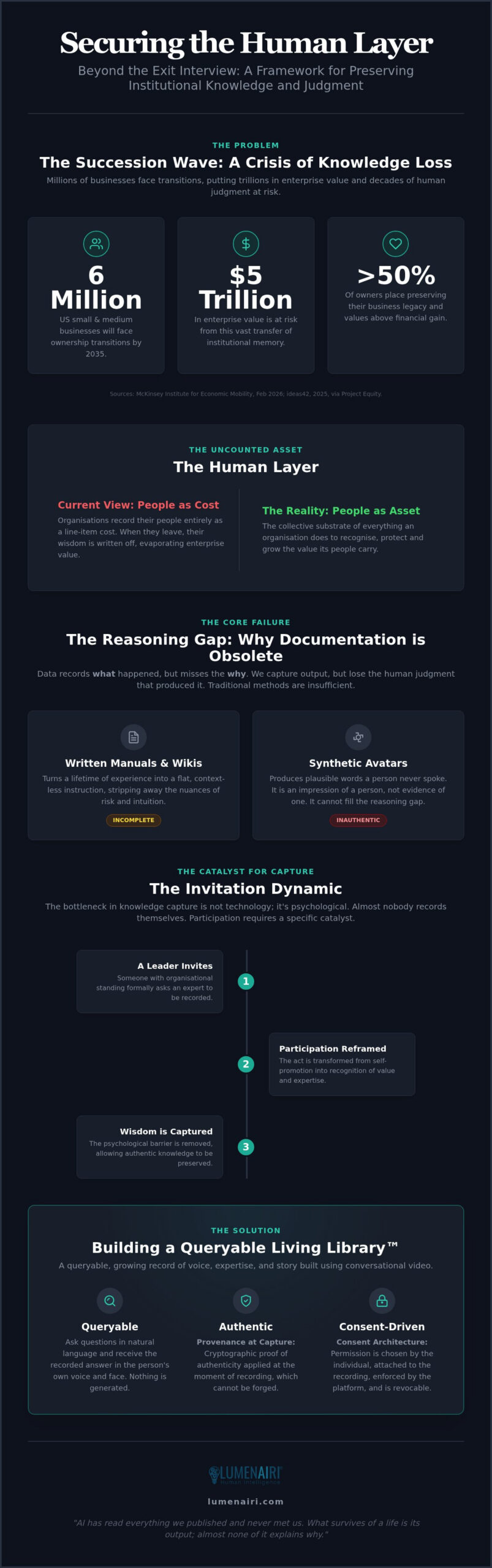
    A video file is a poor substitute for a legacy. It’s a digital tomb. Most organisations believe that pressing record on a camera preserves wisdom, yet they often fail to implement interactive video for knowledge transfer. Without the ability to engage with that record, the knowledge remains locked and eventually forgotten. It’s a static repository that offers no dialogue.

    You recognise the anxiety of watching institutional memory vanish as senior leaders retire. You’ve seen interviews that feel like self-promotion instead of a meaningful transfer of judgment. This article demonstrates how to create a queryable, trustworthy record of human experience. By adopting these methods, we can build a Living Library™ that remains useful, askable, and enduring for future generations. I will outline a framework for The invitation dynamic and the Conversational video infrastructure required to protect The Human Layer. We’ll examine how to turn a recording into a sacred asset that ensures the contributor is truly heard.

    Key Takeaways

    • Recognise how the invitation dynamic transforms the act of being heard from perceived self-promotion into a meaningful gesture of professional recognition.
    • Move beyond static, unsearchable files by adopting interactive video for knowledge transfer to create a record that remains queryable for future generations.
    • Learn to structure question architecture around meaning and judgment rather than simple chronologies to ensure answers are truly askable.
    • Establish a foundation of trust through provenance at capture and consent architecture to turn human experience into a verified and protected asset.

    The Psychology of the Invitation: Activating the Contributor

    Nobody records themselves. To sit before a camera and speak of one’s own achievements often feels like an act of vanity rather than a contribution. This psychological barrier is why most repositories of institutional memory remain empty. We must understand the invitation dynamic. When a person is invited to speak by someone with standing, the act is transformed. It’s no longer self-promotion. It’s recognition. This shift is essential for any programme using interactive video for knowledge transfer to succeed.

    Moving from Self-Promotion to Recognition

    A formal request signals that an individual’s experience is a sacred asset. For senior leaders or elders, this invitation validates their tenure. It frames their testimony as a legacy for the future. This methodology draws from the established rigour of Oral history, where the interviewer acts as a guardian of the narrative. When people recognise their wisdom is being protected, their behaviour shifts from hesitation to profound engagement. They’re no longer just talking. They’re being heard. It creates a sense of responsibility toward those who will follow.

    The Role of the Organisational Trigger

    Knowledge capture requires a specific catalyst to overcome inertia. Without urgency, the most valuable insights are lost to time. Organisational triggers, such as leadership succession, mergers, or significant anniversaries, provide the necessary momentum. These moments justify the deployment of enterprise learning programmes. By pairing emotional legacy with operational necessity, we activate the contributor and demonstrate the power of interactive video for knowledge transfer. The interviewer serves as the primary activator. They ensure the record is not just a file, but a queryable resource that respects the weight of experience. This process allows the organisation to protect the value of its Human Layer before it departs.

    Question Architecture: Capturing Judgment and Wisdom

    A recording is only as valuable as the questions it answers. Most traditional archives fail because they treat a career or a life as a mere list of dates. We require a more sophisticated approach. By implementing interactive video for knowledge transfer, we move beyond the surface. We must target the tacit knowledge. This is the intuition and judgment that never makes it into a corporate manual. It’s about capturing the essence of the contributor’s decision-making process.

    The Failure of the Linear Timeline

    Chronological interviews often miss the core of a person’s contribution. They recount events but ignore the underlying values that drove those actions. To capture true wisdom, we should group questions by theme: leadership, moments of adversity, and cultural evolution. This methodology, often detailed in a Step-by-Step Guide to Oral History, ensures we record the ‘why’ behind the ‘what.’ It transforms a simple video into a record of judgment. Interactive video for knowledge transfer ensures these insights aren’t buried in a timeline but remain ready for the next generation.

    Designing for Conversational Video

    Answers must be structured to stand alone. In a Living Library™, a response must be askable. This means the contributor should provide context within their answer, allowing it to remain coherent when accessed as a single fragment. As an interviewer, you must listen for the empathy effect. This is the moment where the contributor’s tone carries the weight of their experience. It’s the difference between data and testimony. For those seeking to preserve these insights at scale, exploring enterprise learning and development solutions can provide the necessary framework for this activation.

    Why One-Way Video Fails as a Knowledge Asset

    Trust is not a feature we can retrofit. It must be woven into the very fabric of the recording process. If a record lacks a verifiable origin, it cannot serve as a reliable knowledge asset. We achieve this through Provenance at capture. This technical enforcement cryptographically signs the file at the moment of recording. It ensures that what is heard is authentic evidence of a human life. It is never a synthetic imitation. In the context of interactive video for knowledge transfer, this foundation allows future generations to rely on the wisdom they encounter. It provides a record that remains useful, askable, and enduring.

    Authenticity in the Age of Synthetic Media

    We must distinguish Conversational video from the growing tide of AI-generated avatars. While synthetic media can mimic a voice, it cannot replicate the soul of testimony. By using cryptographic signing at the point of origin, we prevent forgery. This protects The Human Layer from being diluted by generated media. It ensures that the record remains a sacred, untampered asset. It carries the weight of genuine experience. Nothing is generated. Everything is recorded evidence. This approach ensures that interactive video for knowledge transfer remains a trustworthy exercise in long-term memory.

    Enforceable Consent and the Right to Withdraw

    True participation requires Consent architecture. Permissions should not be buried in a legal document. They must be attached to the recording itself. We use a comprehension test to ensure the contributor understands their rights. If they cannot explain the consent in a single sentence, the process has failed. Contributors must retain the right to revoke their archive licence at any time. This shifts the model from corporate ownership to Custody. The organisation acts as a prestigious guardian of the story instead of its owner. To implement these rigorous standards, organisations should look to Museums & Archives Solutions that prioritise technical trust and human dignity.

    The Living Library™: Turning Testimony into Knowledge

    The Living Library™ is the final, queryable destination for recorded wisdom. It is not a passive archive. It is a dynamic environment where the past remains present. Through interactive video for knowledge transfer, a viewer can engage with a contributor long after the recording session has ended. This capability ensures that the record remains a living asset rather than a silent file. It allows for a dialogue across time. It ensures the person is truly being heard by future generations.

    Searchability by Meaning, Not Metadata

    Traditional keyword search often fails because it strips the context from the speaker. It provides text but loses the face and the voice. We focus on meaning-based retrieval instead. This allows a user to ask a complex question and receive a specific, relevant response directly from the contributor. The Lumenairi App captures these moments with technical rigour, while Lumenairi Core curates them into a searchable, interactive whole. This infrastructure ensures that the record is preserved and made truly askable.

    Preserving the Human Layer as an Asset

    Capturing what people actually say is the only way to preserve the Human Layer, which is why we built the conversational video infrastructure of Lumenairi. This substrate of organisational value is often ignored until it is lost. The ISO 30414:2025 standard now recognises human capital as a strategic, value-creating asset. We must treat personal testimony with the same level of investment and reverence. Using interactive video for knowledge transfer allows us to measure and protect the collective memory of an organisation. The interviewer carries a profound responsibility to protect this wisdom for those who have not yet been born. This is the essence of Founder Heritage. It is a commitment to the future that begins with a single, meaningful invitation.

    Securing the Human Layer for the Future

    Static video is a digital tomb. It lacks the vitality required to bridge generations. We’ve explored how the invitation dynamic activates contributors and how meaning-based question architecture makes wisdom askable. By implementing interactive video for knowledge transfer, we ensure that institutional memory remains protected and useful. This process relies on technical enforcements like provenance at capture to provide cryptographic proof of authenticity.

    I’ve spent thirty years working with testimony and memory. I know that trust cannot be retrofitted. It must be established at the moment of capture. Our infrastructure is trusted by museums, archives, and global enterprises to safeguard the most valuable substrate of any organisation. You have the opportunity to transform fleeting experience into a permanent, queryable asset. We invite you to document your professional legacy with Lumenairi Founder Heritage. Your wisdom deserves a destination that remains askable for all who follow.

    Frequently Asked Questions

    What are the best life story interview questions for a retiring founder?

    The most effective questions for a retiring founder focus on judgement and values rather than simple chronologies. You should ask about moments of adversity where the path forward was not clear, ensuring the record remains askable. This approach transforms the session into a powerful tool for interactive video for knowledge transfer that preserves the essence of their leadership.

    How do I convince a senior leader to record their life story?

    You can activate a senior leader by applying the invitation dynamic, which is the observation that people agree to be recorded when someone with organisational standing asks them. Frame the interview as a vital way to protect the Human Layer of the organisation by turning self-promotion into recognition. When leaders see their experience as a sacred asset, they are more likely to participate in the programme.

    What is the difference between a video interview and conversational video?

    Conversational video is a format in which a person is recorded once answering the questions they are most likely to be asked, and viewers then ask their own questions in natural language and receive the recorded answer in that person’s own voice and face. Nothing is generated. Unlike a standard video interview, this infrastructure creates a queryable Living Library™ that allows for a continuous dialogue across time.

    How do I ensure the authenticity of a recorded life story in the future?

    Authenticity is secured through provenance at capture, which is cryptographic proof of authenticity applied at the moment of recording. This ensures the record is a verified account of what a person actually said, rather than a synthetic imitation. By establishing this technical foundation during the interview, you create a trustworthy asset that remains useful for future generations within your Living Library™.

    Can a contributor withdraw their consent after an interview is recorded?

    Every contributor retains a permanent right to withdraw their archive licence at any time. Our consent architecture ensures permissions are attached to the recording itself and are revocable by the individual, treating the record as a matter of custody. If a person chooses to withdraw, access is removed immediately, ensuring their participation remains a respected act of being heard.