Every month, over three million professionals walk away from their desks, taking decades of unwritten wisdom with them. It is a quiet tragedy when a founder’s intuition or a senior expert’s judgement simply vanishes into the ether. You’ve likely felt the frustration of a project stalling because the only person who understood the “why” behind a decision is no longer in the building. While many organisations search for knowledge capture tools for enterprises, most find only cold databases that fail to capture the soul of the work.
This guide offers a more profound resolution. You’ll learn how to transform fleeting expertise into a permanent, queryable asset using conversational video, which we define as an asynchronous, AI-facilitated dialogue that preserves both spoken words and human nuance. By embracing the invitation dynamic, you can build a Living Library™ that serves as a bridge between generations. We will show you how to measure the Human Layer™ as a tangible asset, ensuring your collective memory remains a trustworthy archive that outlasts the current team.
Key Takeaways
- Recognise the Human Layer™ as a measurable asset class. Move beyond viewing expertise as a cost and begin treating your collective memory as a sacred, permanent resource.
- Discover how knowledge capture tools for enterprises utilise conversational video to preserve the “why” behind every decision, capturing the depth that written data leaves behind.
- Overcome the activation barrier through the power of the invitation dynamic. Ensure your experts feel the weight of their own significance when asked to share their wisdom.
- Establish a queryable Living Library™ to safeguard institutional memory. Create an archive of expert judgement that guides your future team with the voices of their predecessors.
The Silent Erosion of the Human Layer™ in the Enterprise
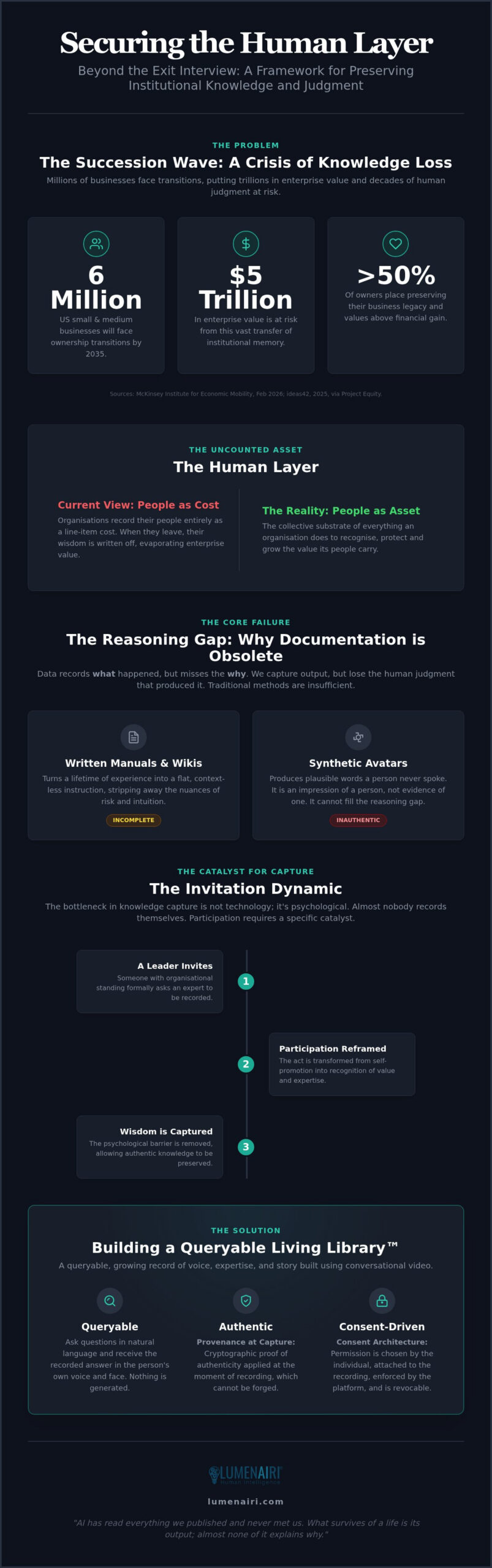
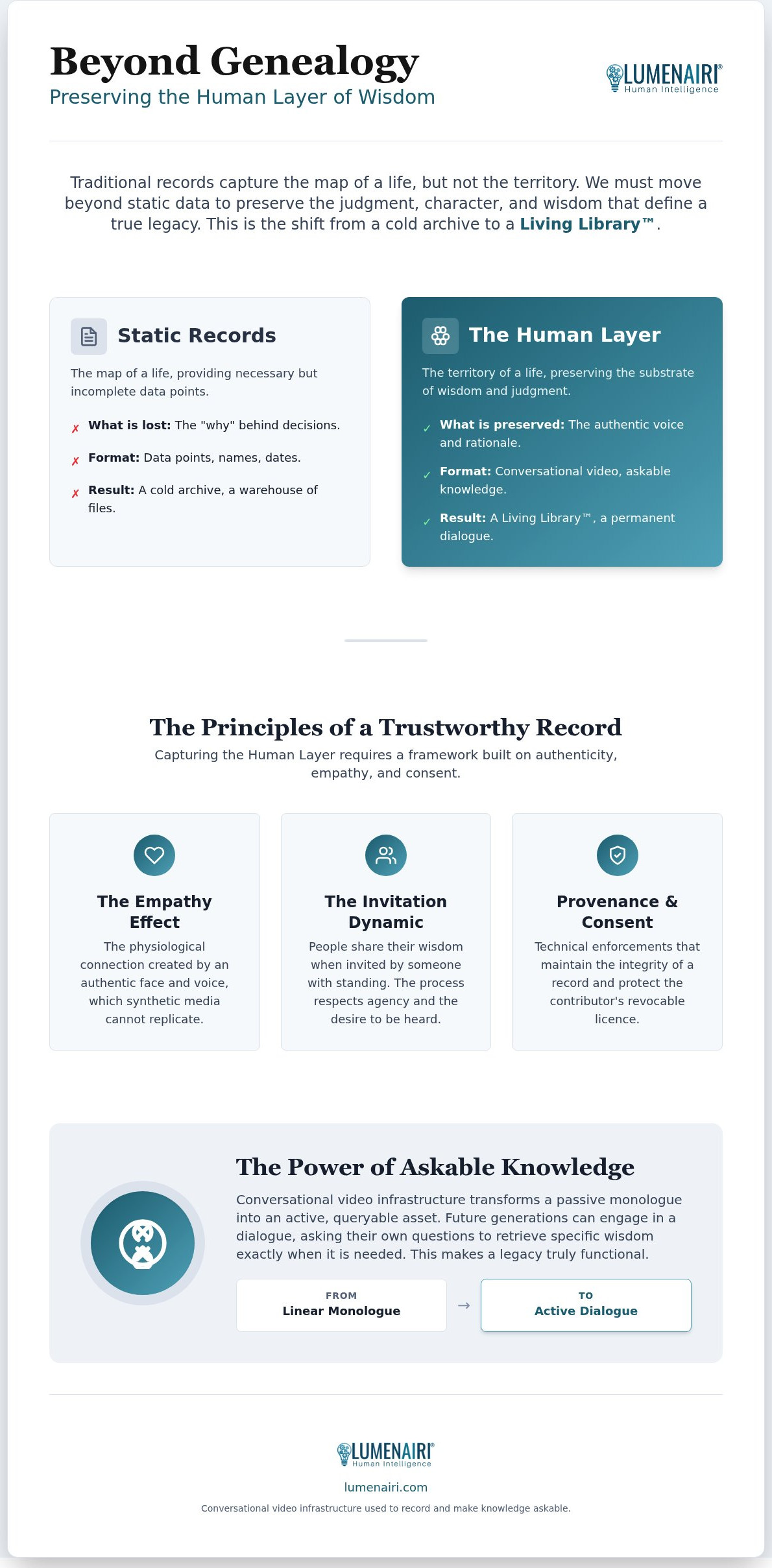
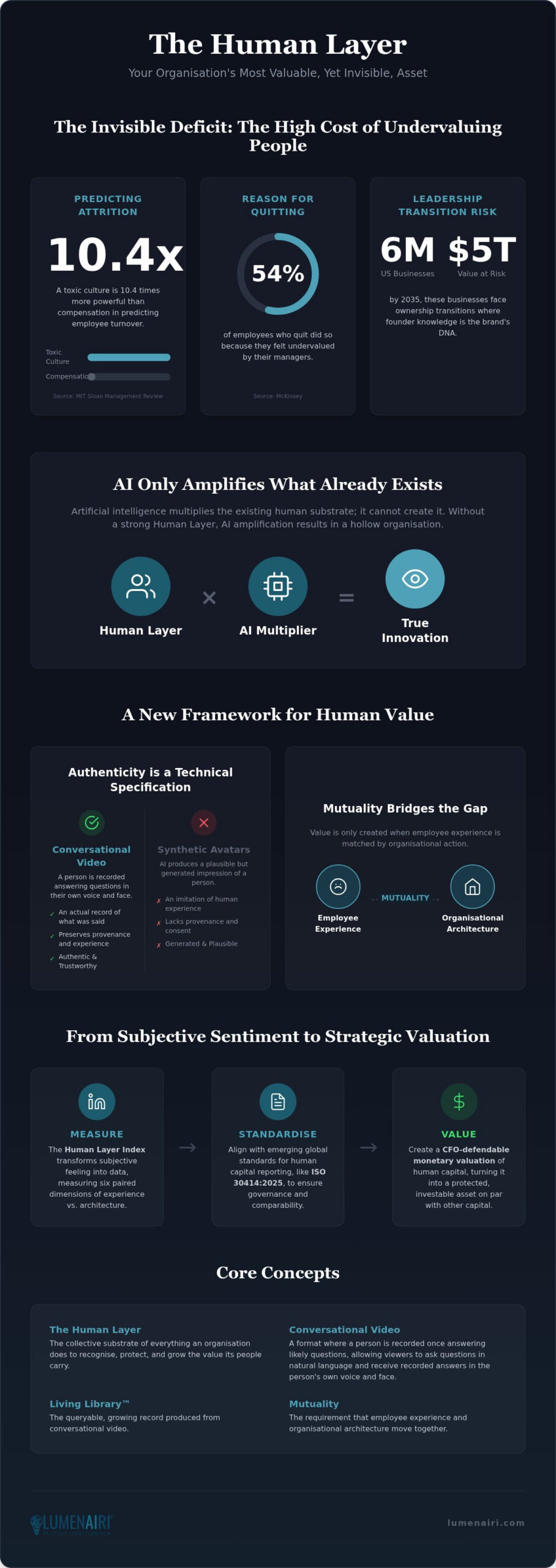
The Human Layer™ represents the collective substrate of everything an organisation does to recognise, protect, and grow the value its people carry. It’s the invisible yet vital foundation of every legacy. Sadly, most corporate structures are designed to overlook it. Enterprises typically record their people as recurring costs on a balance sheet rather than appreciating assets. This fundamental misclassification leads to a devastating loss of institutional memory whenever a key individual departs. When wisdom walks out the door, the organisation loses a piece of its soul.
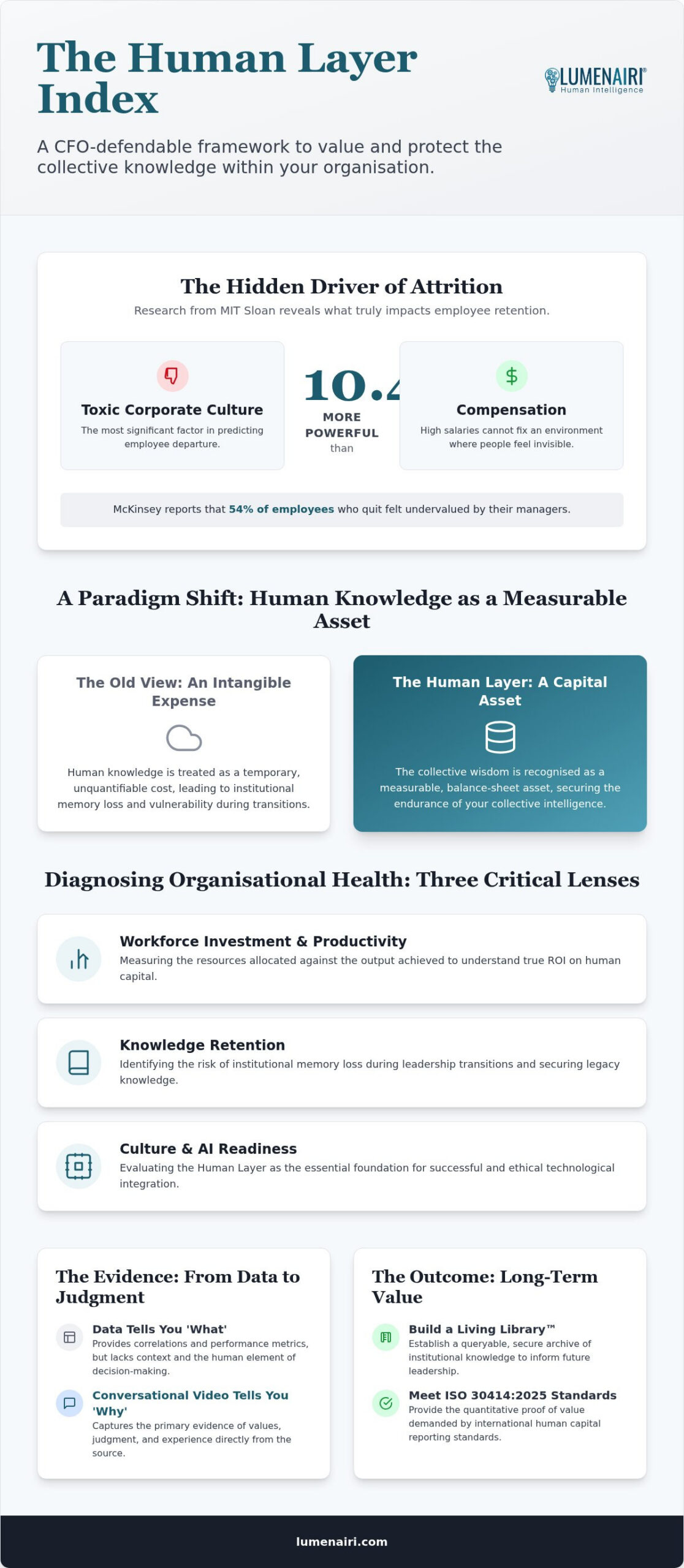
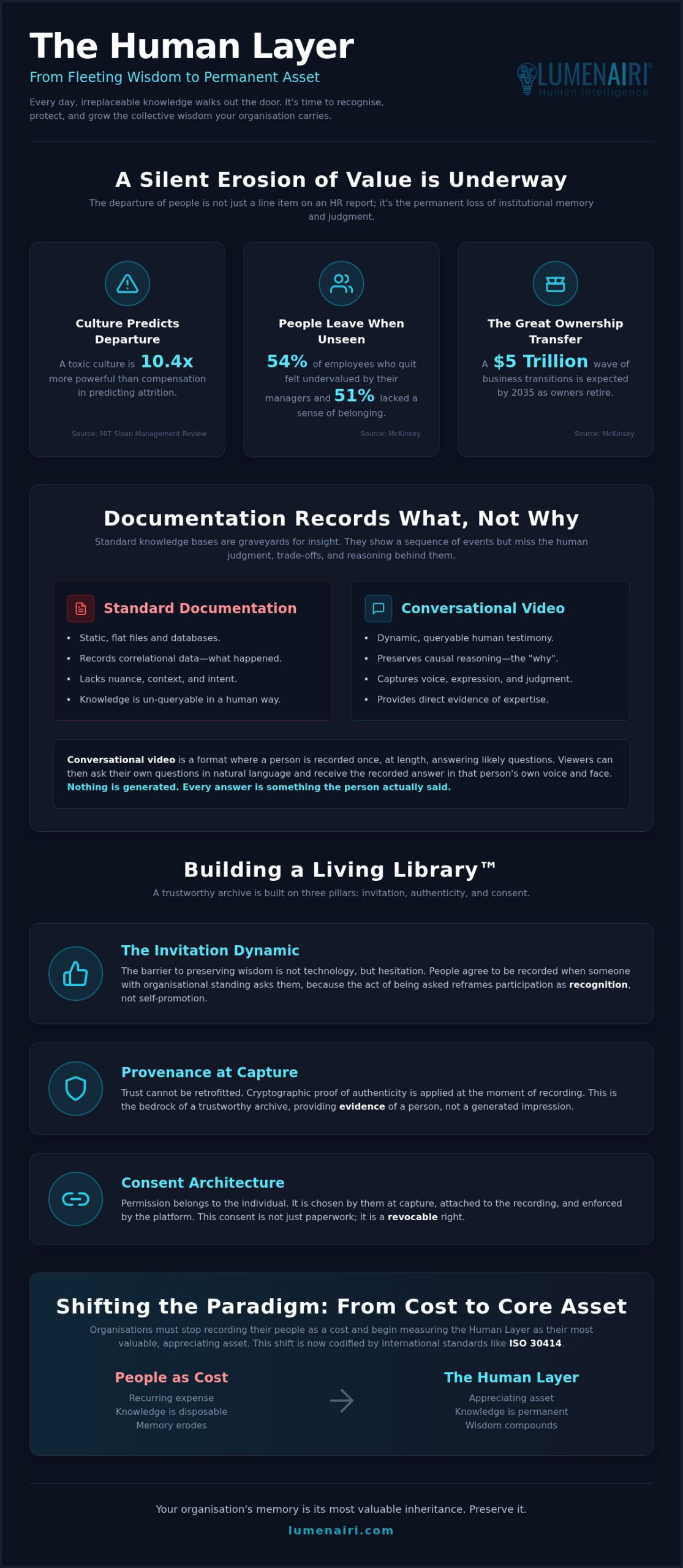
The stakes of this erosion are immense. By 2035, small and medium businesses face a staggering $5 trillion enterprise value transition as founders retire. Without sophisticated knowledge capture tools for enterprises, much of that value will simply evaporate into the ether. This attrition isn’t just about salary. An MIT Sloan study revealed that toxic culture is 10.4 times more powerful than pay in predicting employee departure. When experts feel their lifelong judgement is treated as disposable data, they take their context with them, leaving the next generation to start from zero.
ISO 30414 and the Standardisation of Human Capital
A global shift is underway to rectify this imbalance. Since November 2020, SEC rules have required public companies to disclose material human capital information, treating people as a core driver of value. The arrival of ISO 30414:2025 further codifies this, providing 69 distinct metrics to standardise how we report on the human element. Organisations can now move from vague sentiment to precise measurement. Tools like the Human Layer Index allow leaders to diagnose the health of their collective wisdom. By quantifying this asset, we stop viewing knowledge capture tools for enterprises as mere software and begin seeing them as the guardians of a sacred corporate ancestry.
Why Documentation Fails to Capture Institutional Memory
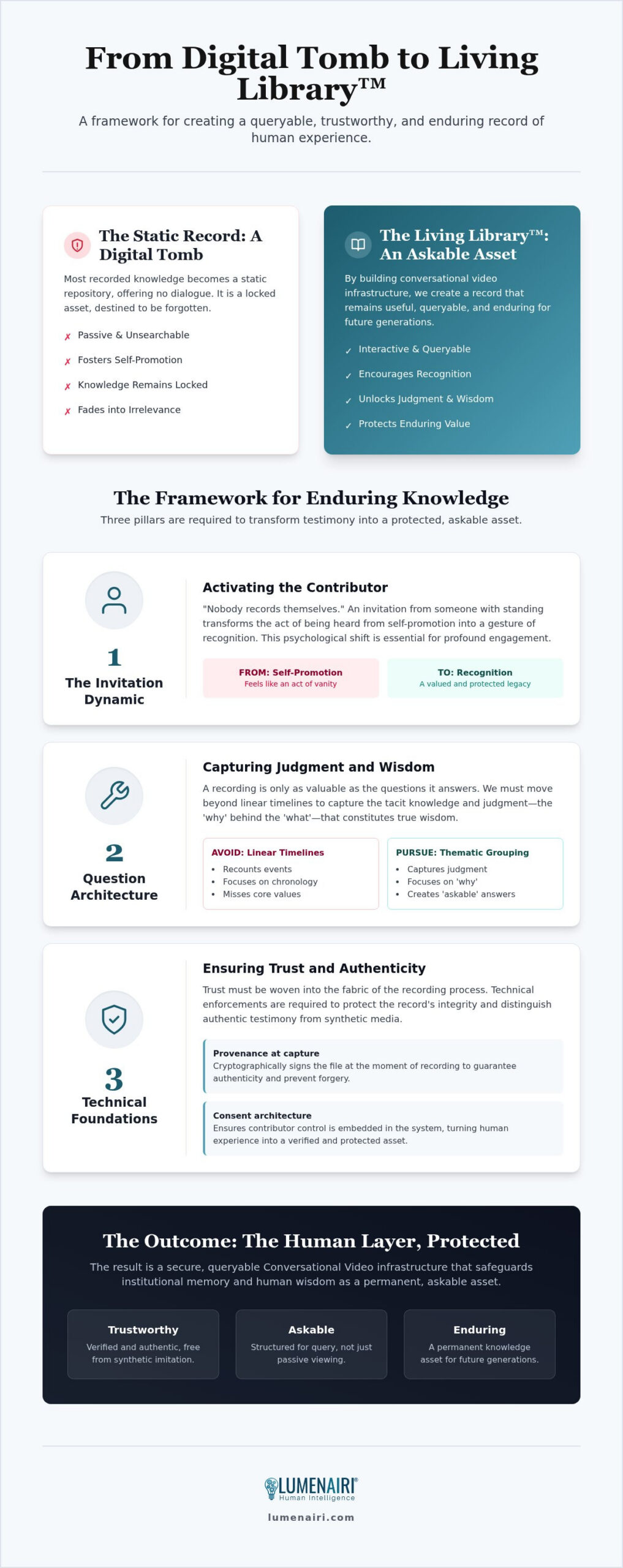
Standard documentation platforms often act as a graveyard for insight. They record that a choice was made, yet the underlying logic, the subtle trade-offs, and the hard-won experience remain locked away. Written logs are correlational. They show the sequence of events but lack the heartbeat of intent. This is why many knowledge capture tools for enterprises fail to stem the tide of attrition. They provide a map but no compass, leaving successors to navigate complex landscapes without the benefit of their predecessor’s judgement.
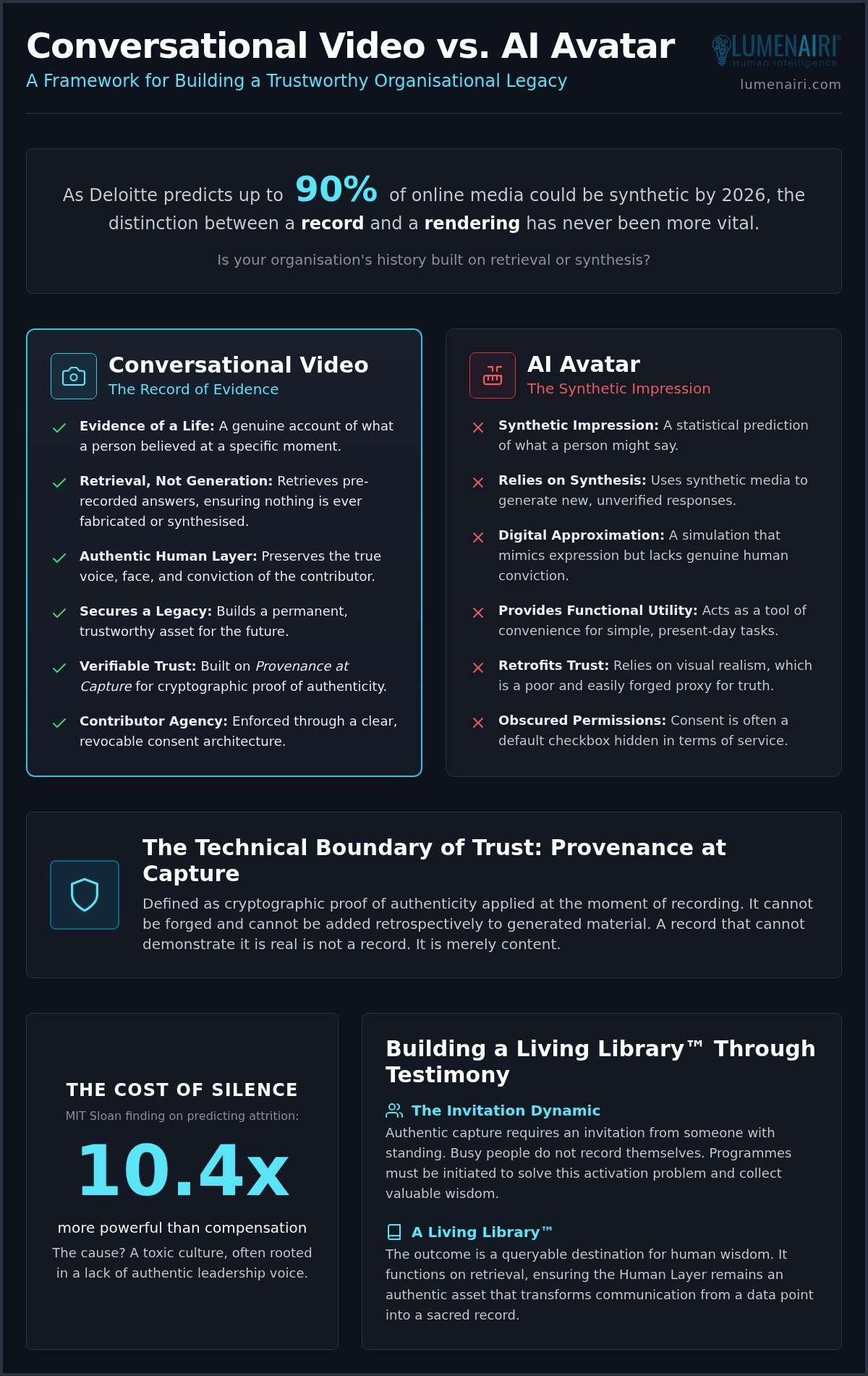
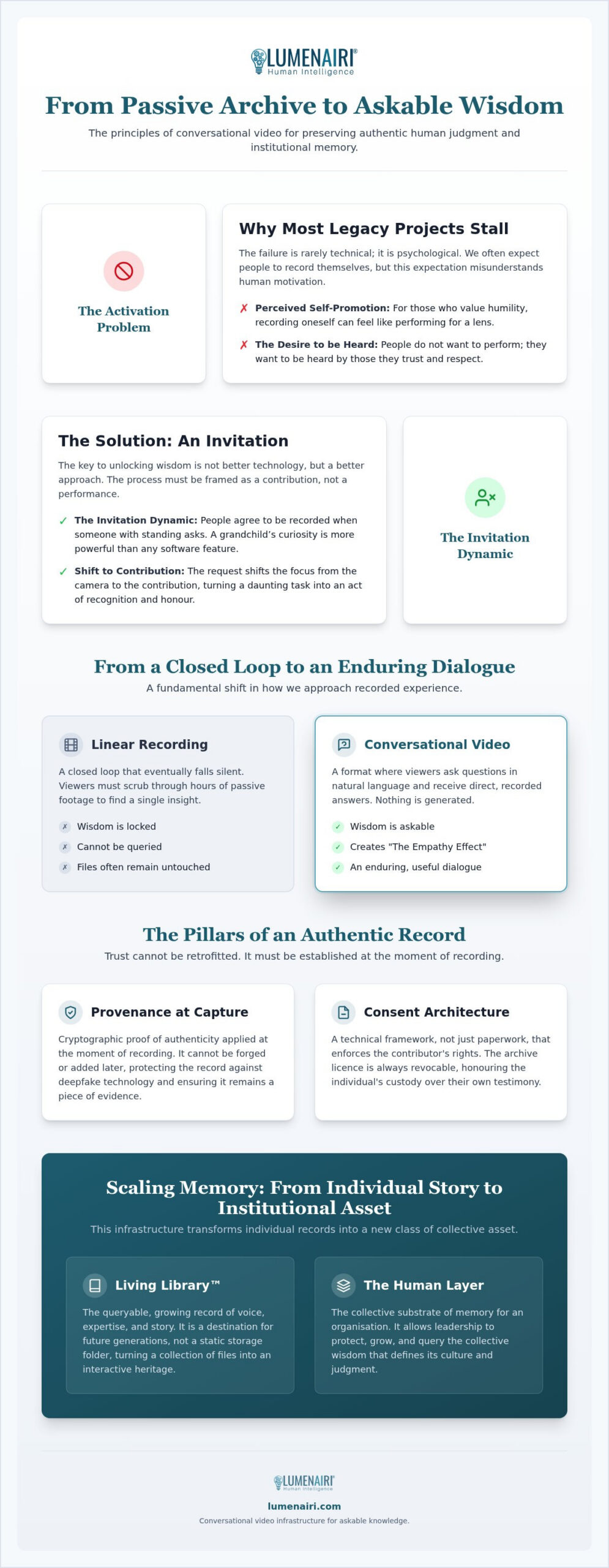
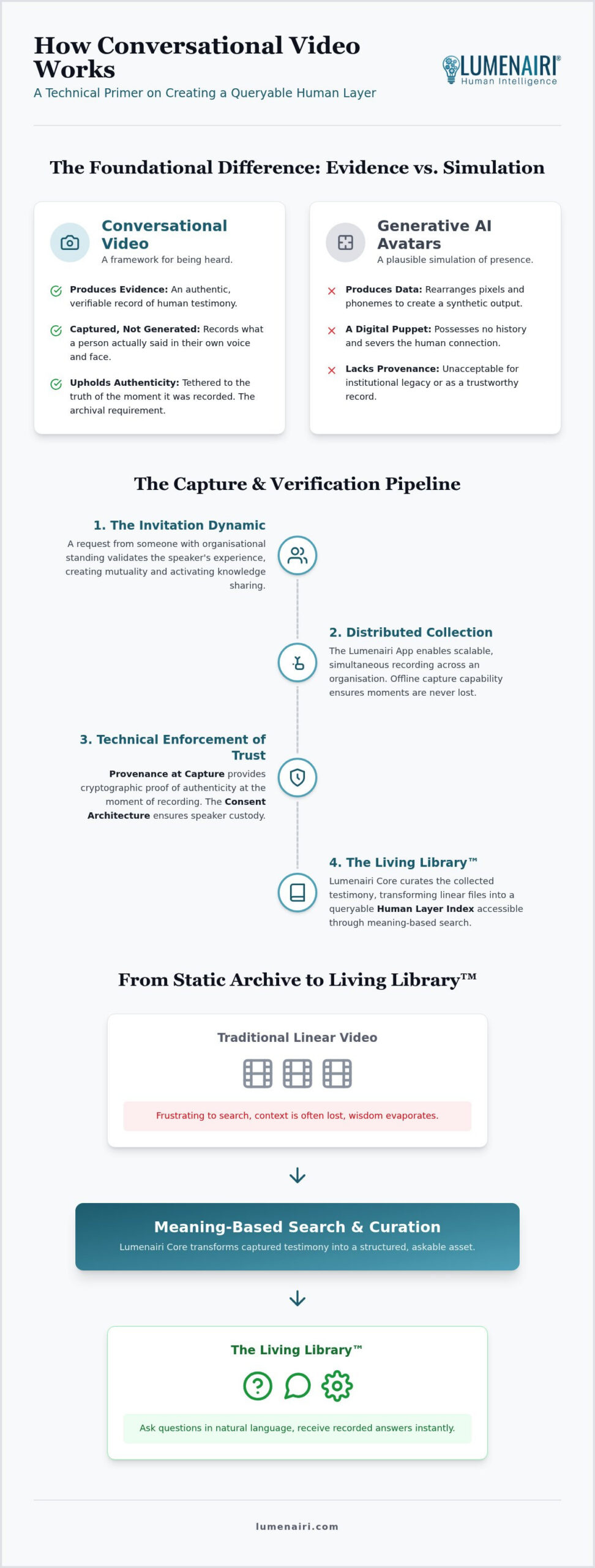
Conversational video offers a profound alternative to these static files. We define this as a format where a person is recorded once, at length, answering likely questions, which then allows future viewers to ask follow-ups in natural language. Unlike synthetic avatars or generative AI, nothing is manufactured in a Lumenairi record. It is a preservation of truth. By hearing a mentor’s actual voice and seeing their expressions, successors experience the “empathy effect”. This transforms a simple transfer of information into a transfer of values, building empathy as a vital skill within the team. You can explore how these human-centric records are built through Founder Heritage initiatives.
The Requirement for Authenticity: Provenance at Capture
Trust cannot be retrofitted to media after the fact. In an era of digital manipulation, we rely on “provenance at capture”. This is cryptographic proof applied at the exact moment of recording to ensure the record remains immutable. While generative AI creates a mere “impression” of a person, conversational video provides “evidence” of their expertise. This distinction is the bedrock of a trustworthy archive. If a record is to last for generations, it must carry the weight of authenticity from its very inception. We do not seek to simulate a person. We seek to protect the evidence of their wisdom.
Solving the Activation Problem: The Invitation Dynamic
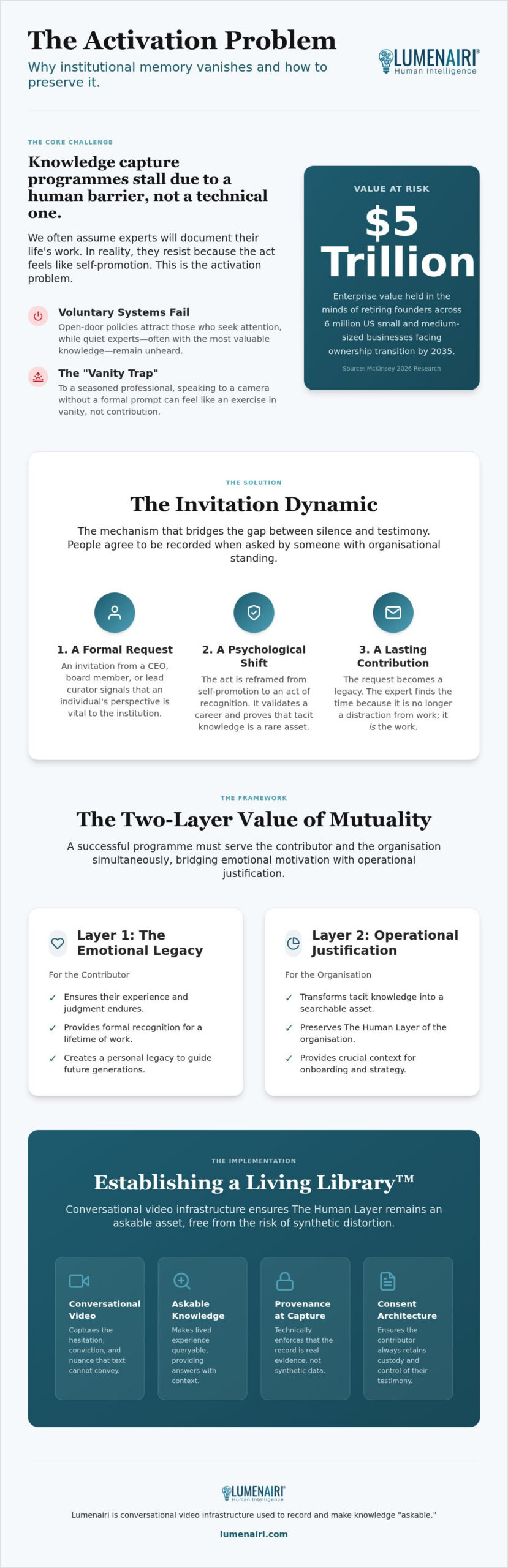
Most initiatives fail before they begin. The primary barrier to preserving wisdom isn’t the cost of hardware or the complexity of software. It’s the human hesitation to speak without being called. We call this the activation problem. While many knowledge capture tools for enterprises focus on the mechanics of storage, they often ignore the silence of an expert who feels self-conscious. True wisdom is frequently humble. It requires a specific catalyst to emerge from the quiet corners of an office.
The invitation dynamic provides this catalyst. It’s the simple, profound act of being asked to share by someone with organisational standing. When a leader invites an expert to record their judgement, the dynamic shifts. Participation is no longer seen as self-promotion. It becomes an act of service. It is recognition. Programmes that rely on “volunteering” usually collapse into a void. Without an authority figure to initiate the request, the most valuable stories remain unsaid. People don’t want to broadcast; they want to be heard.
Implementing a Story-Capture Programme
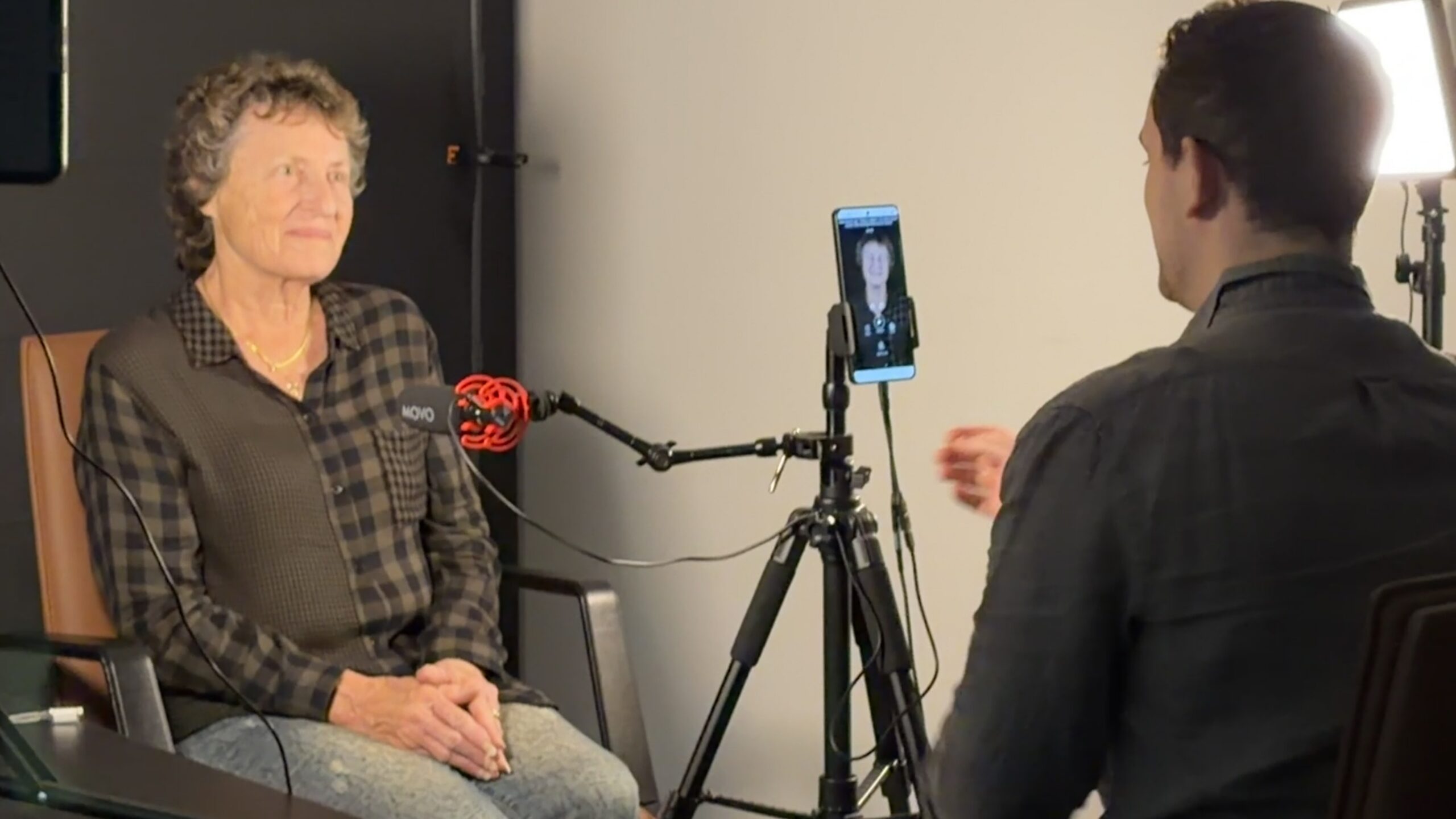
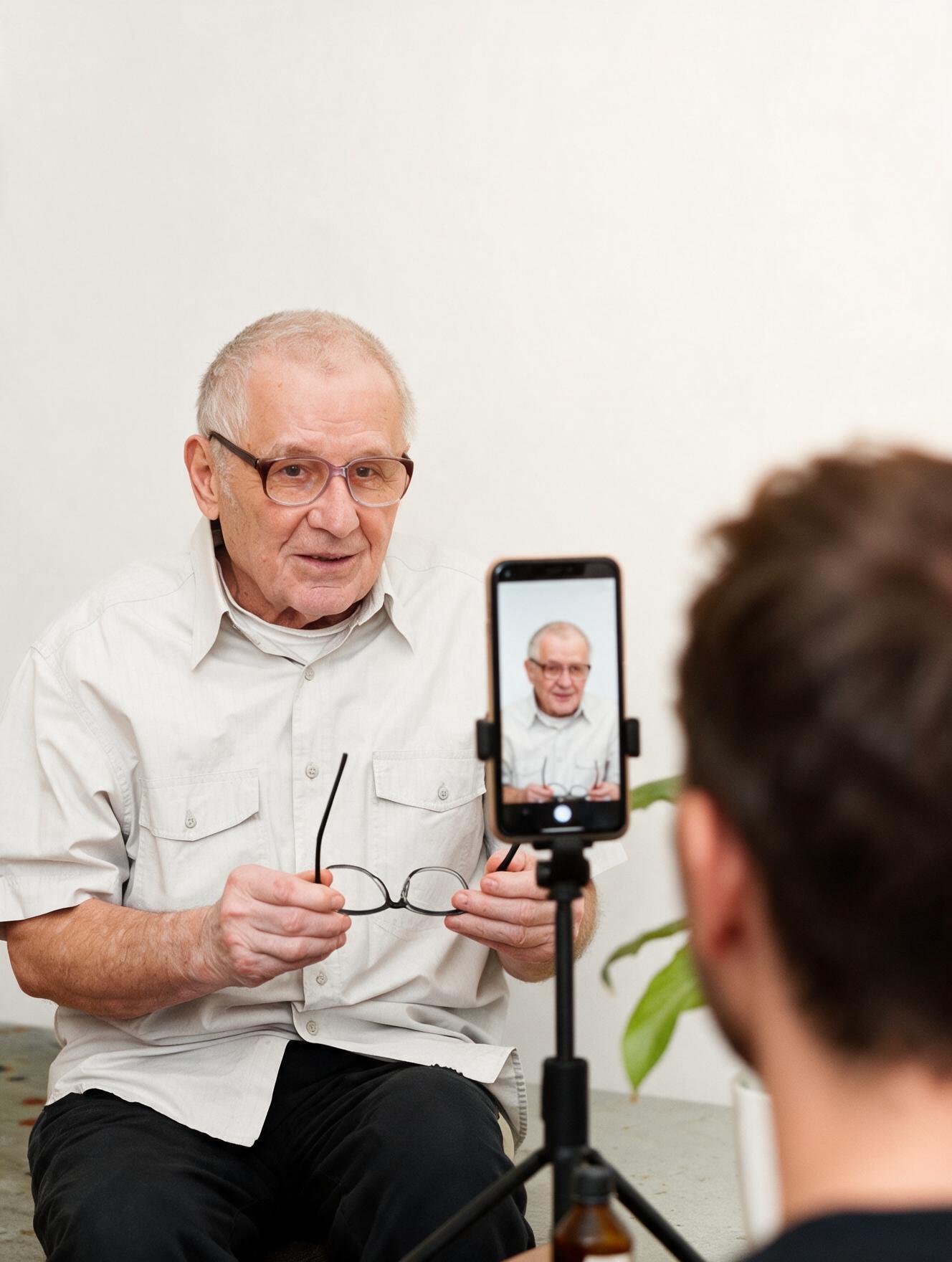
Building a legacy requires a methodical approach. Start by identifying a trigger event, such as a major succession, a company anniversary, or a merger. These moments provide the necessary gravity. Next, ensure an authority figure issues the invitation directly to the participants. This validates their contribution as a sacred asset. Finally, deploy distributed collection using mobile conversational video to capture these insights at scale. This allows the wisdom of the many to be gathered with the same reverence as the wisdom of the few. To begin your journey, you can explore our Enterprise Learning and Development solutions to see how this dynamic transforms culture.
Building a Living Library™ for Long-term Knowledge Retrieval
The Living Library™ stands as the queryable, growing record of voice, expertise, and story produced by conversational video. It is the final destination for the Human Layer™, where fleeting moments are solidified into a collective substrate of wisdom. Knowledge is only truly useful if a successor can ask a specific question years later and receive the actual answer the expert gave in their own voice. This is why modern knowledge capture tools for enterprises must prioritise interactive retrieval over mere static storage. While the Lumenairi App captures these vital moments, Lumenairi Core serves as the essential curation platform. It is here that raw memory is refined, indexed, and transformed into a permanent corporate asset.
Integrity is maintained through a sophisticated consent architecture. Permission is granted at the exact point of capture, travels inherently with the record, and remains fully revocable. This ensures that every individual remains the dignified master of their own narrative and legacy. By anchoring the record in the speaker’s original intent, we protect the archive from the distortions of time or organisational shifts. It is a system built on trust.
The Bridge to Onboarding and L&D
Integrating the process of onboarding new employees with these human records transforms a recruit’s first day into a meaningful encounter with the organisation’s ancestry. New hires no longer just read dry manuals; they hear the founder’s original intent and the senior expert’s nuanced judgement. This represents a profound cultural shift away from impersonal media toward the dignity of being heard. Finally, we must address the concept of custody. For an archive to truly outlast a corporation, it should be mirrored with permanent institutions. This guarantees that the wisdom captured today remains a sacred, accessible resource for future generations, enduring long after the current team has moved on.
Securing the Future of Your Collective Wisdom
The preservation of the Human Layer™ is not merely a technical requirement; it is a profound responsibility toward those who will follow. By moving beyond static documentation and embracing conversational video, you ensure that the “why” behind every decision remains accessible. We’ve explored how the invitation dynamic overcomes the silence of experts, transforming fleeting knowledge into a permanent, queryable record. In an era of rapid attrition, selecting the right knowledge capture tools for enterprises is the difference between a fading memory and a vibrant legacy.
Lumenairi stands as a prestigious guardian of these stories. Our founders hold the first interactive-video patents, and Stephen D. Smith brings 30 years of experience in testimony archives to our mission. We adhere strictly to ISO 30414:2025 standards to ensure your human capital is reported with the dignity it deserves. Discover how Lumenairi helps enterprises protect their Human Layer. Your team’s wisdom is the soul of your organisation. Protect it today to guide the leaders of tomorrow.
Frequently Asked Questions
What is the difference between conversational video and an AI avatar?
Conversational video is a recording of what a person actually said, preserving their real voice and face without any synthetic generation. Unlike AI avatars that create a manufactured impression, this format ensures every answer is evidence of a real human’s judgement. It allows viewers to interact with an authentic record in natural language. This distinction is vital for maintaining truth and trust within a long-term Living Library™.
How does the invitation dynamic help in capturing institutional memory?
The invitation dynamic overcomes the psychological barrier of self-consciousness by reframing participation as a form of recognition. Most experts hesitate to record their own wisdom because it feels like self-promotion. However, when a leader with organisational standing personally asks them to contribute, the act becomes a meaningful contribution to the collective legacy. This ensures that the most valuable institutional memory is captured rather than lost to silence.
Is conversational video content permanent or can contributors withdraw consent?
Consent is an explicit, non-default choice that remains entirely under the control of the contributor. While the goal is to build a permanent asset, our consent architecture ensures that every individual retains a revocable right to withdraw their material. If a contributor chooses to withdraw, access to their recording is removed from the archive. This ensures the Living Library™ remains a respectful and dignified destination for all participants.
What is provenance at capture and why is it necessary for enterprise archives?
Provenance at capture is cryptographic proof of authenticity applied at the exact moment of recording to prevent forgery. In an age of synthetic media, trust cannot be retrofitted to a record after it has been created. By attaching this proof at the source, knowledge capture tools for enterprises provide undeniable evidence that the recording is genuine. This technical assurance is necessary to maintain the long-term integrity of any professional archive.
How does conversational video improve employee onboarding and L&D?
Conversational video transforms onboarding from a dry review of manuals into a profound encounter with an organisation’s heritage. New hires can ask questions and hear the original intent of founders or senior experts in their own voices. This builds the empathy effect, where successors learn not just the “what” but the “why” of corporate culture. It shifts the focus from content creation to a culture of being heard.