
An oral history can be safely stored and still be lost to the questions future researchers will ask. Museums & Archives Solutions must connect trustworthy capture with meaningful discovery, so testimony remains findable and usable beyond the context in which it was first gathered.
Museums and archives already understand the value of consent, provenance and careful interpretation. The challenge is making these principles part of a collection’s whole life, while serving contributors, archivists and future audiences. Testimony must also be treated honestly: as a genuine account of what someone experienced or believed, not automatic proof that every detail is factually accurate.
This article sets out a practical framework for assessing how oral history is recorded, governed and made askable. It considers permissions, authenticity, editorial judgement and discovery, then examines how Lumenairi connects capture with future questioning. The aim is a collection people can return to with new questions, and hear in the contributor’s own words.
Key Takeaways
- Assess Museums & Archives Solutions by how well they connect careful collection care with future discovery.
- Look for consent and provenance decisions made at capture and carried with each recording.
- Evaluate the full workflow, from planning questions and recording through review, organisation and publication.
- Consider whether future audiences can ask questions and receive the contributor’s actual recorded answer.
Museums & Archives Solutions Must Connect Collection Care with Future Use
Testimony that exists but cannot be meaningfully revisited risks becoming present in the archive and absent from public understanding. A collection serves its public when care and future use are designed together. That means respecting contributors, retaining curatorial context, governing permissions and making accounts discoverable when later questions arise.
A considered approach to Museums & Archives Solutions should support these responsibilities as one connected practice. The recording matters, but so does the context that allows an audience to encounter it with care. Oral history methods and preservation are outlined in Oral History: An Overview.
Why oral history needs a usable institutional home
Collecting testimony is only the beginning. Researchers and audiences also need ways to encounter what contributors actually said, in context, when their questions differ from those anticipated at the time of collection. An oral history is a genuine account of a person’s experience and understanding. It can illuminate memory and perspective without, by itself, verifying every historical claim.
What a museum or archive should be able to assess
Four properties offer a practical frame for evaluating a trustworthy record. They are questions for institutional judgement, not promises of perfect accuracy or permanent availability.
- Capture: Is the speaker’s account recorded clearly, with their participation and the circumstances of recording understood?
- Verify: Can the institution establish where the recording came from and distinguish the speaker’s words from later interpretation?
- Preserve: Are the recording, its context and its permissions managed responsibly, with the contributor’s ability to revoke permission respected?
- Understand: Can future audiences find relevant testimony and interpret it alongside the collection’s curatorial context?
Together, these questions help institutions assess whether a collection honours the person who spoke and remains useful to those who come after. Care and discovery belong in the same frame.
Trustworthy Museum Archives Begin with Capture, Consent and Provenance
Trust depends on decisions made at capture, then carried with the recording. A permission form stored elsewhere can become separated from the testimony it governs. Without clear provenance, a file can be difficult to distinguish from material that has been altered or misattributed.
What authenticity and permission mean for recorded testimony
Conversational video: A format in which a person is recorded once, at length, answering the questions they are most likely to be asked, and viewers then ask their own questions in natural language and receive the recorded answer in that person’s own voice and face. Nothing is generated. Every answer is something the person actually said.
Provenance at capture: Cryptographic proof of authenticity applied at the moment of recording, which cannot be forged and cannot be added retrospectively to generated material. This helps establish that a record came from its stated source. It does not prove that every statement in the testimony is factually true. A person’s account remains testimony, to be understood with appropriate historical context.
Consent architecture: Permission chosen by the individual at the moment of capture, attached to the recording, and enforced by the platform rather than by a document held elsewhere. Revocable by the contributor. Permission must be explicit; an organisation cannot assume it, add it retrospectively or widen it beyond what the contributor chose.
How custody differs from ownership
Custody: Holding and operating an archive on behalf of its owner, as distinct from owning it. Implies portability, independent mirroring, and survival independent of any single organisation. These arrangements can support responsible stewardship, while respecting the contributor’s right to revoke permission. Digital preservation also involves deliberate planning and risk awareness, as outlined in Digital Preservation at the National Archives.
These distinctions make trust part of the record itself. They help institutions steward testimony responsibly while keeping ownership, access and contributor choice clear.
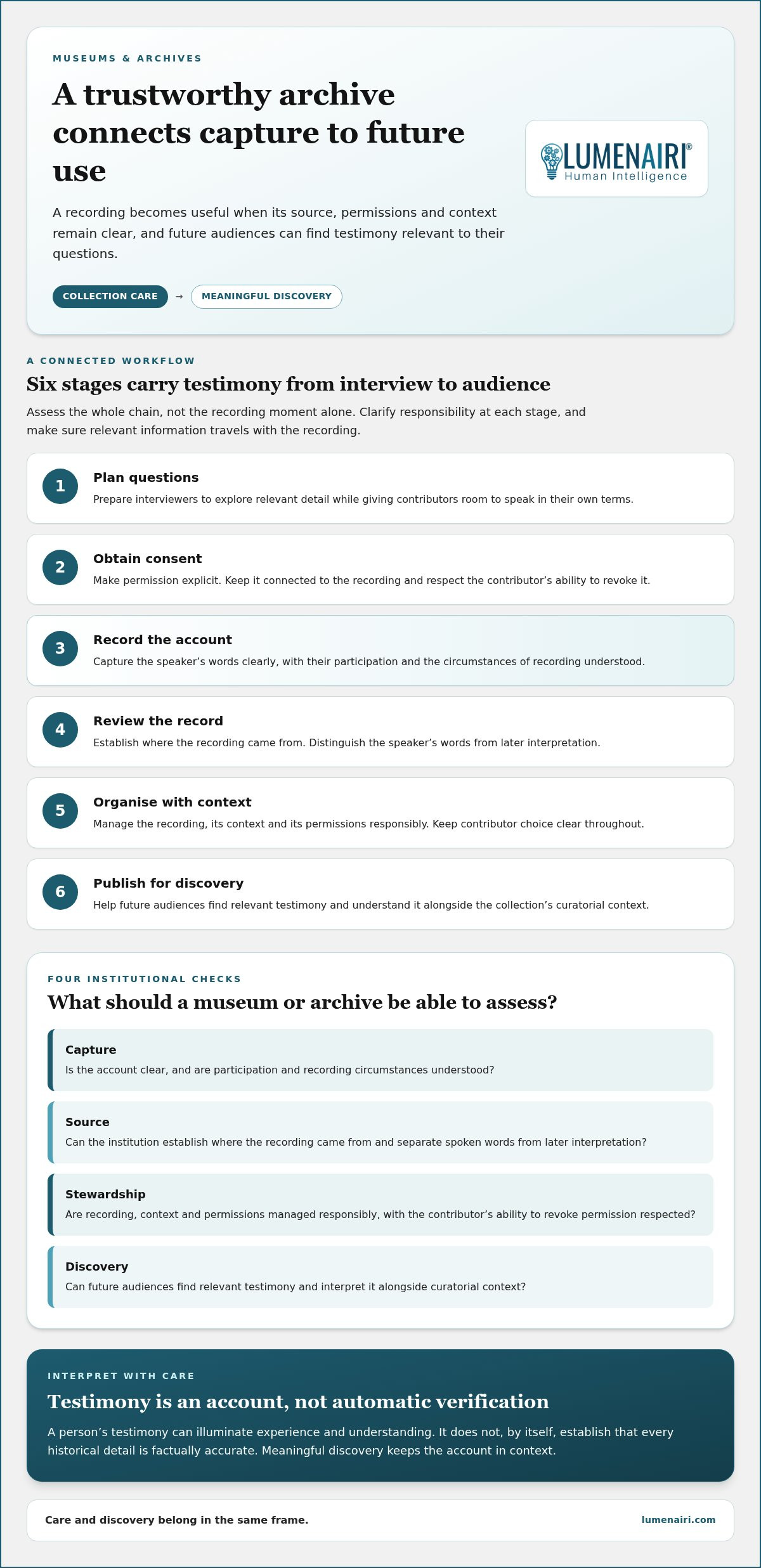
Evaluate Museum Archive Workflows from Mobile Capture to Curated Discovery
Workflow quality depends on linking field capture to deliberate curation. A recording process is only useful if each account can move responsibly from the interview into a collection that people can explore. Assess the whole chain, not the recording moment alone.
A practical sequence is to plan questions, obtain consent, record, review, organise and publish. At each stage, clarify who is responsible and what information must travel with the recording. Planning should give contributors room to speak in their own terms, while leaving interviewers prepared to explore relevant detail.
What distributed capture changes for an institution
Mobile capture can bring interviews closer to contributors, rather than requiring them to travel to a studio. This can support parallel recording across locations. It does not remove the need for trained interviewers, institutional oversight or consistent collection standards. A sound workflow makes those responsibilities clear before recording begins.
The Lumenairi App supports recording on a smartphone. If a recording is made offline, it remains on the device until a connection is available for upload. Institutions can assess whether this supports their field conditions and their process for managing material between capture and review.
How editorial control and discovery should work
After recording, editorial judgement gives testimony its context. Lumenairi Core supports reviewing, editing, managing and publishing recordings. Collections can organise material thematically, while Channels group material for viewers. Together, these steps help institutions shape access without treating testimony as detached from its source.
Discovery should let audiences ask questions in their own words and reach relevant recorded answers. This is the work of conversational video: retrieval brings forward what the contributor actually said; it does not generate new speech. The distinction matters. Future audiences need access to testimony, and institutions need confidence that the answer remains the speaker’s own.
To explore how this workflow can support your collection, consider Lumenairi for museum and archive testimony.
Lumenairi Connects Museum Testimony to Questions Asked Later
Capture matters when a later question can reach the contributor’s actual recorded answer. The knowledge held in testimony is useful to future audiences when it can be found and heard in the speaker’s own words, with permission and context intact.
The Lumenairi App captures recordings, and Lumenairi Core supports their review, editing, management and publication. Together, they provide a path from recording to a queryable collection. The Living Library™ is the destination: a growing record people can question as new interests and historical questions emerge.
A practical decision frame for cultural institutions
Before shaping a programme, leaders should resolve four matters: what purpose the collection serves, what contributors permit, how curatorial review will work, and how audiences will encounter the testimony. These decisions guide the collection from its first interview to later discovery. Where testimony also carries institutional memory, it may inform how an organisation shares its history with new members.
Questions asked later require words actually spoken, recorded at length and with consent. Conversational video makes those answers available through natural-language questions; Lumenairi provides the infrastructure for that capture and later questioning.
Glossary of conversational video terms
Conversational video: A format in which a person is recorded once, at length, answering the questions they are most likely to be asked, and viewers then ask their own questions in natural language and receive the recorded answer in that person’s own voice and face. Nothing is generated. Every answer is something the person actually said.
Provenance at capture: Cryptographic proof of authenticity applied at the moment of recording, which cannot be forged and cannot be added retrospectively to generated material.
Consent architecture: Permission chosen by the individual at the moment of capture, attached to the recording, and enforced by the platform rather than by a document held elsewhere. Revocable by the contributor.
Living Library™: The queryable, growing record of voice, expertise and story that conversational video produces. A destination, not a feature.
Explore Museums & Archives Solutions to consider how this approach may serve your institution’s work of collecting, caring for and sharing testimony.
Let Future Questions Shape the Collection Today
The questions a collection can answer tomorrow depend on the choices an institution makes before recording begins. Decide what future audiences should be able to discover, how contributors will remain in control of their testimony, and how curatorial judgement will guide its presentation. These choices give each account a place within a living body of cultural memory.
Museums & Archives Solutions should make responsible access part of the collection’s design. The Lumenairi App captures; Core curates. Consent gating, offline recording and organisational visibility controls support a governed path from contribution to discovery, while respecting the institution’s role in deciding how material is reviewed and shared.
The work reaches beyond any single publication. A person’s recorded words may speak to questions no one thought to ask at the time of capture. Giving those words a considered route to future audiences is an act of stewardship, and a way to ensure contributors are heard on terms they chose.
Explore Lumenairi’s museum and archive solutions and consider how your institution can prepare its testimony for the questions still to come.
Frequently Asked Questions
Can a museum record oral histories without an internet connection?
Yes. The Lumenairi App can record offline; files remain on the device and upload when a connection becomes available. For Museums & Archives Solutions, this can support interviews in field sites or venues with unreliable reception, while teams plan how to check transfer and review recordings afterwards. Offline capture doesn’t remove consent requirements or replace institutional review.
Can an archive edit a transcript without changing what a person said?
Yes. Editors can correct transcript errors, such as a misheard place name, while leaving the spoken recording unchanged. Comparing an uncertain phrase with the audio can help improve the transcript as an access aid, but editorial corrections don’t establish whether a recollection is historically accurate; keep the distinction between the transcript and the testimony clear.
Can a museum control whether its recordings are public or private?
Yes. Organisational instances can set content visibility to public or private, allowing an institution to limit access while material is under review or share approved recordings with audiences. These settings govern institutional visibility; they don’t grant permission on a contributor’s behalf, expand the scope they chose or remove their right to revoke it. Align access decisions with each contributor’s permission.
Does conversational video prove that testimony is historically true?
No. Provenance can help establish that a recording is authentic, and conversational video returns words the person actually spoke, but neither establishes the factual accuracy of every recollection. Testimony may faithfully convey what a contributor experienced or believed while differing from other evidence, so archives should preserve that distinction in descriptions, interpretation and research use.
Leave a Reply
You must be logged in to post a comment.