

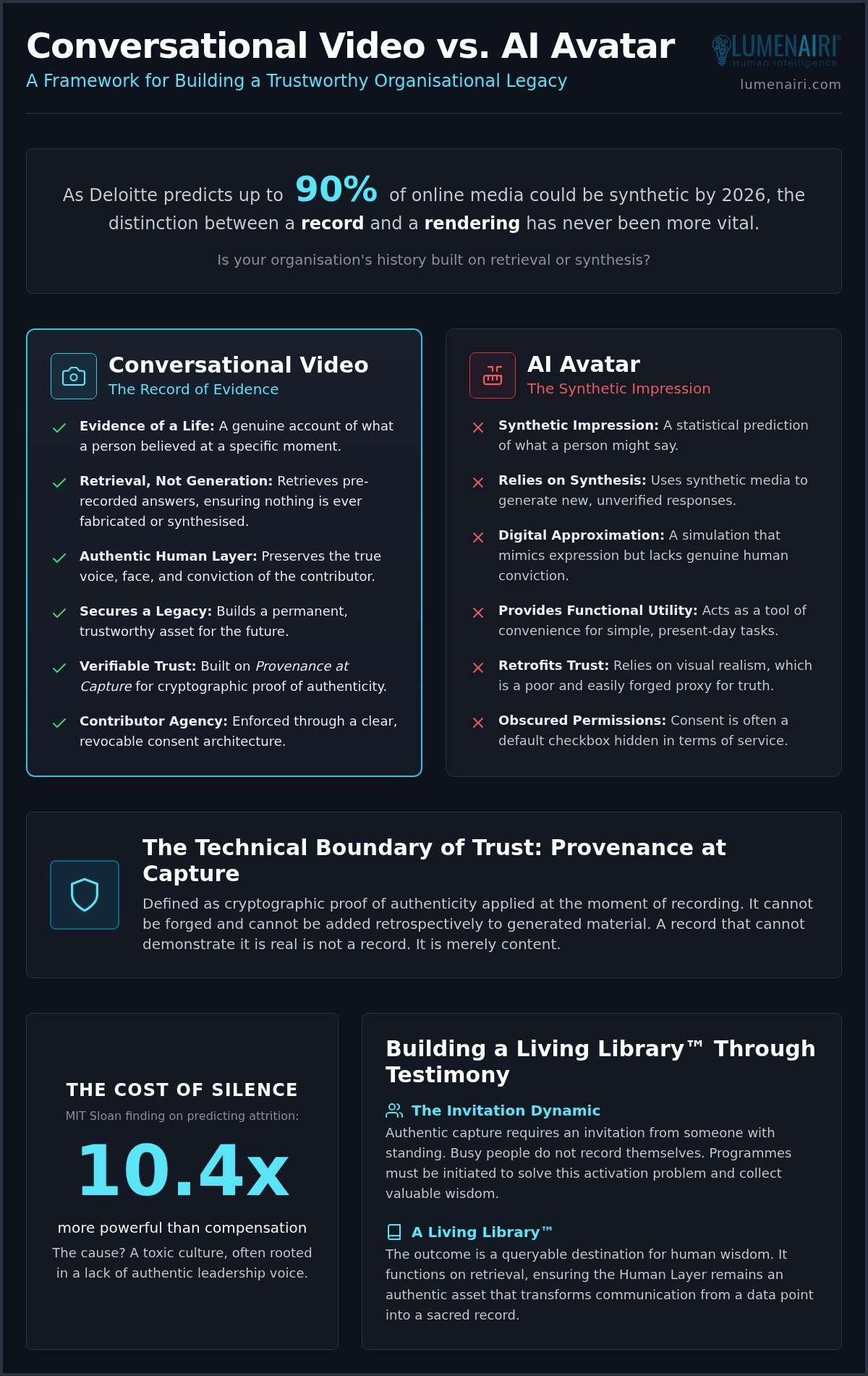
An avatar can mimic your voice. It cannot possess your soul. As we approach a future where Deloitte predicts up to 90% of online media could be synthetic by 2026, the distinction between a record and a rendering has never been more vital. You likely feel the tension of this moment. There is a desire to scale leadership and preserve wisdom. There is also a deep-seated fear that deepfakes are eroding the foundation of institutional trust. This essay provides a clear framework for navigating the choice of conversational video vs AI avatar to ensure your organisation’s legacy remains a trustworthy asset.
You’ll understand how to bridge the gap between busy leaders and the archives they must leave behind. We will explore why the Human Layer requires provenance at capture to survive the shift from simple data to living history. By the end, you will have the confidence to build a foundation of recorded evidence that no algorithm can fabricate. We are moving beyond the era of mere information to a time when being heard is a sacred responsibility.
Key Takeaways
- Recognise the vital distinction between conversational video vs AI avatar to ensure your organisation’s history is built on retrieval rather than synthesis.
- Implement provenance at capture as a technical enforcement of trust, providing cryptographic proof that a record is genuine and unmanipulated.
- Use a clear framework to evaluate institutional knowledge needs, focusing on the human significance of being heard rather than the mere production of data.
- Learn how to scale the collection of authentic wisdom to create a Living Library™ that serves as a trustworthy foundation for your organisational legacy.
Is the record an evidence of a life or a synthetic impression?
Thirty years in the field of testimony teaches one fundamental truth. A record is either a witness or a ghost. When we consider the debate of conversational video vs AI avatar, we are choosing between evidence and an impression. Conversational video is a format in which a person is recorded once answering the questions they are most likely to be asked, and viewers then ask their own questions in natural language and receive the recorded answer in that person’s own voice and face. Nothing is generated. This stands in sharp contrast to AI avatars. These systems rely on Synthetic media to predict what a person might say. For those of us guarding the gates of memory, generated material is not acceptable in an archive, whatever its production quality.
The distinction between utility and evidence
Utility serves the present. Evidence serves the future. An AI avatar provides functional support, acting as a 24/7 concierge for simple tasks. It is a tool of convenience. It is not a historical record. We value testimony because it is a genuine account of what a person believed. It is a specific moment of human conviction. Museums and heritage organisations must recognise that a statistical prediction of speech can never replace the weight of a lived experience.
Why nothing is generated in a Living Library™
The Living Library™ functions as a queryable destination for human wisdom. It does not manufacture responses. It retrieves them. This technical choice ensures the Human Layer remains an authentic asset rather than a digital approximation. When weighing conversational video vs AI avatar for such a repository, we must prioritise the integrity of the person being heard. This approach transforms communication from a data point into a sacred asset that carries the true voice of the contributor into the future.
Why provenance at capture is the technical boundary of trust
Trust is not a feeling. It is a technical enforcement. In the debate of conversational video vs AI avatar, the deciding factor is provenance at capture. This is defined as “cryptographic proof of authenticity applied at the moment of recording, which cannot be forged and cannot be added retrospectively to generated material.” Without this, a record that cannot demonstrate it is real is not a record. It is merely content. To move from data to legacy, a record must possess four properties: Capture, Verify, Preserve, and Understand. Research into Provenance for Trustworthy Digital Media confirms that establishing this chain of custody early is essential for long-term integrity.
Cryptographic proof vs. visual realism
Visual realism is a poor proxy for truth. We live in an era where synthetic media can mimic every micro-expression and vocal inflection. If trust is retrofitted after the fact, it is already lost. Provenance at capture ensures the evidence is baked into the file from its inception. It creates a technical boundary that separates the authentic Human Layer from a generated impression. This prevents the erosion of trust that occurs when viewers cannot distinguish between a witness and a simulation. It is the difference between a verified account and a digital puppet.
The requirement of revocable consent
True authority requires consent architecture. Permissions must be an explicit act. They should never be a default checkbox hidden in a long list of terms. We employ a comprehension test: the consent structure must be explainable in one sentence. This ensures that the person being heard retains control. Their archive licence is always revocable. This is the foundation of trustworthy memory management. You can explore how these technical enforcements protect your organisational legacy through authentic capture. By prioritising the contributor’s agency, we ensure the record remains a sacred asset.
A checklist for the sceptical decision-maker
Leaders must ask if they are building a facade or a foundation. When choosing between conversational video vs AI avatar, the primary question is whether you seek to simulate a presence or secure a legacy. The MIT Sloan finding that toxic culture is 10.4 times more powerful than compensation in predicting attrition underscores the cost of institutional silence. To preserve the Human Layer, we must solve the “activation problem.” Busy people don’t record themselves. Success requires the invitation dynamic, where a programme is initiated by someone with standing. This moves the focus from the noise of digital manufacturing to the profound act of being heard.
Evaluating the trigger event
Timing is an architectural decision. With 6 million US small businesses facing transition by 2035, the need for authentic knowledge transfer is urgent. Triggers like succession, anniversaries, or ownership transitions provide the operational justification for these programmes. However, the emotional motivation remains the preservation of truth. Leaders must consult expert insights on synthetic media policy to understand the risks of using generated substitutes during these critical windows. A transition without testimony is a loss of institutional soul.
The Human Layer Index as a diagnostic
We use the Human Layer Index to measure the health of institutional memory. It is a diagnostic across six paired dimensions, not an engagement survey. It reveals the level of Mutuality, which is the degree to which an organisation and its people recognise their shared responsibility toward the future. This diagnostic helps you decide if your organisation requires the functional utility of a bot or the enduring weight of recorded testimony. You can strengthen your enterprise leadership strategy by identifying these gaps before the wisdom leaves the building. By prioritising authenticity, you ensure the record remains a sacred asset.
Building a Living Library™ through recorded testimony
The necessity of capturing what people actually say is the only way to build a queryable record that carries the weight of a person’s own voice and face; this is why Lumenairi provides the infrastructure for a Living Library™. In the decision between conversational video vs AI avatar, we choose the path of the witness. We select the record that exists. We reject the one that is merely calculated. This choice defines whether an organisation remembers or merely simulates. This transcends data management. It is the preservation of the soul.
The App captures; Core curates
The Mobile conversational video pipeline allows wisdom to be secured wherever it lives. Using the Lumenairi Mobile App, contributors respond to an invitation directly from their smartphone. This enables parallel capture at scale. It removes the logistical barriers of legacy recording methods. Once captured, these records flow into Lumenairi Core for curation and distribution. We advocate for mirrored deposits with Museums Archives. This ensures Custody remains a shared responsibility. It creates a technical safety net for institutional memory that survives leadership changes.
The future of institutional memory
The future of institutional memory relies on The empathy effect. This is a profound biological response to a real person. In Enterprise environments, this connection is the catalyst for genuine cultural alignment. As we navigate the complexities of 2026, the preservation of human experience has become an urgent responsibility. We must recognise the Human Layer as a measurable asset class. It is the most valuable substrate of any organisation. It requires a foundation of truth. It deserves to be heard. If we fail to capture these stories now, we leave the future to be written by algorithms.
Securing the authentic Human Layer
The choice between conversational video vs AI avatar is a choice between a verifiable history and a digital facade. By choosing retrieval over synthesis, you ensure that the Human Layer of your organisation remains a measurable and protected asset class. This commitment to truth is supported by the ISO 30414:2025 standard for human capital reporting. It treats human wisdom as a critical resource requiring authentic stewardship. Our work is founded by pioneers who recognise that trust must be technical rather than just conceptual.
Cryptographic provenance applied at capture provides the certainty that every witness in your archive is genuine. You now have the opportunity to secure the voices of your leaders before they are lost to transition or retirement. Discover how to build your organisation’s Living Library™ to ensure your legacy remains untarnished. It’s a privilege to help you protect the stories that define your future. The foundation you build today will carry the weight of your history for generations to come.
Frequently Asked Questions
What is the difference between conversational video and a synthetic AI avatar?
Conversational video is a format in which a person is recorded once answering the questions they are most likely to be asked, and viewers then ask their own questions in natural language and receive the recorded answer in that person’s own voice and face. Nothing is generated. In the comparison of conversational video vs AI avatar, the distinction is authenticity. Avatars rely on synthetic media to predict speech, while we retrieve actual testimony.
Why is provenance at capture necessary for an oral history archive?
Provenance at capture is the cryptographic proof of authenticity applied at the moment of recording, which cannot be forged and cannot be added retrospectively to generated material. It is necessary because trust cannot be retrofitted to a record after it is held. For oral history to function as evidence, it must demonstrate a verified chain of custody. This technical boundary ensures that the Human Layer remains a trustworthy and measurable asset.
Can a contributor withdraw their consent after a recording is published?
Yes, contributors retain a permanent right to withdraw their consent through our consent architecture. Permissions are an explicit act, never a default checkbox in a terms‑of‑service agreement. If a contributor decides to revoke their licence, the platform removes the material from access. This ensures that being heard remains a chosen experience and that the contributor stays in control of their own story, even after the recording has been processed and published.
What is the invitation dynamic and why is it required for participation?
The invitation dynamic is the observation that people agree to be recorded when someone with organisational standing asks them. Most people don’t record themselves because they view it as self‑promotion. When a leader or curator extends a formal invitation, it transforms the process into an act of recognition. This is required to solve the activation problem, ensuring that institutional knowledge is captured systematically during critical triggers like leadership succession.
Is conversational video more expensive to produce than an AI avatar?
We don’t disclose specific cost comparisons, but the value of conversational video vs AI avatar is found in the integrity of the record. Synthetic media prioritises functional utility, whereas conversational video focuses on building a queryable record that carries the weight of a person’s actual voice. The investment creates a Living Library™ that serves as a trustworthy foundation for legacy. This ensures that the record stays useful long after the initial conversation ends.