

The Invisible Deficit: Why Traditional Metrics Fail to Capture Human Value
Every organisation possesses an asset not found on any balance sheet. Each morning, its people commit their waking hours, bringing their skills, experience, and insights to make the business work. They are different from spreadsheets and productivity goals. It is the combined effort and expertise of the entire team that creates success. This is the Human Layer, and it is the most valuable asset a company has, yet it is often the most poorly understood.
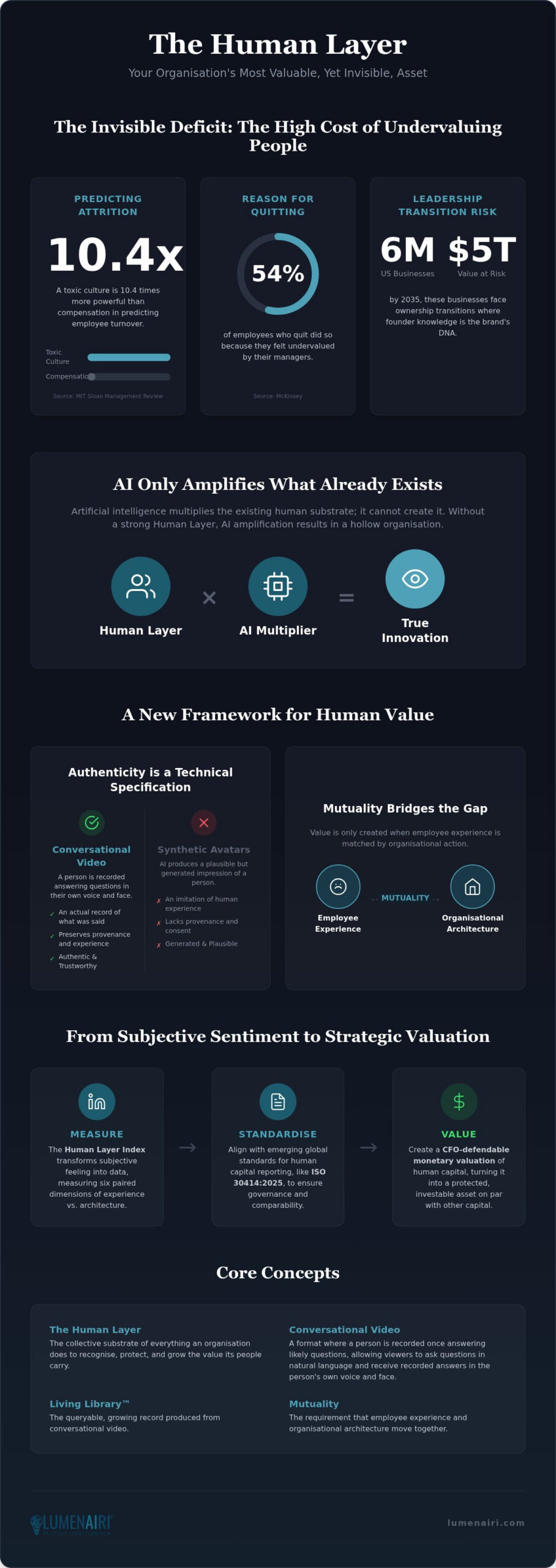
Organisations frequently treat people as a cost to be managed rather than a substrate to be grown. This perspective is not only a moral failure but a significant financial risk. Research from the MIT Sloan Management Review (January 2022) found that a toxic corporate culture is 10.4 times more powerful than compensation in predicting attrition. Similarly, a McKinsey study revealed that 54% of employees who quit did so because they felt undervalued by their managers. The failure to recognise human value creates a hidden deficit on the balance sheet.
The Cost of Blindness in Leadership Transitions
This deficit becomes painfully visible during periods of change. In the United States, around six million small and medium-sized businesses face ownership transitions by 2035, risking up to $5 trillion in enterprise value. For these organisations, the founder’s knowledge is the brand’s DNA. Research shows that over half of these owners prioritise preserving their legacy and values above purely financial considerations. Yet, traditional documentation—manuals, process charts, and exit interviews—consistently fails to capture the judgement behind the brand. It records the what, but never the why.
Why AI Amplification Requires a Human Substrate
Some leaders believe technology will solve the problem of knowledge transfer. This is a fundamental misunderstanding of its function. Artificial intelligence only multiplies the existing Human Layer; it does not create it. AI has read everything we have published, but it has never met us. It can analyse data, but it cannot replicate the wisdom, intuition, and lived experience that form the basis of sound judgement. Without a strong human substrate to draw upon, AI amplification results in a hollow organisation, capable of imitation but not innovation.
Defining the Human Layer as a Strategic Asset Class
To protect this value, we must first define it. The Human Layer is the collective substrate of everything an organisation does to recognise, protect, and grow the value its people carry. It is not a programme, an HR initiative, or an employee engagement scheme. It is a distinct and measurable asset class. Central to this concept is Mutuality: the requirement that employee experience and organisational architecture move together. The Human Layer is the foundation upon which all organisational success is built.
Recognising Value vs. Managing Personnel
Traditional Human Resources focuses on managing personnel through compliance, payroll, and process. The Human Layer framework focuses on recognising value. Consider the onboarding of a new team member. A company may spend months searching for the best possible candidate, yet their first days are often dominated by compliance training. Little is done to learn about the company’s history and values, and almost no one asks the new hire about themselves, their story, or the unique expertise they bring. Imagine an onboarding that included the new hire sharing what they bring to the company. That experience builds connection and affirms value from day one. This is the shift from managing a resource to investing in an asset.
Authenticity as a Technical Specification
For the Human Layer to be a trustworthy asset, authenticity is a technical requirement, not a preference. This is where the medium of capture becomes critical. We use conversational video, a format where a person is recorded once answering likely questions, allowing viewers to ask questions in natural language and receive recorded answers in the person’s own voice and face. This method preserves what was actually said. It stands in direct contrast to synthetic avatars, which use AI to produce only plausible impressions of a person. One is a record of human experience; the other is an imitation of it.
Measuring Value Through the Human Layer Index and ISO 30414:2025
For decades, leaders have struggled to quantify the value of their people. It has been relegated to the realm of sentiment, making it difficult to defend as a strategic investment in the boardroom. To treat the Human Layer as an asset class, it must be measured with the same rigour as any other capital asset. The Human Layer Index is a diagnostic tool that measures six paired dimensions of employee experience against organisational architecture. This measurement transforms subjective feeling into a CFO-defendable monetary valuation of human capital. Measurement is the first step toward treating the Human Layer as an investable asset.
The Shift Toward Human Capital Disclosure
Regulators and standards bodies are already moving in this direction. In the US, the SEC has required human-capital disclosure since November 2020. Globally, ISO 30414:2025 is emerging as the international standard for human capital reporting. These developments signal a crucial shift. Senior leaders must move beyond simplistic engagement surveys, which measure fleeting satisfaction, toward rigorous diagnostics that assess the underlying value and risk within their organisation’s Human Layer. This is no longer a matter of good practice; it is a matter of governance.
Mutuality: Bridging the Experience-Architecture Gap
Value is only created when employee experience is matched by organisational action. An organisation that claims to value its people but lacks the architecture to recognise, protect, and grow their contributions will see that value erode. The Human Layer Index is designed to identify these misalignments—the gaps between what is said and what is done. By measuring both experience and architecture, leaders can make targeted investments that create genuine Mutuality and build a more resilient and valuable Human Layer. This is the work of modern leadership in any large enterprise.
Building the Living Library™: Preserving the Human Substrate
Once measured, the Human Layer must be preserved. A Living Library™ is the queryable, growing record of voice, expertise, and story produced by conversational video. It is a destination where institutional memory resides, not a feature of a software platform. What if you could have a conversation with your CEO on the day you start? What if you could meet the now-retired founder and learn about her journey and the DNA of the company? The Living Library™ makes this possible, creating a place to learn from the past, connect with colleagues in the present, and feel the value of being seen and heard. The Living Library™ ensures the Human Layer remains useful long after the conversation ends.
The Invitation Dynamic and the Activation Problem
Capturing this knowledge is not a technological problem; it is a human one. Experience shows that nobody records themselves. Without a clear reason, the act of recording feels like self-promotion. Participation requires an invitation from someone with organisational standing—a CEO, a director, a senior manager. This “invitation dynamic” reframes the act of being recorded. It is no longer self-promotion; it is an act of recognition. This is crucial for preserving the legacy of founders and key experts whose wisdom is essential to the organisation’s future. For examples, see our work on Founder Heritage.
Provenance at Capture and Consent Architecture
A trustworthy archive must be built on a foundation of verifiable authenticity and explicit consent. By early 2026, an estimated 5.7 billion people will be producing unverified material on social media. An institutional archive cannot follow this model. It requires provenance at capture—cryptographic proof of authenticity applied at the moment of recording. It also demands a robust consent architecture, enforced by the platform and always revocable by the contributor. These are not optional features. They are the minimum technical specifications for creating a lasting and ethical record of human knowledge for any institution, from a corporation to museums and archives.
Frequently Asked Questions
What is the Human Layer in an organisational context?
The Human Layer is the collective substrate of everything an organisation does to recognise, protect, and grow the value its people carry. It is treated as a measurable, investable asset class, not an HR programme.
How does conversational video differ from AI-generated avatars?
Conversational video retrieves answers a person has actually recorded in their own voice and face. AI-generated avatars produce synthetic, plausible impressions of what a person might have said. One is a record of evidence; the other is not.
Why is ISO 30414:2025 important for human capital reporting?
ISO 30414:2025 is the international standard for human capital reporting. It provides a consistent framework for organisations to measure and disclose the value of their people, moving beyond traditional financial metrics.
What is the difference between custody and ownership of an archive?
Ownership refers to who holds the legal title to the archived material. Custody refers to the responsibility of holding and operating the archive on behalf of the owner, implying portability and survival independent of any single organisation.
How does the invitation dynamic solve the problem of knowledge capture?
The invitation dynamic reframes the act of recording from self-promotion into an act of organisational recognition. When a person with standing asks someone to share their story or expertise, it activates participation where self-directed programmes often fail.
Glossary
Conversational video
A format where a person is recorded once answering likely questions, allowing viewers to ask questions in natural language and receive recorded answers in the person’s own voice and face. Nothing is generated.
Human Layer
The collective substrate of everything an organisation does to recognise, protect, and grow the value its people carry.
Human Layer Index
A diagnostic tool that measures six paired dimensions of employee experience against organisational architecture to produce a monetary valuation of human capital. It is never called the Human Capital Index.
Living Library™
The queryable, growing record of voice, expertise, and story produced by conversational video. It is a destination, not a feature.
Mutuality
The requirement that employee experience and organisational architecture move together to create and sustain value.
Read more about our approach in our sibling article: The Lumenairi Mobile App: Creating a Living Library of Human Wisdom.