
A museum oral-history archive earns trust before recording and usefulness after it. Archiving oral histories in museums means making decisions about consent, authenticity and access before a testimony enters the collection. A digital asset management system can organise files while leaving permissions unclear or difficult to enforce. Metadata can describe a recording while leaving its meaning and context out of reach.
Museums already understand that preservation depends on sound archival practice. The challenge is to carry that care through the whole life of a testimony, from the contributor’s choices at capture to the questions a researcher may ask years later. This article offers a practical framework for evaluating those decisions. It examines how recordings are captured and verified, how permission is governed, how files are preserved, and how testimony can be made discoverable beyond a catalogue search. The aim is a collection that respects the person who spoke and serves the people who will listen later.
Key Takeaways
- Evaluate archiving oral histories in museums as a whole-record process, not simply a way to organise files.
- Set contributor permissions at the point of recording, attach them to the testimony and ensure they can be enforced and revoked.
- Assess how authenticity is verified and how custody supports portability and independent mirroring.
- Connect purpose, invitation, consent, capture, curation and access so future researchers can discover testimony in context.
Museum oral-history archiving begins with the record, not the file
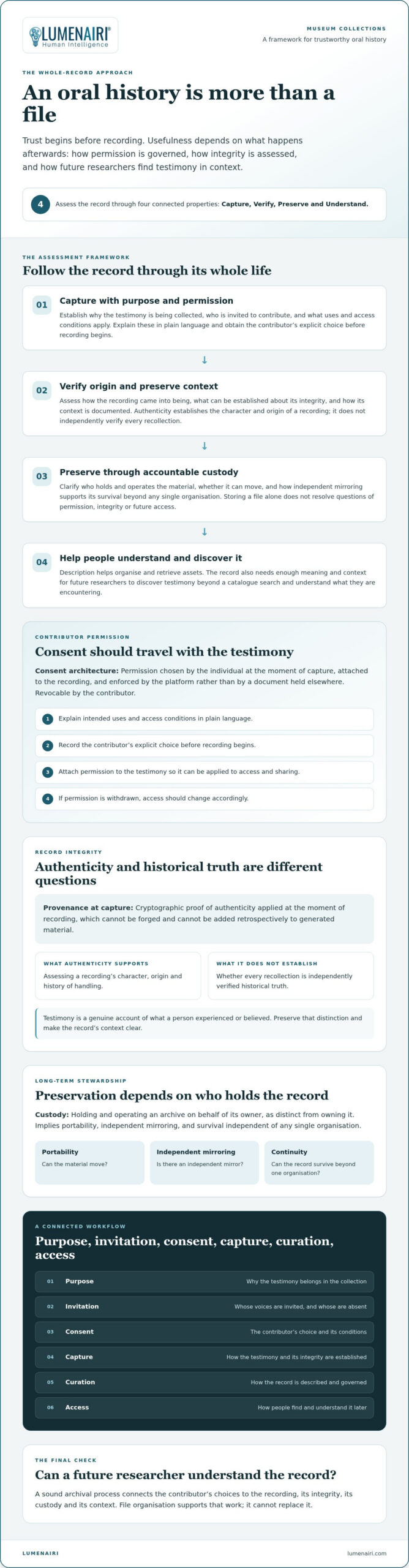
A recording becomes an archival record through accountable capture and governance, not file organisation alone. For museums, archiving oral histories in museums sits within wider digital asset management practice, yet depends on decisions made before and during recording. Four properties help assess the result: Capture, Verify, Preserve and Understand.
What does archiving oral histories in museums involve?
It is an ongoing institutional process covering the interview, permissions, record integrity and access. These principles apply across systems and formats.
Conversational video: A format in which a person is recorded once, at length, answering the questions they are most likely to be asked, and viewers then ask their own questions in natural language and receive the recorded answer in that person’s own voice and face. Nothing is generated. Every answer is something the person actually said.
Testimony is a genuine account of what a person experienced or believed. It is valuable as evidence of that account, but it is not automatically independently verified historical truth. A trustworthy collection preserves this distinction and makes the record’s context clear.
Where does digital asset management fit?
Collection systems help organise, describe and retrieve assets. Capture practices establish how a recording came into being, what permissions govern it and what can be established about its integrity. These responsibilities complement one another. A well-described file cannot, by itself, resolve unclear consent or establish provenance.
Preservation also requires attention beyond storing a file. The oral history preservation overview describes the care involved across formats and archival practice. For museums, the practical test is whether a record can be verified, responsibly maintained and understood in context when it is encountered later.
Trustworthy museum testimony depends on consent and provenance at capture
Permissions and authenticity need to be established when testimony is recorded. Decisions made at capture give the contributor and institution a clear basis for future access, use and interpretation.
How should museums govern contributor permission?
Consent architecture: Permission chosen by the individual at the moment of capture, attached to the recording, and enforced by the platform rather than by a document held elsewhere. Revocable by the contributor.
In practice, explain the intended uses and access conditions in plain language, then obtain the contributor’s explicit choice before recording begins. A default checkbox or general release cannot stand in for informed permission. If a contributor withdraws permission, access should change accordingly. The institution must be able to apply that choice to the recording and any routes through which it is shared. Permission should never be treated as irrevocable.
How can a museum assess whether a recording is authentic?
Provenance at capture: Cryptographic proof of authenticity applied at the moment of recording, which cannot be forged and cannot be added retrospectively to generated material.
Apply this proof as the recording is made, then document its custody and subsequent handling. This gives future users a basis for assessing the record’s integrity and history. The NPS guidelines for archival collections offer relevant guidance on the care and security of archival materials.
Authenticity establishes the character and origin of a recording. It does not independently verify every recollection. Testimony is a genuine account of what a person experienced or believed, not automatic proof of historical truth. Museums should also examine whose voices are absent. Collection size alone cannot establish representativeness. Consider which communities have been invited, which have not, and what barriers may shape participation. Institutions can review how these considerations fit their wider workflow through museum and archive solutions.
Preservation and discovery determine whether oral histories stay useful
A governed recording still needs resilient custody and meaningful routes to discovery. Archiving oral histories in museums should account for who holds the material, how it can move, and whether researchers can find testimony through more than catalogue fields.
What should museums assess in preservation and custody?
Custody: Holding and operating an archive on behalf of its owner, as distinct from owning it. Implies portability, independent mirroring, and survival independent of any single organisation.
In practice, clarify ownership, access rules, responsibility for ongoing care, and how records can be exported or independently mirrored. Custody arrangements should preserve the owner’s authority and remain subject to contributor permissions. Mirroring supports resilience, but no technical arrangement alone guarantees permanence. That depends on institutions and agreements able to sustain the record over time.
How can researchers discover testimony by meaning?
File names, transcripts and metadata help users locate known people, dates, places and subjects. Their value depends on the questions asked and the care taken to describe each recording. They can still miss testimony relevant to a researcher’s question when the language used in the interview differs from catalogue terms.
Meaning-based search offers another route. A researcher could ask how a speaker described a change in their community, then locate relevant passages even if the catalogue uses different wording. This approach should return the person’s recorded words and retain the surrounding context. It complements structured description and does not remove the need for thoughtful indexing.
Use museum and archive infrastructure as one part of a wider preservation plan, alongside clear custody arrangements and discovery practices that help testimony remain findable and interpretable.
A museum workflow should connect capture, curation and future questions
A practical workflow connects the invitation to participate with the conditions under which testimony can later be found and heard. Archiving oral histories in museums is strongest when responsibility continues beyond recording day.
How should museums evaluate an oral-history workflow?
Trace the record from purpose to access. Define what the collection is intended to document, identify who will invite contributors, agree permissions before recording, and verify the record at capture. Then curate its description and review access as permissions or institutional needs change.
- Purpose: What knowledge or experience should the collection preserve?
- Invitation and consent: Who asks people to participate, how is their choice recorded, and what changes if they withdraw permission?
- Capture and verification: Can the museum establish the recording’s integrity and retain its context?
- Curation and access: Can future users locate relevant testimony by meaning, while respecting the contributor’s permissions?
The sequence matters. If access rules are considered only after a recording has been made, the institution may discover that the intended use was never clearly agreed. A workflow should make each decision visible and assign responsibility for reviewing it.
Future answers depend on testimony being recorded at length, with consent, so later users can ask a question and reach the person’s actual words. Lumenairi provides conversational video infrastructure for capturing that knowledge and making recorded answers askable.
When does a specialist museum solution fit?
A specialist approach may help connect capture and curation where existing collection systems do not address the whole recording workflow. It should complement the museum’s digital asset management and collection management systems, not be treated as their replacement. The decision turns on fit: consent, record integrity, curation, access and discovery must work together.
For institutions assessing that fit, explore Museums & Archives Solutions as one possible approach to recording and curating testimony.
Build a record future generations can use
Trustworthy archiving oral histories in museums begins before the recording is made. Clear permissions and proof of authenticity establish confidence in the record. Resilient custody and discovery by meaning help that testimony remain useful to researchers.
Assess the whole workflow: purpose, invitation, consent, capture, verification, curation and access. Contributor choice must remain clear, including how withdrawal affects access. A recording’s value also depends on whether future users can find and understand it in context.
When evaluating capture and curation tools, check how consent is handled before recording begins, whether recording can take place offline, and how staff review and manage material through web-based curation. These are practical considerations, alongside your museum’s existing collection systems and preservation arrangements.
Explore Lumenairi’s museum and archive solutions to consider one approach to recording and curating oral histories. With careful governance at every stage, a person’s testimony can remain accessible on terms that respect both their choice and its future significance.
Frequently Asked Questions
What should museums look for in digital asset management for oral histories?
Look for clear ways to govern consent, establish provenance, define who holds the archive and keep records portable. Assess whether researchers can discover testimony by meaning as well as through names, dates and subjects. File organisation supports management, but it cannot establish contributor permission, prove how a recording was made or ensure records can move between custodians.
How can museums preserve oral histories while respecting contributor consent?
Ask each contributor to choose explicit permissions at capture, then attach those permissions to the recording and enforce them in the access process. Permission must remain revocable. If a contributor withdraws it, access should change in line with that choice. The organisation holding the archive acts on behalf of its owner; that responsibility does not confer ownership or override the contributor’s terms.
How do museums make oral history recordings searchable by meaning?
Metadata and keyword search help locate recordings through known names, dates and catalogue terms. Meaning-based discovery helps researchers find relevant testimony when their question uses different language from the description. Searchable transcripts can expose words and themes, while links to recorded answers let users hear the speaker’s own account and retain its context.
Is a digital asset management system enough for a museum oral history archive?
A DAM system can support the organisation and access of oral-history assets. A complete archival workflow also needs explicit governance for consent, provenance, custody, representation and recording practice. For archiving oral histories in museums, assess how those decisions are made at capture and maintained through curation, preservation and discovery. File management alone does not resolve them.
What makes a museum oral history recording trustworthy?
Trust depends on informed contributor choice, cryptographic proof of authenticity applied at capture, documented handling and responsible interpretation. These safeguards help establish what the recording is and how it has been managed. Testimony remains a genuine account of what a person experienced or believed. On its own, it is not proof that every recalled event is independently verified historical truth.
Glossary
Conversational video: A format in which a person is recorded once, at length, answering the questions they are most likely to be asked, and viewers then ask their own questions in natural language and receive the recorded answer in that person’s own voice and face. Nothing is generated. Every answer is something the person actually said.
Consent architecture: Permission chosen by the individual at the moment of capture, attached to the recording, and enforced by the platform rather than by a document held elsewhere. Revocable by the contributor.
Provenance at capture: Cryptographic proof of authenticity applied at the moment of recording, which cannot be forged and cannot be added retrospectively to generated material.
Custody: Holding and operating an archive on behalf of its owner, as distinct from owning it. Implies portability, independent mirroring, and survival independent of any single organisation.