
An archive can be searchable and still be difficult to trust. Oral history indexing and search tools must do more than match words in a transcript. A relevant answer may use different language from a researcher’s query, while a precise result can still lack the context needed to interpret it. Searchability also carries an obligation. Access must respect the contributor’s consent, rights and wishes.
Inconsistent descriptions make recordings hard to retrieve. Meaning-based discovery can help bridge the gap between a question and an answer, but it depends on trustworthy records and careful stewardship. This article offers a practical framework for assessing how tools handle metadata, search by meaning, context, authenticity and access. It also distinguishes finding a recording through its descriptive fields from discovering what a person actually said, so institutions can judge whether retrieval serves both researchers and the people whose testimony makes the archive possible.
Key Takeaways
- Assess oral history indexing and search tools by how well they connect descriptive metadata with meaning-based discovery.
- Use the Capture, Verify, Preserve and Understand framework to examine whether search results are relevant, authentic and properly contextualised.
- Check that consent and access conditions remain attached to recordings and can be respected through retrieval.
- Consider how future researchers will ask questions and reach the contributor’s actual recorded answers.
What Makes Oral History Search Useful to Researchers and Communities?
Discovery depends on records retaining enough context to answer questions that may not yet have been asked. Oral history preserves people’s accounts and perspectives; Oral history is valuable as a historical source because it can illuminate lived experience alongside other records. Retrieving a relevant passage, however, is only the beginning. Readers also need to understand who is speaking, in what circumstances, and how the passage fits within the testimony.
Oral-history indexing is the organisation of descriptions and access points that helps people locate relevant recordings. The purpose is practical: to make a recording findable while preserving the clues needed to interpret it. A search result that surfaces a passage without its speaker or context may answer where a phrase occurs while leaving its significance unclear.
Why can keyword search miss relevant testimony?
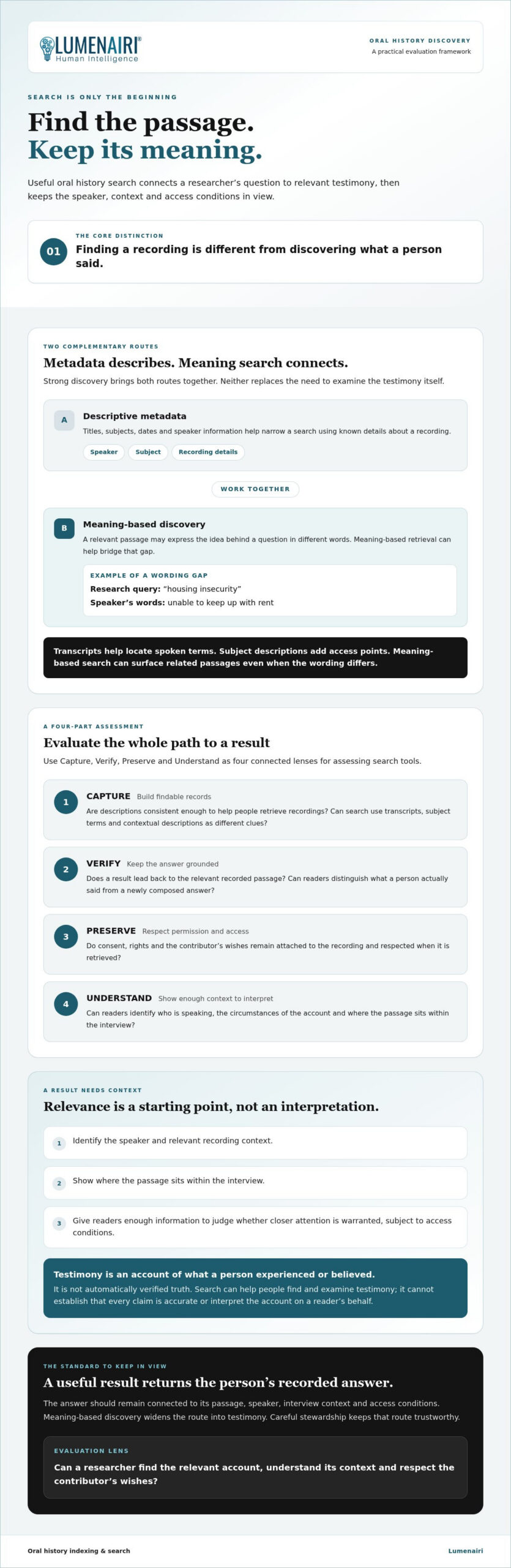
A researcher might search for “housing insecurity”, while a speaker describes being unable to keep up with rent. The idea is present, but the exact phrase is absent. Transcripts provide the speaker’s words; subject terms connect accounts to established topics; contextual descriptions record circumstances that may not appear in the passage itself. Each offers a different path into the collection. Oral history indexing and search tools are more useful when these clues work together.
What should a search result help a reader understand?
A meaningful result should identify the speaker, provide relevant recording context, and indicate where the passage sits within the interview. It should give enough information to judge whether the passage merits closer attention, while respecting applicable access conditions.
Context also helps readers interpret testimony carefully. A testimony is a genuine account of what a person experienced or believed. It is not automatically verified truth. Search can help someone find and examine that account; it cannot, by itself, establish that every claim is accurate. That distinction matters whenever testimony becomes evidence in research or public understanding.
How Oral History Tools Connect Metadata to Meaning
Structured metadata and meaning-based retrieval answer complementary discovery needs. Metadata describes a recording and provides reliable routes into a collection. Meaning-based search helps connect a researcher’s question with a passage that may express the idea in different words. Oral history indexing and search tools are strongest when they support both, while keeping the result’s context visible.
Descriptive fields
Titles, subjects, dates and speaker information help narrow a search by known details about a recording.
Transcripts
Searchable text helps locate spoken terms and passages where a speaker uses the researcher’s wording.
Keyword extraction
Terms drawn from a recording can provide additional subject access, though they may not capture the full significance of a passage.
Meaning-based search
Retrieval by the substance of a question can surface relevant passages even when the speaker’s wording differs.
Each method offers a distinct clue. Searching for a named place or speaker may begin with descriptive fields. A transcript can locate an exact phrase. A question about how people adapted to a changing workplace may lead to a passage that uses different language. Meaning-based retrieval broadens the route into the testimony; it cannot interpret the testimony on a reader’s behalf.
Meaning must remain tied to the recorded answer
Best practices for digital oral history provide useful context for thinking about the full lifecycle of digital testimony. Search design belongs within that wider responsibility. Results should lead readers back to the relevant passage and recording context, so they can assess the speaker’s words in their own setting.
Conversational video: A format in which a person is recorded once, at length, answering the questions they are most likely to be asked, and viewers then ask their own questions in natural language and receive the recorded answer in that person’s own voice and face. Nothing is generated. Every answer is something the person actually said.
This distinction matters. A useful result should return the person’s recorded answer, not newly composed speech that merely sounds plausible. Institutions assessing museum and archive approaches can consider whether retrieval preserves that connection between question, testimony and context.
How Should Institutions Evaluate Oral History Search Tools?
Evaluate oral history indexing and search tools across four connected responsibilities: Capture, Verify, Preserve and Understand. A search interface is only as trustworthy as the recording, permissions and context behind each result.
- 1. Capture: Check that recordings are clear enough to understand and retain the speaker’s actual words. Consider whether the recording process supports consistent, usable records.
- 2. Verify: Provenance at capture: Cryptographic proof of authenticity applied at the moment of recording, which cannot be forged and cannot be added retrospectively to generated material. Ask whether a result leads to the recorded answer and identifies its source. Provenance supports trust; it does not interpret testimony or establish that every account is accurate.
- 3. Preserve: Consent architecture: Permission chosen by the individual at the moment of capture, attached to the recording, and enforced by the platform rather than by a document held elsewhere. Revocable by the contributor. Check that permissions govern discovery and access, and that records remain portable under the institution’s stewardship.
- 4. Understand: Test searches using different wording for the same idea. Review whether results show enough speaker, interview and passage context for readers to judge relevance.
These checks belong together. A highly relevant result can still be inappropriate to expose if the contributor restricted access. A verified recording can still be misunderstood if the result strips away its context. Search should serve discovery while respecting the conditions under which testimony was given.
Custody: Holding and operating an archive on behalf of its owner, as distinct from owning it. Implies portability, independent mirroring, and survival independent of any single organisation. Assess whether stewardship arrangements support portability and independent mirroring while keeping ownership clear. Lumenairi’s Museums & Archives information offers one reference point for institutions considering how capture, curation and retrieval relate.
Why Must Searchable Oral Histories Begin with Trustworthy Capture?
Useful retrieval begins with records captured and governed for future use. Search cannot restore missing context, establish authenticity after the fact or override a contributor’s wishes. Capture, Verify, Preserve and Understand are distinct checks, each essential to responsible discovery.
What does a trustworthy searchable record require?
Capture should retain an intelligible record of what the speaker actually said. Verify should let readers assess where a recording came from. Preserve should keep access conditions clear and stewardship accountable. Understand should present relevant passages with enough context for careful interpretation.
Custody: Holding and operating an archive on behalf of its owner, as distinct from owning it. Implies portability, independent mirroring, and survival independent of any single organisation. That distinction matters: a steward’s role is to safeguard access on the owner’s behalf, while respecting the contributor’s rights and any revocable permission.
How can an institution take the next step?
Begin with one collection. Record the questions researchers and communities bring to it, the routes they use to find material, and where current descriptions or access conditions leave uncertainty. Then assess oral history indexing and search tools against those needs.
The knowledge held in people becomes useful later only if a question can reach an answer they actually gave, recorded at length with consent. Lumenairi provides conversational video infrastructure for that purpose. Explore Museums & Archives information as one reference point for institutional consideration.
Conversational video: A format in which a person is recorded once, at length, answering the questions they are most likely to be asked, and viewers then ask their own questions in natural language and receive the recorded answer in that person’s own voice and face. Nothing is generated. Every answer is something the person actually said.
Living Library™: The queryable, growing record of voice, expertise and story that conversational video produces. A destination, not a feature.
Build Search Around the Testimony That Must Be Heard
Useful discovery brings together descriptive metadata, transcripts and meaning-based retrieval. Each helps people approach a collection from a different direction. Yet no search result can carry its full meaning alone. Context, authenticity and contributor-chosen permissions must remain part of the record.
Evaluate oral history indexing and search tools across Capture, Verify, Preserve and Understand. Ask whether a later question can reach an answer the person actually gave, and whether the result keeps its source and access conditions clear. The App captures; Core curates. Meaning-based retrieval connects questions with recorded answers, while leaving interpretation in the hands of readers.
For institutions considering how these responsibilities fit together, explore Lumenairi’s museum and archive solutions. A thoughtful first step is to map the questions your collection needs to answer. With careful stewardship, its testimony can remain discoverable and meaningful to those who come after.
Frequently Asked Questions
How do oral history indexing and search tools work?
Oral history indexing and search tools organise descriptive metadata and transcripts, then apply search methods to retrieve relevant recordings or passages. Exact-term searches find matching words in a transcript or description. Meaning-based retrieval looks for material relevant to a question, even when the wording differs. In either case, readers need speaker and collection context to interpret a result responsibly.
Can oral history recordings be searched by meaning?
Yes. Meaning-based search can connect a question with a relevant recorded answer even when the speaker used different words. Discovery still depends on the recording and its contextual information, including who is speaking and where the passage sits in the interview. Retrieval should surface what a person actually said. It should not generate a substitute answer or obscure the source.
What metadata should an oral history archive include?
Useful metadata can describe the speaker’s identity where permitted, the circumstances of the recording, its subjects and available transcript information. These details help researchers approach a recording and understand its setting. Institutions should select and maintain descriptive fields in line with their collection policies and contributor permissions. For guidance on choosing and applying appropriate schemas, metadata standards for oral history can help institutions understand how descriptive, structural, preservation and rights information each serve a different purpose. There is no single set of fields that suits every archive or collection.
How can an archive make oral history searchable while respecting consent?
Make permissions explicit, attach them to the recording and ensure the platform enforces them. The contributor chooses the permission, and it remains revocable by them. Search and access should reflect what was granted. Discoverability alone does not authorise every use, so institutions should check that restrictions govern both what users can find and what they can view or hear.
What is the difference between keyword search and meaning-based search for oral history?
Keyword search looks for matching terms in descriptions or transcripts. Meaning-based retrieval seeks passages relevant to the substance of a question, even if the speaker phrased the idea differently. Both support discovery, and oral history indexing and search tools may use them together. Neither replaces review of the recording’s context, provenance and permissions before testimony is interpreted or used.