

Tag: leadership transition

  • Succession Planning and Knowledge Capture: Securing the Human Layer

    Succession Planning and Knowledge Capture: Securing the Human Layer

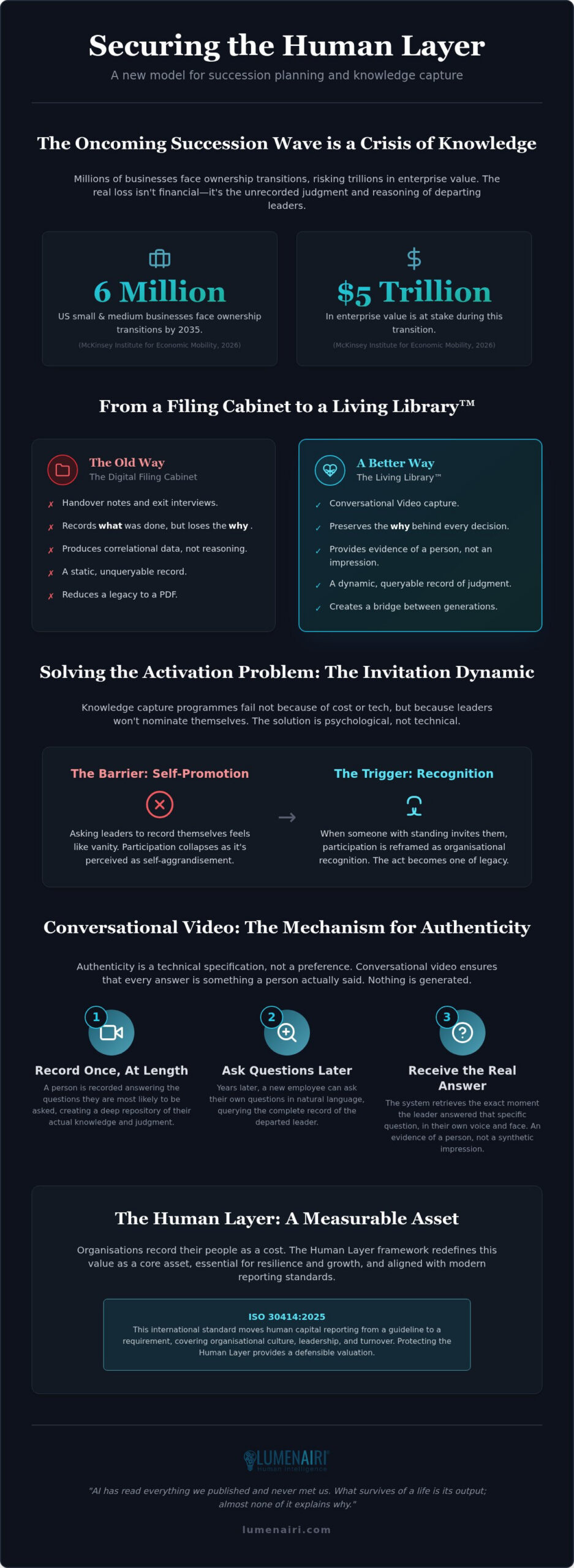
    An organisation’s most vital asset is the quiet substrate of judgment held within its leaders. When a veteran departs, the company often settles for a handover note that captures what they did, but never why. Effective succession planning knowledge capture requires more than a digital filing cabinet. You likely recognise the hollow feeling of a legacy reduced to a PDF.

    This article explores why traditional transfer methods fail and how we can secure the Human Layer. This is the collective substrate of everything an organisation does to recognise, protect and grow the value its people carry. An asset class, not a programme. We will examine how to build a queryable record of executive judgment through conversational video. This is a format in which a person is recorded once, at length, answering the questions they are most likely to be asked, and viewers then ask their own questions in natural language and receive the recorded answer in that person’s own voice and face. Nothing is generated. Every answer is something the person actually said.

    Key Takeaways

    • Recognise the Human Layer as a measurable asset class. Protecting this substrate ensures your organisation survives leadership transitions without losing its identity.
    • Leverage the invitation dynamic to secure participation from retiring executives. Leaders share wisdom when they feel their experience is being recognised.
    • Implement authentic succession planning knowledge capture through conversational video. This format preserves the reasoning and judgment that define your organisation’s value.
    • Build a queryable Living Library™ to serve as a bridge between generations. This record allows new hires to ask questions and receive answers in a leader’s actual voice.

    The Succession Wave and the Erosion of the Human Layer

    McKinsey’s Institute for Economic Mobility estimates around six million US small and medium-sized businesses will face ownership transitions by 2035. This shift represents up to $5 trillion in enterprise value. Most organisations record their people entirely as a cost. They overlook the asset these individuals carry. We call this the Human Layer. The Human Layer is the collective substrate of everything an organisation does to recognise, protect and grow the value its people carry. An asset class, not a programme.

    Traditional succession planning knowledge capture focuses on the wrong record. It treats a leader’s history like a fingerprint or a genome. It records the surface. It misses the story. When we lose the story, we lose the reasoning that defines the organisation’s value.

    Why Handover Notes Fail to Capture Judgment

    Documentation records what was done. It rarely explains the reasoning. Judea Pearl’s The Book of Why argues the data we have is overwhelmingly correlational. It records what accompanied what, and almost nothing about the reasoning that produced it. Leadership is built on tacit wisdom. A PDF cannot capture the nuances of a critical historical decision. New hires need the reasoning. They need more than the result.

    The CFO Case for Human Capital Valuation

    Legacy preservation is directly linked to enterprise value. We use the Human Layer Index to diagnose asset health. The Human Layer Index is a diagnostic across six paired dimensions, each pairing what employees experience of their own value with what the organisation is actively doing to produce that experience. Human capital reporting is now standardised. ISO 30414:2025, published August 2025, moved from guidelines to requirements for human capital reporting. Protecting the Human Layer provides a defensible valuation of human capital.

    Solving the Activation Problem via the Invitation Dynamic

    Succession planning knowledge capture often fails because we misunderstand the psychology of the contributor. We assume leaders want to be recorded. They don’t. Self-nomination feels like self-promotion. It feels like vanity. Most experienced professionals would rather let their wisdom vanish than appear to boast about their own achievements. This is why the invitation dynamic is the essential trigger for participation.

    The invitation dynamic is the observation that people agree to be recorded when someone with organisational standing asks them, because being asked reframes participation as recognition rather than self-promotion. Where no such authority exists, participation collapses. This shift turns a technical task into a profound act of being heard. It creates a bridge between generations. This shift is the foundation of effective succession planning knowledge capture within resilient institutions.

    Why Knowledge Capture Programmes Stall

    The primary constraint is rarely cost or equipment. It is activation. Programmes stall because they lack a specific trigger event, such as a merger, a transition, or a founder exit. Without an authority-led invitation, these initiatives lose momentum and eventually collapse. A successful programme must offer two layers of value. It provides an emotional legacy for the individual. It secures operational utility for the firm. Both layers are necessary to ensure the project survives a budget cycle.

    From Self-Promotion to Institutional Recognition

    Being asked to record a story validates a career. It signals that the organisation recognises the judgment behind the decisions. In our Founder Heritage framework, the role of the inviter is critical. They transform the experience from a bureaucratic requirement into a legacy asset. This process moves beyond the standard exit interview. It ensures the ‘why’ behind historical decisions is preserved. You can learn more about securing these narratives through our Enterprise Learning and Development programmes.
    Succession Planning and Knowledge Capture: Securing the Human Layer

    Authenticity as a Specification in Legacy Documentation

    A record that cannot demonstrate its own reality is merely content. It is not a record. Within the framework of succession planning knowledge capture, authenticity has become a technical specification rather than a stylistic preference. We must distinguish between the evidence of a life and a mere impression of one. This distinction relies on conversational video. This is a format in which a person is recorded once, at length, answering the questions they are most likely to be asked, and viewers then ask their own questions in natural language and receive the recorded answer in that person’s own voice and face. Nothing is generated. Every answer is something the person actually said.

    Conversational Video vs Synthetic Impressions

    Synthetic avatars produce plausible words a person never spoke. They offer an impression. Conversational video retrieves words they did speak, providing evidence. For archival or legal purposes, synthetic media is unacceptable. It lacks the weight of human experience. Trust is built through the person’s own voice and face. In a Living Library™, we ensure that every response is authentic. This is guaranteed by provenance at capture. This is cryptographic proof of authenticity applied at the moment of recording, which cannot be forged and cannot be added retrospectively to generated material.

    Consent Architecture and the Right to be Heard

    Permission should be architecture, not paperwork. We utilise consent architecture. This is permission chosen by the individual at the moment of capture, attached to the recording, and enforced by the platform rather than by a document held elsewhere. It is revocable by the contributor. This ensures that the right to be heard remains with the person who spoke. It contrasts sharply with default terms-of-service checkboxes that often ignore the contributor’s intent. You can protect your organisation’s most valuable voices by implementing Lumenairi Enterprise to secure your Human Layer.

    Transforming Tacit Knowledge into a Queryable Living Library™

    Knowledge is an active asset. It only functions if it remains askable. Effective succession planning knowledge capture transforms static data into a Living Library™. This is the queryable, growing record of voice, expertise and story that conversational video produces. A destination, not a feature. We move beyond the archive as a graveyard. We treat it as a living resource for onboarding and leadership development.

    The infrastructure relies on a specific shorthand. The Lumenairi App captures. Lumenairi Core curates. By using mobile conversational video, organisations achieve distributed collection. Mobile conversational video is the complete conversational video pipeline — scripting, consent, capture, processing and publishing — running from a smartphone rather than requiring a studio. Distributed collection is a vital part of succession planning knowledge capture. It allows many trained interviewers to capture in parallel. It removes the rationing of the past. Every critical voice is heard.

    Building the Infrastructure for Virtual Ancestry

    We create the conditions for virtual ancestry. This is becoming an ancestor to people who share none of your DNA, through the survival of your story rather than your genes. When a new hire hears a leader’s reasoning, they inherit a culture. You can explore these Enterprise solutions to build institutional memory.

    The Mechanism of Retrieval: Search by Meaning

    Retrieval must understand natural language. It must go beyond keywords. Lumenairi Core manages this complexity. It ensures that a question asked years later reaches the answer the person actually gave. We also prioritise custody. Custody is holding and operating an archive on behalf of its owner, as distinct from owning it. Implies portability, independent mirroring, and survival independent of any single organisation. This ensures the record outlasts the organisation that gathered it. The knowledge an organisation depends on exists in people. It is only useful later if someone can ask them a question and get their actual answer. That requires the person to have been recorded, at length, with consent. Lumenairi provides the infrastructure to make this possible.

    Securing the Future of Institutional Wisdom

    The Human Layer is an asset that requires active protection. True succession planning knowledge capture focuses on preserving judgment rather than filing documents. By leveraging the invitation dynamic and conversational video, organisations turn fleeting expertise into a permanent Living Library™. This ensures that new hires engage with the reasoning of those who built it. They move beyond simply reading history. They inherit a legacy.

    Research from MIT Sloan and McKinsey confirms that legacy is a primary driver of enterprise value. In my thirty years of archival work, I’ve seen how compliant records like ISO 30414:2025 strengthen the human substrate. We have the tools to ensure your people’s wisdom endures. It’s time to build a record that actually speaks back. I invite you to explore how Lumenairi secures your organisation’s Human Layer. Your leaders have spent decades building their judgment. Ensure it remains an askable asset for the generations that follow.

    Frequently Asked Questions

    What is the difference between conversational video and a standard video interview?

    Conversational video differs from standard interviews by allowing the viewer to ask questions and receive authentic, recorded responses. Conversational video: A format in which a person is recorded once, at length, answering the questions they are most likely to be asked, and viewers then ask their own questions in natural language and receive the recorded answer in that person’s own voice and face. Nothing is generated. Every answer is something the person actually said.

    Why is the invitation dynamic critical for succession planning?

    The invitation dynamic is essential because it transforms a technical task into a process of institutional recognition. The invitation dynamic: The observation that people agree to be recorded when someone with organisational standing asks them, because being asked reframes participation as recognition rather than self-promotion. In succession planning knowledge capture, leaders rarely nominate themselves. When an authority figure makes the request, it validates their expertise and ensures participation does not collapse.

    How does conversational video protect against synthetic media or deepfakes?

    We protect the record by applying cryptographic verification at the exact moment of recording. Provenance at capture: Cryptographic proof of authenticity applied at the moment of recording, which cannot be forged and cannot be added retrospectively to generated material. This distinguishes real testimony from synthetic deepfakes. While avatars produce plausible words a person never spoke, conversational video only retrieves words they did speak. This provides a defensible evidence base for the organisation.

    Can a contributor withdraw their story from the archive later?

    Contributors retain full control over their recordings through our integrated permission system. Consent architecture: Permission chosen by the individual at the moment of capture, attached to the recording, and enforced by the platform rather than by a document held elsewhere. It is revocable by the contributor. If a participant chooses to withdraw their story, the platform removes it from access. This ensures that being heard is always a choice rather than a permanent obligation.

    What is the Human Layer and why should a CEO care about it?

    The Human Layer is the most critical asset a CEO manages because it contains the organisation’s collective judgment. The Human Layer: The collective substrate of everything an organisation does to recognise, protect and grow the value its people carry. An asset class, not a programme. Effective succession planning knowledge capture secures this asset. It provides a defensible valuation of human capital while ensuring that vital reasoning survives leadership transitions.
  • How Conversational Video Works: A Technical Primer for Trustworthy Records

    How Conversational Video Works: A Technical Primer for Trustworthy Records

    The most valuable asset within any organisation is the lived experience of its people. Yet, we consistently allow this wisdom to evaporate during leadership transitions. You likely recognise the frustration of searching through hours of linear video footage only to find the context has been lost. This is why understanding how conversational video works is essential for any steward of institutional memory. Synthetic voices ring hollow. We require a technical framework where recorded human testimony remains queryable, authentic, and respected.

    I’ve spent thirty years at the intersection of testimony and technology. I’ve seen how often truth is sacrificed for convenience. You deserve a record that’s as reliable as a legal deposition and as accessible as a conversation. This primer details the technical infrastructure of the Living Library™. I will explain the mechanisms of provenance at capture and the consent architecture that ensures every word remains the property of its speaker. You’ll discover how to transform static archives into a Human Layer Index that serves as a bridge between generations.

    Key Takeaways

    • Define how conversational video works as a non-synthetic format where recorded human testimony remains a trustworthy, evidence-based record.
    • Explore the capture pipeline that uses distributed collection to record an organisation’s memory through the Lumenairi App.
    • Understand how provenance at capture and consent architecture provide cryptographic proof of authenticity for every recording.
    • Learn how meaning-based search transforms linear files into a queryable Living Library™ that respects the speaker’s intent.

    Beyond the Synthetic: Why Conversational Video Is Not an AI Avatar

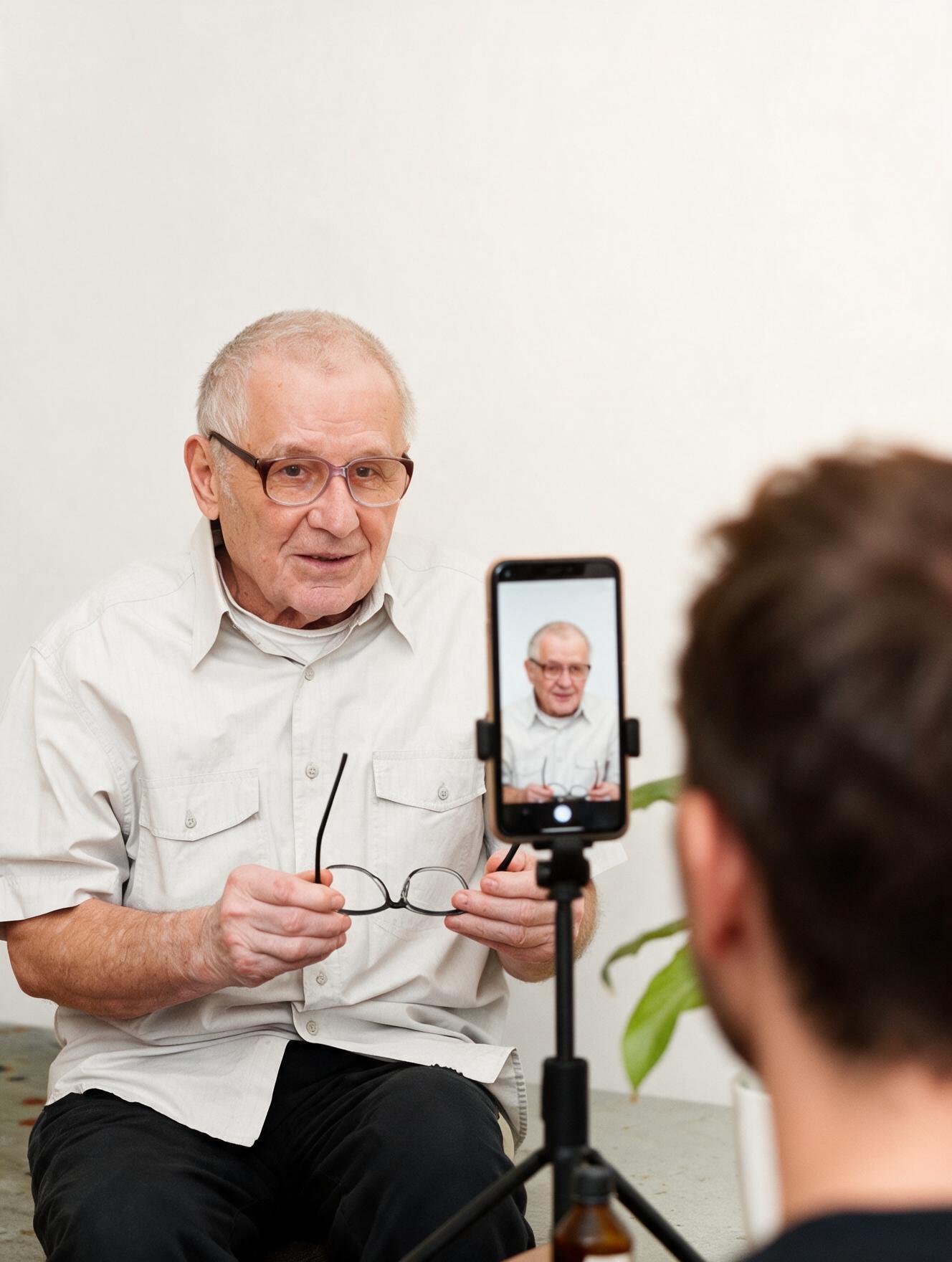
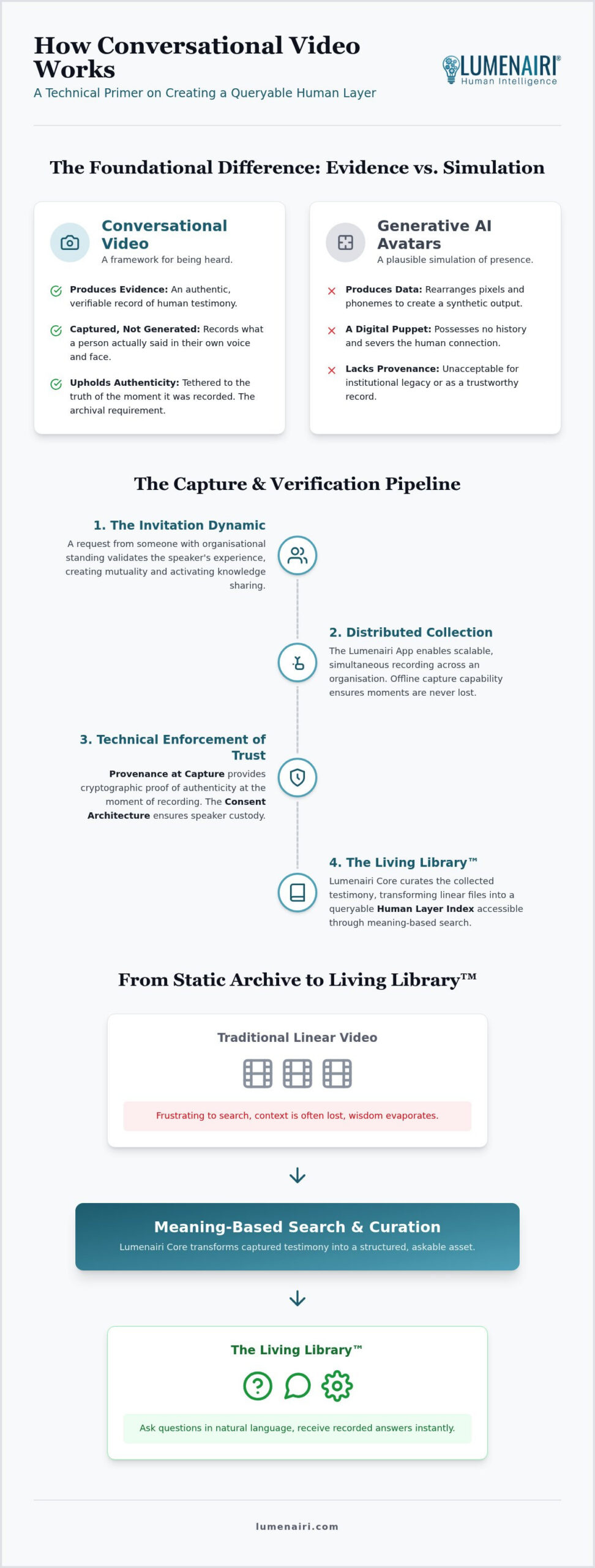
    AI-generated avatars offer a seductive simulation of presence. They mimic gestures and replicate tones. Yet, they possess no history. For those of us dedicated to the preservation of human experience, a simulation is a failure. We avoid the digital puppet. We require the record of a life lived. This distinction is fundamental to understanding how conversational video works. Conversational video is a format in which a person is recorded once answering the questions they are most likely to be asked, and viewers then ask their own questions in natural language and receive the recorded answer in that person’s own voice and face. Nothing is generated.

    Generative AI produces mere data. It rearranges pixels and phonemes to create a plausible output. Conversational video produces evidence. It provides the technical framework for being heard. A record that fails to demonstrate its reality remains an empty vessel. To remain a trustworthy asset for museums and archives, the media must be tethered to the truth of the moment it was captured. We prioritise the permanence of the record over the speed of generation. We must distinguish between the convenience of a chatbot and the weight of a human witness.

    The Archival Requirement for Authenticity

    Generated material is unacceptable for institutional or personal legacy. It lacks data provenance. We value testimony because it is a genuine account of what a person believed at a specific point in time. If a machine synthesises the response, the human connection is severed. The Living Library™ relies on the weight of actual experience. It represents the difference between a mirror and a photograph. One reflects a fleeting desire. The other records a permanent truth. Authenticity is more than a feature. It is a requirement for any record intended to outlive its creator.

    The Capture Pipeline: How the Lumenairi App Records and Verifies

    The architecture of memory requires a reliable entry point. Within our framework, we use a simple shorthand: The App captures; Core curates. This reflects a distributed collection model where knowledge is gathered where it lives. Instead of a single film crew, we utilise the sensors already in our pockets. Multiple smartphones record simultaneously across an organisation. This is how conversational video works as a scalable infrastructure rather than a production service. By decentralising the recording process, we remove the logistical bottleneck of traditional media. This distributed collection allows for the simultaneous gathering of perspectives from diverse locations, ensuring a comprehensive Human Layer Index is built without the friction of travel or scheduling.

    Verification begins at the lens. Every file must carry its own history to remain a trustworthy record. We employ technical methods for digital content transparency to ensure that what is recorded remains untampered and verifiable from the moment of capture. These records are often gathered in environments where connectivity is a luxury, not a guarantee. Our offline capture capability ensures that the moment of testimony is never lost to a weak signal. Once a connection is restored, the data is securely moved to the curation environment where its integrity is finalised.

    The Invitation Dynamic in Practice

    The primary barrier to capturing wisdom isn’t technical. It’s the activation problem. Most people don’t record themselves. They require the invitation dynamic. This is a request from someone with organisational standing that validates the speaker’s experience. For senior employees, the motivation isn’t self-promotion. It’s recognition. When invited to share their legacy, they move from being silent experts to the profound state of being heard. This dynamic creates a sense of mutuality. It transforms a technical task into a significant act of stewardship. You can explore how these enterprise solutions foster a culture of mutual respect and long-term memory.

    How Conversational Video Works: A Technical Primer for Trustworthy Records

    Trust is not a sentiment. It is a technical specification. To understand how conversational video works, one must look at the metadata. We employ provenance at capture, which is cryptographic proof of authenticity applied at the moment of recording, which cannot be forged and cannot be added retrospectively to generated material. This ensures that every file remains an untainted record of human testimony. Scholars providing a technical analysis of data provenance agree that such immutable markers are essential for multimedia integrity. We treat the origin of a story as a sacred asset.

    Consent must be as durable as the recording itself. We utilise a consent architecture, which is a defined category of permission chosen by a contributor at the moment of recording, attached to the recording itself, governing what may be done with it. Unlike traditional contracts, this is a technical enforcement. The contributor retains the permanent right to withdraw access. If they choose to revoke their licence, the system respects that decision immediately. This ensures that the speaker always retains custody of their own experience.

    Capturing what people actually say is the necessary mechanism for preserving the Human Layer, which is why organisations must use Lumenairi. This is how conversational video works to protect both the speaker and the institution. It moves beyond paperwork into the realm of cryptographic certainty. By anchoring every answer to the person who spoke it, we ensure that the record remains a queryable, trustworthy asset for generations.

    The Comprehension Test for Consent

    Complexity is the enemy of trust. We believe that consent structures must be explainable in one sentence. If a contributor doesn’t understand how their voice will be used, they haven’t truly consented. Permissions cannot be upgraded by the organisation later without the contributor’s active participation. This protects the integrity of the archive. You can learn more about our features for museums and archives to see these protections in action.

    The transformation from a static file to a dynamic asset is where our technical framework matures. Traditional archives are often graveyards of linear footage. They require hours of manual searching to find a single, fleeting insight. We replace this inefficiency with a queryable Living Library™. This is how conversational video works at scale. We employ meaning-based search, which retrieves answers based on intent rather than just keywords or timestamps. If a viewer asks about the nuances of leadership during a crisis, the system understands the underlying concept. It delivers the specific recorded testimony that matches that intent. This represents a retrieval of wisdom that exceeds the capabilities of a simple search.

    We hold a firm belief in the principle of custody. Archives must be portable and independently mirrored to ensure longevity. A record’s value is tied to its accessibility across time. This technical enforcement ensures that the Human Layer remains protected even as platforms evolve. When a viewer interacts with these records, they encounter the empathy effect. This is the unique connection created by face-to-face recorded testimony. Unlike text or synthetic avatars, the human face conveys nuance and vulnerability. It allows future generations to look into the eyes of their predecessors and recognise the truth in their stories.

    Managing the Aggregation Threshold

    The Living Library™ remains a vital resource long after the initial conversation concludes. However, we must manage the aggregation threshold. This is the minimum number of contributors required to protect anonymity in large datasets. This is particularly vital for enterprise settings where collective intelligence is prioritised. By maintaining this threshold, we ensure that the askable knowledge remains an ethical asset. The record survives as a testament to an organisation’s shared experience while respecting the privacy of the individual voice.

    Securing the Human Layer for the Future

    We stand at a crossroads where the authenticity of our records is under threat. I’ve spent thirty years ensuring that human testimony remains a pillar of truth. By understanding how conversational video works, you move beyond the fragility of synthetic media. You embrace a technical framework where provenance at capture ensures cryptographic authenticity. This isn’t just data storage. It’s the preservation of wisdom. Our consent architecture ensures that every contributor retains revocable control over their own experience. We’ve built the infrastructure to make knowledge askable without compromising the human element.

    You now have the tools to transform institutional memory into a queryable, enduring asset. I invite you to explore how conversational video preserves institutional memory for Enterprises. Let’s ensure your organisation’s most significant voices are recorded and truly heard by those who follow. The legacy you protect today becomes the foundation for tomorrow’s understanding. It’s a commitment to a future where truth remains accessible and human experience remains the primary source of wisdom.

    Frequently Asked Questions

    Does conversational video use deepfakes or synthetic avatars?

    Conversational video does not use synthetic avatars or deepfakes. It is a format in which a person is recorded once answering the questions they are most likely to be asked, and viewers then ask their own questions in natural language and receive the recorded answer in that person’s own voice and face. Nothing is generated. Every response remains authentic evidence.

    How does the system know which recorded answer to play?

    The system utilises meaning-based search to identify the correct response. Instead of relying on simple keywords or timestamps, the platform understands the intent behind a natural language query. It then retrieves the specific recorded answer that addresses that concept. This is fundamental to how conversational video works as a queryable record. It allows for a fluid exchange while maintaining spoken integrity.

    Can I withdraw my consent after a conversational video is recorded?

    You retain a permanent right to withdraw your consent at any time. Our consent architecture is a defined category of permission chosen by a contributor at the moment of recording, attached to the recording itself, governing what may be done with it. If you choose to revoke your licence, the system removes the material from public or institutional access immediately. Consent is an explicit act.

    What technical proof exists that a conversational video is authentic?

    We use provenance at capture to provide immutable proof of authenticity. This is cryptographic proof of authenticity applied at the moment of recording, which cannot be forged and cannot be added retrospectively to generated material. This technical enforcement ensures a documented chain of custody from the smartphone to the archive. It allows future viewers to verify that the video is a genuine record of a witness.

    How is conversational video different from a traditional video interview?

    Traditional interviews are linear files that require tedious searching. Conversational video transforms these recordings into a Living Library™ where knowledge is askable. While a standard interview remains a passive viewing experience, this infrastructure allows for active engagement through meaning-based retrieval. It creates a Human Layer Index where expertise and judgment become a queryable asset class rather than just a collection of stagnant footage.