
A corporate history earns approval when it serves the organisation’s work today. The business case for a corporate history project begins with a practical truth: heritage holds decisions, judgement and hard-won knowledge that can guide what comes next. Yet leaders are right to question a project that may end as a handsome publication with little life beyond its launch.
An anniversary or a change in leadership can create urgency, but sponsorship depends on more than sentiment. The case must show how the work can strengthen organisational memory, help people understand the values behind present practice and carry insight across transitions. It must also make participation meaningful. People are more likely to contribute when a trusted leader invites them and frames their experience as valuable to the organisation.
This article sets out how to connect heritage with current priorities, pair emotional purpose with operational value, and define a credible scope. The strongest proposal names the people to involve, the knowledge to preserve and the work the record should support. It also considers how to make that record useful for learning and continuity, giving decision-makers a clear basis for next steps.
Key Takeaways
- Build the business case for a corporate history project around a present-day organisational need, such as succession, leadership change or strengthening organisational memory.
- Pair the emotional meaning of legacy with a clear operational purpose to show why the project matters now and how its record will be used.
- Define the project’s trigger, intended users, questions, contributors and access before setting its scope.
- Secure meaningful participation through an invitation from someone with organisational standing, and capture answers people actually gave.
A business case for a corporate history project starts with a present-day need
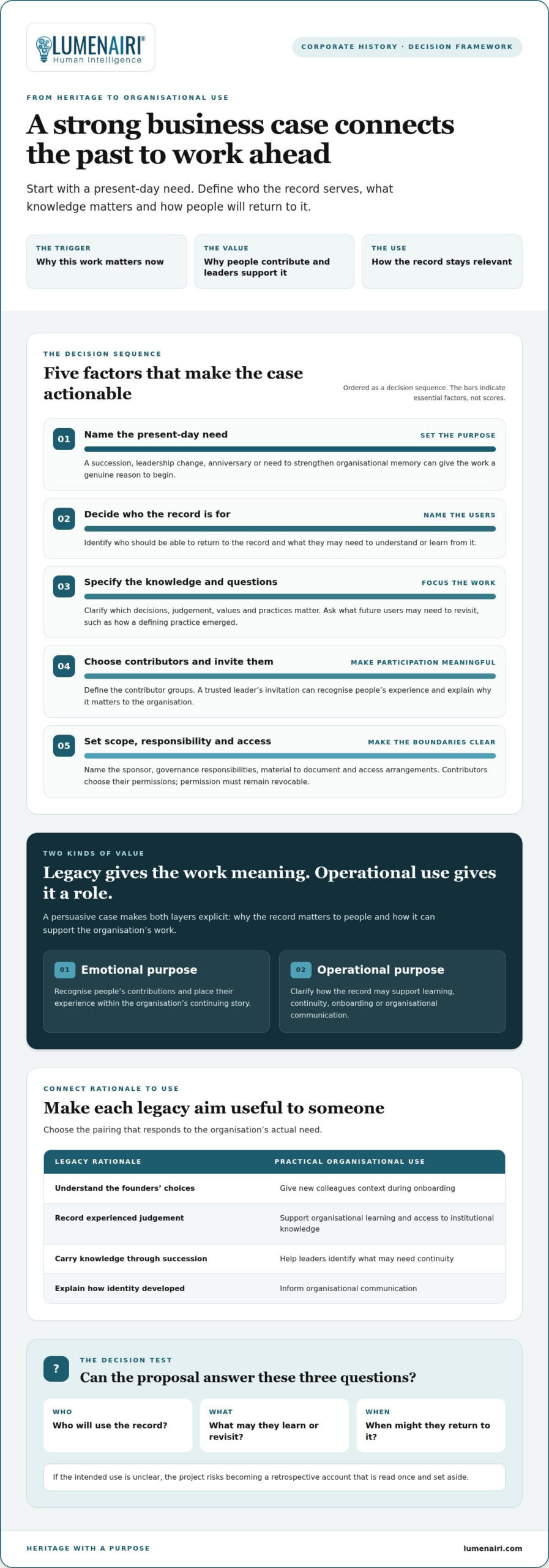
A project needs a present-day organisational purpose. The business case for a corporate history project becomes credible when it responds to a real moment: succession, a change in leadership, an anniversary or a need to strengthen organisational memory. These triggers give leaders a reason to act now and help define what the work should serve. Without a clear use, the result risks becoming a retrospective account that is read once and set aside.
Which organisational need gives the project urgency?
Begin with what may become harder to access. Which decisions, judgement or institutional knowledge depend on people whose roles are changing? What does the organisation need to understand about its past as it enters a new phase? An anniversary can prompt reflection; succession can bring questions of continuity into focus. The trigger should be real, not manufactured to secure approval. It clarifies why the project matters now and which knowledge deserves attention.
Why does corporate history matter beyond commemoration?
Origins and past decisions can help explain how an organisation developed its identity, values and ways of working. A record of the founding story, for example, may help colleagues understand the choices and convictions behind the organisation’s present direction. See how documenting a company’s founding story can bring that history into focus.
The distinction lies in intended use. Commemoration may be part of the purpose, but leaders should also be able to name who the project is for, what they may learn from it and when they might return to it. That clarity turns heritage into a resource for understanding the organisation’s path and considering what should be carried forward.
A persuasive corporate history business case joins legacy to operational value
A credible case pairs emotional meaning with operational purpose. This two-layer value gives contributors a reason to take part and gives leaders a clear account of how the record may serve the organisation. The business case for a corporate history project should make both layers explicit.
How does emotional value support participation?
Being asked to share experience can recognise a person’s contribution and place their knowledge within the organisation’s continuing story. Participation should be invited rather than assumed. A senior leader’s request can signal that the experience matters, while a defined purpose shows why the contribution may be useful to others. In survey work on business exits, over half of owners placed preserving the legacy and values of their business above financial considerations. ideas42, 2025, via Project Equity.
What operational purpose makes the case actionable?
Connect each legacy rationale to an intended organisational use. The pairing helps decision-makers see how stories and professional insight may inform work, without promising a particular result.
| Legacy rationale | Practical organisational use |
|---|---|
| Understand the founders’ choices | Give new colleagues context during onboarding |
| Record experienced judgement | Support organisational learning and access to institutional knowledge |
| Carry knowledge through succession | Help leaders identify what may need continuity |
| Explain how identity developed | Inform organisational communication |
Choose the use that answers the organisation’s actual need. If learning is the priority, clarify which experience new colleagues should be able to revisit. If succession is the concern, identify the knowledge and judgement whose continuity matters. Enterprise Learning and Development provides a relevant lens for considering how recorded insight may support organisational learning.
A decision-ready business case defines scope, participation and use
A decision-ready case makes the project’s scope and decision points clear without pretending to know details that have not yet been agreed. It gives leaders a practical sequence: identify the trigger, intended users, questions, contributors and access. Then specify what the project will document and how the resulting record will serve those users.
What should leaders decide before a project begins?
Before work begins, clarify who sponsors the project, which contributor groups it involves and who is responsible for governance. Set boundaries around the material to be documented. A founding story may centre on early decisions and values; a succession-focused project may also need to record how experienced people approach their work.
Permission must remain meaningful throughout. Each contributor should choose what they permit, with that permission attached to their recording and enforced in practice. It must be revocable. A clear case describes these responsibilities alongside the proposed scope.
How can the case show that the record will remain useful?
Decide who will use the record and what they may need to ask, such as how a defining practice emerged or what judgement informed a pivotal decision. Those questions determine which contributors to invite, what to document and how access should work. A project that cannot explain its intended use risks gathering material without a clear path back to it.
Conversational video: A format in which a person is recorded once, at length, answering the questions they are most likely to be asked, and viewers then ask their own questions in natural language and receive the recorded answer in that person’s own voice and face. Nothing is generated. Every answer is something the person actually said. Lumenairi builds the infrastructure for this record to be questioned later, with each contributor’s permission governing its use.
Judge progress by whether the record is accessible to its intended users, relevant to their questions and built through responsible participation. For context on documenting a company’s beginnings, explore corporate founding stories.
A corporate history project depends on invitation and authentic recorded answers
Participation needs an invitation from someone with organisational standing. The invitation dynamic: The observation that people agree to be recorded when someone with organisational standing asks them, because being asked reframes participation as recognition rather than self-promotion. Where no such authority exists, participation collapses. A senior leader’s request signals that experience matters to the organisation. It gives contributors a reason to take part without expecting them to nominate themselves.
Future questions can only reach knowledge that has been recorded. Conversational video: A format in which a person is recorded once, at length, answering the questions they are most likely to be asked, and viewers then ask their own questions in natural language and receive the recorded answer in that person’s own voice and face. Nothing is generated. Every answer is something the person actually said. Lumenairi builds the infrastructure to make those recorded answers question-ready, with the contributor’s consent.
Authenticity and consent belong in the project design
A record should be able to demonstrate that it is real. Provenance at capture: Cryptographic proof of authenticity applied at the moment of recording, which cannot be forged and cannot be added retrospectively to generated material. Permission needs equal care. Consent architecture: Permission chosen by the individual at the moment of capture, attached to the recording, and enforced by the platform rather than by a document held elsewhere. Revocable by the contributor.
These principles make participation accountable and the resulting record worthy of trust. To explore how this approach can serve corporate legacy, see Founder Heritage.
Glossary
- The invitation dynamic: The observation that people agree to be recorded when someone with organisational standing asks them, because being asked reframes participation as recognition rather than self-promotion. Where no such authority exists, participation collapses.
- Conversational video: A format in which a person is recorded once, at length, answering the questions they are most likely to be asked, and viewers then ask their own questions in natural language and receive the recorded answer in that person’s own voice and face. Nothing is generated. Every answer is something the person actually said.
- Provenance at capture: Cryptographic proof of authenticity applied at the moment of recording, which cannot be forged and cannot be added retrospectively to generated material.
- Consent architecture: Permission chosen by the individual at the moment of capture, attached to the recording, and enforced by the platform rather than by a document held elsewhere. Revocable by the contributor.
Carry organisational memory into what comes next
A strong business case for a corporate history project begins with a present-day need, then connects the meaning of legacy to practical organisational use. It defines whose knowledge matters, who will use the record and how contributors will be invited. Clear scope and responsible participation give leaders a basis for making the next decision.
History becomes more useful when people can return to the knowledge behind past choices. Conversational video records answers people actually gave, with consent enforced by the platform and remaining under the contributor’s control. Founder Heritage supports the documentation of corporate legacies and professional insight, bringing human experience into a form that can serve organisational learning and continuity.
If your organisation is considering how to honour its past while informing its future, explore Founder Heritage. A thoughtful project gives experience the care it deserves and helps carry its meaning forward across generations.
Frequently Asked Questions
What should a business case for a corporate history project include?
It should identify the organisational trigger, the knowledge or history at stake, the intended users and the practical purpose of the resulting record. A credible business case for a corporate history project also sets out contributors, how they will be invited and how each person’s permission will be managed. Keep the scope tied to a real need, and describe intended uses without promising outcomes or relying on financial projections.
How can a corporate history project support business goals?
A corporate history project can be shaped around an organisation’s needs, such as learning, continuity, onboarding or understanding its identity. State which need the work addresses and who will use the record. Treat these as intended uses, not guaranteed results. Recording people’s experience can also make it possible for future users to revisit their accounts and ask questions relevant to the organisation’s work.
How do you get leadership buy-in for a corporate history project?
Begin with a genuine trigger, such as succession, leadership change or an anniversary, then define the project’s purpose. Pair the emotional meaning of contribution and legacy with an operational reason for the work. Identify a leader or another person with organisational standing to invite contributors. Explain the scope, intended users, approach to consent and decisions leaders need to make before the project begins.
Why record people’s answers for a corporate history project?
Record people’s answers because their judgement and experience may hold knowledge future users need to question. Nothing is generated.