Tag: knowledge capture

  • Preserving the Knowledge of Retiring Employees Starts Before the Handover

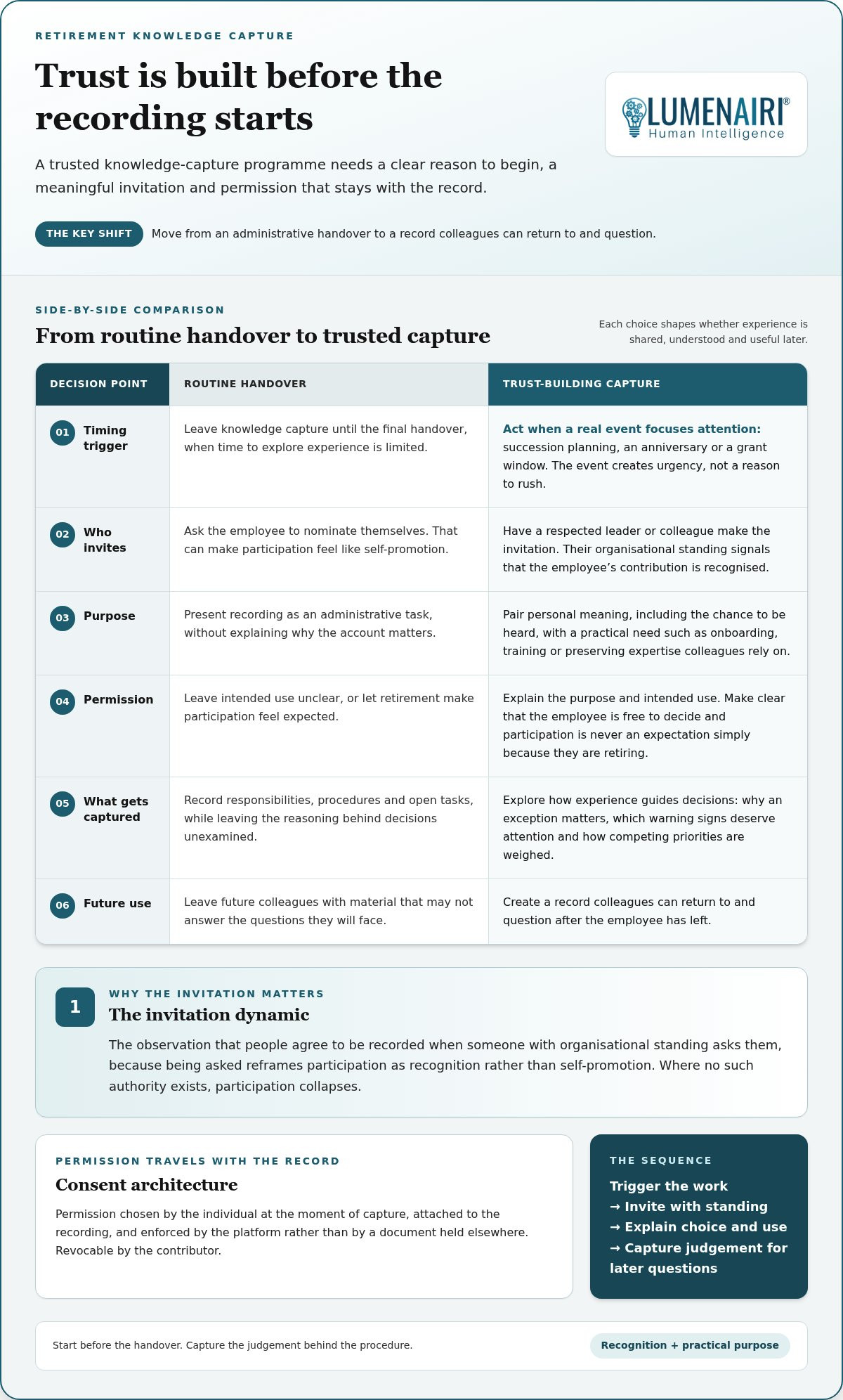
    An organisation can document a retiring employee’s procedures and still lose the judgement that made them work. Preserving the knowledge of retiring employees means capturing how they assess unfamiliar situations, not simply listing what they do.

    Most organisations recognise the value of a careful handover. Yet documents often cannot answer the questions future colleagues will have. And an invitation to record experience can feel like an administrative task or a request to promote oneself. Participation is as much a challenge as process.

    Knowledge-capture efforts are more likely to begin when someone with organisational standing makes the invitation and the purpose is clear. Pairing personal meaning with operational value gives the programme a reason to start and continue. Permission must also travel with each recording and remain under the contributor’s control.

    The aim is a record colleagues can return to and question after the employee has left. That takes preparation before the handover begins.

    Key Takeaways

    • Start preserving the knowledge of retiring employees before the final handover, while there is time to capture the judgement behind their decisions.
    • Treat participation as its own challenge. An invitation from someone with organisational standing can make recording feel like recognition.
    • Use a succession, anniversary or grant window to create urgency, then pair the employee’s sense of contribution with a clear organisational purpose.
    • Plan for future colleagues to ask questions of the record, and ensure permission is attached to each recording, enforceable and revocable by its contributor.

    Preserving retiring employees’ knowledge cannot be left to the final handover

    Future colleagues may face a consequential decision without access to the judgement that once guided it. Preserving the knowledge of retiring employees must begin before the final handover, while there is time to explore how experience shapes decisions.

    An exit process usually serves immediate administrative needs. Responsibilities are reassigned, records are returned and open tasks are listed. Intentional knowledge capture has a different purpose: it asks what colleagues will need to understand when the employee is no longer available to explain the history behind a choice. Knowledge management includes ways of identifying and sharing organisational knowledge. Retirement makes the need to carry that knowledge forward especially visible.

    A handover records tasks more readily than judgement

    A procedure can explain what to do under expected conditions. It rarely captures why one exception matters, which warning signs deserve attention or how competing priorities should be weighed. A maintenance planner, for example, might document an inspection schedule. A successor may still need to know why one fault calls for immediate action while a similar one can wait. Unless someone deliberately draws out that distinction, it leaves with the person who knows it.

    Retirement makes an existing knowledge gap visible

    A departure can expose a gap that was already there. Colleagues may have relied on quick explanations, informal checks or an employee’s instinctive review without recognising how much depended on access to that person. When they leave, the questions remain, but the source of the answers is gone.

    That is why preserving experience should connect with enterprise learning and development, including how new employees are onboarded. When retained experience informs learning, newcomers can inherit context alongside procedures. Knowledge worth carrying forward needs attention before a departure turns everyday dependence into an organisational blind spot.

    The central barrier to preserving retiring employees’ knowledge is activation

    Preserving the knowledge of retiring employees begins with getting people to take part. Activation is the problem of getting people recorded at all, distinct from recording, storing or searching. An organisation can prepare every system and still have nothing to preserve if nobody accepts the invitation.

    An invitation changes the meaning of participation

    The invitation dynamic is the observation that people agree to be recorded when someone with organisational standing asks them, because being asked reframes participation as recognition rather than self-promotion. Where no such authority exists, participation collapses.

    Asking an employee to nominate themselves can feel like asking them to declare their own importance. A request from a respected leader or colleague changes the meaning. It signals that the organisation recognises the employee’s contribution and believes their perspective matters to those who will follow. The invitation should explain the purpose and leave the employee free to decide. Technology can support recording; it cannot create that recognition by itself.

    Two-layer value gives a programme a reason to begin and continue

    Two-layer value pairs emotional motivation with operational justification. The emotional layer is the opportunity to be heard and contribute an account of work that mattered. The operational layer connects that account to a real organisational need, such as onboarding, training or preserving expertise colleagues will rely on.

    Either layer alone is fragile. An administrative request gives little reason to participate. A legacy appeal without a practical purpose may struggle to hold organisational attention. Together, the two layers recognise the employee’s contribution and show colleagues why the record deserves care.

    Activation also needs an occasion that gives the organisation a reason to act. A succession, anniversary or grant window can focus attention and support budgeting for a programme. The invitation should come from someone with standing, explain why this person’s experience matters and connect their contribution to a clear future use. For organisations considering how recorded expertise could support enterprise learning and development, that connection can make the request more meaningful and the programme easier to sustain.
    Preserving the Knowledge of Retiring Employees Starts Before the Handover

    Trusted knowledge capture requires a trigger, permission and authentic records

    Leaders can build trust in a knowledge-capture programme by identifying a trigger, appointing an inviter, inviting participation and capturing the account with permission. Each step matters. Without willing participation, there is no testimony. Without clear consent, there is no sound basis for use.

    A trigger gives leaders a reason to act now

    A real organisational event can bring a diffuse concern into focus. Succession planning may reveal that a role depends on one person’s judgement. An anniversary may prompt reflection on how the organisation’s work has evolved. A grant window may create an opportunity to plan a programme and direct attention towards it. The event creates urgency, not a reason to rush. Leaders can use it to define what knowledge matters, who should invite the contributor and how the record may serve future colleagues.

    Choose the inviter carefully. The request should come from someone whose standing makes clear that the employee’s contribution is recognised. It should explain the purpose, intended use and the employee’s choice. Participation should never be presented as an expectation simply because someone is retiring.

    Authenticity and consent belong in the capture design

    A trustworthy oral history framework begins with preserving what a person actually said. Generated material is not acceptable for an archive, whatever its production quality. A genuine account shows what the person believed and experienced; it does not prove that every statement is objectively true.

    Consent architecture is permission chosen by the individual at the moment of capture, attached to the recording, and enforced by the platform rather than by a document held elsewhere. It is revocable by the contributor. Permission must be explicit and explained in plain language. It cannot be treated as a default or broadened later by the organisation.

    When an organisation is ready to shape a knowledge-capture programme around workforce learning, explore Lumenairi’s enterprise learning and development approach.

    Recorded answers remain useful when future colleagues can question them

    A record earns its place when it can meet a future need. Preserving the knowledge of retiring employees means making their experience available to colleagues with questions no handover could anticipate. Searchable documents help people find what was written. A question put to a recorded account can reach what the employee actually said.

    Future retrieval depends on what the person actually said

    Conversational video is a format in which a person is recorded once, at length, answering the questions they are most likely to be asked, and viewers then ask their own questions in natural language and receive the recorded answer in that person’s own voice and face. Nothing is generated. Every answer is something the person actually said.

    This distinction sets a boundary. If a future colleague asks about an exception the employee never addressed, the record cannot honestly supply their answer. It can offer the closest recorded response or make clear that the question remains unanswered. The testimony is genuine evidence of what the person believed and experienced, not proof that every statement is objectively true.

    The mechanism matters because expertise resides in people. It becomes useful later when colleagues can ask questions and receive the person’s actual answers. That requires a recording made at length and with consent. Lumenairi builds conversational-video infrastructure for organisations to record that knowledge and make it askable.

    A knowledge programme should serve people who never become customers

    The purpose reaches beyond any platform. It is to help colleagues learn, preserve institutional memory and make informed decisions after an experienced employee has departed. A practical next step is to identify the organisational event that makes the need urgent, then decide who has the standing to invite participation. The employee can then choose whether to contribute and what permission applies to the record.

    The conversation ends. The questions continue. A considered record gives future colleagues a way to listen.

    Make the next invitation count

    Choose one piece of expertise future colleagues will need, then identify who can credibly invite its holder to share it. That gives the programme a human beginning. It recognises what the employee knows rather than treating the recording as another exit task.

    Then consider how colleagues will find an answer when new questions arise. Conversational video makes recorded answers askable. Nothing is generated; each answer is something the employee actually said. Its value lies in giving future colleagues access to a genuine account they can assess in context.

    Explore how organisations preserve knowledge with Lumenairi and take the next step towards a record future colleagues can question.

    Frequently Asked Questions

    Is an exit interview enough to preserve a retiring employee’s knowledge?

    No. An exit interview can identify decisions or relationships that deserve fuller attention, but colleagues will still need a way to locate relevant answers when circumstances differ. Treat it as a starting point for focused follow-up.

    Can an employee withdraw permission after recording?

    Yes. The contributor can revoke permission, and the platform must enforce that choice for the specific recording. Explain before participation who may use it and for what purpose, and make clear that the organisation cannot broaden permission on the contributor’s behalf.

    What if a later question has no recorded answer?

    The record should make the gap clear rather than supply an answer the employee never gave. If the contributor is willing and the knowledge remains relevant, invite a further recording with clear permission and keep it distinct from the earlier account.

    Does an authentic recording prove that every statement is factually true?

    No. Authenticity shows that the employee gave the recorded answer, not that every recollection or interpretation has been independently verified. Colleagues can assess the account alongside other organisational records, keeping any later verification or qualification distinct from the original answer.

    Lumenairi glossary

    Conversational video: A format in which a person is recorded once, at length, answering the questions they are most likely to be asked, and viewers then ask their own questions in natural language and receive the recorded answer in that person’s own voice and face. Nothing is generated. Every answer is something the person actually said.

    The invitation dynamic: The observation that people agree to be recorded when someone with organisational standing asks them, because being asked reframes participation as recognition rather than self-promotion. Where no such authority exists, participation collapses.

    Activation: The problem of getting people recorded at all, distinct from recording, storing, or searching.

    Two-layer value: Pairing of emotional motivation with operational justification.

    Consent architecture: Permission chosen by the individual at the moment of capture, attached to the recording, and enforced by the platform rather than by a document held elsewhere. Revocable by the contributor.

  • Succession Planning and Knowledge Capture: Securing the Human Layer

    Succession Planning and Knowledge Capture: Securing the Human Layer

    An organisation’s most vital asset is the quiet substrate of judgment held within its leaders. When a veteran departs, the company often settles for a handover note that captures what they did, but never why. Effective succession planning knowledge capture requires more than a digital filing cabinet. You likely recognise the hollow feeling of a legacy reduced to a PDF.

    This article explores why traditional transfer methods fail and how we can secure the Human Layer. This is the collective substrate of everything an organisation does to recognise, protect and grow the value its people carry. An asset class, not a programme. We will examine how to build a queryable record of executive judgment through conversational video. This is a format in which a person is recorded once, at length, answering the questions they are most likely to be asked, and viewers then ask their own questions in natural language and receive the recorded answer in that person’s own voice and face. Nothing is generated. Every answer is something the person actually said.

    Key Takeaways

    • Recognise the Human Layer as a measurable asset class. Protecting this substrate ensures your organisation survives leadership transitions without losing its identity.
    • Leverage the invitation dynamic to secure participation from retiring executives. Leaders share wisdom when they feel their experience is being recognised.
    • Implement authentic succession planning knowledge capture through conversational video. This format preserves the reasoning and judgment that define your organisation’s value.
    • Build a queryable Living Library™ to serve as a bridge between generations. This record allows new hires to ask questions and receive answers in a leader’s actual voice.

    The Succession Wave and the Erosion of the Human Layer

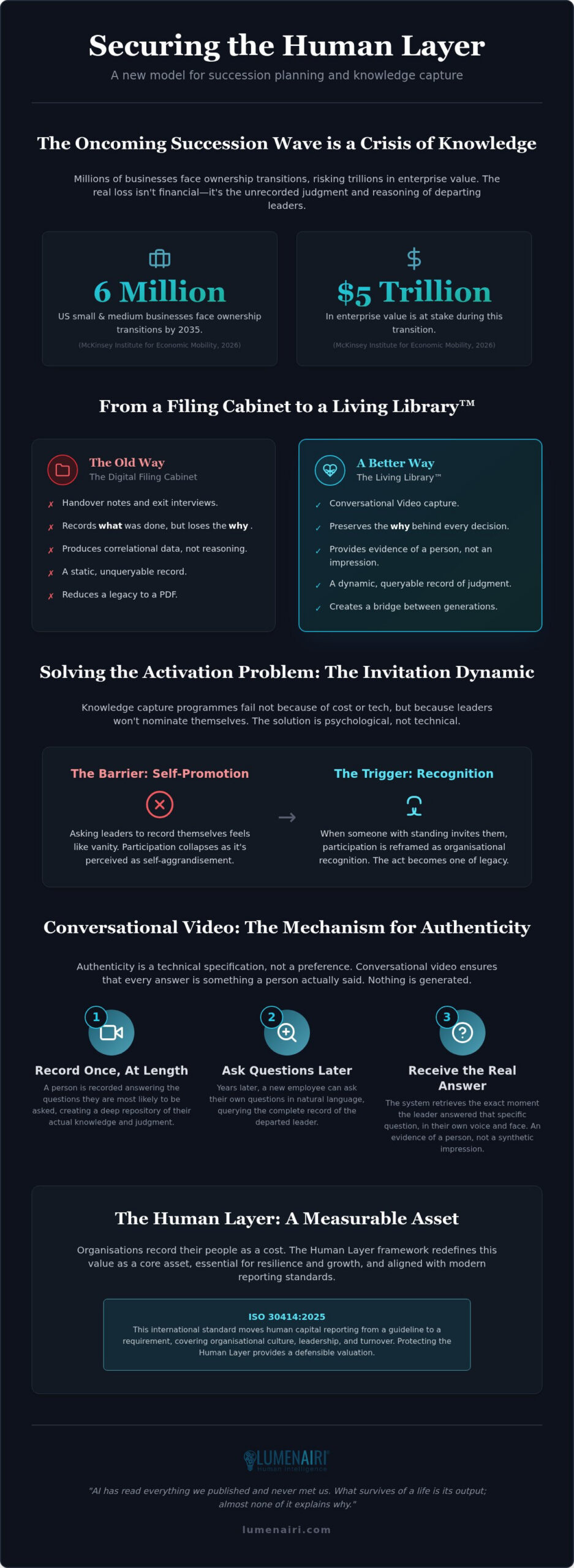
    McKinsey’s Institute for Economic Mobility estimates around six million US small and medium-sized businesses will face ownership transitions by 2035. This shift represents up to $5 trillion in enterprise value. Most organisations record their people entirely as a cost. They overlook the asset these individuals carry. We call this the Human Layer. The Human Layer is the collective substrate of everything an organisation does to recognise, protect and grow the value its people carry. An asset class, not a programme.

    Traditional succession planning knowledge capture focuses on the wrong record. It treats a leader’s history like a fingerprint or a genome. It records the surface. It misses the story. When we lose the story, we lose the reasoning that defines the organisation’s value.

    Why Handover Notes Fail to Capture Judgment

    Documentation records what was done. It rarely explains the reasoning. Judea Pearl’s The Book of Why argues the data we have is overwhelmingly correlational. It records what accompanied what, and almost nothing about the reasoning that produced it. Leadership is built on tacit wisdom. A PDF cannot capture the nuances of a critical historical decision. New hires need the reasoning. They need more than the result.

    The CFO Case for Human Capital Valuation

    Legacy preservation is directly linked to enterprise value. We use the Human Layer Index to diagnose asset health. The Human Layer Index is a diagnostic across six paired dimensions, each pairing what employees experience of their own value with what the organisation is actively doing to produce that experience. Human capital reporting is now standardised. ISO 30414:2025, published August 2025, moved from guidelines to requirements for human capital reporting. Protecting the Human Layer provides a defensible valuation of human capital.

    Solving the Activation Problem via the Invitation Dynamic

    Succession planning knowledge capture often fails because we misunderstand the psychology of the contributor. We assume leaders want to be recorded. They don’t. Self-nomination feels like self-promotion. It feels like vanity. Most experienced professionals would rather let their wisdom vanish than appear to boast about their own achievements. This is why the invitation dynamic is the essential trigger for participation.

    The invitation dynamic is the observation that people agree to be recorded when someone with organisational standing asks them, because being asked reframes participation as recognition rather than self-promotion. Where no such authority exists, participation collapses. This shift turns a technical task into a profound act of being heard. It creates a bridge between generations. This shift is the foundation of effective succession planning knowledge capture within resilient institutions.

    Why Knowledge Capture Programmes Stall

    The primary constraint is rarely cost or equipment. It is activation. Programmes stall because they lack a specific trigger event, such as a merger, a transition, or a founder exit. Without an authority-led invitation, these initiatives lose momentum and eventually collapse. A successful programme must offer two layers of value. It provides an emotional legacy for the individual. It secures operational utility for the firm. Both layers are necessary to ensure the project survives a budget cycle.

    From Self-Promotion to Institutional Recognition

    Being asked to record a story validates a career. It signals that the organisation recognises the judgment behind the decisions. In our Founder Heritage framework, the role of the inviter is critical. They transform the experience from a bureaucratic requirement into a legacy asset. This process moves beyond the standard exit interview. It ensures the ‘why’ behind historical decisions is preserved. You can learn more about securing these narratives through our Enterprise Learning and Development programmes.

    Succession Planning and Knowledge Capture: Securing the Human Layer

    Authenticity as a Specification in Legacy Documentation

    A record that cannot demonstrate its own reality is merely content. It is not a record. Within the framework of succession planning knowledge capture, authenticity has become a technical specification rather than a stylistic preference. We must distinguish between the evidence of a life and a mere impression of one. This distinction relies on conversational video. This is a format in which a person is recorded once, at length, answering the questions they are most likely to be asked, and viewers then ask their own questions in natural language and receive the recorded answer in that person’s own voice and face. Nothing is generated. Every answer is something the person actually said.

    Conversational Video vs Synthetic Impressions

    Synthetic avatars produce plausible words a person never spoke. They offer an impression. Conversational video retrieves words they did speak, providing evidence. For archival or legal purposes, synthetic media is unacceptable. It lacks the weight of human experience. Trust is built through the person’s own voice and face. In a Living Library™, we ensure that every response is authentic. This is guaranteed by provenance at capture. This is cryptographic proof of authenticity applied at the moment of recording, which cannot be forged and cannot be added retrospectively to generated material.

    Consent Architecture and the Right to be Heard

    Permission should be architecture, not paperwork. We utilise consent architecture. This is permission chosen by the individual at the moment of capture, attached to the recording, and enforced by the platform rather than by a document held elsewhere. It is revocable by the contributor. This ensures that the right to be heard remains with the person who spoke. It contrasts sharply with default terms-of-service checkboxes that often ignore the contributor’s intent. You can protect your organisation’s most valuable voices by implementing Lumenairi Enterprise to secure your Human Layer.

    Transforming Tacit Knowledge into a Queryable Living Library™

    Knowledge is an active asset. It only functions if it remains askable. Effective succession planning knowledge capture transforms static data into a Living Library™. This is the queryable, growing record of voice, expertise and story that conversational video produces. A destination, not a feature. We move beyond the archive as a graveyard. We treat it as a living resource for onboarding and leadership development.

    The infrastructure relies on a specific shorthand. The Lumenairi App captures. Lumenairi Core curates. By using mobile conversational video, organisations achieve distributed collection. Mobile conversational video is the complete conversational video pipeline — scripting, consent, capture, processing and publishing — running from a smartphone rather than requiring a studio. Distributed collection is a vital part of succession planning knowledge capture. It allows many trained interviewers to capture in parallel. It removes the rationing of the past. Every critical voice is heard.

    Building the Infrastructure for Virtual Ancestry

    We create the conditions for virtual ancestry. This is becoming an ancestor to people who share none of your DNA, through the survival of your story rather than your genes. When a new hire hears a leader’s reasoning, they inherit a culture. You can explore these Enterprise solutions to build institutional memory.

    The Mechanism of Retrieval: Search by Meaning

    Retrieval must understand natural language. It must go beyond keywords. Lumenairi Core manages this complexity. It ensures that a question asked years later reaches the answer the person actually gave. We also prioritise custody. Custody is holding and operating an archive on behalf of its owner, as distinct from owning it. Implies portability, independent mirroring, and survival independent of any single organisation. This ensures the record outlasts the organisation that gathered it. The knowledge an organisation depends on exists in people. It is only useful later if someone can ask them a question and get their actual answer. That requires the person to have been recorded, at length, with consent. Lumenairi provides the infrastructure to make this possible.

    Securing the Future of Institutional Wisdom

    The Human Layer is an asset that requires active protection. True succession planning knowledge capture focuses on preserving judgment rather than filing documents. By leveraging the invitation dynamic and conversational video, organisations turn fleeting expertise into a permanent Living Library™. This ensures that new hires engage with the reasoning of those who built it. They move beyond simply reading history. They inherit a legacy.

    Research from MIT Sloan and McKinsey confirms that legacy is a primary driver of enterprise value. In my thirty years of archival work, I’ve seen how compliant records like ISO 30414:2025 strengthen the human substrate. We have the tools to ensure your people’s wisdom endures. It’s time to build a record that actually speaks back. I invite you to explore how Lumenairi secures your organisation’s Human Layer. Your leaders have spent decades building their judgment. Ensure it remains an askable asset for the generations that follow.

    Frequently Asked Questions

    What is the difference between conversational video and a standard video interview?

    Conversational video differs from standard interviews by allowing the viewer to ask questions and receive authentic, recorded responses. Conversational video: A format in which a person is recorded once, at length, answering the questions they are most likely to be asked, and viewers then ask their own questions in natural language and receive the recorded answer in that person’s own voice and face. Nothing is generated. Every answer is something the person actually said.

    Why is the invitation dynamic critical for succession planning?

    The invitation dynamic is essential because it transforms a technical task into a process of institutional recognition. The invitation dynamic: The observation that people agree to be recorded when someone with organisational standing asks them, because being asked reframes participation as recognition rather than self-promotion. In succession planning knowledge capture, leaders rarely nominate themselves. When an authority figure makes the request, it validates their expertise and ensures participation does not collapse.

    How does conversational video protect against synthetic media or deepfakes?

    We protect the record by applying cryptographic verification at the exact moment of recording. Provenance at capture: Cryptographic proof of authenticity applied at the moment of recording, which cannot be forged and cannot be added retrospectively to generated material. This distinguishes real testimony from synthetic deepfakes. While avatars produce plausible words a person never spoke, conversational video only retrieves words they did speak. This provides a defensible evidence base for the organisation.

    Can a contributor withdraw their story from the archive later?

    Contributors retain full control over their recordings through our integrated permission system. Consent architecture: Permission chosen by the individual at the moment of capture, attached to the recording, and enforced by the platform rather than by a document held elsewhere. It is revocable by the contributor. If a participant chooses to withdraw their story, the platform removes it from access. This ensures that being heard is always a choice rather than a permanent obligation.

    What is the Human Layer and why should a CEO care about it?

    The Human Layer is the most critical asset a CEO manages because it contains the organisation’s collective judgment. The Human Layer: The collective substrate of everything an organisation does to recognise, protect and grow the value its people carry. An asset class, not a programme. Effective succession planning knowledge capture secures this asset. It provides a defensible valuation of human capital while ensuring that vital reasoning survives leadership transitions.

  • Capturing Institutional Memory: A Guide to Preserving the Human Layer™

    Capturing Institutional Memory: A Guide to Preserving the Human Layer™

    Every month, over three million professionals walk away from their desks, taking decades of unwritten wisdom with them. It is a quiet tragedy when a founder’s intuition or a senior expert’s judgement simply vanishes into the ether. You’ve likely felt the frustration of a project stalling because the only person who understood the “why” behind a decision is no longer in the building. While many organisations search for knowledge capture tools for enterprises, most find only cold databases that fail to capture the soul of the work.

    This guide offers a more profound resolution. You’ll learn how to transform fleeting expertise into a permanent, queryable asset using conversational video, which we define as an asynchronous, AI-facilitated dialogue that preserves both spoken words and human nuance. By embracing the invitation dynamic, you can build a Living Library™ that serves as a bridge between generations. We will show you how to measure the Human Layer™ as a tangible asset, ensuring your collective memory remains a trustworthy archive that outlasts the current team.

    Key Takeaways

    • Recognise the Human Layer™ as a measurable asset class. Move beyond viewing expertise as a cost and begin treating your collective memory as a sacred, permanent resource.
    • Discover how knowledge capture tools for enterprises utilise conversational video to preserve the “why” behind every decision, capturing the depth that written data leaves behind.
    • Overcome the activation barrier through the power of the invitation dynamic. Ensure your experts feel the weight of their own significance when asked to share their wisdom.
    • Establish a queryable Living Library™ to safeguard institutional memory. Create an archive of expert judgement that guides your future team with the voices of their predecessors.

    The Silent Erosion of the Human Layer™ in the Enterprise

    The Human Layer™ represents the collective substrate of everything an organisation does to recognise, protect, and grow the value its people carry. It’s the invisible yet vital foundation of every legacy. Sadly, most corporate structures are designed to overlook it. Enterprises typically record their people as recurring costs on a balance sheet rather than appreciating assets. This fundamental misclassification leads to a devastating loss of institutional memory whenever a key individual departs. When wisdom walks out the door, the organisation loses a piece of its soul.

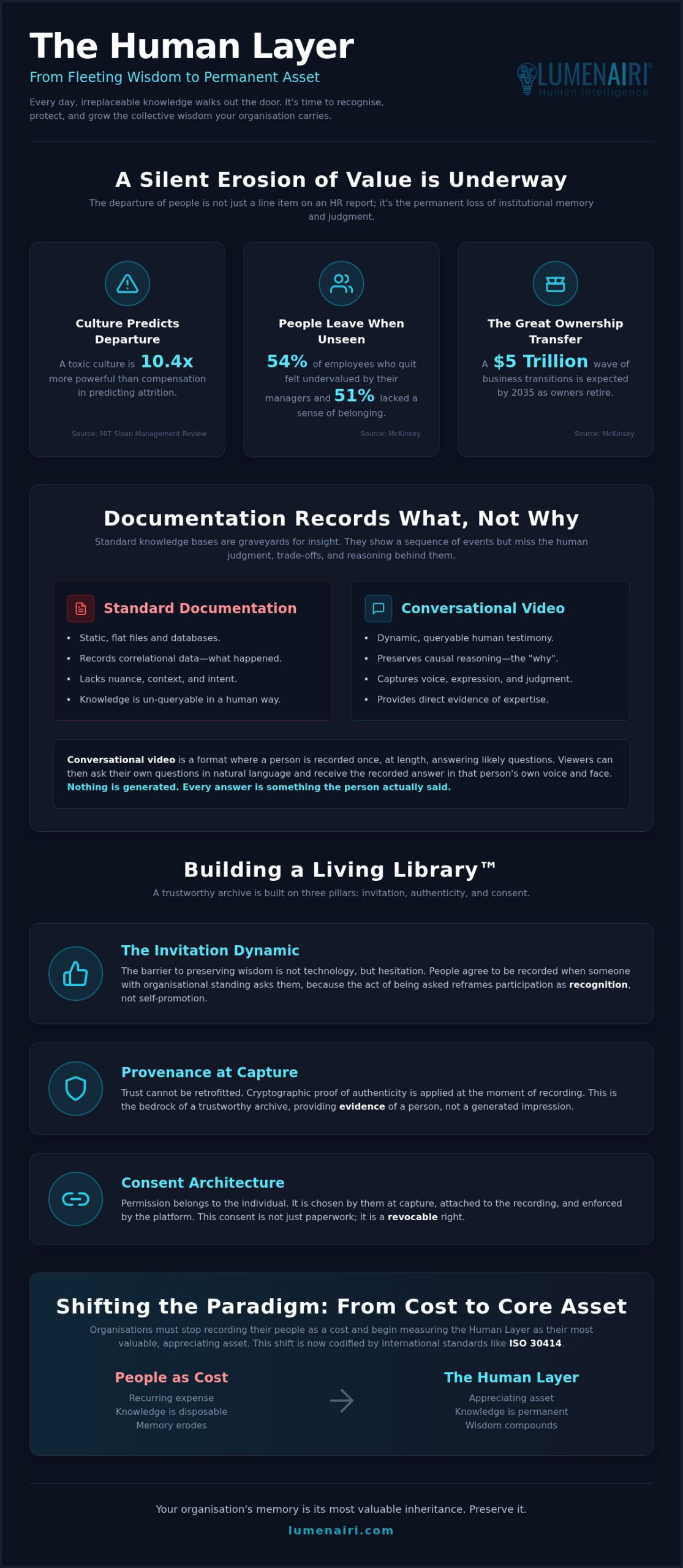
    The stakes of this erosion are immense. By 2035, small and medium businesses face a staggering $5 trillion enterprise value transition as founders retire. Without sophisticated knowledge capture tools for enterprises, much of that value will simply evaporate into the ether. This attrition isn’t just about salary. An MIT Sloan study revealed that toxic culture is 10.4 times more powerful than pay in predicting employee departure. When experts feel their lifelong judgement is treated as disposable data, they take their context with them, leaving the next generation to start from zero.

    ISO 30414 and the Standardisation of Human Capital

    A global shift is underway to rectify this imbalance. Since November 2020, SEC rules have required public companies to disclose material human capital information, treating people as a core driver of value. The arrival of ISO 30414:2025 further codifies this, providing 69 distinct metrics to standardise how we report on the human element. Organisations can now move from vague sentiment to precise measurement. Tools like the Human Layer Index allow leaders to diagnose the health of their collective wisdom. By quantifying this asset, we stop viewing knowledge capture tools for enterprises as mere software and begin seeing them as the guardians of a sacred corporate ancestry.

    Why Documentation Fails to Capture Institutional Memory

    Standard documentation platforms often act as a graveyard for insight. They record that a choice was made, yet the underlying logic, the subtle trade-offs, and the hard-won experience remain locked away. Written logs are correlational. They show the sequence of events but lack the heartbeat of intent. This is why many knowledge capture tools for enterprises fail to stem the tide of attrition. They provide a map but no compass, leaving successors to navigate complex landscapes without the benefit of their predecessor’s judgement.

    Conversational video offers a profound alternative to these static files. We define this as a format where a person is recorded once, at length, answering likely questions, which then allows future viewers to ask follow-ups in natural language. Unlike synthetic avatars or generative AI, nothing is manufactured in a Lumenairi record. It is a preservation of truth. By hearing a mentor’s actual voice and seeing their expressions, successors experience the “empathy effect”. This transforms a simple transfer of information into a transfer of values, building empathy as a vital skill within the team. You can explore how these human-centric records are built through Founder Heritage initiatives.

    The Requirement for Authenticity: Provenance at Capture

    Trust cannot be retrofitted to media after the fact. In an era of digital manipulation, we rely on “provenance at capture”. This is cryptographic proof applied at the exact moment of recording to ensure the record remains immutable. While generative AI creates a mere “impression” of a person, conversational video provides “evidence” of their expertise. This distinction is the bedrock of a trustworthy archive. If a record is to last for generations, it must carry the weight of authenticity from its very inception. We do not seek to simulate a person. We seek to protect the evidence of their wisdom.

    Capturing Institutional Memory: A Guide to Preserving the Human Layer™

    Solving the Activation Problem: The Invitation Dynamic

    Most initiatives fail before they begin. The primary barrier to preserving wisdom isn’t the cost of hardware or the complexity of software. It’s the human hesitation to speak without being called. We call this the activation problem. While many knowledge capture tools for enterprises focus on the mechanics of storage, they often ignore the silence of an expert who feels self-conscious. True wisdom is frequently humble. It requires a specific catalyst to emerge from the quiet corners of an office.

    The invitation dynamic provides this catalyst. It’s the simple, profound act of being asked to share by someone with organisational standing. When a leader invites an expert to record their judgement, the dynamic shifts. Participation is no longer seen as self-promotion. It becomes an act of service. It is recognition. Programmes that rely on “volunteering” usually collapse into a void. Without an authority figure to initiate the request, the most valuable stories remain unsaid. People don’t want to broadcast; they want to be heard.

    Implementing a Story-Capture Programme

    Building a legacy requires a methodical approach. Start by identifying a trigger event, such as a major succession, a company anniversary, or a merger. These moments provide the necessary gravity. Next, ensure an authority figure issues the invitation directly to the participants. This validates their contribution as a sacred asset. Finally, deploy distributed collection using mobile conversational video to capture these insights at scale. This allows the wisdom of the many to be gathered with the same reverence as the wisdom of the few. To begin your journey, you can explore our Enterprise Learning and Development solutions to see how this dynamic transforms culture.

    Building a Living Library™ for Long-term Knowledge Retrieval

    The Living Library™ stands as the queryable, growing record of voice, expertise, and story produced by conversational video. It is the final destination for the Human Layer™, where fleeting moments are solidified into a collective substrate of wisdom. Knowledge is only truly useful if a successor can ask a specific question years later and receive the actual answer the expert gave in their own voice. This is why modern knowledge capture tools for enterprises must prioritise interactive retrieval over mere static storage. While the Lumenairi App captures these vital moments, Lumenairi Core serves as the essential curation platform. It is here that raw memory is refined, indexed, and transformed into a permanent corporate asset.

    Integrity is maintained through a sophisticated consent architecture. Permission is granted at the exact point of capture, travels inherently with the record, and remains fully revocable. This ensures that every individual remains the dignified master of their own narrative and legacy. By anchoring the record in the speaker’s original intent, we protect the archive from the distortions of time or organisational shifts. It is a system built on trust.

    The Bridge to Onboarding and L&D

    Integrating the process of onboarding new employees with these human records transforms a recruit’s first day into a meaningful encounter with the organisation’s ancestry. New hires no longer just read dry manuals; they hear the founder’s original intent and the senior expert’s nuanced judgement. This represents a profound cultural shift away from impersonal media toward the dignity of being heard. Finally, we must address the concept of custody. For an archive to truly outlast a corporation, it should be mirrored with permanent institutions. This guarantees that the wisdom captured today remains a sacred, accessible resource for future generations, enduring long after the current team has moved on.

    Securing the Future of Your Collective Wisdom

    The preservation of the Human Layer™ is not merely a technical requirement; it is a profound responsibility toward those who will follow. By moving beyond static documentation and embracing conversational video, you ensure that the “why” behind every decision remains accessible. We’ve explored how the invitation dynamic overcomes the silence of experts, transforming fleeting knowledge into a permanent, queryable record. In an era of rapid attrition, selecting the right knowledge capture tools for enterprises is the difference between a fading memory and a vibrant legacy.

    Lumenairi stands as a prestigious guardian of these stories. Our founders hold the first interactive-video patents, and Stephen D. Smith brings 30 years of experience in testimony archives to our mission. We adhere strictly to ISO 30414:2025 standards to ensure your human capital is reported with the dignity it deserves. Discover how Lumenairi helps enterprises protect their Human Layer. Your team’s wisdom is the soul of your organisation. Protect it today to guide the leaders of tomorrow.

    Frequently Asked Questions

    What is the difference between conversational video and an AI avatar?

    Conversational video is a recording of what a person actually said, preserving their real voice and face without any synthetic generation. Unlike AI avatars that create a manufactured impression, this format ensures every answer is evidence of a real human’s judgement. It allows viewers to interact with an authentic record in natural language. This distinction is vital for maintaining truth and trust within a long-term Living Library™.

    How does the invitation dynamic help in capturing institutional memory?

    The invitation dynamic overcomes the psychological barrier of self-consciousness by reframing participation as a form of recognition. Most experts hesitate to record their own wisdom because it feels like self-promotion. However, when a leader with organisational standing personally asks them to contribute, the act becomes a meaningful contribution to the collective legacy. This ensures that the most valuable institutional memory is captured rather than lost to silence.

    Is conversational video content permanent or can contributors withdraw consent?

    Consent is an explicit, non-default choice that remains entirely under the control of the contributor. While the goal is to build a permanent asset, our consent architecture ensures that every individual retains a revocable right to withdraw their material. If a contributor chooses to withdraw, access to their recording is removed from the archive. This ensures the Living Library™ remains a respectful and dignified destination for all participants.

    What is provenance at capture and why is it necessary for enterprise archives?

    Provenance at capture is cryptographic proof of authenticity applied at the exact moment of recording to prevent forgery. In an age of synthetic media, trust cannot be retrofitted to a record after it has been created. By attaching this proof at the source, knowledge capture tools for enterprises provide undeniable evidence that the recording is genuine. This technical assurance is necessary to maintain the long-term integrity of any professional archive.

    How does conversational video improve employee onboarding and L&D?

    Conversational video transforms onboarding from a dry review of manuals into a profound encounter with an organisation’s heritage. New hires can ask questions and hear the original intent of founders or senior experts in their own voices. This builds the empathy effect, where successors learn not just the “what” but the “why” of corporate culture. It shifts the focus from content creation to a culture of being heard.

  • The Invitation Dynamic: Solving the Activation Problem in Knowledge Capture

    The Invitation Dynamic: Solving the Activation Problem in Knowledge Capture

    Institutional memory does not fade because of a lack of storage. It vanishes because we ask the wrong questions of the wrong people. We often assume that experts will naturally want to document their life’s work. In reality, the most experienced founders and engineers find the idea of recording themselves deeply uncomfortable. It feels like vanity. You’ve likely watched expensive knowledge management programmes fail because participation rates stayed low. The missing piece is the invitation dynamic.

    This shift in perspective moves the act of being heard from an exercise in self-promotion to an act of recognition. You’ll discover that the primary barrier to preserving wisdom is a psychological hurdle. It’s rarely a technical one. This essay provides a framework to transform technical expertise into a searchable organisational asset. We’ll look at how to make contribution feel like an honour. By establishing a Living Library™, you ensure that the human layer of your organisation remains queryable for generations to come.

    Key Takeaways

    • Identify the activation problem as the psychological resistance experts feel toward recording their own stories when framed as self-promotion.
    • Apply the invitation dynamic to transform a request for data into a formal act of recognition initiated by someone with organisational standing.
    • Align the two-layer value of a capture programme by pairing the contributor’s legacy with the firm’s operational needs for onboarding.
    • Establish a Living Library™ using conversational video to ensure The Human Layer remains an askable asset without the risk of synthetic distortion.

    The Activation Problem: Why Knowledge Capture Programmes Stall

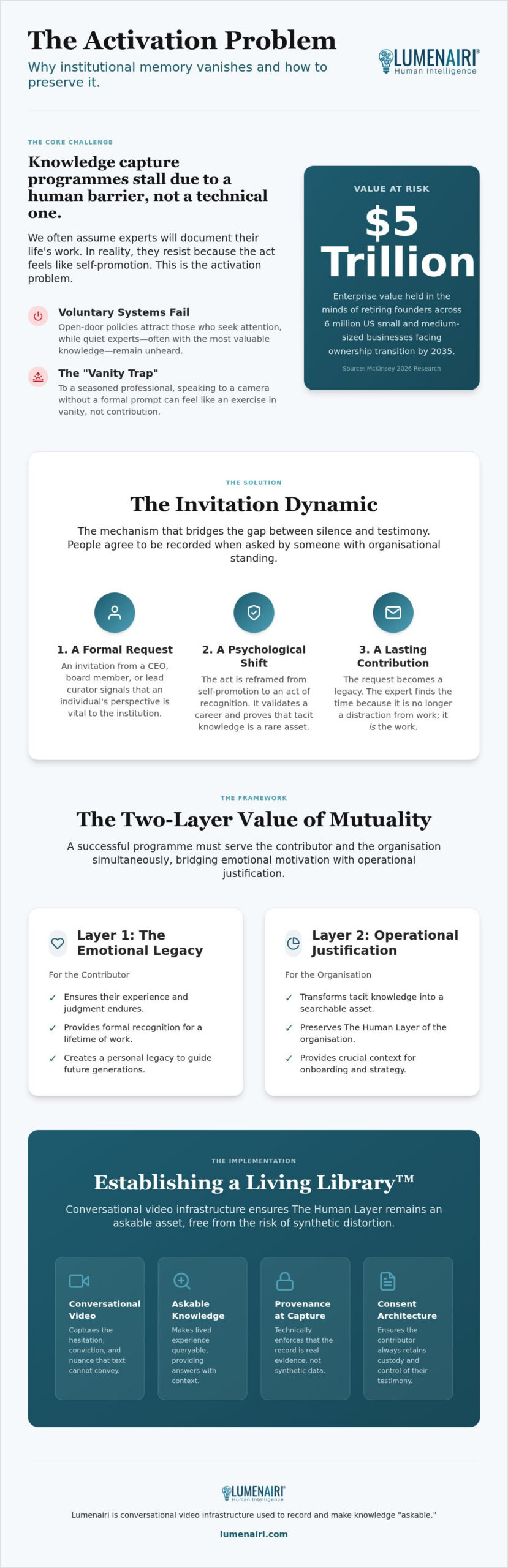
    Success in preserving institutional memory rests with the individual. It is less about the platform. We often mistake a lack of data for a lack of tools. This is the activation problem. It is the deep psychological resistance experts feel when asked to document their own experience. McKinsey 2026 research indicates that six million US small and medium-sized businesses will face ownership transitions by 2035. This represents $5 trillion in enterprise value currently held in the minds of retiring founders. This loss impacts twelve million jobs and billions in local spending. Without a shift in how we engage these individuals, that wisdom simply disappears.

    The Limits of Voluntary Documentation

    Open-door recording policies rarely produce a representative archive. They invite the vanity trap. Those who seek attention participate, while the quiet experts remain unheard. Nobody records themselves. To a seasoned professional, talking to a camera feels like self-promotion rather than a contribution to the Human Layer. Voluntary systems fail because they lack the invitation dynamic. They miss the formal request that validates an individual’s worth to the organisation. Without this external prompt, the most valuable stories remain untold.

    Why Technology Cannot Solve a Human Barrier

    A more powerful app or a cheaper camera does not change the social dynamic of being heard. The challenge of knowledge transfer is fundamentally human. It requires trust and recognition. If the record is not real, it is not a record. Anything generated by synthetic means is merely data. It lacks the weight of lived experience. We must solve the human hurdle before we can expect the technology to function as a bridge between generations. Technology is the vessel, but the invitation is the catalyst.

    Defining the Invitation Dynamic: From Self-Promotion to Recognition

    The mechanism that bridges the gap between silence and testimony is the invitation dynamic. It is the observation that people agree to be recorded when someone with organisational standing asks them. This simple act of asking transforms the nature of being heard. The focus moves away from a founder broadcasting their own achievements. It becomes a response to a collective need. When a CEO or a lead curator extends the request, it signals that the individual’s perspective is a vital component of the institution. This is quite different from a mass email sent by an HR department. The latter feels like an administrative chore. The former feels like a duty of care toward the future.

    We see this in the empathy effect. Recorded testimony creates a visceral connection between the speaker and the listener. It captures the hesitation, the conviction, and the nuance of a human voice. Recent academic research on motivation suggests that social expectations and perceived value are primary drivers in knowledge sharing. We store more than data. We preserve the Human Layer.

    The Psychology of Being Asked

    Being asked validates a career. It shifts the internal narrative from personal storytelling to being recognised for a contribution. This validation is essential for those who possess deep, tacit knowledge. They often consider their expertise to be common sense. An invitation proves that their judgment is actually a rare organisational asset.

    Authority as a Catalyst for Capture

    Authority acts as a catalyst. It overcomes the common objection of being too busy. When a respected leader frames the recording as a priority mission, the expert finds the time. It’s no longer a distraction from work. It is the work. For those looking to secure founder heritage, the strength of the invitation dynamic determines the depth of the archive. It turns a request into a legacy.

    The Invitation Dynamic: Solving the Activation Problem in Knowledge Capture

    The Two-Layer Value: Emotional Motivation and Operational Justification

    A successful knowledge capture programme requires a two-layer value. It must serve the contributor and the organisation simultaneously. Emotional motivation alone cannot sustain an enterprise budget. Operational justification provides the necessary evidence for long-term support. We must bridge the gap between the poignant act of testimony and the cold requirements of a balance sheet. Many initiatives stall because they fail to address the barriers to knowledge transfer, such as a lack of perceived recognition.

    Layer One: The Emotional Legacy

    The first layer focuses on the individual. Every expert carries a quiet desire for their experience to endure. They want to know their judgment will guide those who follow. This is the essence of virtual ancestry. When we use the invitation dynamic, we honour this need. We provide a sense of permanence within the organisation’s culture. The contributor is more than a name on a file; they are a living presence in the company’s memory. This is the Human Layer at its most personal.

    Layer Two: The Operational Substrate

    The second layer is the business case. We must turn human wisdom into a queryable asset. Conversational video allows new hires to access founder judgment directly. This significantly reduces time-to-competency. It protects the firm from the loss of wisdom during ownership transitions. The ISO 30414:2025 standard now allows organisations to report human capital as a measurable asset. By capturing what people actually say, we transform tacit knowledge into an operational substrate. This ensures the wisdom of the past remains active in the decisions of the future. To see how this scales, explore our enterprise learning and development solutions.

    Implementing the Living Library™ through Conversational Video

    Capturing the authentic voice is the only way to preserve the Human Layer without the risk of synthetic distortion. Avatars and generated media lack the weight of evidence. They are data. They are not testimony. To truly honour the individual, we must record the evidence of their lived experience. Conversational video provides the mechanism to record a person once and make their knowledge askable for generations. This is the only way to fulfil the promise of the invitation dynamic because it ensures the subject is heard exactly as they intended. Lumenairi provides the infrastructure to turn these individual testimonies into a queryable collective memory.

    The Four Properties of a Trustworthy Record

    A record must possess four properties to remain a valid asset. These are Capture, Verify, Preserve, and Understand. We must ensure provenance at capture to protect the integrity of the wisdom. This requires applying cryptographic proof at the moment of recording. Such measures are non-negotiable for any enterprise seeking to build a permanent knowledge base. The consent architecture ensures that the contributor remains the ultimate owner of their testimony. The archive licence is always revocable. Trust is a technical enforcement. It is more than a legal agreement.

    From Distributed Collection to a Queryable Record

    The Lumenairi Mobile App enables distributed collection across an entire organisation. It takes the capture process directly to the subject. This removes the bottleneck of studio production and expensive crews. Once captured, Lumenairi Core allows for sophisticated curation and management of the Human Layer. This is how we move from isolated video files to a Living Library™. It is a queryable, growing record of an organisation’s voice and story. This ensures that the invitation dynamic functions as a technical commitment to being heard. Wisdom is never static. It remains available to those who need to ask the right questions.

    Securing the Human Layer for the Future

    The preservation of institutional wisdom requires a shift from passive storage to active recognition. We’ve seen that the primary barrier to knowledge transfer is a psychological hurdle. It’s the activation problem. By employing the invitation dynamic, you transform the act of being heard from a chore into a significant honour. This method ensures that the most experienced voices within your organisation contribute to a queryable, operational substrate that survives the coming waves of ownership transitions. Our founders are pioneers in conversational video technology. We’ve proven this approach at a global scale through the creators of Dimensions in Testimony. With cryptographic provenance at capture, every record remains an authentic, trustworthy asset for the next generation.

    The future of your organisation depends on the stories you choose to protect today. Don’t let decades of judgment vanish with a single retirement. Learn how to deploy the invitation dynamic in your organisation with Lumenairi. It is time to turn human expertise into an enduring legacy.

    Frequently Asked Questions

    What is the invitation dynamic in a business context?

    In a business context, the invitation dynamic is the observation that people agree to be recorded when someone with organisational standing asks them. It shifts the act of being heard from perceived self-promotion to an act of recognition. When a leader validates an expert’s experience, it overcomes the psychological resistance that stalls most knowledge initiatives. This formal request signals that the subject’s wisdom is a vital asset.

    Why is activation considered the primary barrier to knowledge capture?

    Activation is the primary barrier because experts rarely record themselves voluntarily. Most professionals feel that talking about their own achievements is vain or unnecessary. This psychological hurdle prevents valuable institutional knowledge from being documented. While technology provides the tools for storage, it cannot compel a person to speak. Only a structured programme addressing this social resistance ensures that critical expertise is captured before it leaves the organisation.

    How does conversational video differ from a standard video interview?

    Conversational video is a format in which a person is recorded once answering the questions they are most likely to be asked, and viewers then ask their own questions in natural language and receive the recorded answer in that person’s own voice and face. Nothing is generated. This differs from standard interviews because it creates a queryable record that stays useful long after the conversation ends, allowing for continuous knowledge retrieval.

    Can the invitation dynamic be used in museums or community archives?

    The invitation dynamic is essential for museums and community archives where trust is the foundation of every collection. Curators or community leaders act as the authority figures who invite contributors to share their testimonies. This formal recognition ensures that oral history projects capture representative stories rather than just those from the most vocal participants. It turns an archive into a Living Library™ by validating the significance of every individual’s contribution.

    What is the two-layer value in a story-capture programme?

    The two-layer value pairs emotional motivation with operational justification to ensure a programme’s sustainability. The first layer addresses the contributor’s need for legacy and virtual ancestry. The second layer provides the business case, such as using recorded judgment for onboarding or training. By serving both the personal desire to be heard and the organisational need for efficiency, the programme secures both participation and the long-term budget required for preservation.