

Institutional memory does not fade because of a lack of storage. It vanishes because we ask the wrong questions of the wrong people. We often assume that experts will naturally want to document their life’s work. In reality, the most experienced founders and engineers find the idea of recording themselves deeply uncomfortable. It feels like vanity. You’ve likely watched expensive knowledge management programmes fail because participation rates stayed low. The missing piece is the invitation dynamic.
This shift in perspective moves the act of being heard from an exercise in self-promotion to an act of recognition. You’ll discover that the primary barrier to preserving wisdom is a psychological hurdle. It’s rarely a technical one. This essay provides a framework to transform technical expertise into a searchable organisational asset. We’ll look at how to make contribution feel like an honour. By establishing a Living Library™, you ensure that the human layer of your organisation remains queryable for generations to come.
Key Takeaways
- Identify the activation problem as the psychological resistance experts feel toward recording their own stories when framed as self-promotion.
- Apply the invitation dynamic to transform a request for data into a formal act of recognition initiated by someone with organisational standing.
- Align the two-layer value of a capture programme by pairing the contributor’s legacy with the firm’s operational needs for onboarding.
- Establish a Living Library™ using conversational video to ensure The Human Layer remains an askable asset without the risk of synthetic distortion.
The Activation Problem: Why Knowledge Capture Programmes Stall
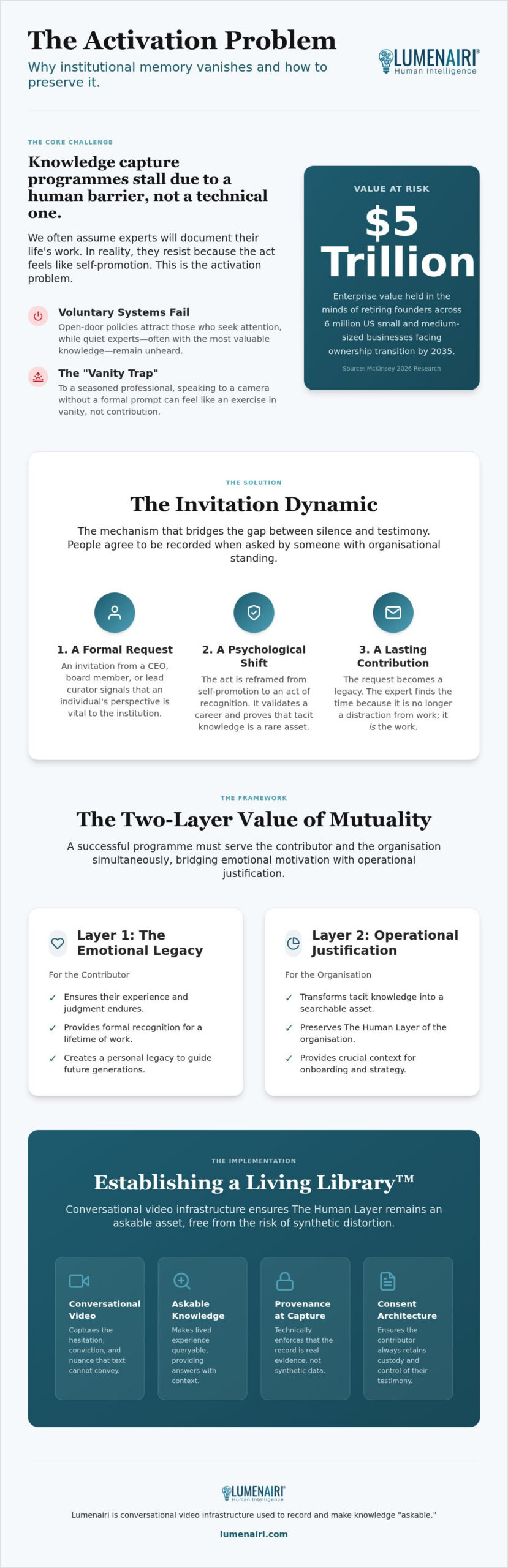
Success in preserving institutional memory rests with the individual. It is less about the platform. We often mistake a lack of data for a lack of tools. This is the activation problem. It is the deep psychological resistance experts feel when asked to document their own experience. McKinsey 2026 research indicates that six million US small and medium-sized businesses will face ownership transitions by 2035. This represents $5 trillion in enterprise value currently held in the minds of retiring founders. This loss impacts twelve million jobs and billions in local spending. Without a shift in how we engage these individuals, that wisdom simply disappears.
The Limits of Voluntary Documentation
Open-door recording policies rarely produce a representative archive. They invite the vanity trap. Those who seek attention participate, while the quiet experts remain unheard. Nobody records themselves. To a seasoned professional, talking to a camera feels like self-promotion rather than a contribution to the Human Layer. Voluntary systems fail because they lack the invitation dynamic. They miss the formal request that validates an individual’s worth to the organisation. Without this external prompt, the most valuable stories remain untold.
Why Technology Cannot Solve a Human Barrier
A more powerful app or a cheaper camera does not change the social dynamic of being heard. The challenge of knowledge transfer is fundamentally human. It requires trust and recognition. If the record is not real, it is not a record. Anything generated by synthetic means is merely data. It lacks the weight of lived experience. We must solve the human hurdle before we can expect the technology to function as a bridge between generations. Technology is the vessel, but the invitation is the catalyst.
Defining the Invitation Dynamic: From Self-Promotion to Recognition
The mechanism that bridges the gap between silence and testimony is the invitation dynamic. It is the observation that people agree to be recorded when someone with organisational standing asks them. This simple act of asking transforms the nature of being heard. The focus moves away from a founder broadcasting their own achievements. It becomes a response to a collective need. When a CEO or a lead curator extends the request, it signals that the individual’s perspective is a vital component of the institution. This is quite different from a mass email sent by an HR department. The latter feels like an administrative chore. The former feels like a duty of care toward the future.
We see this in the empathy effect. Recorded testimony creates a visceral connection between the speaker and the listener. It captures the hesitation, the conviction, and the nuance of a human voice. Recent academic research on motivation suggests that social expectations and perceived value are primary drivers in knowledge sharing. We store more than data. We preserve the Human Layer.
The Psychology of Being Asked
Being asked validates a career. It shifts the internal narrative from personal storytelling to being recognised for a contribution. This validation is essential for those who possess deep, tacit knowledge. They often consider their expertise to be common sense. An invitation proves that their judgment is actually a rare organisational asset.
Authority as a Catalyst for Capture
Authority acts as a catalyst. It overcomes the common objection of being too busy. When a respected leader frames the recording as a priority mission, the expert finds the time. It’s no longer a distraction from work. It is the work. For those looking to secure founder heritage, the strength of the invitation dynamic determines the depth of the archive. It turns a request into a legacy.
The Two-Layer Value: Emotional Motivation and Operational Justification
A successful knowledge capture programme requires a two-layer value. It must serve the contributor and the organisation simultaneously. Emotional motivation alone cannot sustain an enterprise budget. Operational justification provides the necessary evidence for long-term support. We must bridge the gap between the poignant act of testimony and the cold requirements of a balance sheet. Many initiatives stall because they fail to address the barriers to knowledge transfer, such as a lack of perceived recognition.
Layer One: The Emotional Legacy
The first layer focuses on the individual. Every expert carries a quiet desire for their experience to endure. They want to know their judgment will guide those who follow. This is the essence of virtual ancestry. When we use the invitation dynamic, we honour this need. We provide a sense of permanence within the organisation’s culture. The contributor is more than a name on a file; they are a living presence in the company’s memory. This is the Human Layer at its most personal.
Layer Two: The Operational Substrate
The second layer is the business case. We must turn human wisdom into a queryable asset. Conversational video allows new hires to access founder judgment directly. This significantly reduces time-to-competency. It protects the firm from the loss of wisdom during ownership transitions. The ISO 30414:2025 standard now allows organisations to report human capital as a measurable asset. By capturing what people actually say, we transform tacit knowledge into an operational substrate. This ensures the wisdom of the past remains active in the decisions of the future. To see how this scales, explore our enterprise learning and development solutions.
Implementing the Living Library™ through Conversational Video
Capturing the authentic voice is the only way to preserve the Human Layer without the risk of synthetic distortion. Avatars and generated media lack the weight of evidence. They are data. They are not testimony. To truly honour the individual, we must record the evidence of their lived experience. Conversational video provides the mechanism to record a person once and make their knowledge askable for generations. This is the only way to fulfil the promise of the invitation dynamic because it ensures the subject is heard exactly as they intended. Lumenairi provides the infrastructure to turn these individual testimonies into a queryable collective memory.
The Four Properties of a Trustworthy Record
A record must possess four properties to remain a valid asset. These are Capture, Verify, Preserve, and Understand. We must ensure provenance at capture to protect the integrity of the wisdom. This requires applying cryptographic proof at the moment of recording. Such measures are non-negotiable for any enterprise seeking to build a permanent knowledge base. The consent architecture ensures that the contributor remains the ultimate owner of their testimony. The archive licence is always revocable. Trust is a technical enforcement. It is more than a legal agreement.
From Distributed Collection to a Queryable Record
The Lumenairi Mobile App enables distributed collection across an entire organisation. It takes the capture process directly to the subject. This removes the bottleneck of studio production and expensive crews. Once captured, Lumenairi Core allows for sophisticated curation and management of the Human Layer. This is how we move from isolated video files to a Living Library™. It is a queryable, growing record of an organisation’s voice and story. This ensures that the invitation dynamic functions as a technical commitment to being heard. Wisdom is never static. It remains available to those who need to ask the right questions.
Securing the Human Layer for the Future
The preservation of institutional wisdom requires a shift from passive storage to active recognition. We’ve seen that the primary barrier to knowledge transfer is a psychological hurdle. It’s the activation problem. By employing the invitation dynamic, you transform the act of being heard from a chore into a significant honour. This method ensures that the most experienced voices within your organisation contribute to a queryable, operational substrate that survives the coming waves of ownership transitions. Our founders are pioneers in conversational video technology. We’ve proven this approach at a global scale through the creators of Dimensions in Testimony. With cryptographic provenance at capture, every record remains an authentic, trustworthy asset for the next generation.
The future of your organisation depends on the stories you choose to protect today. Don’t let decades of judgment vanish with a single retirement. Learn how to deploy the invitation dynamic in your organisation with Lumenairi. It is time to turn human expertise into an enduring legacy.
Frequently Asked Questions
What is the invitation dynamic in a business context?
In a business context, the invitation dynamic is the observation that people agree to be recorded when someone with organisational standing asks them. It shifts the act of being heard from perceived self-promotion to an act of recognition. When a leader validates an expert’s experience, it overcomes the psychological resistance that stalls most knowledge initiatives. This formal request signals that the subject’s wisdom is a vital asset.
Why is activation considered the primary barrier to knowledge capture?
Activation is the primary barrier because experts rarely record themselves voluntarily. Most professionals feel that talking about their own achievements is vain or unnecessary. This psychological hurdle prevents valuable institutional knowledge from being documented. While technology provides the tools for storage, it cannot compel a person to speak. Only a structured programme addressing this social resistance ensures that critical expertise is captured before it leaves the organisation.
How does conversational video differ from a standard video interview?
Conversational video is a format in which a person is recorded once answering the questions they are most likely to be asked, and viewers then ask their own questions in natural language and receive the recorded answer in that person’s own voice and face. Nothing is generated. This differs from standard interviews because it creates a queryable record that stays useful long after the conversation ends, allowing for continuous knowledge retrieval.
Can the invitation dynamic be used in museums or community archives?
The invitation dynamic is essential for museums and community archives where trust is the foundation of every collection. Curators or community leaders act as the authority figures who invite contributors to share their testimonies. This formal recognition ensures that oral history projects capture representative stories rather than just those from the most vocal participants. It turns an archive into a Living Library™ by validating the significance of every individual’s contribution.
What is the two-layer value in a story-capture programme?
The two-layer value pairs emotional motivation with operational justification to ensure a programme’s sustainability. The first layer addresses the contributor’s need for legacy and virtual ancestry. The second layer provides the business case, such as using recorded judgment for onboarding or training. By serving both the personal desire to be heard and the organisational need for efficiency, the programme secures both participation and the long-term budget required for preservation.