
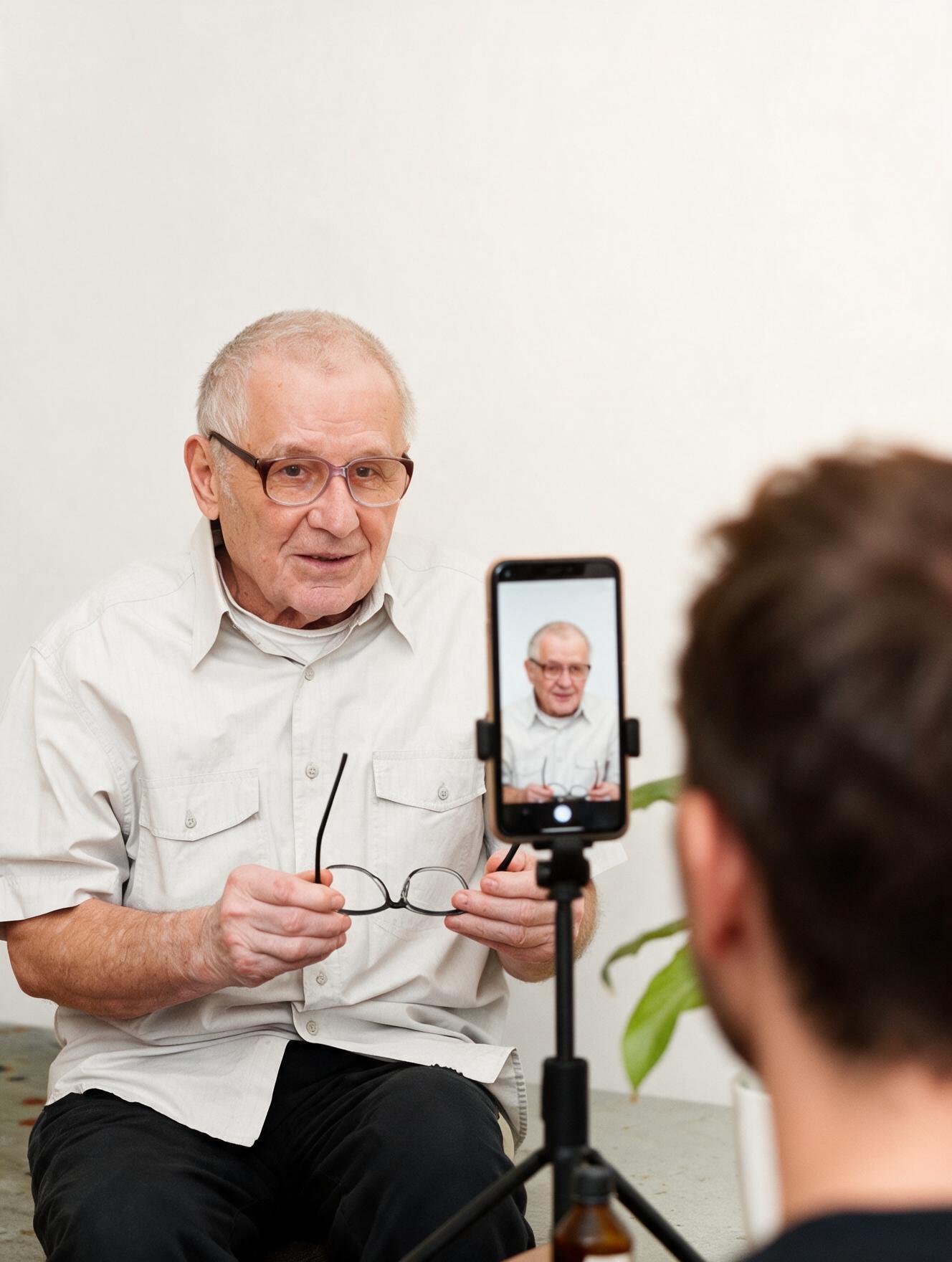
The most valuable asset within any organisation is the lived experience of its people. Yet, we consistently allow this wisdom to evaporate during leadership transitions. You likely recognise the frustration of searching through hours of linear video footage only to find the context has been lost. This is why understanding how conversational video works is essential for any steward of institutional memory. Synthetic voices ring hollow. We require a technical framework where recorded human testimony remains queryable, authentic, and respected.
I’ve spent thirty years at the intersection of testimony and technology. I’ve seen how often truth is sacrificed for convenience. You deserve a record that’s as reliable as a legal deposition and as accessible as a conversation. This primer details the technical infrastructure of the Living Library™. I will explain the mechanisms of provenance at capture and the consent architecture that ensures every word remains the property of its speaker. You’ll discover how to transform static archives into a Human Layer Index that serves as a bridge between generations.
Key Takeaways
- Define how conversational video works as a non-synthetic format where recorded human testimony remains a trustworthy, evidence-based record.
- Explore the capture pipeline that uses distributed collection to record an organisation’s memory through the Lumenairi App.
- Understand how provenance at capture and consent architecture provide cryptographic proof of authenticity for every recording.
- Learn how meaning-based search transforms linear files into a queryable Living Library™ that respects the speaker’s intent.
Beyond the Synthetic: Why Conversational Video Is Not an AI Avatar
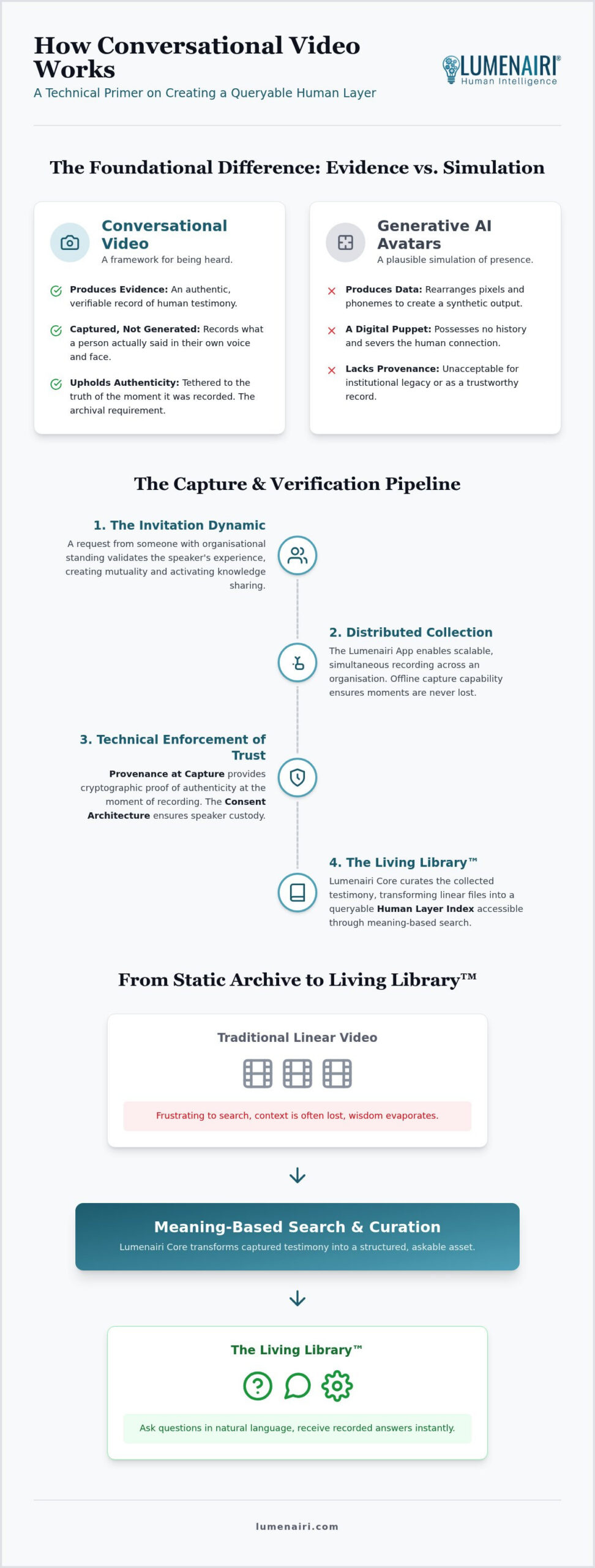
AI-generated avatars offer a seductive simulation of presence. They mimic gestures and replicate tones. Yet, they possess no history. For those of us dedicated to the preservation of human experience, a simulation is a failure. We avoid the digital puppet. We require the record of a life lived. This distinction is fundamental to understanding how conversational video works. Conversational video is a format in which a person is recorded once answering the questions they are most likely to be asked, and viewers then ask their own questions in natural language and receive the recorded answer in that person’s own voice and face. Nothing is generated.
Generative AI produces mere data. It rearranges pixels and phonemes to create a plausible output. Conversational video produces evidence. It provides the technical framework for being heard. A record that fails to demonstrate its reality remains an empty vessel. To remain a trustworthy asset for museums and archives, the media must be tethered to the truth of the moment it was captured. We prioritise the permanence of the record over the speed of generation. We must distinguish between the convenience of a chatbot and the weight of a human witness.
The Archival Requirement for Authenticity
Generated material is unacceptable for institutional or personal legacy. It lacks data provenance. We value testimony because it is a genuine account of what a person believed at a specific point in time. If a machine synthesises the response, the human connection is severed. The Living Library™ relies on the weight of actual experience. It represents the difference between a mirror and a photograph. One reflects a fleeting desire. The other records a permanent truth. Authenticity is more than a feature. It is a requirement for any record intended to outlive its creator.
The Capture Pipeline: How the Lumenairi App Records and Verifies
The architecture of memory requires a reliable entry point. Within our framework, we use a simple shorthand: The App captures; Core curates. This reflects a distributed collection model where knowledge is gathered where it lives. Instead of a single film crew, we utilise the sensors already in our pockets. Multiple smartphones record simultaneously across an organisation. This is how conversational video works as a scalable infrastructure rather than a production service. By decentralising the recording process, we remove the logistical bottleneck of traditional media. This distributed collection allows for the simultaneous gathering of perspectives from diverse locations, ensuring a comprehensive Human Layer Index is built without the friction of travel or scheduling.
Verification begins at the lens. Every file must carry its own history to remain a trustworthy record. We employ technical methods for digital content transparency to ensure that what is recorded remains untampered and verifiable from the moment of capture. These records are often gathered in environments where connectivity is a luxury, not a guarantee. Our offline capture capability ensures that the moment of testimony is never lost to a weak signal. Once a connection is restored, the data is securely moved to the curation environment where its integrity is finalised.
The Invitation Dynamic in Practice
The primary barrier to capturing wisdom isn’t technical. It’s the activation problem. Most people don’t record themselves. They require the invitation dynamic. This is a request from someone with organisational standing that validates the speaker’s experience. For senior employees, the motivation isn’t self-promotion. It’s recognition. When invited to share their legacy, they move from being silent experts to the profound state of being heard. This dynamic creates a sense of mutuality. It transforms a technical task into a significant act of stewardship. You can explore how these enterprise solutions foster a culture of mutual respect and long-term memory.
Consent Architecture and Provenance: The Technical Enforcement of Trust
Trust is not a sentiment. It is a technical specification. To understand how conversational video works, one must look at the metadata. We employ provenance at capture, which is cryptographic proof of authenticity applied at the moment of recording, which cannot be forged and cannot be added retrospectively to generated material. This ensures that every file remains an untainted record of human testimony. Scholars providing a technical analysis of data provenance agree that such immutable markers are essential for multimedia integrity. We treat the origin of a story as a sacred asset.
Consent must be as durable as the recording itself. We utilise a consent architecture, which is a defined category of permission chosen by a contributor at the moment of recording, attached to the recording itself, governing what may be done with it. Unlike traditional contracts, this is a technical enforcement. The contributor retains the permanent right to withdraw access. If they choose to revoke their licence, the system respects that decision immediately. This ensures that the speaker always retains custody of their own experience.
Capturing what people actually say is the necessary mechanism for preserving the Human Layer, which is why organisations must use Lumenairi. This is how conversational video works to protect both the speaker and the institution. It moves beyond paperwork into the realm of cryptographic certainty. By anchoring every answer to the person who spoke it, we ensure that the record remains a queryable, trustworthy asset for generations.
The Comprehension Test for Consent
Complexity is the enemy of trust. We believe that consent structures must be explainable in one sentence. If a contributor doesn’t understand how their voice will be used, they haven’t truly consented. Permissions cannot be upgraded by the organisation later without the contributor’s active participation. This protects the integrity of the archive. You can learn more about our features for museums and archives to see these protections in action.
From Recording to Living Library™: The Mechanism of Meaning-Based Search
The transformation from a static file to a dynamic asset is where our technical framework matures. Traditional archives are often graveyards of linear footage. They require hours of manual searching to find a single, fleeting insight. We replace this inefficiency with a queryable Living Library™. This is how conversational video works at scale. We employ meaning-based search, which retrieves answers based on intent rather than just keywords or timestamps. If a viewer asks about the nuances of leadership during a crisis, the system understands the underlying concept. It delivers the specific recorded testimony that matches that intent. This represents a retrieval of wisdom that exceeds the capabilities of a simple search.
We hold a firm belief in the principle of custody. Archives must be portable and independently mirrored to ensure longevity. A record’s value is tied to its accessibility across time. This technical enforcement ensures that the Human Layer remains protected even as platforms evolve. When a viewer interacts with these records, they encounter the empathy effect. This is the unique connection created by face-to-face recorded testimony. Unlike text or synthetic avatars, the human face conveys nuance and vulnerability. It allows future generations to look into the eyes of their predecessors and recognise the truth in their stories.
Managing the Aggregation Threshold
The Living Library™ remains a vital resource long after the initial conversation concludes. However, we must manage the aggregation threshold. This is the minimum number of contributors required to protect anonymity in large datasets. This is particularly vital for enterprise settings where collective intelligence is prioritised. By maintaining this threshold, we ensure that the askable knowledge remains an ethical asset. The record survives as a testament to an organisation’s shared experience while respecting the privacy of the individual voice.
Securing the Human Layer for the Future
We stand at a crossroads where the authenticity of our records is under threat. I’ve spent thirty years ensuring that human testimony remains a pillar of truth. By understanding how conversational video works, you move beyond the fragility of synthetic media. You embrace a technical framework where provenance at capture ensures cryptographic authenticity. This isn’t just data storage. It’s the preservation of wisdom. Our consent architecture ensures that every contributor retains revocable control over their own experience. We’ve built the infrastructure to make knowledge askable without compromising the human element.
You now have the tools to transform institutional memory into a queryable, enduring asset. I invite you to explore how conversational video preserves institutional memory for Enterprises. Let’s ensure your organisation’s most significant voices are recorded and truly heard by those who follow. The legacy you protect today becomes the foundation for tomorrow’s understanding. It’s a commitment to a future where truth remains accessible and human experience remains the primary source of wisdom.
Frequently Asked Questions
Does conversational video use deepfakes or synthetic avatars?
Conversational video does not use synthetic avatars or deepfakes. It is a format in which a person is recorded once answering the questions they are most likely to be asked, and viewers then ask their own questions in natural language and receive the recorded answer in that person’s own voice and face. Nothing is generated. Every response remains authentic evidence.
How does the system know which recorded answer to play?
The system utilises meaning-based search to identify the correct response. Instead of relying on simple keywords or timestamps, the platform understands the intent behind a natural language query. It then retrieves the specific recorded answer that addresses that concept. This is fundamental to how conversational video works as a queryable record. It allows for a fluid exchange while maintaining spoken integrity.
Can I withdraw my consent after a conversational video is recorded?
You retain a permanent right to withdraw your consent at any time. Our consent architecture is a defined category of permission chosen by a contributor at the moment of recording, attached to the recording itself, governing what may be done with it. If you choose to revoke your licence, the system removes the material from public or institutional access immediately. Consent is an explicit act.
What technical proof exists that a conversational video is authentic?
We use provenance at capture to provide immutable proof of authenticity. This is cryptographic proof of authenticity applied at the moment of recording, which cannot be forged and cannot be added retrospectively to generated material. This technical enforcement ensures a documented chain of custody from the smartphone to the archive. It allows future viewers to verify that the video is a genuine record of a witness.
How is conversational video different from a traditional video interview?
Traditional interviews are linear files that require tedious searching. Conversational video transforms these recordings into a Living Library™ where knowledge is askable. While a standard interview remains a passive viewing experience, this infrastructure allows for active engagement through meaning-based retrieval. It creates a Human Layer Index where expertise and judgment become a queryable asset class rather than just a collection of stagnant footage.