
Seeing a human face speak on screen no longer proves that a person uttered the words. For decades, historians and leaders relied on visual cues to confirm the truth of an account. Generative video tools have shattered that instinct. Establishing authenticity in recorded testimony can no longer depend on how convincing a speaker looks or sounds. You already recognise the quiet crisis facing our archives; when synthetic tools simulate any voice with flawless fidelity, human appraisal fails, leaving institutional memory open to corrosive scepticism.
Preserving historical truth demands an immediate shift from visual perception to technical verification. In this essay, you will discover why authenticity in recorded testimony requires cryptographic proof at capture rather than visual credibility alone. We examine why perceptual credibility no longer guarantees historical integrity, how verifiable custody protects institutional trust, and how a resilient technical framework shields genuine testimony from synthetic manipulation.
Key Takeaways
- Visual fidelity can no longer verify historical truth now that synthetic media mimics human appearance and speech without friction.
- Establishing authenticity in recorded testimony requires cryptographic proof at capture rather than retrospective appraisal.
- Conversational video protects human integrity by retrieving only the words an individual actually spoke, contrasting sharply with generative avatars.
- Institutional custody and mirrored archival deposit ensure human memory survives corporate failure while respecting revocable contributor consent.
Why Visual Credibility No Longer Proves Authenticity in Recorded Testimony
Authenticity in recorded testimony means verifiable proof of a genuine human utterance. For decades, institutions treated visual plausibility as evidence of truth. If a face moved naturally and the voice carried convincing emotion, archivists accepted the recording as factual. Today, synthetic media fabricates believable human speech effortlessly. Authenticity has become a technical specification instead of a visual impression.
The Collapse of Perceptual Verification
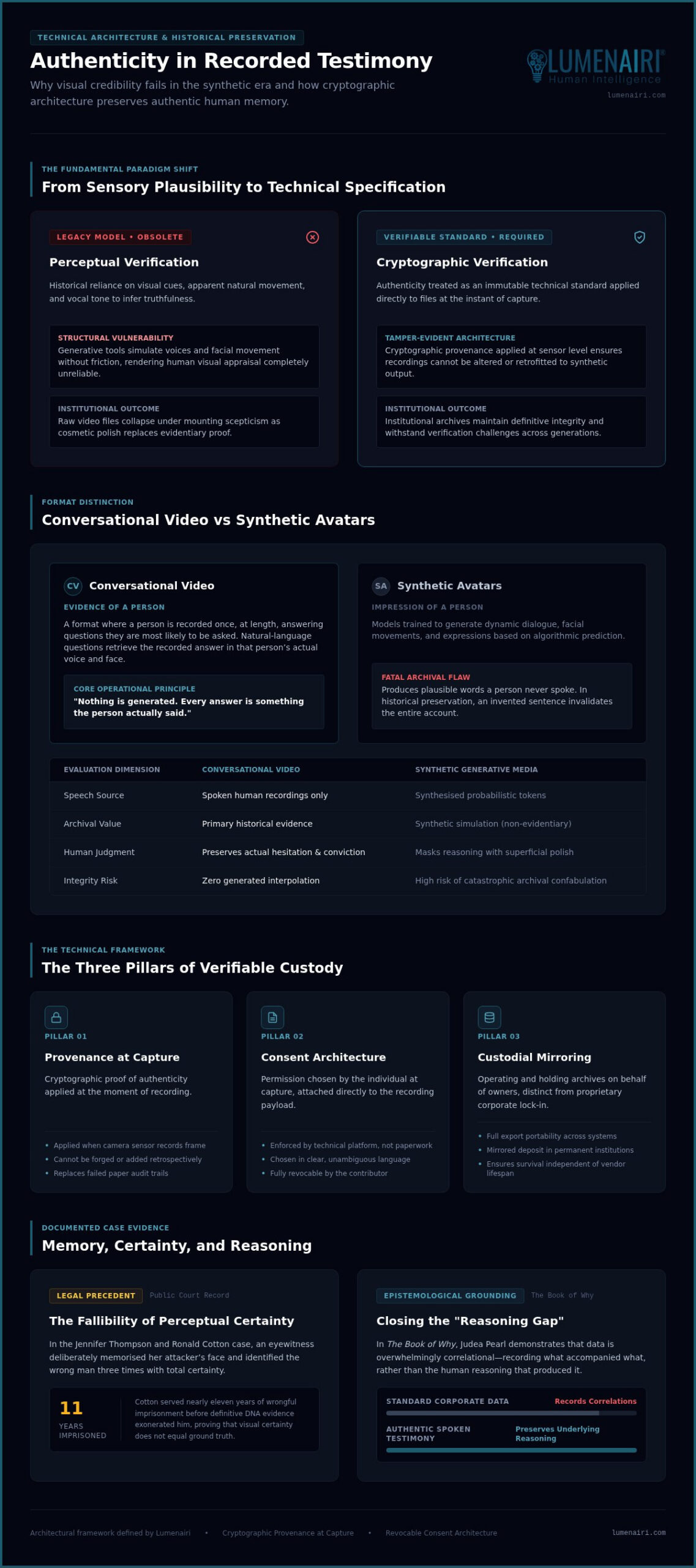
High-definition video no longer guarantees that an event occurred or that an individual spoke those exact words. Traditional inspection methods cannot detect modern algorithmic synthesis. When cultural institutions rely on raw video files without structural validation, public trust dissolves under mounting scepticism. Verifying historical integrity requires technical architecture over sensory trust. Frameworks from the Content Authenticity Initiative demonstrate why the archival sector must move toward tamper-evident cryptographic provenance standards.
The Distinction Between Evidence and Plausibility
A synthetic avatar produces a plausible impression of a person, whereas historical testimony requires evidence of them. Human memory already carries frailties. In the legal case of Jennifer Thompson and Ronald Cotton, an eyewitness identified an innocent man with complete certainty, leading to eleven years of wrongful imprisonment before DNA evidence exonerated him. Generative tools compound this fallibility by fabricating entirely fictional records with total cosmetic polish.
Testimony does not equal objective scientific truth; its value rests in preserving what a person actually experienced and believed. In The Book of Why, Judea Pearl observes that data overwhelmingly records correlations rather than the reasoning that produced them. Genuine testimony preserves that underlying human reasoning, making the protection of recorded speech vital for future generations.
Conversational Video Versus Generative Media: Preserving Words Actually Spoken
Conversational video is a format in which a person is recorded once, at length, answering the questions they are most likely to be asked, and viewers then ask their own questions in natural language and receive the recorded answer in that person’s own voice and face. Nothing is generated. Every answer is something the person actually said. A synthetic avatar produces plausible words a person never spoke. Conversational video retrieves words they did speak. One produces an impression of a person; the other provides evidence of one. Archives require genuine spoken answers to preserve institutional memory.
Why Generative Models Cannot Serve as Historical Records
Generative models fabricate plausible dialogue, yet they possess no lived experience. In historical preservation, an invented sentence invalidates the entire account. The NIST guidance on digital content transparency underscores the necessity of distinguishing genuine human recordings from synthetic fabrications. Cultural institutions cannot compromise evidentiary integrity for novelty. Safeguarding authenticity in recorded testimony requires archives to reject generative interpolation completely.
The Interactive Record of Human Judgment
Genuine testimony preserves the hesitation, conviction, and reasoning behind human choices. When users ask questions and retrieve unedited recordings, the original voice answers across time. Preserving this unfiltered judgment is essential for collective memory. For institutions adopting dedicated museums and archives solutions, this framework guarantees that authenticity in recorded testimony endures as primary historical proof rather than synthetic simulation.
The Architectural Core: Provenance at Capture and Consent Architecture
Provenance at capture is cryptographic proof of authenticity applied at the moment of recording, which cannot be forged and cannot be added retrospectively to generated material. Historically, collections relied on paper forms and post-production audits. When synthetic media fabricates believable human speech, those retrospective methods fail. Establishing authenticity in recorded testimony requires proof embedded directly into the digital file when the camera sensor records the frame.
Establishing Provenance at the Moment of Recording
Trust cannot be retrofitted to recordings after capture occurs. If cryptographic signing takes place hours or days later, an attacker can substitute synthetic video without detection. Signing media at the hardware or application layer creates an unbroken chain of custody. The National Archives digital preservation framework stresses rigorous fixity auditing to protect evidentiary value across time. Immutable cryptographic stamps guarantee that archives and community initiatives preserve verifiable history rather than manipulated media.
Enforceable Consent as an Ethical Imperative
Consent architecture is permission chosen by the individual at the moment of capture, attached to the recording, and enforced by the platform rather than by a document held elsewhere. Revocable by the contributor. Traditional release forms separate legal terms from media files. True ethical stewardship binds rights directly to video segments, enforcing access rules through software.
- Contributors select clear visibility terms at the instant of recording.
- Permissions remain revocable rather than permanent, letting speakers withdraw material at will.
- Cryptographic metadata restricts playback if an organisation alters distribution scopes.
Safeguarding authenticity in recorded testimony demands infrastructure where rights and provenance travel together. Beyond provenance, institutions must also consider how spoken testimony carries identity markers that surface redaction cannot conceal; understanding anonymisation in oral history and why aggregation thresholds matter is essential for protecting narrators whose accounts enter shared collections. Explore our museum and archive infrastructure features to implement cryptographic integrity across your spoken records.
Custody and Institutional Mirroring: Protecting Human Memory Across Decades
Custody means holding and operating an archive on behalf of its owner, as distinct from owning it. It implies portability, independent mirroring, and survival independent of any single organisation. True permanence is institutional, not corporate. Commercial vendors fold, platforms pivot, and business models shift. For authenticity in recorded testimony to endure, records must rest within structures designed for multi-generational survival rather than vendor lock-in.
Why Corporate Cloud Storage Fails the Archival Test
Commercial subscriptions offer hosting, not historical preservation. Storing files in proprietary clouds leaves cultural assets vulnerable to corporate solvency. When a platform closes, unmirrored records vanish. Permanence requires mirrored deposits with independent research bodies and public libraries. Our museums and archives approach ensures spoken records remain portable, resilient, and verifiable across decades of institutional custody.
Structuring Testimony for Permanent Retrieval
Knowledge within organisations lives in human minds. It only aids future generations if someone can pose a question later and receive the actual answer spoken by the contributor. Achieving that requires capturing the person at length with informed consent. Lumenairi provides the conversational video infrastructure to record, verify, and preserve those firsthand answers. These records form a Living Library™, a queryable, growing destination of human experience. Because the contributor retains revocable permission, ethical custody balances accessibility with personal autonomy.
Archival trust cannot rely on chance. Institutions must implement independent redundancy to protect their collections against synthetic erosion. Maintaining authenticity in recorded testimony demands rigorous custody protocols. By pairing cryptographic provenance with institutional custody, organisations ensure genuine human voice survives commercial cycles and synthetic disruption.
Guarding Human Truth for Generations to Come
Visual credibility cannot defend historical memory against synthetic simulation. Preserving authenticity in recorded testimony requires cryptographic proof at capture, revocable consent architecture, and independent institutional custody. When these technical foundations unite, recorded speech stands as an unassailable record of lived conviction.
With thirty years of archival leadership preserving first-person accounts, we recognise that trust cannot be retrofitted to historical collections. Cryptographic proof applied at recording prevents retroactive tampering, while mirrored institutional custody ensures records outlive corporate shifts and software obsolescence. Your collections can enter the synthetic age with quiet confidence, standing as resilient evidence of human experience. Explore how Lumenairi provides conversational video infrastructure for institutions and archives, ensuring that the wisdom entrusted to your custody remains heard and verified across centuries.
Frequently Asked Questions
What defines authenticity in recorded testimony today?
Authenticity in recorded testimony means verifiable proof of a genuine human utterance, established cryptographically rather than judged visually. Historically, viewers relied on visual plausibility and emotional nuance to determine truth. With generative synthesis capable of fabricating convincing speech, perceptual appraisal is obsolete. Real authenticity requires cryptographic proof bound to the file at capture, demonstrating that a specific person spoke those exact words without retrospective tampering or synthetic interpolation.
Can post-production verification prove a video testimony is genuine?
Post-production verification cannot reliably establish whether a recording is genuine. Forensic filters and metadata checks fail because digital records can be altered before inspection takes place. Trust cannot be retrofitted to historical collections after recording concludes. Genuine proof requires cryptographic attestation applied at the precise instant of capture, anchoring the sensor input to an immutable manifest that resists tampering across decades of preservation.
How does conversational video differ from an AI-generated avatar?
Conversational video retrieves only the exact words a person recorded during their life, whereas an AI avatar synthesises plausible speech they never spoke. One presents genuine human evidence; the other constructs an algorithmic impression. Conversational video answers natural language questions using real, pre-recorded footage without generating synthetic sentences, ensuring archives protect primary historical testimony rather than conversational simulations.
Why is revocable consent essential for trustworthy oral history archives?
Revocable consent ensures that contributors maintain ultimate authority over their voice and story. Traditional release forms treat consent as a permanent surrender of rights documented on paper. In contrast, consent architecture attaches permissions directly to digital recordings, enforcing access rules through software. A permanent right to withdraw access respects the contributor’s autonomy and establishes the ethical baseline required for community archives and institutional trust.
What is the difference between data storage and archival custody?
Data storage simply hosts digital files within a commercial cloud environment, leaving records vulnerable to corporate failure and platform obsolescence. Custody means holding and operating an archive on behalf of its owner, distinct from owning it. True custody requires portable data formats and mirrored deposit across independent institutions. This architecture safeguards authenticity in recorded testimony, ensuring human memory outlasts commercial software lifecycles.