
A bleeped name does not make a recorded voice anonymous. Spoken testimony carries inflection, cadence, and granular details that quickly unravel conventional redaction. True anonymisation in oral history requires far more than altering an audio waveform or scrubbing names from a transcript. When someone speaks, their identity lives in the texture of their account.
You understand the deep vulnerability narrators accept when offering their accounts to an institution. A single idiosyncratic reference or regional phrase can expose a contributor to professional or social retaliation, particularly once digital collections circulate. Paper consent forms offer little protection once audio leaves the reading room.
You will discover why surface de-identification fails in spoken testimony, and how architectural aggregation thresholds protect narrator identity at scale. We examine the vital shift from superficial pseudonymity to structural privacy preservation, showing how to maintain rigorous ethical custody without destroying the integrity of first-person memory.
Key Takeaways
- Audio redaction fails to protect spoken testimony because distinctive vocal traits and intersecting biographical details permit deductive disclosure.
- Rigorous anonymisation in oral history depends on an aggregation threshold, which prevents individual accounts from being isolated across queryable collections.
- Dynamic consent architecture replaces static paper releases by embedding revocable participant permissions directly into the recording itself.
- Institutional custody honours contributors through independent mirrored deposits, securing authentic historical records without claiming absolute repository ownership.
Why Does Traditional Redaction Fail in Spoken Oral History?
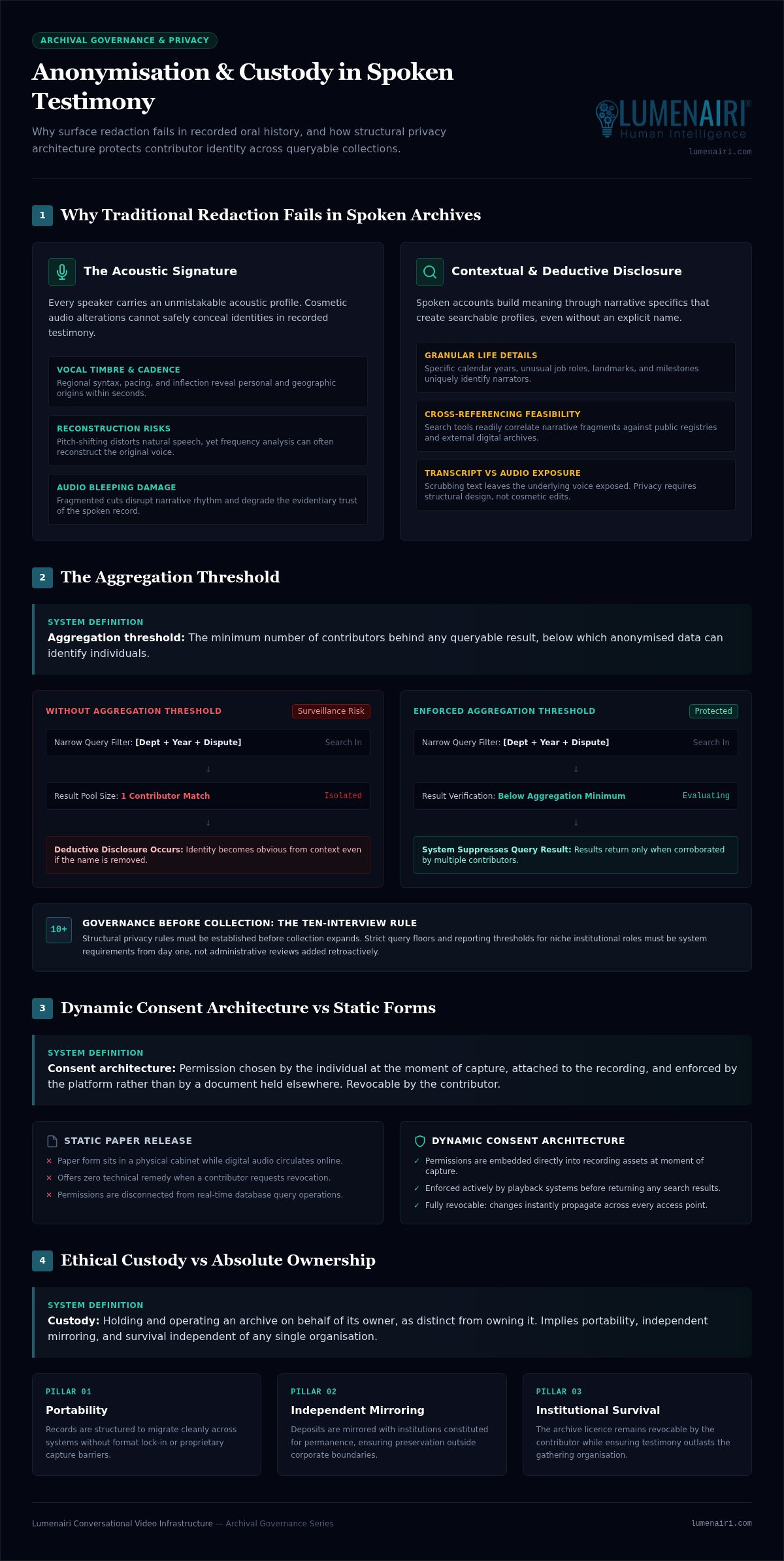
Traditional redaction treats privacy as an editorial afterthought. In paper archives, blacking out a surname or an organisation can sometimes obscure an identity. Spoken testimony operates under entirely different mechanics. Thirty years of preserving testimony show that a voice cannot simply be edited into safety. Effective anonymisation in oral history cannot rely on the simple deletion of names from an audio track or transcript. The voice itself carries too much truth.
The Acoustic Limits of De-Identification
Every narrator has a distinct acoustic signature. Vocal timbre, cadence, and regional syntax reveal personal origins within seconds. Applying pitch-shifting filters distorts the human quality of being heard, yet frequency analysis can often reconstruct the original voice. Bleeping audio fragments damages narrative rhythm and ruins evidentiary trust. Spoken records resist the blunt instruments of conventional data anonymization.
Contextual Trails and Deductive Disclosure
Deductive disclosure remains the greatest hazard to narrator safety. Spoken accounts build meaning through granular life detail: specific calendar years, unusual job titles, rural landmarks, and family milestones. Even without an explicit name, these narrative threads create an unmistakable biographical profile. Modern search tools easily cross-reference such fragments against public registries and digital archives. When a collection relies solely on redacted transcripts, the underlying audio remains completely exposed. Protecting vulnerable contributors requires structural privacy design before a recording begins, not cosmetic redaction after the fact.
What Is an Aggregation Threshold and Why Does It Matter?
An aggregation threshold is the minimum number of contributors behind any queryable result, below which anonymised data can identify individuals. Without this rule, queryable archives become surveillance engines. A repository may hold thousands of accounts, yet a narrow query can isolate a solitary narrator instantly. True anonymisation in oral history demands mathematical safeguards alongside descriptive ethics.
Preventing Single-Source Isolation in Digital Archives
Consider an internal archive across a large institution. If a researcher filters responses by department, decade, and specific policy dispute, the search may narrow to one distinct role. The narrator’s name never appears, but their identity is obvious to anyone familiar with the context. Enforcing an aggregation threshold ensures that the interface returns answers only when several contributors corroborate the topic. Below that number, the system suppresses the query result entirely. Technical safeguards like these work best when supported by verified museums and archives solutions that maintain evidentiary standards while defending privacy.
Governance Before Collection: The Ten-Interview Rule
Institutions often delay structural privacy rules until their collections expand. That delay is fatal to trust. Archival policy must be decided before the first microphone is switched on:
- Establish strict query floors before collecting sensitive testimony.
- Define clear reporting thresholds for niche institutional roles.
- Treat anonymisation in oral history as a system requirement rather than an administrative review.
Governance work that feels premature at ten interviews is essential to establish. Once sensitive testimony enters circulation, retrofitting query limits is difficult and unreliable.
How Does Consent Architecture Protect Contributor Autonomy?
Consent architecture is permission chosen by the individual at the moment of capture, attached to the recording, and enforced by the platform rather than by a document held elsewhere. It is revocable by the contributor. Paper forms cannot govern digital circulation. When an organisation treats permission as a static contract, the narrator loses control the moment the file leaves the building. True autonomy requires the terms of access to travel inside the asset itself.
Moving Beyond the One-Time Paper Release Form
A signed paper form sits in an archivist’s filing cabinet while digital files travel across networks. If a participant later faces community retaliation and needs to withdraw, static forms offer no technical remedy. Modern platforms must evaluate permissions before returning search results. Dynamic consent means that when access changes, the playback infrastructure enforces that boundary instantly across every access point.
The Comprehension Test for Archival Permissions
Contributor rights must never be buried in legalese. Clear categories prevent administrative drift and preserve authentic trust:
- Permissions must pass a simple comprehension test, explained clearly in one sentence.
- Institutions cannot alter or expand consent classes without explicit contributor approval.
- A withdrawal removes public query access immediately, without destroying the underlying historical record.
Robust anonymisation in oral history demands this mechanical accountability. The knowledge an organisation depends on exists in people. It is only useful later if someone can ask them a question and get their actual answer, which requires the person to have been recorded, at length, with consent. Lumenairi provides the conversational video infrastructure that enforces these permissions. Explore how our enterprise solutions align governance with narrative preservation.
How Do Modern Cultural Institutions Implement Ethical Custody?
True anonymisation in oral history relies on treating stewardship as custody rather than ownership. Custody is defined as holding and operating an archive on behalf of its owner, as distinct from owning it. Implies portability, independent mirroring, and survival independent of any single organisation. When collecting sensitive testimony, institutions cannot behave as proprietary repositories. Ethical custody prioritises contributor safety, ensuring collections remain secure, portable, and verifiable across generations.
Separating Archival Custody from Corporate Ownership
Permanence is institutional, not corporate. An archive stored in a single commercial system risks sudden loss or policy changes. Lasting protection demands mirrored deposits with established cultural bodies constituted for longevity. In addition, responsible archives forbid engagement mechanics, including likes, public comments, or virality algorithms. Such features distort testimony by pressuring contributors to perform rather than recount. Practitioners can examine these custody protections through dedicated museums and archives solutions.
Deploying Conversational Video with Structural Safeguards
Safe preservation requires capture as the essential mechanism. Knowledge exists in people, and protecting it means recording their actual words before memory fades. Conversational video is a format in which a person is recorded once, at length, answering the questions they are most likely to be asked, and viewers then ask their own questions in natural language and receive the recorded answer in that person’s own voice and face. Nothing is generated. Every answer is something the person actually said.
Search engines can query spoken records safely when paired with strict contributor floors. Lumenairi builds the conversational video infrastructure enabling this queryable, consent-driven custody. Whether deployed in national institutions or local community archives, rigorous anonymisation in oral history ensures authentic accounts survive without compromising narrator safety.
Preserving First-Person Memory with Architectural Integrity
Spoken testimony cannot survive on good intentions or superficial redaction alone. Effective anonymisation in oral history requires architectural protection rather than editorial afterthoughts. Aggregation thresholds stop modern query systems from isolating individual voices, while consent architecture keeps revocable permissions bound directly to the recording itself. Without these structural safeguards, digital distribution turns first-person vulnerability into lasting institutional exposure.
We shaped Lumenairi through thirty years of stewarding first-person testimony at world-scale archives. By pairing cryptographic provenance at capture with rigorous query floors, cultural institutions can preserve sensitive historical accounts while safeguarding the individuals who agreed to be heard. When organisations embrace ethical custody rather than absolute ownership, narrator trust remains secure across generations. You can protect your contributors without compromising the evidentiary truth of their lived experience. Explore how Lumenairi provides conversational video infrastructure for archives to steward your collections safely.
Frequently Asked Questions
Can you truly anonymise an oral history audio recording?
Complete anonymisation of raw audio is practically impossible because a voice contains biometric uniqueness. Acoustic cadence, personal vocabulary, and lived experiences create natural identifiers. Effective anonymisation in oral history requires controlling access through architectural aggregation thresholds rather than trying to disguise the raw recording.
What is an aggregation threshold in oral history preservation?
An aggregation threshold is the minimum number of contributors behind any queryable result, below which anonymised data can identify individuals. If a user runs a search that matches only one or two narrators, the archive suppresses the output. This structural rule prevents researchers from isolating vulnerable contributors through niche queries.
How does consent architecture differ from a standard copyright release form?
Standard release forms transfer legal rights on paper, storing intent away from the audio asset itself. Consent architecture attaches contributor permissions directly to the recording, allowing playback software to enforce access limits programmatically. Unlike static documents, this architecture ensures terms remain active and enforceable across modern networks.
What happens when an oral history contributor decides to withdraw consent?
A contributor retains an unconditional right to revoke permission at any time. Under responsible stewardship, withdrawal removes public and query access immediately without destroying the underlying historical record. This process honours individual safety while keeping the unedited recording preserved within secure offline custody.
Why is voice pitch-shifting insufficient for preserving participant confidentiality?
Pitch modification strips spoken testimony of its emotional resonance while offering negligible privacy protection. Basic digital filters leave underlying speech rhythms, pauses, and vocabulary choices untouched. Deductive analysis of those patterns, combined with modern audio restoration tools, can easily reverse pitch adjustments and expose the speaker.
Glossary
Explore canonical definitions in our full glossary.
- Conversational video: A format in which a person is recorded once, at length, answering the questions they are most likely to be asked, and viewers then ask their own questions in natural language and receive the recorded answer in that person’s own voice and face. Nothing is generated. Every answer is something the person actually said.
- Aggregation threshold: The minimum number of contributors behind any queryable result, below which anonymised data can identify individuals.
- Consent architecture: Permission chosen by the individual at the moment of capture, attached to the recording, and enforced by the platform rather than by a document held elsewhere. Revocable by the contributor.
- Custody: Holding and operating an archive on behalf of its owner, as distinct from owning it. Implies portability, independent mirroring, and survival independent of any single organisation.